Crypto for Beginners 2026: Start Smart and Stay Safe

Cryptocurrency is now a word Thais hear every day — stories of people getting rich on Bitcoin, stories of people losing everything, and ads promising returns that are too good to be true. For a beginner, the real question isn't "how rich can I get?" but "what is this actually, what are the real risks, and if I want to try, how do I start safely and legally?" This guide covers all of it: the basics, the risks, how to choose a Thai SEC-licensed exchange, the latest 2026 tax rules, and the scams that are spreading fast — written straight, with no hype and no guaranteed-riches promises. This is not investment advice.
⚠️ Read this first: Crypto is an extremely high-risk asset. Prices swing violently and your money can go to zero. This article is for education only — it is not a solicitation or investment advice. Decide for yourself and only invest money you are prepared to lose.
What Is Crypto (Explained Without the Jargon)
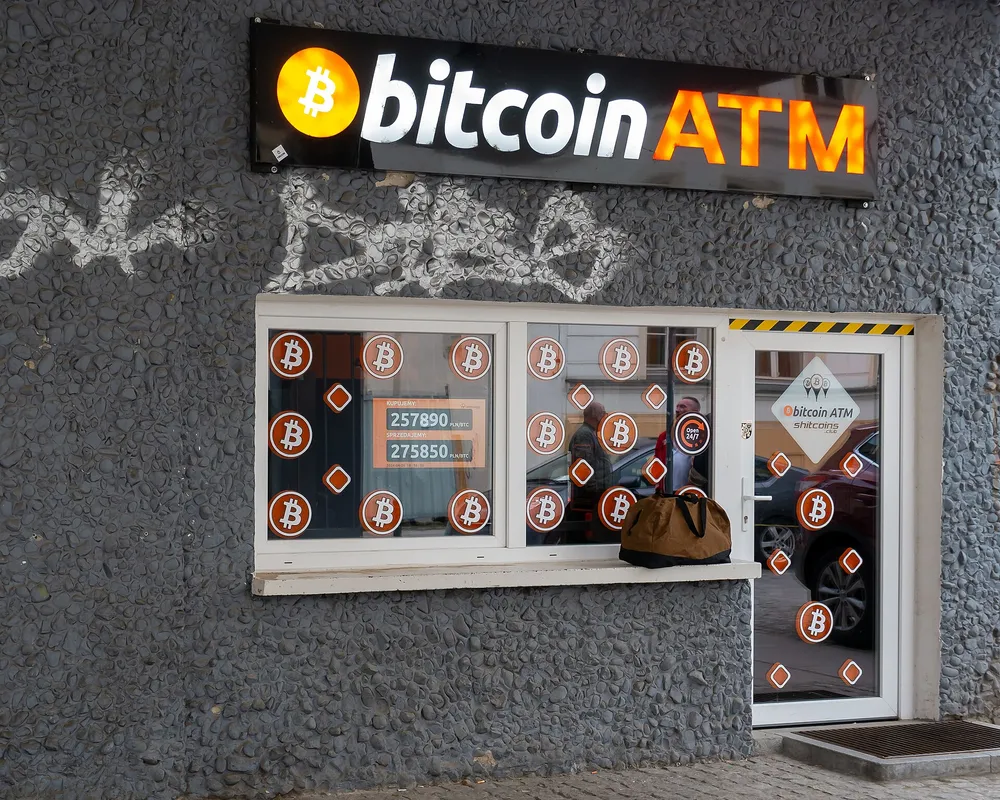 Photo: Bitcoin ATM — CC0 via StockSnap
Think of crypto as a kind of "digital money" that no central bank or government controls. Instead of a bank keeping a ledger of who owns what, a worldwide network of computers maintains and verifies that ledger together — a shared, tamper-resistant record everyone can see, called the blockchain. The upside: you can send value directly, anywhere, 24 hours a day, without a middleman. The downside: no one guarantees its value, and if you send to the wrong place or get scammed, there's usually no one to reverse it.
Bitcoin (BTC) is the first and largest crypto, created in 2009, with a fixed supply capped at 21 million coins — which is why many treat it as "digital gold," a store of value more than a spending currency. Ethereum (ETH) is the second largest and stands out for running automated programs (smart contracts), making it the foundation for many financial apps and tokens. There are also stablecoins like USDT and USDC, pegged so that 1 coin ≈ 1 US dollar, which stay steady and are used to park funds between trades.
The thing beginners must understand from day one: crypto is not a bank deposit. There's no guaranteed interest and no deposit-protection scheme like a bank account. Its value comes purely from market supply and demand — up 20% today, down 30% tomorrow is normal. Grasp this first and you'll avoid most of the disappointment and emotional decisions that sink newcomers.
How Risky Is Crypto — A Realistic Look
Before we get to how to start, we have to be clear about risk, because this is exactly what investment ads tend to hide:
- Extreme volatility — Bitcoin has crashed more than 50% within a few months multiple times in history. Some small altcoins drop 80–90% or go to zero. If you can't stomach seeing your portfolio cut in half, crypto may not be for you.
- No tangible underlying value like a stock — a stock is backed by a real, profit-making company. Many cryptos derive their value from belief and hype alone, which makes a "fair price" hard to judge.
- Risk of being hacked or losing it yourself — lose your password or seed phrase, or get tricked into transferring out, and the money is gone permanently. There's no "forgot password" and no one to refund you.
- Scam risk — the space is full of fraudsters: fake platforms, pumped tokens, and cross-border investment-scam syndicates (see the scams section below).
- Regulatory risk — crypto rules worldwide are still evolving. A coin or service allowed today may be restricted tomorrow.
The golden rule for beginners: only invest "cool money" you could lose without it affecting your life. Never borrow to invest, never use emergency or tuition money, and before you touch crypto, always have an emergency fund of at least 3–6 months of expenses set aside safely first. Crypto should be a supplement to your portfolio, not its foundation.
How Thailand's SEC Regulates Crypto — and Why You Should Use a Licensed Exchange
In Thailand, crypto is classified as a "digital asset" under the Digital Asset Business Decree B.E. 2561 (2018). Any operator offering trading must be licensed by the SEC (Securities and Exchange Commission) and must follow strict KYC (identity verification) and AML (anti-money-laundering) rules.
Why does this matter to you as a beginner?
- Safety of your money — licensed exchanges are supervised, with standards for safeguarding client assets and segregating accounts — far better than handing money to a platform whose owners you don't even know.
- Tax benefits — the crypto capital-gains tax exemption (next section) applies only to trades through Thai-licensed operators.
- A complaint channel — if something goes wrong, you have a domestic authority to turn to, unlike foreign platforms you can barely trace.
The Anti-Money Laundering Office (AMLO) also requires stricter verification, such as in-person "dip-chip" national-ID verification for new accounts, transaction record-keeping, and reporting of high-value transactions (thresholds in the millions of baht). These steps may feel like a hassle, but they're a sign the exchange follows the rules — which is good for you.
Thai SEC-Licensed Exchanges (as of June 2026)
| Exchange | Strengths | Notes |
|---|---|---|
| Bitkub | Wide coin selection, most users in Thailand, easy baht deposits | Good for beginners who want plenty of options |
| Bitazza | Simple interface, competitive fees | Good for newcomers who want an uncomplicated start |
| Orbix Trade | Part of the KBank (Kasikornbank) group | Big-bank credibility |
| InnovestX | SCBX group; links to your stocks/funds portfolio | Good if you already invest in other assets |
| Gulf Binance | Gulf + Binance joint venture, diverse coins | Global-grade platform within the Thai license framework |
| Upbit Thailand | PromptPay deposits, diverse coins | A growing alternative |
⚠️ Always verify before signing up: the official list of licensed operators is on the SEC website sec.or.th. Before depositing money anywhere, check the name against that official list — scammers love to copy the names of real exchanges.
Note: the assets tradable on Thai exchanges come from an SEC-approved list, currently covering majors like BTC, ETH, XRP, XLM and stablecoins like USDC, USDT. Meme tokens, fan tokens and NFTs are generally not allowed on licensed platforms — so if someone pitches you a meme coin via a "Thai exchange," be immediately suspicious.
Crypto Tax in Thailand for 2026 — Made Simple
This is where most people get confused. Here's the clear version:
- Gains from selling crypto are exempt from personal income tax during the period 1 Jan 2025 – 31 Dec 2029, under Ministerial Regulation No. 399 (published in the Royal Gazette on 5 Sep 2025) — a policy aimed at making Thailand a digital-asset hub.
- Key condition: the sale must be through a Thai-licensed operator (exchange/broker/dealer under SEC supervision). Gains from trading on unlicensed foreign exchanges do not qualify for this exemption.
- Individuals only — corporate entities are not covered.
- You still must file — the exemption removes the payment of tax on qualifying gains, but you should still file your annual return and keep full trading records in case of an audit.
- VAT — digital-asset trading has been VAT-exempt since 1 Jan 2024, with no expiry.
A summary table beginners should know:
| Scenario | Income tax on gains | Notes |
|---|---|---|
| Sold via a Thai-licensed exchange (2025–2029) | Exempt | Still file + keep records |
| Sold via a foreign/unlicensed exchange | Treated as personal income (progressive 5–35%) | No exemption |
| Income from mining / receiving coins as pay | Generally taxable income to be included | Consult a tax professional |
| After the measure ends (from 2030) | Depends on rules in force then | Watch Revenue Dept / SEC announcements |
Tax rules can change — always check with the Revenue Department (rd.go.th) and the SEC before filing. If you have large gains or income, consult an accountant or tax adviser. And if you're planning your taxes for the whole year, see our 2026 tax deductions list.
How to Start Safely, Step by Step
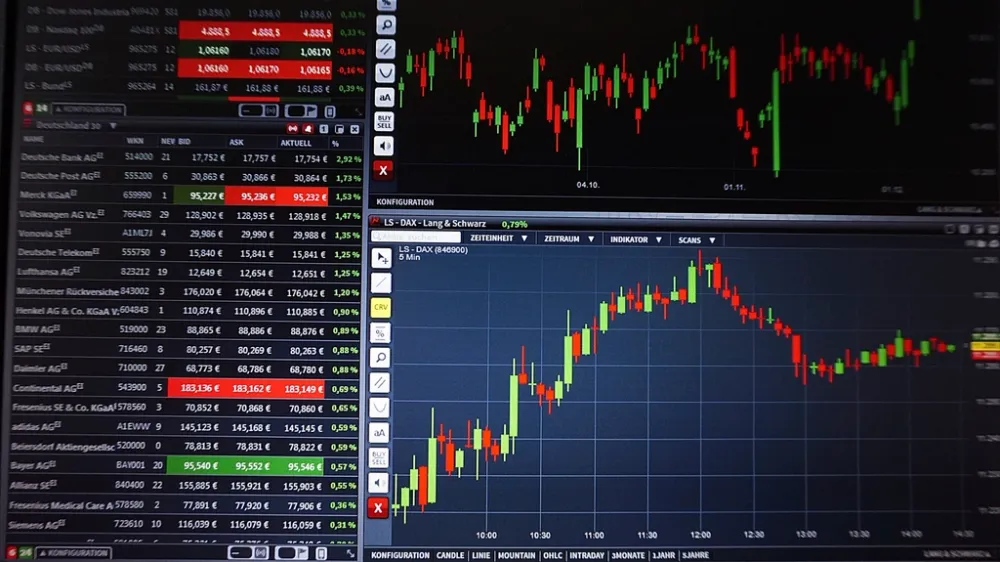 Photo: A trading screen and price chart — CC0 via Openverse
- Build a solid financial base first — have an emergency fund, clear high-interest debt, and have genuine "cool money" left over before you begin.
- Choose an SEC-licensed exchange — check the name on the official list at sec.or.th, then sign up only from the official website/app (never tap links in chats or ads).
- Verify your identity (KYC) — have your ID card ready and complete the dip-chip / face-scan steps fully. This is normal procedure for a legal exchange.
- Turn security up to maximum — use a unique password, enable 2FA (two-factor authentication) via an app (e.g. Google Authenticator) rather than SMS alone, and set a withdrawal password / address whitelist.
- Start with a small amount — make a tiny first purchase to learn the deposit-buy-sell-withdraw flow before adding more.
- Use a DCA strategy — buy equal amounts at regular intervals (e.g. monthly) instead of all at once, to average your cost and reduce the impact of volatility — the same disciplined approach as mutual fund investing.
- Log every transaction — keep the price, date and amount, both to calculate real gains/losses and for filing tax.
How to Store Crypto Safely: Hot Wallet vs Cold Wallet
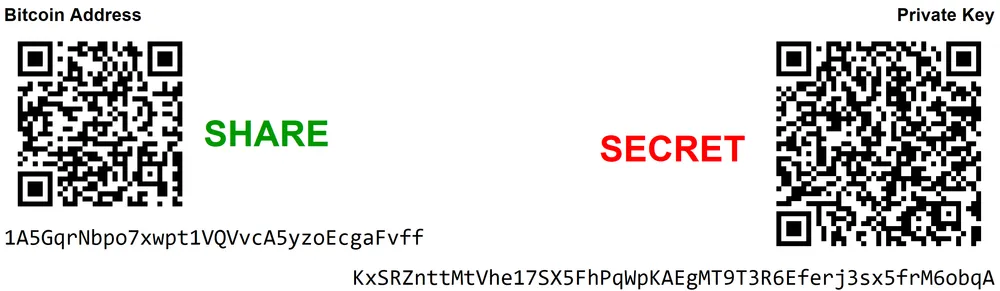 Photo: Bitcoin address (SHARE) vs private key (SECRET) — CC0 via Openverse
The heart of crypto security is one rule: whoever holds the private key owns the coins. The image above shows it clearly: your wallet address can be shared so others can send to you, but your private key / seed phrase must be kept absolutely secret — anyone who gets it can drain your funds instantly. The main storage options:
| Type | What it is | Pros | Cons | Best for |
|---|---|---|---|---|
| Leave it on the exchange | Coins kept in your exchange account | Convenient, fast to trade | The exchange holds the key for you; at risk if it's hacked/collapses | Small amounts, frequent trading |
| Hot wallet | An app/extension connected to the internet, e.g. a mobile wallet | Easy to use, you control the coins | Always online; vulnerable to malware/phishing | Mid-size, everyday use |
| Cold / hardware wallet | An offline device storing the key apart from the internet | Safest; very hard to hack online | Costs a few thousand baht; less convenient to carry | Large amounts, long-term holding |
Beginner advice: early on, when amounts are small, keeping coins on a licensed exchange is fine for convenience. But as your portfolio grows (say into the tens or hundreds of thousands of baht), invest in a hardware wallet and move your long-term holdings off the exchange. Write your seed phrase on paper and store it offline in two places — never photograph it on your phone, never type it into notes/email/cloud, and never tell anyone, not even a "staff member" who calls you.
The Crypto Scams Spreading Fast — and How to Spot a Fraudster
In 2025–2026, crypto investment-scam syndicates have become a full-blown cross-border industry. Joint crackdowns between Thai police and the FBI have seized enormous hauls — over 8,000 phones, more than 1,300 hard drives, and over US$580 million in crypto frozen in connection with fraud — showing how big and close-to-home this threat really is. Watch out for these patterns:
- "Pig butchering" / romance-investment scams — fraudsters build a fake profile (often via dating apps or social DMs), cultivate friendship or romance over weeks or months, then lure you into a fake platform that "shows great profits." At first they let you withdraw a little to build trust, then push you to deposit a large sum — before vanishing with everything.
- Fake trading platforms/apps — sites/apps that look like real exchanges, but the profit figures are entirely fabricated. When you try to withdraw, they demand "fees/taxes" be paid first, again and again.
- Pump and dump — groups pump a small coin's price with rumors and fake reviews; when victims pile in, they dump and leave you holding a crashing coin.
- Impersonating celebrities/big brands — fake ads use images of celebrities, business figures, or well-known company logos to "guarantee" returns.
- Phishing and fake links — emails/SMS/ads linking to fake login pages to steal your password and seed phrase, or tricking you into "approving" a permission that drains your wallet.
Red flags that mean walk away immediately:
- Guaranteed high returns with no risk — in real investing, high return always means high risk. There's no free ticket to riches.
- Pressure to transfer fast — "promotion ends soon," "quota almost full" — urgency is a classic manipulation tool.
- Asking you to send to a personal wallet/individual account instead of a licensed exchange's system.
- Asking for your seed phrase / OTP / private key — real exchanges and authorities will never ask for these.
- Pitches via private chats, secret groups, or new online acquaintances who suddenly offer you a "path to riches."
If you see these signs, stop, don't transfer, and verify with an official source first.
What to Do If You're Already a Victim
- Stop transferring immediately and cut contact with the scammer.
- Gather evidence — transfer slips, conversations, names/numbers/links, and the destination wallet address (it helps trace funds on the blockchain).
- Report online at thaipoliceonline.go.th or the cyber-police hotline 1441.
- Notify your bank to freeze the destination account as fast as possible — the sooner you act, the better the chance of recovery.
Common Beginner Mistakes
- Going all-in or borrowing to invest — when prices crash you'll be forced to sell at the worst point, and borrowed money buries you in debt. Invest only cool money.
- Chasing the news / buying when prices spike (FOMO) — beginners often buy when everyone's talking and the price has peaked, then get stuck. DCA and a plan beat chasing hype.
- Trusting "gurus" and coin-shilling groups — many groups exist to pump and dump on you. Always do your own research first.
- Neglecting security — no 2FA, reused passwords, clicking random links, storing the seed phrase on your phone — all open doors for theft.
- Not logging transactions — then you can't calculate real gains/losses or file taxes properly.
- Treating crypto as a get-rich-quick shortcut — survivors view it as a high-risk portion of a portfolio, not a lottery ticket.
- Using foreign exchanges because fees are lower — you trade that away for losing the tax exemption and taking on legal and fund-recovery risk.
Who Crypto Is For — and How Much to Allocate
Crypto suits people with a solid financial base (emergency fund in place, no high-interest debt), who can genuinely tolerate high risk, are prepared to lose that money entirely, and treat it as a long-term investment they're willing to learn about — not gambling.
Crypto is not for people who don't yet have an emergency fund, carry credit-card or informal debt, will need that money soon, or can't bear seeing the value halve.
The allocation financial planners often suggest for beginners is to cap crypto at around 5–10% of your total portfolio, with the rest spread across less volatile assets such as mutual funds, deposits, or gold investing that Thais know well. This way you get exposure to crypto's upside while ensuring that, if it crashes hard, your overall portfolio doesn't collapse with it.
Conclusion
Crypto is a fascinating technology and asset, but it comes with high risk and rampant fraud. A good start isn't "which coin should I buy?" — it's understand the risk → use an SEC-licensed exchange → secure your wallet → know the tax rules → watch for scams. Invest only cool money in a small slice of your portfolio, DCA with discipline, and don't let greed or fear-of-missing-out make decisions in place of your judgment. Do this and even if you don't get rich overnight, you won't become a victim — and you'll stay in the long game with your eyes open.
Investing in digital assets is high risk and you could lose your entire investment. This article is for education only and is not investment advice. Please research and decide for yourself.
Sources
- Thai SEC (Securities and Exchange Commission) — list of licensed operators and digital-asset rules: sec.or.th
- Revenue Department — guidance on taxing cryptocurrency / digital tokens: rd.go.th
- Expat Tax Thailand — Thailand Crypto Tax Exemption 2025–2029 (Ministerial Regulation No. 399)
- Nishimura & Asahi / Acclime / HLB Thailand — Five-Year Digital Asset Tax Exemption analyses
- Bitazza Blog — Crypto Tax in Thailand 2026
- U.S. DOJ / Chainalysis / TRM Labs — Southeast Asia pig-butchering scam crackdowns 2026
- Cyber Police (ThaiPoliceOnline) — online reporting channel and the 1441 hotline
Frequently asked questions
- How much money do I need to start with crypto?
- You can start with as little as a few hundred baht — most Thai exchanges allow tiny minimum buys. But the principle matters more than the amount: only invest money you can afford to lose entirely. Most beginners should cap crypto at 5–10% of their total portfolio.
- Is investing in crypto legal in Thailand?
- Yes, if you trade through operators licensed by the Thai SEC (e.g. Bitkub, Bitazza, Orbix, InnovestX, Gulf Binance). Using unlicensed foreign exchanges carries legal risk and does not qualify for the tax exemption.
- Do I owe tax on crypto gains in 2026?
- Gains from selling crypto through a Thai SEC-licensed exchange are exempt from personal income tax from 1 Jan 2025 to 31 Dec 2029. You still must file a return and keep records, and trading on unlicensed platforms does not qualify for the exemption.
- Is it safe to keep crypto on an exchange?
- It's convenient but not the safest option — if the exchange is hacked or collapses, your funds are at risk. For larger long-term holdings, move coins to a personal wallet (ideally a hardware wallet) and store your seed phrase offline.
- What's the difference between Bitcoin and a stablecoin?
- Bitcoin's price is highly volatile and moves with the market. A stablecoin (e.g. USDT, USDC) is pegged to the US dollar, so it stays steady and is often used to park funds between trades — but stablecoins still carry issuer and de-peg risk; they are not guaranteed deposits.
- What should I do if I get scammed?
- Gather evidence fast (transfer slips, chats, the destination wallet address), report it at thaipoliceonline.go.th or via the 1441 hotline, and notify your bank to freeze the account as quickly as possible. The sooner you act, the better your chance of recovering funds.
Related articles

SSF vs RMF 2026: which tax-saving fund is better + the rules
A clear comparison of Thailand's tax-deductible funds, SSF and RMF — deduction caps, holding periods, conditions, and how to choose the right one for you.

Thai tax deductions 2026: the full checklist + how to plan
A complete checklist of Thai personal income tax deductions — personal, family, insurance, funds, home and donations — with caps and how to plan to save the most.

Thai personal income tax 2026 + how to legally pay less
Understand Thailand's progressive tax brackets and key deductions, with a worked example and how to cut tax legally with insurance and funds.