Microsoft, Amazon Surge as Meta, Apple Slide in AI Earnings Split

Four Big Tech giants — Microsoft, Amazon, Meta and Apple — reported quarterly earnings within the same week, July 29-31, 2026. All four beat analysts' revenue expectations, but their stock prices moved in sharply opposite directions. Microsoft and Amazon surged by double digits, while Meta and Apple slid. The split reflects a market now seriously asking whether the nearly $725 billion combined being poured into AI infrastructure this year is producing measurable returns — or is still an open-ended bet.
Photo: Brian Smale / Microsoft — CC BY-SA 4.0 via Wikimedia Commons
The week that put Big Tech's AI bet on trial
Alphabet opened the reporting window on July 22, followed by Meta and Microsoft on July 29, then Apple and Amazon on July 30 — a stretch the market is calling the most important "Big Tech earnings week" of the year. For the first time, investors could see real numbers on whether the enormous sums each company has poured into data centers and AI chips over the past year are finally converting into revenue.
The combined figure is striking: Alphabet, Amazon, Meta and Microsoft's combined 2026 capital expenditure has climbed to roughly $725 billion, up about 77% from 2025's already-record $410 billion, and some analysts (Goldman Sachs) expect it to climb further, to nearly $1.2 trillion in 2027. Alphabet had already taken a hit ahead of this week — its stock fell more than 7% in a single day on July 23 after it guided 2026 capex up to $205 billion and reported its first-ever negative quarterly free cash flow since its 2004 IPO, even as its cloud revenue grew 82%.
Microsoft and Amazon: when the AI bet starts paying off
Microsoft reported fiscal Q4 2026 results on July 29: revenue of $90.01 billion, up 18% year-over-year and above the $87.62 billion analysts expected, with earnings per share of $4.74 versus a forecast $4.24. The number that excited the market most was Azure, which grew 43% for the quarter, pushing full fiscal-year Azure revenue past $100 billion for the first time in company history. Contracted backlog jumped by $51 billion in a single quarter to $678 billion, while paid Microsoft 365 Copilot seats crossed 30 million, up from about 20 million in April.
CFO Amy Hood told analysts on the call that "demand continues to exceed available supply," meaning customers are still queuing for cloud capacity. The market responded by pushing Microsoft's stock up roughly 9-15% the next day — one of its best trading days since 2008 — adding nearly $450 billion in market value in a single session.
Amazon reported Q2 2026 results on July 30: revenue of $200.6 billion, up 20% and crossing the $200 billion mark for the first time, with operating income up 43% to $27.5 billion. The standout was AWS, which grew 37% — its fastest pace in 18 quarters — putting its annualized revenue run rate at $169 billion, with contracted backlog jumping $132 billion in one quarter to $496 billion.
CEO Andy Jassy announced Amazon is raising its 2026 cash capex from $200 billion to $220 billion, citing rising memory-chip costs, and admitted plainly that even at that level Amazon still "won't have enough capacity to meet all the demand we have in 2026, and I believe this dynamic will also be true in 2027, too." Part of Amazon's reported profit this quarter came from a $53.4 billion non-cash accounting gain from revaluing its stake in AI startup Anthropic — an accounting entry, not operating revenue.
 Photo: Lisi Mezistrano Wolf — CC BY-SA 4.0 via Wikimedia Commons
Meta and Apple: costs that don't show up until it's time to pay
Meta reported Q2 2026 results on July 29: revenue of $60.8 billion, up 28% and slightly above forecasts, but earnings per share of $6.18 missed the $7.22 consensus by 14%, snapping a six-quarter streak of earnings beats. What alarmed investors most was free cash flow, which collapsed 91% from $8.55 billion a year earlier to just $784 million, as total costs jumped 55% to $42.03 billion — including $2.4 billion in legal charges and $1.18 billion in severance tied to roughly 8,000 layoffs in May. The company also raised its 2026 capex guidance to $130-145 billion. The market responded by selling the stock down roughly 7-10% overnight, wiping out about $15 billion of Mark Zuckerberg's personal stake in a single evening.
Apple reported fiscal Q3 2026 results on July 30: revenue of $109.4 billion, up 16% and a record for the June quarter, with net profit of $29.8 billion, or $2.02 per share, above estimates. iPhone revenue reached $54.25 billion, up 22% and a record in every region — but Services revenue, which includes the App Store and iCloud, came in at $30.74 billion, below the $31.22 billion analysts expected, and was the focus of investor concern. Combined with Apple's comparatively cautious, partnership-based AI strategy rather than heavy data-center spending like its rivals, the stock fell roughly 3-7% after the report. Tim Cook led what was his final earnings call as CEO, ahead of handing the role to hardware chief John Ternus, who officially becomes CEO on September 1, 2026, under a succession plan the company announced back in April.
Why the market is treating them so differently
The clearest split is that Microsoft and Amazon can point to numbers that show an "immediate, measurable" return — paying external cloud customers (Azure, AWS) growing faster and faster, with more demand than either company can currently supply. Meta, by contrast, is pouring huge sums into infrastructure to build its own AI models with no clear direct revenue yet (though Zuckerberg has begun talking about renting out spare computing capacity in a cloud-like business down the line). Apple's core business remains strong, but it simply doesn't have an AI story exciting the market the way its rivals do.
One analyst summed up the market's shifting mood to Fortune bluntly: "People are really focused on capex, obsessed with it. It used to be the more the better, but now it is the less the better." It's a sign that the market is losing patience with open-ended AI spending and wants to see tangible returns every single quarter.
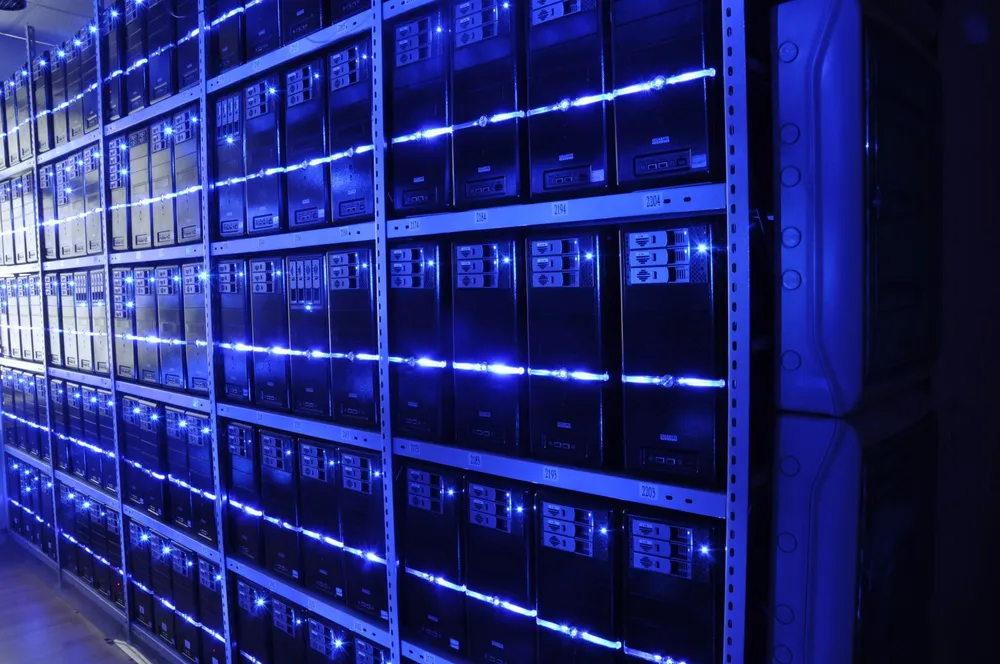 Illustrative photo: BalticServers.com — CC BY-SA 3.0 via Wikimedia Commons
What to watch next
The big unanswered question is how these companies will keep funding capex that shows no sign of slowing, especially as rising memory-chip costs threaten to squeeze margins across the whole industry. Asked directly how Amazon would fund the extra $20 billion, Andy Jassy gave a short answer: "Nothing to share today."
For readers in Thailand, this isn't just a distant US stock-market story. Thailand is one of the key manufacturing bases feeding directly into these companies' AI hardware supply chains — the IMF recently ranked Thailand among the world's top 4 AI hardware exporters, driven by a surge in hard-disk and electronics-component exports this year. How much Microsoft, Amazon, Meta and Alphabet keep spending on AI infrastructure will directly affect Thai orders and exports in the quarters ahead.
Key facts as of August 1, 2026:
- Combined 2026 AI capex across Alphabet, Amazon, Meta and Microsoft: roughly $725 billion (up 77% from last year)
- Microsoft: stock +9 to 15%, Azure grew 43%, crossed $100 billion/year
- Amazon: stock +7 to 15%, AWS grew 37% — fastest in 18 quarters — capex raised to $220 billion
- Meta: stock -7 to 10%, free cash flow -91% to $784 million
- Apple: stock -3 to 7%, Services revenue missed estimates, Tim Cook hands CEO role to John Ternus on Sep 1, 2026
Sources
- CNBC — Meta sinks 8%, Microsoft jumps 15% as the AI trade splits Big Tech
- Fortune — Big Tech earnings slam into a market in revolt over AI spending
- Fortune — Andy Jassy said Amazon will spend $220 billion this year — and still won't have enough capacity to meet demand
- MacRumors — Apple Reports 3Q 2026 Results: $29.8B Profit on $109.4B Revenue
- TechCrunch — Tim Cook stepping down as Apple CEO, John Ternus taking over
- TechTimes — Meta Q2 Beats Revenue While Legal Charges and AI Spending Destroy Free Cash Flow
Frequently asked questions
- Why did Microsoft and Amazon's stock rise while Meta and Apple's fell, when all four beat revenue expectations?
- Because investors weren't just asking 'did revenue grow' — they were asking whether the hundreds of billions spent building AI data centers is turning into revenue that can actually be measured. Microsoft and Amazon showed cloud numbers (Azure, AWS) growing faster with customers waiting in line for capacity, so investors judged the spending worthwhile. Meta's cash flow shrank sharply and Apple's services revenue missed estimates, so investors grew uneasy that the payoff isn't clear yet.
- What is the hundreds of billions in AI capex actually being spent on?
- Mostly building data centers, buying AI processing chips (GPUs and custom-designed chips), and building out the power and networking infrastructure needed to run cloud services and AI models for both the companies themselves and the enterprise customers renting that capacity.
- How does this affect Thailand?
- Thailand is one of the manufacturing bases feeding into these companies' AI hardware supply chains (see the related story below), so how much these firms keep spending on AI infrastructure directly affects Thai hard-disk and electronics-component orders and exports.
Related news
 World
WorldChina's AI Companion Law Takes Effect Today — Doubao and Qwen Shut Down Emotional AI Features
China's new 'Interim Measures for Anthropomorphic AI Interactive Services' takes effect July 15, 2026, forcing ByteDance and Alibaba to disable AI companion and humanlike agent features. Hundreds of millions of users lose AI relationships built over years.
 World
WorldUN Opens Historic AI Governance Dialogue: Scientists Warn No Guarantee Advanced AI Will Follow Orders
The UN launched its first Global Dialogue on AI Governance in Geneva on July 6–7, 2026, as a 40-scientist panel warned AI may not follow human instructions.
 Thailand
Thailand PM Anutin Leads 100-Executive Delegation to China for WAIC 2026, Eyes AI and EV Investment
Prime Minister Anutin Charnvirakul leads over 100 business executives on a five-day state visit to China (July 16–20) to attend the World AI Conference 2026 in Shanghai, meet President Xi Jinping, and sign 14 MOUs targeting AI, data center, and EV investment into Thailand.