iPhone 17 vs Samsung Galaxy S26 2026: Which Flagship Is Worth It
Watch more: iPhone 17 vs Galaxy S26 – 4 Months Later Review by Nick Ackerman
If you're deciding between the two flagship phone makers that have dominated the global market the longest — iPhone 17 and Samsung Galaxy S26 — there's no single answer that fits everyone. The two series launched just 6 months apart (iPhone 17 in late 2025, Galaxy S26 in March 2026), and both now sell in Thailand with their full lineups, from entry model to top tier.
This article breaks down every sub-model in both series, compares Thailand pricing head-to-head at similar price points — display, chip, camera, battery, AI software, and something buyers often overlook: resale value when you upgrade next time — so you can choose based on your actual budget and use case. Sourced from official Apple Thailand and Samsung Thailand specs, GSMArena, and multiple hands-on reviews as of August 2026.
Getting to know both lineups
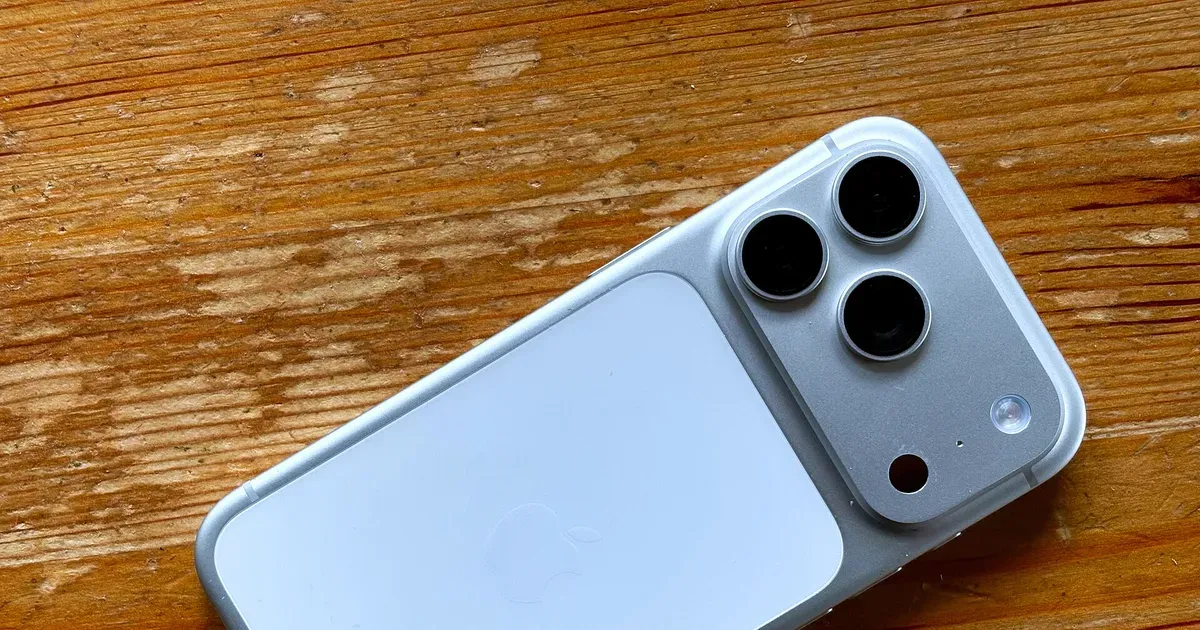
The iPhone 17 series has 4 sub-models: iPhone 17 (base), iPhone 17 Air (Apple's thinnest phone ever), iPhone 17 Pro, and iPhone 17 Pro Max. Air replaces the Plus slot from the previous series, favoring thinness over a bigger battery.
The Samsung Galaxy S26 series keeps the traditional 3-model split: Galaxy S26 (base), Galaxy S26+ (bigger screen), and Galaxy S26 Ultra (top tier, with S Pen). Samsung has no "extra-thin" model like Apple, but compensates with a nearly borderless display and a dual telephoto camera on the Ultra.
Who fits which: if you already use a Mac, iPad, AirPods, or other Apple devices and want a seamlessly connected ecosystem, stay with iPhone. If you prefer more freedom to customize your device, primarily use Windows, or want an S Pen, choose Galaxy S26.
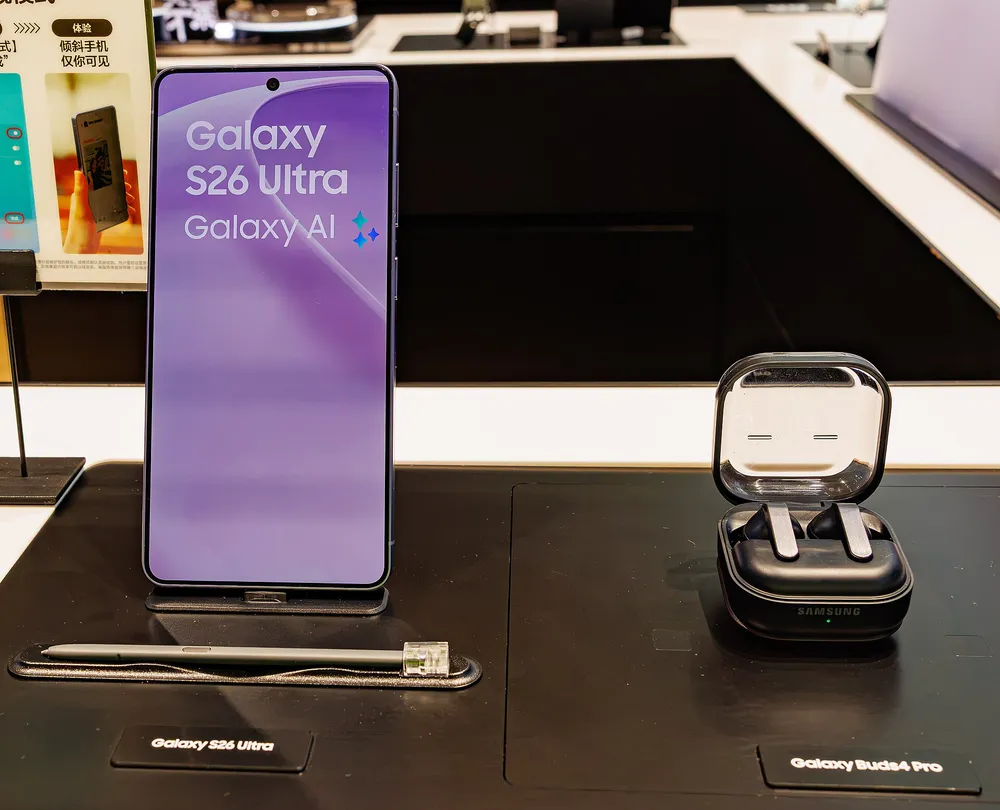 Photo: Wikimedia Commons — CC
Full specs, model by model
| Spec | iPhone 17 | iPhone 17 Air | iPhone 17 Pro | iPhone 17 Pro Max |
|---|---|---|---|---|
| Display | 6.3" OLED 120Hz | 6.5" OLED 120Hz | 6.3" OLED 120Hz | 6.9" OLED 120Hz |
| Chip | A19 (3nm) | A19 Pro | A19 Pro | A19 Pro |
| RAM | 8GB | 12GB | 12GB | 12GB |
| Rear camera | 48MP+48MP (2 lenses) | 48MP (single lens) | 48MP×3 (4x telephoto) | 48MP×3 (4x telephoto) |
| Battery | 3,692mAh | ~3,200mAh (thin) | ~4,000mAh | ~5,000mAh |
| Starting price (256GB) | ฿29,900 | ฿39,900 | ฿43,900 | ฿48,900 |
| Spec | Galaxy S26 | Galaxy S26+ | Galaxy S26 Ultra |
|---|---|---|---|
| Display | 6.3" Dynamic AMOLED 2X 120Hz | 6.7" Dynamic AMOLED 2X 120Hz | 6.9" Dynamic AMOLED 2X 120Hz |
| Chip | Snapdragon 8 Elite Gen 5 / Exynos 2600 | Snapdragon 8 Elite Gen 5 | Snapdragon 8 Elite Gen 5 |
| RAM | 12GB | 12GB | 12GB/16GB |
| Rear camera | 50MP+10MP+12MP (3 lenses) | 50MP+10MP+12MP (3 lenses) | 200MP+50MP+10MP+50MP (4 lenses) |
| Battery | 4,300mAh | ~4,900mAh | 5,000mAh |
| Starting price (256GB) | ฿33,900 | ฿40,900 | ฿46,900 |
Official prices from Apple Thailand and Samsung Thailand as of August 2026 — actual Shopee/Lazada prices may be lower during 11.11/12.12 campaigns; always compare before buying.
Thailand pricing, tier by tier
Matched at the closest price points, to see who gives more for the same budget:
| Price tier | iPhone 17 series | Samsung Galaxy S26 series | Better value |
|---|---|---|---|
| ~30,000-34,000 baht | iPhone 17 (฿29,900) | Galaxy S26 (฿33,900) | Galaxy S26: more RAM + a 3x telephoto the iPhone 17 lacks, but the iPhone is ฿4,000 cheaper |
| ~39,900-40,900 baht | iPhone 17 Air (฿39,900) | Galaxy S26+ (฿40,900) | Very close — Air is thinner/lighter (titanium), S26+ has a bigger battery and a telephoto lens |
| ~43,900-46,900 baht | iPhone 17 Pro (฿43,900) | Galaxy S26 Ultra (฿46,900) | Ultra costs ฿3,000 more but adds an S Pen, dual telephoto cameras, and a bigger screen (6.9" vs 6.3") |
| ~48,900 baht and up | iPhone 17 Pro Max (฿48,900) | Galaxy S26 Ultra 512GB (฿54,900) | Not an equal storage match — for 512GB on both, the Ultra costs ฿6,000 more |
Worth noting: iPhone 17 Pro (฿43,900) vs Galaxy S26 Ultra (฿46,900) is the most interesting matchup — only ฿3,000 apart, yet the Ultra gives a screen nearly as large as the Pro Max (6.9" vs 6.3") plus a built-in S Pen. If you want a "near-top-tier" phone at this budget, the Ultra clearly offers more value per baht.
Display: sharper pixels vs brighter under sunlight
Apple clearly wins on pixel density — the iPhone 17 hits 460 ppi versus the Galaxy S26's 411 ppi at the same 6.3-inch size. In practice, the naked eye can barely tell the difference at normal viewing distance (both are well past the "Retina" threshold where the eye stops resolving individual pixels).
What actually differs is peak brightness: the Galaxy S26 Ultra reaches 2,600 nits versus roughly 2,000 nits on the iPhone 17 Pro Max — a big deal if you use your phone under Thailand's harsh midday sun often. Samsung's screen stays readable outdoors more reliably, even though it loses on the resolution spec sheet.
The Galaxy S26 Ultra also introduces Privacy Display, which narrows the viewing angle to block side-eyes — great if you use your phone in public a lot and worry about people peeking. Apple has no equivalent feature in this series.
Chip and performance
Both are built on 3nm, but the design philosophy differs clearly: Apple's A19/A19 Pro favors single-core performance and steady power management, while Samsung's Snapdragon 8 Elite Gen 5 favors core count and higher multi-core scores. The latest Geekbench results give the Galaxy S26 a multi-core score of 11,249 versus 9,327 for the iPhone 17.
In real-world use this gap barely matters for everyday apps or most mobile games, where both chips are more than fast enough. The difference shows up mainly in sustained heavy work — long 4K video edits or maxed-out 3D games played continuously — where Apple tends to hold its thermals steadier over time, while Samsung offers more raw power in short bursts.
Camera: longer zoom vs more consistent color
This is where the two brands diverge most clearly:
iPhone 17 Pro/Pro Max has three equally capable 48MP rear lenses (wide, ultrawide, 4x telephoto). Its selling point is color and dynamic-range consistency across lenses — switching lenses mid-shot doesn't shift the color, and its 4K video remains an industry benchmark competitors still haven't matched.
Galaxy S26 Ultra packs four rear lenses, including two telephotos (3x and 10x), giving usable zoom quality up to 30-40x — far beyond the iPhone 17 Pro Max's 8x (at good quality). Great for concerts, sports, or wildlife you can't get close to. Its 200MP main sensor also gives more detail when cropping afterward.
The weak spot reviewers agree on for the Galaxy S26 Ultra: its 10MP 3x telephoto is starting to look dated next to some Chinese rivals, and the larger camera bump makes the phone sit less flat on a table.
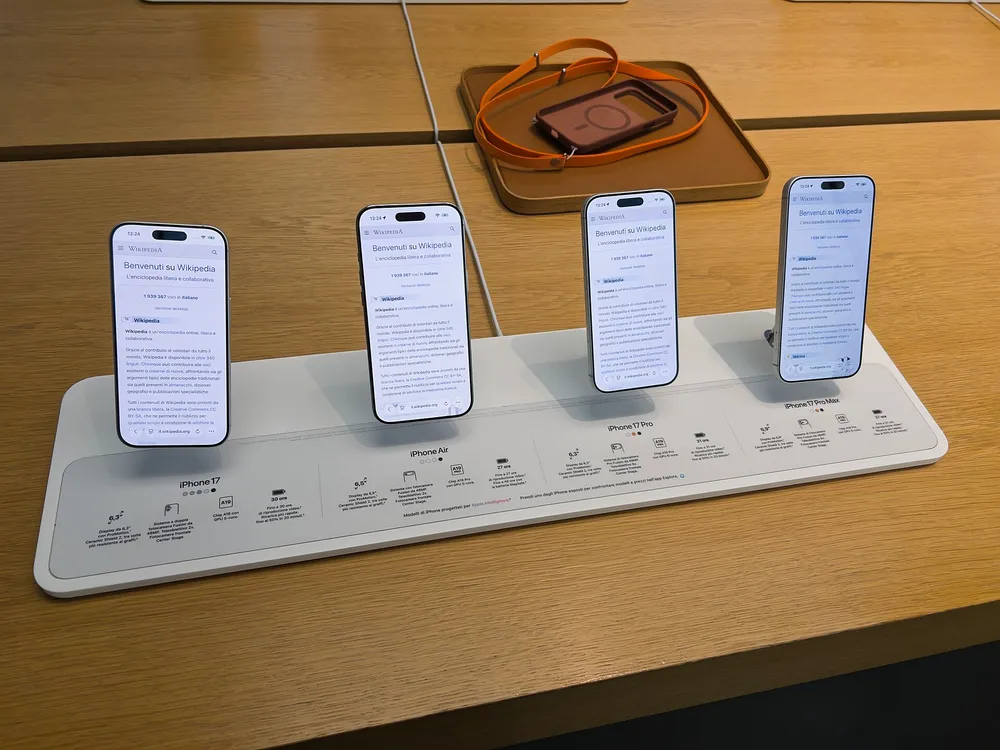 Photo: Wikimedia Commons — CC
Battery and charging
Samsung clearly wins on raw battery capacity: the Galaxy S26 Ultra holds 5,000mAh versus roughly 4,800-5,000mAh on the iPhone 17 Pro Max (close at the top tier), but at the entry tier the Galaxy S26 (4,300mAh) beats the iPhone 17 (3,692mAh) by a much clearer margin.
On charging speed, Samsung has a clear edge: the Galaxy S26 Ultra charges at 60W (75% in 30 minutes) versus 50W wired on the iPhone 17 Pro Max (50% in 20 minutes) — if you top up quickly and often during the day, Samsung refills significantly faster.
But on actual screen-on time per charge, the iPhone 17 Pro Max often posts the best test results of any flagship, thanks to Apple's end-to-end control of hardware and software pairing — so a bigger battery doesn't always mean it lasts longer.
Software and AI: the clearest gap in 2026
This is the difference real users feel every day, more than any spec sheet number:
Galaxy AI (One UI 8.5 on Android 16) currently offers more practically useful, complete features — Photo Eraser removes objects/people from photos accurately, Live Translate works during phone calls, and it summarizes long text messages and voice recordings well. AI Noise Eraser can also clean up video audio retroactively.
Apple Intelligence (iOS 26) is still catching up in several places reviewers consistently agree on — its Clean Up feature (removing objects from photos) more often leaves visible editing traces than Samsung's, and its agentic AI features aren't as complete as Galaxy AI. Apple's strength remains privacy (more on-device processing) and far more seamless integration with Mac/iPad.
Bottom line: if an AI assistant is your main reason for buying a flagship, Galaxy S26 has the clearer edge as of mid-2026. But if you prioritize data privacy and already use other Apple devices, iOS remains the smoother choice.
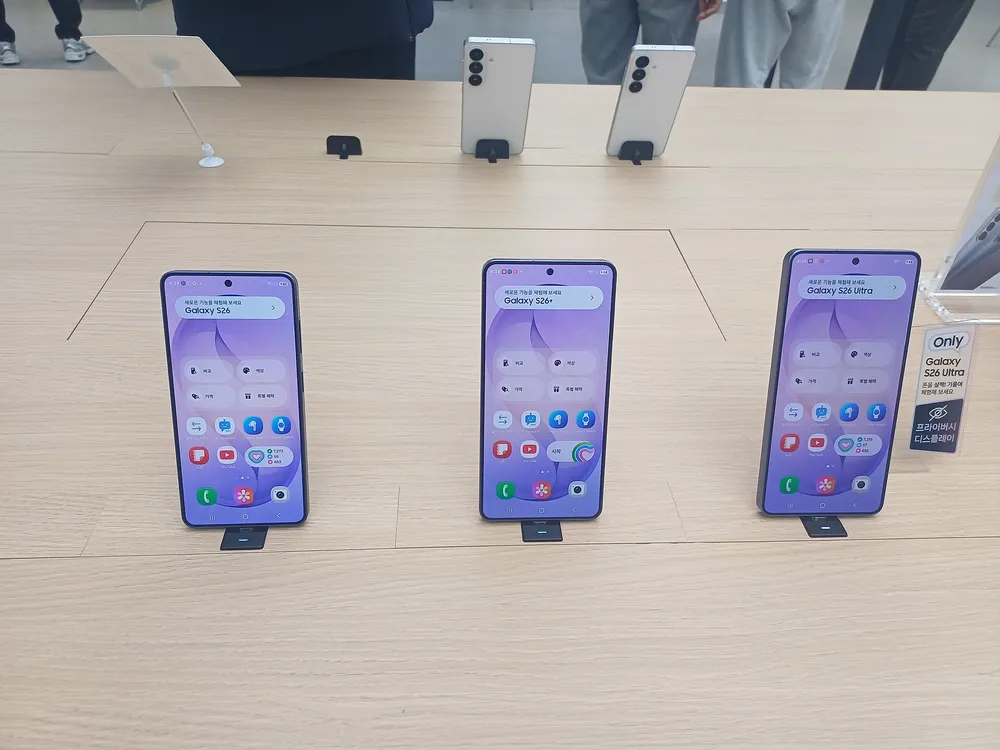 Photo: Wikimedia Commons — CC
Design, materials, and durability
The iPhone 17 Pro/Pro Max uses an aluminum frame with Ceramic Shield 2 glass (a new anti-reflective coating), while the Galaxy S26 Ultra uses a Grade 5 titanium frame with Corning Gorilla Armor 2 glass — both resist scratches and glare noticeably better than the previous generation.
On water resistance, Apple has a clearer selling point: the iPhone 17 is rated to 6 meters deep, versus the Galaxy S26's standard IP68 (1.5 meters for 30 minutes). If you often drop your phone in water or shoot near water frequently, the iPhone clearly has the edge here.
Weight: the iPhone 17 Air is the thinnest, lightest phone in either series — best if you're most concerned about pocket weight. The Galaxy S26 Ultra, despite being thinner and lighter (167g) than its predecessor, is still heavier than the base iPhone 17 (177g vs 167g on the base S26, roughly comparable).
Ecosystem and resale value — the factor people often overlook
Many buyers decide on specs alone, but these two factors affect your wallet more, long-term, than people expect:
Ecosystem: if you already own a MacBook, iPad, or AirPods, staying with iPhone means Handoff, AirDrop, Universal Clipboard, and Find My all work seamlessly together — switch to Android and none of that works. Conversely, if you mainly use a Windows PC and own other Samsung devices (tablet, smartwatch), the Galaxy S26 connects more conveniently via Samsung DeX and Quick Share.
Resale value: Thailand's used-phone market has repeatedly shown that iPhones hold resale value better than any Android brand, including Samsung, in general — partly due to longer software support and a bigger pool of secondhand buyers. Pro-model iPhones also depreciate more slowly than base models. If you plan to upgrade every 1-2 years for maximum cash back, the iPhone usually wins the overall equation even at a similar starting price.
Common buying mistakes
- Assuming more RAM always means faster — iOS manages memory very differently from Android. An iPhone 17 with just 8GB of RAM runs just as smoothly as an Android phone with 12GB, because the OS is purpose-built for its own hardware.
- Buying the Ultra/Pro Max just because you assume the camera is always better — if you don't zoom far or shoot content professionally, the base model's camera takes everyday photos just as well. Save the extra tens of thousands of baht for something else.
- Overlooking add-on costs — a case, screen protector, and AppleCare+/Samsung Care+ can add another ฿2,000-5,000. Budget for this from the start, not just the sticker price of the phone itself.
- Buying from a non-official reseller to save a few hundred baht — you risk getting a grey-market/imported unit with no Thai center warranty, which is harder and more expensive to repair if something goes wrong later.
Verdict: choosing what fits you
Choose iPhone 17 if: you already use Mac/iPad/AirPods, value data privacy, want the highest resale value when you upgrade, or shoot mostly video and need the most consistent color.
Choose Galaxy S26 if: you want the most genuinely useful AI assistant right now, need professional-grade long zoom (Ultra model only), want faster charging, or want an S Pen for notes/sketching.
Tightest budget: the iPhone 17 (฿29,900) is still the cheapest flagship across both series, but the Galaxy S26 (฿33,900) gives better raw spec-per-baht value if you're not locked into an ecosystem.
Unlimited budget: the iPhone 17 Pro Max and Galaxy S26 Ultra are each their brand's best flagship this year. The gap is more about usage philosophy than quality — choosing based on the ecosystem you're already invested in pays off best long-term.
Before buying, always compare the official Apple/Samsung Thailand price against an authorized Shopee/Lazada storefront — major sale campaigns often bring discounts or bundled gifts that beat the sticker price significantly.
Wondering whether to wait for the next generation instead? Read our roundup of every leak on the iPhone 18 Pro, Pro Max, and iPhone Fold before the September 9 launch before deciding whether to buy an iPhone 17 now or hold off.
Sources
- Apple iPhone 17 Pro Max — Apple Thailand
- Samsung Galaxy S26 — Samsung Thailand
- Samsung Galaxy S26 Ultra full specs — Siamphone
- Samsung Galaxy S26 vs Apple iPhone 17 spec comparison — GSMArena
- Apple iPhone 17 Pro Max review — GSMArena
- Samsung Galaxy S26 Ultra review — Digital Camera World
- Thailand pricing, Samsung Galaxy S26 Series — DroidSans
- iPhone 17 vs Galaxy S26 – 4 Months Later Review (YouTube, Nick Ackerman)
If you just decided on a new phone, read on with our Samsung Galaxy A27 5G review for a more budget-friendly pick, or Galaxy Z Fold8 vs Fold8 Ultra vs Flip8 if you're considering a foldable instead, and check our 2026 mid-range phone guide if your budget doesn't stretch to a flagship.
Frequently asked questions
- Which is cheaper, iPhone 17 or Galaxy S26?
- The base iPhone 17 (256GB) costs ฿29,900, which is ฿4,000 less than the base Galaxy S26 (256GB) at ฿33,900. But the Galaxy S26 gives more RAM (12GB vs 8GB) and a 3x telephoto camera that the plain iPhone 17 does not have. On raw sticker price the iPhone 17 wins; on spec-per-baht the Galaxy S26 is the better value at the entry tier.
- Which has the better camera, iPhone 17 Pro Max or Galaxy S26 Ultra?
- Both shoot excellent daylight photos. The Galaxy S26 Ultra zooms much farther (dual telephoto at 3x and 10x, with usable digital zoom up to 30-40x), while the iPhone 17 Pro Max has a single 4x telephoto (optical-quality zoom up to 8x) and consistently more accurate video color across lighting conditions. If you zoom often (concerts, sports, wildlife) the Ultra fits better; if accurate video color matters more, the Pro Max still leads.
- Which phone resells for more, iPhone or Samsung?
- In general, iPhones hold their resale value in the Thai secondhand market better than any Android brand, including Samsung — partly thanks to longer software support and a bigger used-phone market. If you plan to upgrade every 1-2 years and want the most cash back on resale, an iPhone usually works out better long-term even at a similar starting price.
- How does Galaxy AI differ from Apple Intelligence?
- As of mid-2026, Samsung Galaxy AI has more complete, practically useful features right now — Photo Eraser removes objects/people from photos accurately, Live Translate works during phone calls, and it summarizes long text and voice recordings well. Apple Intelligence on iOS 26 is still catching up in several areas reviewers agree on — its object-removal feature more often leaves visible editing artifacts than Samsung's equivalent, and its agentic AI features are less complete than Galaxy AI. If AI assistant features are your main reason for buying, Galaxy S26 currently has the clearer edge.
- Should I buy the base, mid, or top-tier model?
- On a tight budget for everyday use (social media, family photos), the base model (iPhone 17 or Galaxy S26) is enough and saves tens of thousands of baht. If photography/video is your work or you love zooming in, step up to the top tier (Pro Max or Ultra), which has a dedicated telephoto lens. The mid tier (Air/Plus) suits people who want a bigger screen or thinner body without paying full top-tier price.
- Is it safe to buy through Shopee/Lazada, and do I get Thai center warranty?
- It's safe as long as you buy only from the Apple Brand Shop / Samsung Official Store on the platform. These are Thai-center (TH) units with a full 1-year center warranty. Always verify the seller name matches the official brand before ordering, and compare against the official Apple/Samsung Thailand price first, since some sellers list grey-market or imported units with no Thai center warranty.
Related articles

iPhone 18 Series 2026: Price, Specs Before Sept 9 Launch
Every leak on the iPhone 18 Pro, Pro Max, and iPhone Fold before Apple's Sept 9 event: predicted Thailand pricing, the A20 chip, and buy-now-or-wait advice
OPPO Reno16 vs Reno16 Pro vs Reno16 F: Which to Buy in 2026
Compare specs, price, cameras and battery of OPPO Reno16, Reno16 Pro and Reno16 F in Thailand 2026, with real pros/cons and which model is worth the upgrade.
Galaxy Z Fold8 vs Fold8 Ultra vs Flip8 2026: Which Should You Buy?
Compare Samsung Galaxy Z Fold8, Fold8 Ultra and Flip8 — Thailand prices, specs, cameras and battery, before the 14 Aug 2026 launch, with a clear buying recommendation.