9 Best Mosquito Repellents 2026: Prevent Dengue This Rainy Season
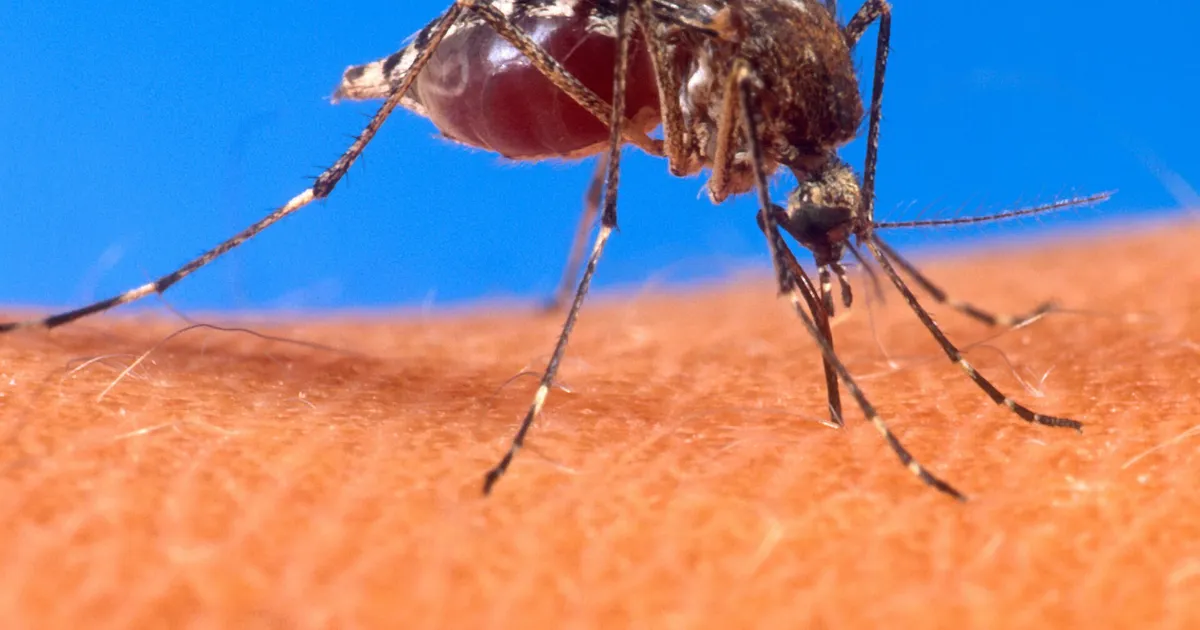
From January 1 to July 22, 2026, Thailand recorded 16,094 cumulative dengue cases and 26 deaths (case-fatality rate 0.16%). School-age children (10–19) make up the largest share of cases, but the highest death rate is actually among people 60 and older, followed by the 40–49 age group. The five provinces with the highest infection rates over the last 4 weeks are Satun, Phuket, Nakhon Nayok, Ranong and Trang — and we're now heading into the middle of the rainy season, the peak breeding period for Aedes mosquitoes all year.
The question most people ask after seeing numbers like this is "what should I actually buy to protect my home?" This guide ranks 9 mosquito-control products worth having at home, with real Thai market prices (as of August 2026 — prices vary by retailer and promotion), how each one works, coverage area, pros and cons, and who it suits — but before shopping, there's one measure that costs nothing and works better than any device, which comes first.
Know your enemy: Aedes mosquitoes and dengue fever
The Aedes aegypti mosquito, the vector for dengue, Zika, and chikungunya, has a behavior many people get wrong — it bites mainly during the day, especially early morning and late afternoon, not at night like the common house mosquito. So being indoors or at the office during daytime is no guarantee of safety.
Aedes mosquitoes lay eggs only in clean, still water (not dirty or sewage water like ordinary mosquitoes) — even a tiny amount, like a bottle cap or a plant-pot saucer, is enough. Eggs hatch into larvae and mature into biting adults within just 7–10 days, which is exactly why clearing standing water has to be a "every week" habit, not a one-time chore.
The warning signs that mean go to hospital immediately are a high fever lasting more than 2 days — especially with bleeding spots, severe abdominal pain, non-stop vomiting, or drowsiness after the fever starts to drop (the period right after the fever breaks is actually the most dangerous, not the safest). For the full symptom breakdown and care guide, see our rainy-season diseases guide. A multi-day hospital stay for dengue at a private hospital can easily run into the tens of thousands of baht — worth reading up on how to choose health insurance that's actually worth it as a backstop.
The most effective, zero-cost measure: 5P 1K
Before spending a single baht on equipment, Thailand's Department of Disease Control always stresses that the single most effective measure is removing Aedes mosquito breeding sites around the house — because no matter how expensive your mosquito trap is, if there's standing water under the house, new mosquitoes keep hatching every 7–10 days regardless.
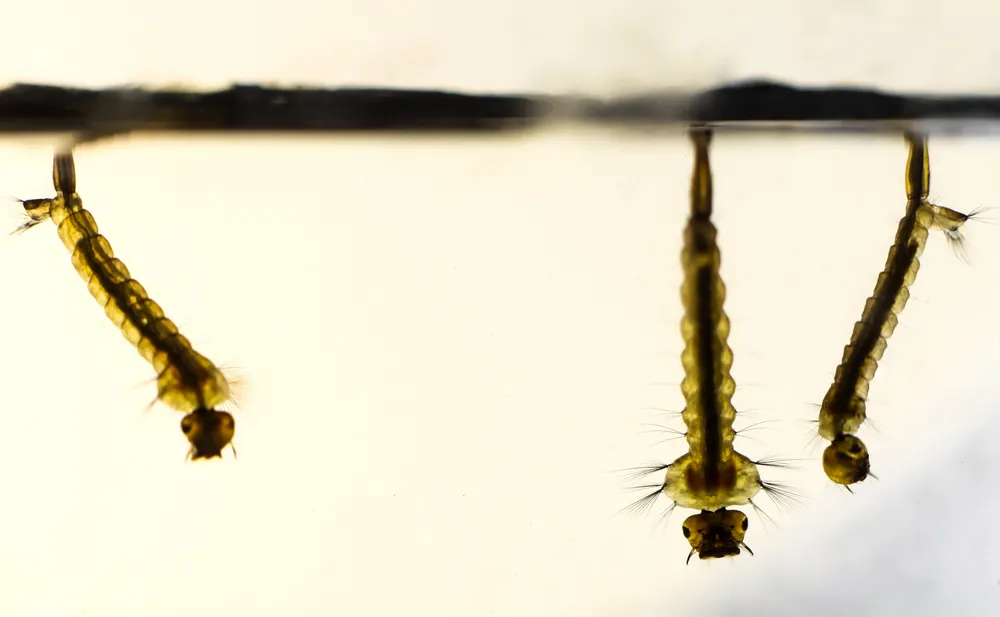 Photo: Denis888 — CC BY (Wikimedia Commons)
The "5P 1K" measures can all be done at home for free:
- Close (ปิด) — seal water-storage containers (jars, tanks) tightly so mosquitoes can't lay eggs inside.
- Change (เปลี่ยน) — change the water in flower vases, plant-pot saucers, and small ponds every 7 days, before eggs can hatch into larvae.
- Release (ปล่อย) — release larvae-eating fish (guppies, mosquitofish) into ponds or water sources that can't be sealed.
- Improve (ปรับ) — tidy up the yard so there are no discarded containers, old tires, or trash that can hold water.
- Practice (ปฏิบัติ) — do all four of the above every week as a habit, not just when there's an outbreak in the news.
- Scrub (ขัด) — scrub water containers clean every time you change the water, since mosquito eggs stick to container walls even after the water is poured out.
Do the full 5P 1K routine first, then add the 9 products below on top — the results will be far better than relying on an expensive device alone.
How to choose a mosquito-control product
Before the ranking, four criteria will help you match a product to your actual situation:
1. Where you'll use it (indoors vs outdoors) Most indoor electric devices list a "coverage area" in square meters (30–80 sqm). If your room is larger than that, the device won't work at full effectiveness. Outdoor use needs a product specifically built to withstand sun and rain — most indoor units aren't rated for high humidity or splashing.
2. How it works (lure-and-trap vs electric shock vs chemical) UV-lure-plus-fan traps are quieter and safer but catch mosquitoes more slowly. Electric-grid zappers kill faster but make noise and a faint burnt smell. Chemical options (sprays, plug-ins, coils) act immediately but need continuous refills/replacement.
3. Safety around children and pets High-voltage electric-grid lamps and smoky mosquito coils aren't suitable for a young child's room or for people with asthma/respiratory allergies — a UV suction trap or Picaridin spray is the gentler choice.
4. Long-term cost, not just the sticker price A liquid plug-in vaporizer lasts about 30 nights per bottle before you need a new one. Thermacell uses cartridges with a limited lifespan. An electric trap, on the other hand, is a one-time purchase that lasts years (only the UV bulb needs occasional replacement) — work out the yearly running cost before deciding, not just the shelf price.
9 best mosquito-control products to keep at home
#1: Indoor UV + suction fan trap — the safest choice for a bedroom (929–2,490 baht)
Example models: Homemi HM0011-P-BL (~929 baht, covers a typical room, quiet operation) and BLACK HOLE Plus (~2,490 baht, covers 30 sqm, auto sensor and 4 UV bulbs)
How it works: A UV bulb lures mosquitoes in, then a fan sucks them into a collection box below. No electric shock, no burnt smell, no loud noise.
Pros
- Quietest of all the electric options — safe to run in a bedroom overnight.
- Safe around children and pets, with no exposed high-voltage grid.
- Lasts for years, so long-term cost is low (just occasional UV bulb replacement).
Cons
- Catches mosquitoes more slowly than an electric-grid zapper — better suited to enclosed rooms than open areas.
- Cheaper models cover a small area; you may need several units for a large home.
- Placement matters (0.5–1.5m off the ground, away from competing light sources).
Who it's for
Bedrooms with young children or elderly family members, people sensitive to smell/noise, and homes that want to run a device quietly all night.
#2: Electric-grid UV mosquito zapper lamp — the widest coverage (555–989 baht)
Example models: LUZINO GM909G (~555 baht, covers 60 sqm) and COMMANDO GIANT 3 (~989 baht, covers 80 sqm, wall-mount or tabletop)
How it works: UV light lures mosquitoes into a high-voltage electric mesh that kills on contact — no waiting for a fan to pull them in.
Pros
- Widest coverage of any indoor device on this list, up to 80 sqm.
- Kills instantly on contact, no delay.
- Cheaper than a suction-fan model with equivalent coverage.
Cons
- Makes an audible "zap" sound and a faint burnt smell that can disturb sleep.
- Not suitable for a young child's room where little fingers could reach the mesh.
- The mesh and collection tray need regular cleaning.
Who it's for
Balconies, garages, living rooms, or any open area where children aren't reaching for the unit constantly.
#3: Personal mosquito repellent spray/lotion — essential whenever you leave the house (54–270 baht)
Example products: OFF! DEET 15% (~161 baht, 6-hour protection), Kayari Body Family Guard Icaridin 5% (~194 baht, 7-hour protection, suitable for sensitive skin/kids 2+), Sketolene citronella (~202 baht, natural formula, 7-hour protection)
How it works: The active ingredient (DEET, Picaridin/Icaridin, or citronella oil) interferes with a mosquito's ability to detect you by scent — apply to any exposed skin.
Pros
- The most portable option — no power outlet required, works anywhere.
- Protects exactly where mosquitoes actually bite, not just within a device's range.
- Wide range of formulas for different needs (kids, sensitive skin, natural).
Cons
- Needs reapplication every 4–7 hours per the label — forget to reapply and protection lapses.
- High-concentration DEET can dissolve plastic and irritate some people's skin.
- Natural formulas protect for shorter periods and need more frequent reapplication.
Who it's for
Anyone heading outside in the early morning or late afternoon — exactly when Aedes mosquitoes bite most — especially near overgrown areas, gardens, or standing water.
#4: Plug-in liquid vaporizer — best for small rooms (131–220 baht)
Example product: Baygon electric liquid mosquito repellent (~131–220 baht depending on scent, covers 7–13 sqm, lasts ~30 nights per bottle)
How it works: Heat from the plug-in unit continuously evaporates the chemical in the bottle, repelling mosquitoes for as long as it's plugged in.
Pros
- Cheapest upfront price among the electric devices.
- Can be left plugged in all night with zero maintenance and no noise.
- Refill bottles are widely available at convenience stores and supermarkets.
Cons
- Very limited coverage (7–13 sqm) — not suitable for a large room or open space.
- Needs a new bottle roughly every 30 nights, an ongoing cost forever.
- Has a faint scent that people sensitive to smell may not like.
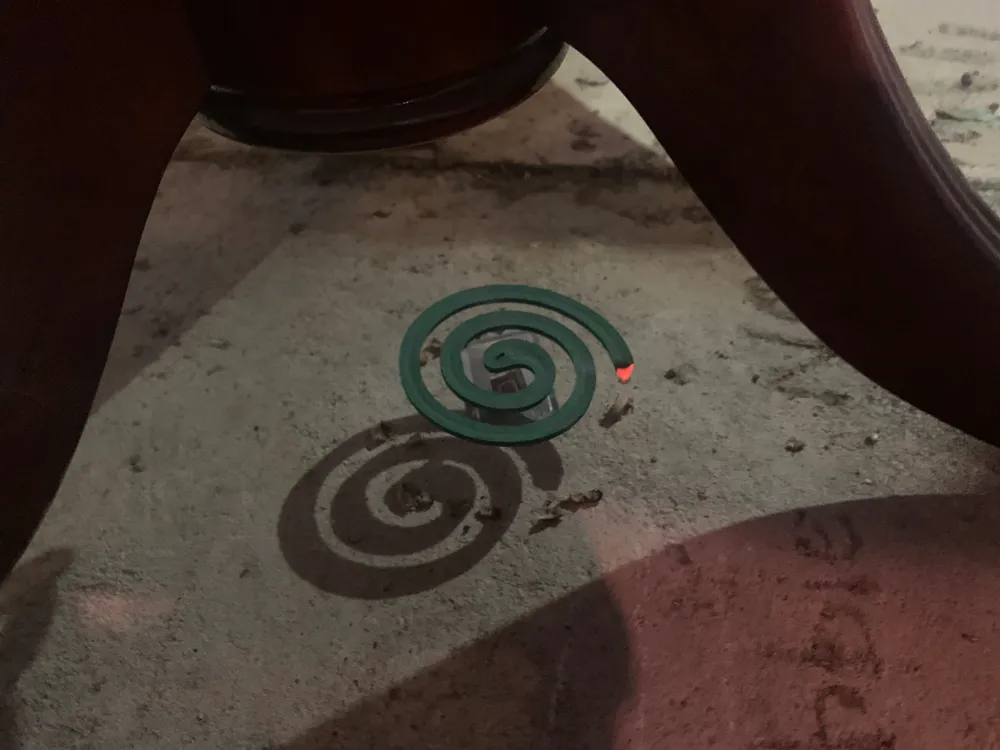 Photo: Ant1234567 — CC BY-SA (Wikimedia Commons)
The classic mosquito coil is far cheaper than a liquid plug-in (just a few baht per coil) and needs no power outlet, but it continuously releases smoke and fine particles for hours. It's not suitable for a sealed room, a young child's bedroom, or anyone with asthma/respiratory allergies. If you must use one, burn it somewhere well-ventilated and don't sleep in the room while it's still smoking.
Who it's for
Small bedrooms in condos or dorms, and anyone who wants the simplest possible hands-off option.
#5: Bed mosquito net — 100% chemical-free protection while you sleep (100–700 baht)
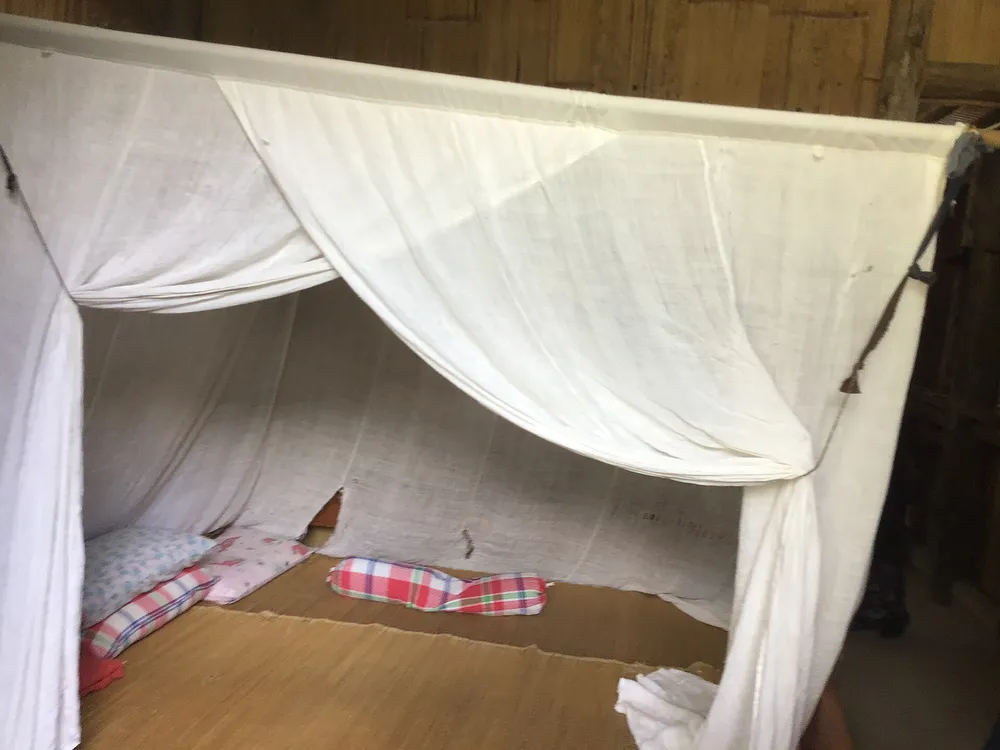 Photo: Tofeiku — CC BY-SA 4.0 (Wikimedia Commons)
Typical price: ~100–700 baht depending on bed size (3.5–6 feet) and material (fine mesh, dome-style, or box-style)
How it works: Fully enclosing the bed acts as a physical barrier mosquitoes can't cross to reach the sleeper — no chemicals involved at all.
Pros
- No chemicals near you while you sleep — the safest option for infants and pregnant women.
- Provides close to 100% protection if there are no tears or gaps.
- No ongoing cost — buy once, use for years.
Cons
- Feels more confining than sleeping without one; some people find it uncomfortable to adjust to.
- Only protects while you're inside it — no help during the day, when Aedes mosquitoes bite most.
- Needs periodic checking for tears or holes, or mosquitoes can slip through.
Who it's for
Infant cribs, elderly family members who nap during the day, and anyone who prefers to avoid chemicals near their sleeping area.
#6: Magnetic door screen / window mesh — stops mosquitoes at the entry point (219–500 baht)
Example size: Standard DIY magnetic curtain, 90x210 cm, ~219–269 baht per set (installation pins included)
How it works: Fine mesh fabric with magnetic strips on a doorway self-closes automatically after you walk through, or a permanent aluminum-frame screen mounts on a window.
Pros
- Blocks mosquitoes at the point of entry, reducing the overall count indoors rather than fixing one spot.
- Magnetic curtains are DIY-installable — no drilling, and machine-washable.
- No ongoing cost, no electricity, no chemicals.
Cons
- Magnetic curtains may not seal fully with frequent use or strong drafts.
- Permanent window screens need accurate measuring or a professional installer.
- Does nothing for mosquitoes already inside the house before installation.
Who it's for
Homes with doors opening and closing often, storefronts, and condos/rentals that want mosquito control without drilling into walls.
#7: Portable outdoor mosquito repeller — for patios, gardens and outdoor gatherings (1,590 baht + 850 baht refills)
Example model: Thermacell MR300 (~1,590 baht for the unit, R-4 gas refill cartridge ~850 baht, covers roughly 4.5x4.5 meters)
How it works: Heat evaporates metofluthrin from a replaceable cartridge, diffusing it over a wide zone around the unit — this repels mosquitoes from the whole area rather than luring and trapping them.
Pros
- Portable and needs no household power — great for camping, fishing, or a garden party.
- Covers outdoor space better than personal spray or an indoor plug-in ever could.
- No burning smell, unlike a mosquito coil.
Cons
- Higher upfront cost than anything else on this list, plus an ongoing cost for replacement cartridges.
- Effectiveness drops sharply in strong wind, since the repellent can't build up.
- Replacement cartridges are less widely available in Thailand than ordinary sprays.
Who it's for
Anyone with a patio, garden, or frequent outdoor activities who isn't put off by the ongoing cartridge cost.
#8: Portable CO2-mimicking trap — more accurate luring than light alone (470 baht)
Example model: FLEXTAIL Light Repel (~470 baht, USB-rechargeable, IPX4 water-resistant, portable)
How it works: Releases heat and moisture that mimics human breath — the actual signal mosquitoes use to find a target — which is more accurate than UV light alone, combined with a sticky or suction trap.
Pros
- Small and portable, USB-rechargeable, works indoors or out.
- IPX4 water resistance means it can handle a damp lawn or balcony.
- Lures mosquitoes using a mechanism closer to real behavior than light alone.
Cons
- Covers a smaller area than a typical tabletop or wall-mounted trap.
- Needs regular recharging — not ideal for running plugged in all night.
- Higher cost per square meter of coverage than an electric-grid zapper.
Who it's for
Anyone who wants a portable supplementary device for a small spot, like a desk, or anywhere an outlet isn't available.
#9: Electric mosquito swatter racket — the cheapest, and worth having in every home (139–299 baht)
Example models: Kamisafe KM-3821 (~139 baht) up to KM-3828 (~299 baht), Yage YG-D006 (~159 baht, 500mAh battery, USB rechargeable)
How it works: A wire mesh racket carries a high-voltage, low-current charge (safe for humans) that zaps any mosquito on contact the instant it touches the mesh.
Pros
- Cheapest item on this list — every home should keep at least one.
- Instantly deals with any mosquito that slips past your other defenses.
- USB-rechargeable and reusable, with zero ongoing cost.
Cons
- Fully manual — you have to swat mosquitoes one at a time, unlike automatic devices.
- Not suitable for young children to use, given the electrified mesh.
- Useless against mosquitoes flying too high to reach or hiding in tight corners.
Who it's for
Every home, as a cheap backup for whatever slips through, and anyone who likes handling a mosquito the moment they spot it.
Comparison table: 9 mosquito-control products
| Product | Price (baht) | How it works | Coverage | Best for |
|---|---|---|---|---|
| UV + suction fan trap | 929–2,490 | Lure + suction | Typical room–30 sqm | Bedrooms, kids/elderly |
| Electric-grid UV zapper | 555–989 | UV + electric shock | 60–80 sqm | Balconies, garages, open areas |
| Repellent spray/lotion | 54–270 | Chemical/natural, on skin | Personal | Going outside, all ages |
| Plug-in liquid vaporizer | 131–220 | Chemical evaporation | 7–13 sqm | Small rooms, condos |
| Bed mosquito net | 100–700 | Physical barrier | Bed area | Infants, elderly |
| Magnetic screen / mesh | 219–500 | Blocks entry | Doors/windows | Homes with doors opening often |
| Portable outdoor repeller | 1,590+850 | Vapor diffusion | ~4.5x4.5 m | Gardens, patios, camping |
| Portable CO2-mimic trap | 470 | Breath simulation | Small spot | Desks, no-outlet spots |
| Electric swatter racket | 139–299 | Manual electric shock | Arm's reach | Every home, as backup |
Long-term cost: it's not just the sticker price
Many people decide based purely on the price tag on the shelf, but some products carry a "hidden" ongoing cost:
- Plug-in liquid vaporizer: ~131–220 baht per bottle, lasting ~30 nights — that's ~130–220 baht/month if run every night, or ~1,600–2,600 baht/year.
- Thermacell: an R-4 cartridge costs ~850 baht and lasts a limited number of hours — heavy use could cost more per year than buying a whole electric trap outright.
- Repellent spray: ~60–270 baht per bottle, lasting roughly 1–2 months with daily use — about 400–1,600 baht/year per person.
- Electric trap / bed net / swatter: one-time purchase, with only a small ongoing cost for electricity or an occasional UV bulb replacement (tens to a few hundred baht per year).
The takeaway: one-time-purchase products usually pay for themselves over time, even with a higher upfront cost, while consumable products suit occasional or targeted use rather than year-round reliance.
Choosing the right combination for your home
Small condo or rental: a plug-in liquid vaporizer + a magnetic door screen + one backup electric swatter — a full setup for under 1,000 baht.
Homes with an infant or young child: a crib/bed net comes first, always, followed by a UV + suction fan trap (not an electric-grid zapper) and Picaridin spray instead of DEET.
Detached house with a garden/patio: an electric-grid zapper for open areas + a portable outdoor repeller for outdoor sitting + strict 5P 1K, since a yard usually has more standing-water spots than a condo.
Very tight budget: do 5P 1K fully first (it's free), then just an electric swatter (~139 baht) and a budget repellent spray (~54–79 baht) — still far better than doing nothing.
Common mistakes when buying mosquito-control products
- Buying an expensive trap but never clearing standing water — new mosquitoes hatch faster than the trap can catch the old ones.
- Putting an electric-grid zapper in a young child's room — risk of little fingers touching the electrified mesh; use a suction-fan model instead.
- Applying repellent spray once in the morning and assuming it lasts all day — reapply per the label's stated hours (usually 4–7).
- Buying a small trap for a large room — insufficient coverage means the device never runs at full effectiveness.
- Forgetting to replace a plug-in vaporizer bottle after 30 nights — an empty bottle left plugged in does nothing, even though it looks like it's still working.
- Assuming any single device gives 100% dengue protection — no device is complete protection; it always has to be paired with 5P 1K.
Summary: how to actually prevent dengue
The priority order is: first, run the 5P 1K routine to clear mosquito breeding sites around the house every week — the single most effective, free measure. Second, choose supplementary devices that match your space and household (a bed net for kids/elderly, a UV suction trap for bedrooms, an electric-grid zapper for open areas). Third, always carry repellent spray when heading outside in the early morning or late afternoon, when Aedes mosquitoes bite most. Fourth, watch closely for a fever lasting more than 2 days, especially right after it starts to break — that's the most dangerous point in dengue fever.
None of the 9 products above is a "shortcut" that replaces removing standing water. But if you can only invest in two things on a tight budget, a UV + suction fan trap (safe, long-lasting) and Picaridin repellent spray (portable protection anywhere) are the best-value pair for a typical household.
Sources
- Thailand Department of Disease Control, Ministry of Public Health — dengue situation and the 5P 1K measures, 2026 (ddc.moph.go.th)
- Hfocus — dengue surveillance warning, seek care after fever lasting more than 2 days (hfocus.org)
- mybest — comparative reviews of electric mosquito traps and repellent sprays, real Thai market prices and specs (th.my-best.com)
- Bangkok Metropolitan Administration, Khlong Sam Wa District Office — the 5P 1K 2Y dengue prevention measures (webportal.bangkok.go.th)
- Thermacell Thailand — outdoor mosquito repeller and cartridge product information (thermacellthailand.com)
Frequently asked questions
- What's the difference between a UV suction trap and an electric-grid zapper — which should I buy?
- The suction-fan type (UV lure + fan pulling mosquitoes into a box) is quieter, has no burning smell, and is safer around kids or pets — good for a bedroom. The electric-grid type (UV + high-voltage mesh) kills faster and covers a wider area, but makes a snapping sound and a faint burnt smell, so it suits a balcony, garage, or open living area where kids aren't touching it.
- DEET vs Picaridin (Icaridin) sprays — which is better?
- Studies show no major difference in protection at comparable concentrations, but Picaridin has no strong smell, isn't sticky, doesn't dissolve plastic/synthetic fabric, and is gentler on skin — so it suits children and sensitive skin better. DEET is slightly cheaper but has a stronger odor.
- I bought a mosquito trap but there are still just as many mosquitoes — why?
- A trap only catches adult mosquitoes that fly into its working range. If standing water remains around the house, new mosquitoes hatch every 7–10 days regardless. You need the 5P 1K source-reduction routine running alongside any device — a device reduces the existing population, it doesn't stop new mosquitoes from being born.
- Can young children and pregnant women use mosquito repellent spray?
- Children under 6 months should not have any repellent applied directly to skin — use a crib net or window screens instead. Children 6 months–2 years can sometimes use low-concentration DEET (10% or less) — check with a doctor first. Children 2+ and pregnant women can use DEET or Picaridin at label-recommended concentrations per Thai FDA/DDC guidance.
- Does an outdoor device like Thermacell actually work?
- Yes, in open areas without strong wind — its active ingredient (metofluthrin) diffuses over roughly a 4.5x4.5 meter zone around the unit, good for a patio, garden, or picnic table. Effectiveness drops in strong wind since the repellent can't build up, and there's a hidden ongoing cost: replacement cartridges you must keep buying.
- On a tight budget, what's the most effective way to prevent dengue?
- Priority order: 1) Do 5P 1K weekly to remove standing water around the house (free, and the most effective long-term measure). 2) A window screen or bed net for children/elderly who nap during the day. 3) Repellent spray whenever you go outside in early morning or late afternoon, when Aedes mosquitoes bite most. An electric trap is a nice-to-have once budget allows.
Related articles

Rainy-Season Diseases 2026: 7 Illnesses to Watch, Symptoms, Prevention and When to Rush to Hospital
A complete guide to the rainy-season diseases Thais must watch — dengue, leptospirosis, influenza, hand-foot-mouth and food poisoning: symptoms, prevention, which medicines to avoid, and the warning signs that mean 'go to hospital now'. Based on Thai DDC data, 2026.

10 Best Treadmills in Thailand 2026: Complete Buying Guide with Prices
Compare the 10 best treadmills in Thailand for 2026, from 7,990 THB to pro-grade — with real Continuous HP specs, belt sizes and picks for every budget.

Home Workouts 2026: Get Started Without a Gym (Beginner's Guide)
A 2026 beginner's guide to working out at home — no-equipment bodyweight moves, a 7-day starter plan, budget gear, warm-ups and habit tips.