Thailand EV Sales Smash Records in Jan 2026 — Over 44,000 Units, 48% Share, as Kingdom Becomes ASEAN's EV Export Base

Thailand's automotive industry marked a major milestone as battery-electric vehicle (BEV) registrations in January 2026 more than tripled year-on-year to over 44,000 units — a record month for the country. EV share of new-car sales climbed to roughly 48%, shattering the previous high of 37% set in December 2025, a clear sign that Thai consumers are shifting into the electric era faster than many had expected.
Records Falling Almost Across the Board
The records did not come alone. Thailand's total car market grew 41.9% year-on-year in January 2026 to about 90,283 units, led largely by electric vehicles. The standout brand was BYD, which sold 12,791 units in a single month — comfortably beating its own prior record of 6,370 units set in June 2025.
Looking at individual models, the picture is even clearer: the Jaecoo 5 EV became the #2 best-selling car in the entire market (7.5% share), followed by the BYD Dolphin at #3 (6.5%) and the BYD Atto 3 at #6. EVs ranking among the top sellers of the whole market — not just within the EV segment — signals that electric cars have become a mainstream choice for Thai buyers.
What Sparked the Surge
January's jump has a clear explanation. Part of it came from the government extending the registration deadline under its EV3 support scheme from December 2025 to January 2026 (announced in November 2025), prompting carmakers to rush registrations to qualify for the incentives.
Another major driver was an excise-tax cut for BEVs effective January 1, 2026: passenger EVs saw their rate fall from 8% to just 2%, while EV pickups dropped from 2% to 0%. Analysts note the sharp January figure is partly a one-off rush ahead of the deadline — but it underscores genuinely strong, sustained EV demand in Thailand.
Across the whole of 2025, Thailand sold about 120,301 BEVs, up more than 80% from the year before, lifting full-year EV share to roughly 19.4% of new-car sales — a solid base ahead of the January 2026 record.
A Charging Network Keeping Pace
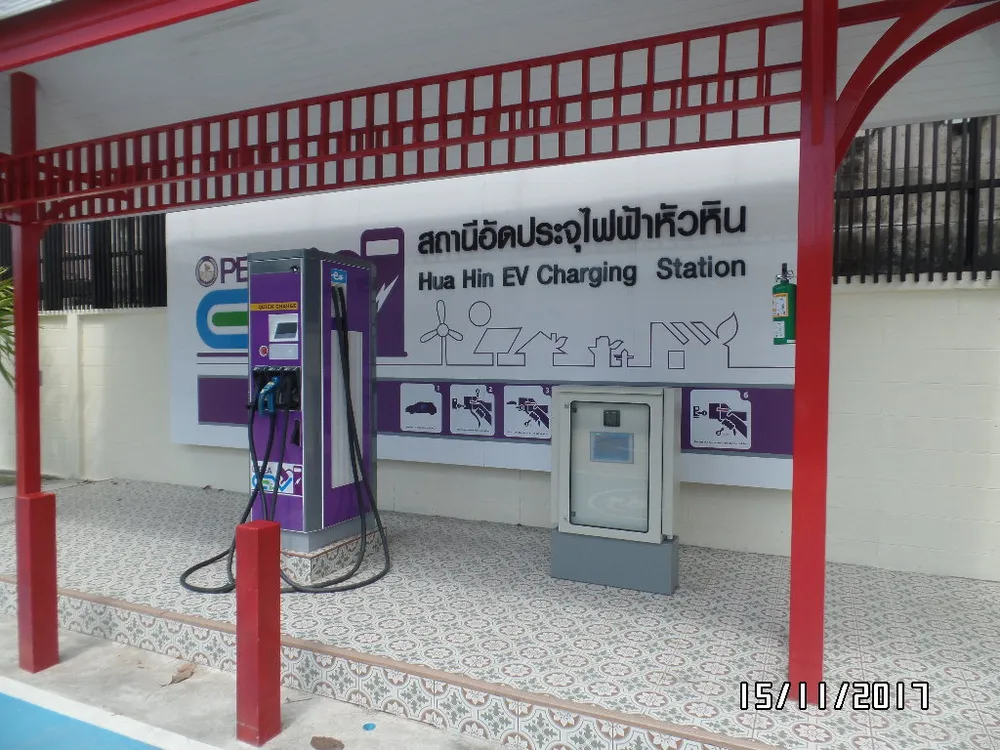 An EV charging station in Thailand — the rapidly growing charging network is key to giving drivers the confidence to go electric. Photo via Wikimedia Commons, CC
A big reason buyers feel confident switching is the fast-growing charging network. As of early 2026, Thailand had several thousand public charging stations and more than ten thousand individual chargers, covering both DC fast chargers and AC chargers.
The major players powering this network include EV Station PluZ (PTT Group), which holds roughly 30% market share, followed by EA Anywhere (Energy Absolute group) and PEA VOLTA (Provincial Electricity Authority). Denser charger coverage in cities and along major highways is easing "range anxiety" — long the single biggest obstacle to buying an EV.
Thailand Rises as an EV Manufacturing and Export Base
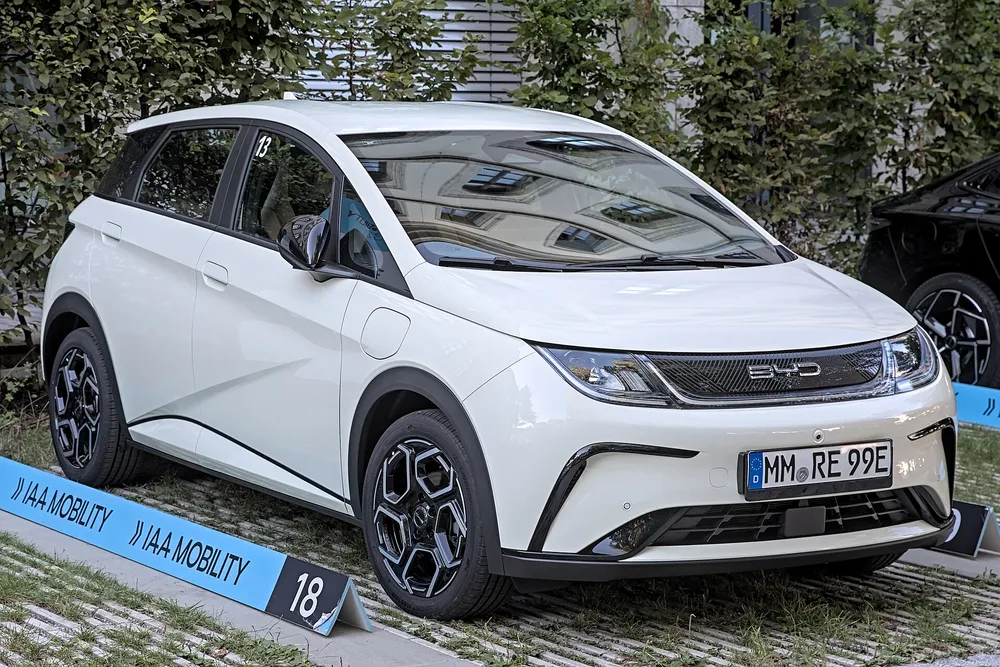 The BYD Dolphin, one of Thailand's best-selling EVs and a model built at the Rayong plant for export. Photo via Wikimedia Commons, CC
Behind the hot domestic sales, Thailand is concretely becoming a regional EV manufacturing and export base. The BYD plant in Rayong — the company's first factory outside China — began production in mid-2024, and in August 2025 it exported its first batch of Thai-made Dolphins to Europe (about 959 cars), a key step lifting Thailand from "buyer market" to "production base."
The government also revised its incentives to grant carmakers a 1.5-to-1 production credit for exported vehicles (up from 1-to-1) to encourage using Thailand as an export hub. EV exports from Thailand are projected to rise from about 12,500 units in 2025 to around 52,000 in 2026. The sector has already created over 9,600 local jobs, with 85–95% of workers being Thai nationals — BYD alone employs more than 5,900 staff and aims to raise its Thai workforce to 95% by 2026.
Why This Matters for Thai People
For ordinary consumers, this trend means more EV choices and fierce price competition — both from Chinese brands (which held roughly 46.8% of January's market) and from Japanese and European makers rolling out their own EVs. Stronger competition usually means better specs at more accessible prices.
On running costs, the energy cost per kilometre of an EV remains markedly lower than a petrol car — and households with a rooftop solar system can cut charging costs even further. If you're weighing an EV against a petrol car, see our comparison, EV vs petrol: which is better value in 2026; for generating your own power to charge at home, read Is rooftop solar worth it, and how long is the payback? and our tips on cutting your home electricity bill.
Anyone about to buy their first car should study insurance and hidden costs alongside the purchase — see our first-car buying guide and what Class 1 car insurance covers. The EV boom also ties into Thailand's wider rise as a regional technology hub, as seen in the major data-centre and AI investment wave.
Looking Ahead
While part of January's total reflects a registration rush before the incentive deadline, the long-term direction of Thailand's EV market remains upward — driven by supportive policy, an expanding charging network, falling battery prices, and competitive locally built cars.
The key challenge to watch is making the electricity used for charging come increasingly from clean sources, so EVs deliver their full environmental benefit, alongside building the EV-industry workforce to meet demand. Play that well, and Thailand becoming ASEAN's electric-vehicle hub is no longer a distant prospect.
Key facts (January 2026 figures):
- BEV registrations: over 44,000 units (record month), share around 48%
- Total market up 41.9% · BYD sold 12,791 units, beating its own record
- Best sellers: Jaecoo 5 EV (#2) · BYD Dolphin (#3) · BYD Atto 3 (#6)
- Exports: BYD Rayong ships to Europe · exports projected to jump from ~12,500 (2025) to ~52,000 units (2026)
Taken together, the signals point to Thailand fully entering the electric-mobility era — as both user and maker — good news for consumers' wallets, domestic jobs, and long-term air quality alike.
Sources
- Benchmark Source — Thailand's EV sales surge to record levels in January 2026
- Best Selling Cars Blog — Thailand January 2026: Chinese at 46.8% share, BYD smashes records
- Nation Thailand — New Incentives to Transform Thailand into an EV Export Hub
- CleanTechnica — BYD Begins Exporting EVs From Thailand To Europe
Frequently asked questions
- What was Thailand's EV sales record in January 2026?
- Battery-electric vehicle (BEV) registrations across passenger and light-duty vehicles more than tripled year-on-year to over 44,000 units, a record month for Thailand. The EV penetration rate rose to about 48%, beating the previous monthly high of 37% set in December 2025.
- Why did January sales spike so sharply?
- The government extended the registration deadline under its EV3 incentive scheme from December 2025 to January 2026, and cut BEV excise tax from January 1, 2026 (passenger BEVs from 8% to 2%, BEV pickups from 2% to 0%). Carmakers rushed to register vehicles before the deadline, so the spike is partly a one-off.
- Which EV models sold best in Thailand in early 2026?
- In January 2026 the Jaecoo 5 EV was the #2 best-selling car overall (7.5% share), followed by the BYD Dolphin at #3 (6.5%) and the BYD Atto 3 at #6. BYD alone sold 12,791 units in the month, smashing its own record.
- Is Thailand really becoming an EV export base?
- Yes. BYD's Rayong plant began exporting Thai-made Dolphin EVs to Europe in August 2025, and the government revised incentives to grant a 1.5-to-1 production credit for exported vehicles. EV exports from Thailand are projected to rise from about 12,500 units in 2025 to around 52,000 in 2026.
- How big is Thailand's EV charging network now?
- As of early 2026 Thailand has several thousand public charging stations and over ten thousand individual chargers, covering both DC fast chargers and AC chargers, led by PTT Group's EV Station PluZ, EA Anywhere and PEA VOLTA.
- What does this mean for everyday consumers?
- More EV choices and fierce price competition deliver better value, energy cost per kilometre is much lower than petrol cars, and the expanding charging network makes daily use more convenient.
Related news
 World
WorldHistoric First: UK Electric Cars Outsell Petrol Vehicles for the First Time Ever
Carbon Brief data for the 12 months to May 2026 shows 516,490 battery EVs registered in the UK versus 504,010 petrol cars — the first time EVs beat petrol.
 World
WorldSodium-Ion Batteries Hit Mass Production in 2026: A Cheaper, Safer Power Source Made From Salt
Sodium-ion batteries reach mass production in 2026, powering the first sodium EV, a record 60 GWh grid order, and costs nearing lithium parity.
 Thailand
TH-AI Passport Tops 1.47M Sign-Ups in Two Weeks as Thailand Gives Away Free Pro AI
Thailand's TH-AI Passport lets citizens 15+ use 30+ AI models from 14 providers for free. Sign-ups hit 1.47 million within days of the program's launch.