Power banks 2026: 20,000mAh charges a phone 2.7 times, and the new flight rules

The number on a power bank's box is the most misleading figure in consumer electronics — technically true, and not what you want to know.
This article explains what capacity you actually get and why, and covers Thailand's current flight rules, which changed in 2025 and many people are unaware of.
Why 20,000mAh only charges a phone 2.7 times
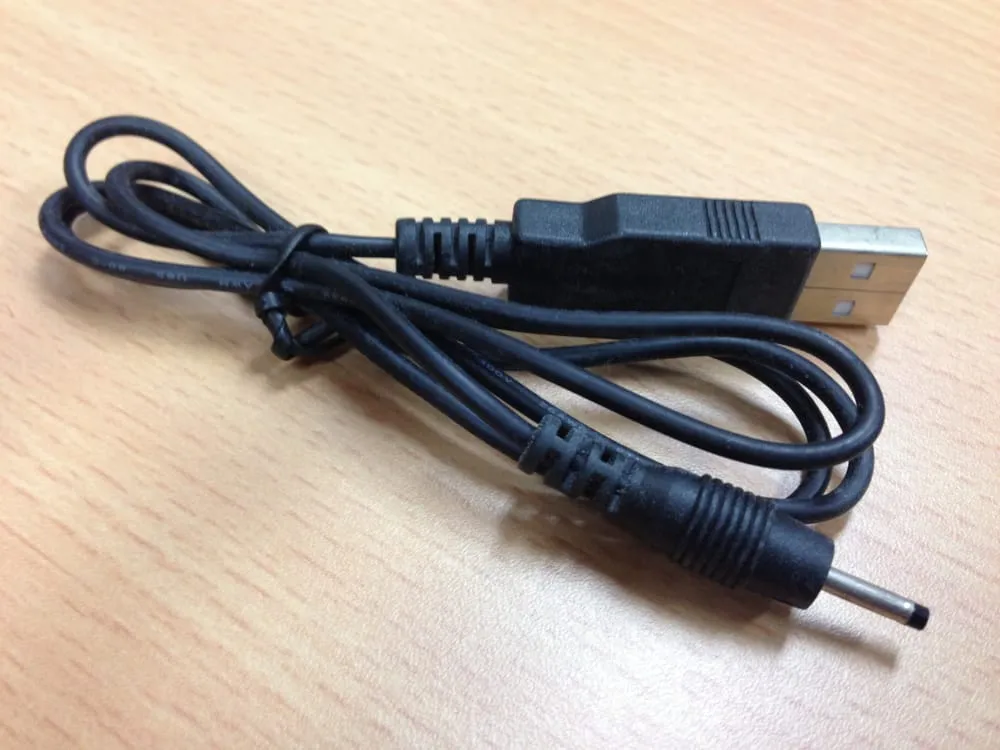 Photo: Dinkun Chen — CC BY-SA 4.0 (Wikimedia Commons)
Intuition says a 20,000mAh power bank should charge a 5,000mAh phone four times. It does not, for two reasons the box does not mention.
Reason one: mAh is not a unit of energy — you have to multiply by voltage
A power bank's 20,000mAh is measured at its internal lithium cell voltage of 3.7V:
20,000 mAh × 3.7 V = 74 Wh (watt-hours, the actual unit of energy)
A phone's 5,000mAh battery is measured at about 3.85V:
5,000 mAh × 3.85 V = 19.25 Wh
Reason two: voltage conversion loses energy
The energy passes through two conversions and loses some at each:
- Stepping up from 3.7V to 5V for the USB port — lost as heat.
- Stepping back down from 5V to ~3.85V in the phone's charging circuit — lost as heat again.
Together that leaves roughly 65–75% efficiency, which is why a power bank gets warm in use — that warmth is the missing energy.
The real arithmetic (at 70% efficiency):
| Rating on the box | Actual energy | Usable at 5V | Charges of a 5,000mAh phone |
|---|---|---|---|
| 5,000 mAh | 18.5 Wh | ~2,590 mAh | ~0.7 |
| 10,000 mAh | 37.0 Wh | ~5,180 mAh | ~1.3 |
| 20,000 mAh | 74.0 Wh | ~10,360 mAh | ~2.7 |
| 26,800 mAh | 99.2 Wh | ~13,880 mAh | ~3.6 |
⚠️ Note that a 5,000mAh power bank does not even fully charge a 5,000mAh phone — it reaches about 70%. That is not a fake or faulty unit; it is physics that applies equally to every brand.
⚠️ Even these figures are slightly optimistic, because they exclude poor-quality cables (added resistance), using the phone while charging, and fast charging, which runs hotter and therefore wastes more. In practice, assume about 2.5 charges from a 20,000mAh bank.
What capacity to choose
With the real numbers in hand, the choice becomes much simpler:
| Capacity | Phone charges | Approx. weight | Suits |
|---|---|---|---|
| 5,000 mAh | ~0.7 | ~100–150 g | An emergency top-up that fits a pocket |
| 10,000 mAh | ~1.3 | ~200 g | The best balance for daily carry |
| 20,000 mAh | ~2.7 | ~400 g | Multi-day travel, several devices, tablets |
| 26,800 mAh | ~3.6 | ~500 g+ | Long trips, but right at the airline ceiling |
⚠️ 10,000mAh is where most people should start, because it fully charges a phone with something left over, at a weight you will actually carry every day. A 20,000mAh unit weighs about twice as much, which is why many end up left at home — and a power bank you did not bring has a capacity of zero.
Wattage matters as much as capacity
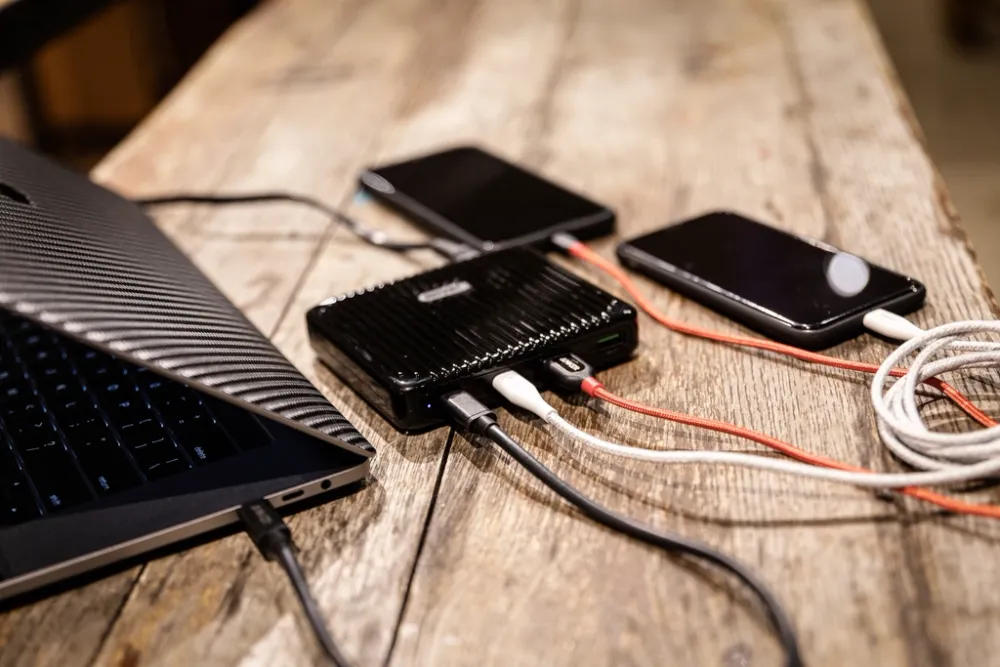 Photo: Logant547 — CC BY 4.0 (Wikimedia Commons)
This is the most overlooked spec, and it decides whether you actually use the thing.
Capacity tells you how many charges; wattage tells you how long each one takes.
| Output | Full phone charge takes | Suits |
|---|---|---|
| 5–10W | 2–3 hours | Overnight charging or emergencies only |
| 18–30W | 45 minutes – 1.5 hours | Ordinary phones — the value sweet spot |
| 45–65W | Faster, plus small laptops | People carrying a thin-and-light laptop |
| 100W+ | Full-speed laptop charging | Working away from a desk |
⚠️ Three things have to line up, not just the wattage number:
- Does the bank support USB Power Delivery (PD)? It is the standard modern phones and laptops use. Without PD, a high wattage figure means nothing to your devices.
- The cable has to support it too. Many cheap USB-C cables are rated for 60W or less, and cables built for data transfer may carry little power. The cable is the most common bottleneck when charging is unexpectedly slow.
- Multiple ports share the total. A "65W" model usually means 65W across all ports, not per port.
⚠️ For laptops, check two things: that the laptop can charge over USB-C at all (not all can), and that the bank supplies what it needs. Too little and the laptop will either charge very slowly or merely hold its level while you use it.
⚠️ Flight rules changed in 2025
Read this before travelling, because the rules are stricter than most people remember.
What has not changed:
- Up to 100Wh (about 20,000mAh) is allowed on board.
- Carry-on only — never in checked baggage, because a fire in the hold is neither visible nor reachable in time.
What has changed, and is widely unknown:
- ⚠️ The Civil Aviation Authority of Thailand (CAAT) has issued rules prohibiting charging or using power banks during a flight.
- ⚠️ Thai Airways banned using or charging power banks on board for the entire journey from 15 March 2025.
The reason is lithium cells short-circuiting and going into thermal runaway in the cabin, which has happened repeatedly worldwide. So the plan of "I'll charge my phone during the long flight" no longer works on many airlines — charge fully before boarding, or use the seat's USB port if there is one.
⚠️ And this explains odd capacities like 26,800mAh — at 3.7V that is exactly 99.2Wh, just under the 100Wh ceiling. It is the largest capacity that is still allowed on board. Anything above about 27,000mAh risks being confiscated at security, and 100–160Wh units need airline approval in advance.
Three things to do before travelling: check the unit has its Wh or mAh printed clearly (unmarked ones can be refused), keep it in your hand luggage from check-in, and re-check that airline's own rules, because they differ.
Safety and lifespan
Lithium batteries degrade with cycles and with age — typically 300–500 cycles before noticeable capacity loss. But in Thailand there is a much stronger accelerant:
⚠️ Heat is the main enemy, and a car parked in the sun is the worst case. Cabin temperatures in a Thai car park climb very high, which both accelerates degradation and raises the risk of a cell swelling or igniting. Do not store a power bank in a car.
Signs to stop using it immediately:
- Swelling or deformation — gas has built up inside the cell. Stop using it and dispose of it properly at once; never puncture it or press it back.
- Getting too hot to hold while charging or discharging.
- Unusual smells or crackling sounds.
- A sudden capacity collapse, such as going from two charges to half of one.
Disposal: a power bank is electronic waste, not household rubbish. Take it to an e-waste collection point at a mall or run by your local authority. Throwing it out with household waste risks fires in bin lorries and landfill.
Common mistakes
Believing 20,000mAh means four charges — then thinking the bank is faulty when it is working normally.
Buying the largest capacity without considering weight — then not carrying it, which makes the capacity worthless.
Looking at mAh and ignoring watts — ending up with a large bank so slow you avoid using it.
Using an underrated cable — the number one cause of "I bought a fast-charging model but it charges slowly".
Putting a power bank in checked baggage — against every airline's rules, and liable to confiscation.
Storing it in a car — heat shortens its life and raises the risk.
Continuing to use a swollen unit — the clearest danger sign there is, and unrepairable.
Leaving it fully flat for a long time — a lithium battery stored with no charge can fail permanently. Store it at about half charge.
Summary
- 20,000mAh = 74Wh, leaving about 10,400mAh usable at 5V after 25–35% conversion losses.
- That is about 2.7 charges of a 5,000mAh phone, not four — assume 2.5 in practice.
- 10,000mAh is the best daily-carry balance, because a weight you will actually carry beats a number on a box.
- Wattage matters as much as capacity — 18–30W with USB PD is the value point for phones.
- The cable is usually the bottleneck, not the bank.
- Up to 100Wh (~20,000mAh), carry-on only, and no using or charging in flight under CAAT rules.
- Never store one in a car, and stop using it the moment it swells.
Sources
- Thai PBS — CAAT issues new rules tightening power bank carriage on aircraft
- Bangkok Biz News — Thai Airways bans power bank use on board for the whole flight
- Sanook — which power banks are allowed on flights under the new CAAT rules
- Baggage & Luggage — power banks on flights, 2026 rules summarised
Capacity calculations use 3.7V for power bank cells, 3.85V for phone batteries, and a combined conversion efficiency of 70%, the midpoint of the 65–75% commonly observed. Real figures vary with model, cable, temperature and whether the phone is in use. Flight rules differ by airline and can change — always check with your airline before travelling.
Frequently asked questions
- How many times does a 20,000mAh power bank charge a phone?
- About 2.7 times for a phone with a 5,000mAh battery, not four. The 20,000mAh rating is measured at the 3.7V cell voltage (74Wh), and stepping up to 5V and back down into the phone's battery loses roughly 25–35%.
- What capacity should I get?
- 10,000mAh is enough for a day out (about 1.3 charges). 20,000mAh suits multi-day travel or several devices (about 2.7 charges). Above 20,000mAh gets heavy and runs into airline limits.
- Can I take one on a plane?
- Yes, up to 100Wh (about 20,000mAh), and only in carry-on — never in checked baggage. Thailand's CAAT also prohibits charging or using power banks during the flight.
- Why are some power banks 26,800mAh?
- Because 26,800mAh at the 3.7V cell voltage is 99.2Wh, just under the airlines' 100Wh ceiling. It is a number designed to be as large as is still allowed on board.
- How much does the wattage matter?
- As much as capacity. A 20,000mAh bank that only outputs 10W takes over two hours per phone charge, while a 30W or better model does it in under an hour. For laptops, look for 60W or more with USB Power Delivery support.
- How long does a power bank last?
- Lithium batteries degrade with charge cycles and with age — typically 300–500 cycles before capacity drops noticeably, and much faster if stored somewhere hot, such as a car parked in the sun, which is routine in Thailand.
Related articles

iPhone vs Android 2026: Apple's update advantage is gone
iPhone against Android in 2026 — how the software support windows changed, cost per supported year, and the reasons that should actually decide it.
AIS vs True vs NT 2026: Which Thai Mobile Network Should You Pick?
Compare AIS, True (merged with dtac) and NT in 2026 — postpaid prices, prepaid/annual SIMs, 5G speed, coverage, plus how to switch networks and keep your number.

iPhone 18 Series 2026: Price, Specs Before Sept 9 Launch
Every leak on the iPhone 18 Pro, Pro Max, and iPhone Fold before Apple's Sept 9 event: predicted Thailand pricing, the A20 chip, and buy-now-or-wait advice