Thailand Completes '30-Baht Treatment Anywhere' Rollout Across Every Province

Thailand has closed out one of its biggest public-health pushes in years: the National Health Security Office (NHSO) has expanded its "30-baht treatment anywhere, with a single ID card" scheme until it now covers every province in the country. That means more than 47 million gold-card holders can walk into any in-network health unit and be treated — no longer tied to the one hospital where they are registered.
From a pilot in just four provinces in early 2024, the scheme rolled out until its final phase began on 1 January 2025, and by 2026 the government has earmarked a record health budget to keep it running. It is a milestone that makes Thailand's "free care for all" system far more usable and seamless in everyday life.
From "treats all diseases" to "treats anywhere"
Thailand's universal coverage scheme — long known by its nickname "30 baht treats all diseases" — has run since 2002 and is praised worldwide as a model for how a middle-income country can put care within reach of almost everyone. The one weak spot was mobility: patients were effectively "stuck" with their home hospital, or needed a referral before being seen elsewhere.
The "treatment anywhere" upgrade closes that gap by linking health data across providers nationwide, so a doctor anywhere can pull up a patient's history. Patients simply walk into the nearest in-network unit and present a single national ID card instead of carrying stacks of referral paperwork.
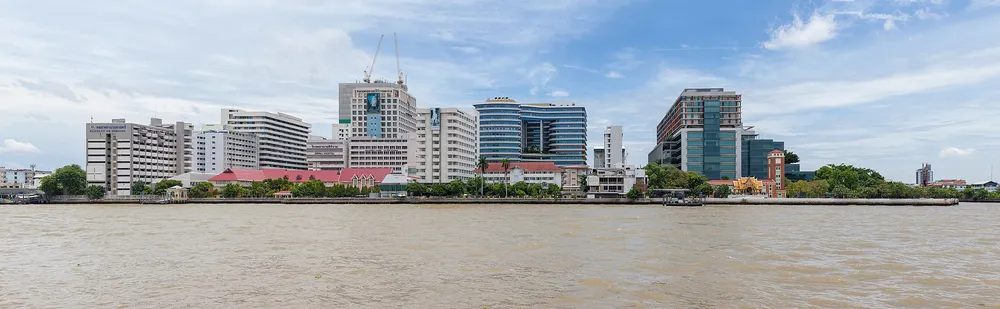 Photo: Siriraj Hospital on the Chao Phraya River in Bangkok, a pillar of Thailand's public health system — Preecha.MJ, CC BY-SA via Wikimedia Commons
Full national coverage in about a year
The striking part is the speed. According to Thai PBS Policy Watch, the NHSO split the work into four phases over roughly a single year:
| Phase | Start date | Areas added |
|---|---|---|
| Phase 1 | 7 Jan 2024 | 4 pilot provinces — Phrae, Roi Et, Phetchaburi, Narathiwat |
| Phase 2 | 1 Mar 2024 | 8 more provinces |
| Phase 3 | 1 May 2024 | 33 more provinces, including Bangkok |
| Phase 4 | 1 Jan 2025 | the remaining provinces — full national coverage |
By the final phase, the scheme reached all 77 provinces, including Bangkok (which joined in phase 3). On the provider side the network expanded fast too, with around 13,000 participating health units — quality pharmacies, general clinics, dental clinics, nursing clinics, physiotherapy clinics and traditional-Thai-medicine clinics — spread close to where people live.
Care near home, not crowding the big hospitals
The core idea is to shift care for minor illnesses away from large, often-crowded hospitals. The clearest example is the quality pharmacies carrying the "30-baht treatment anywhere" logo, which offer free consultation and dispensing for 32 groups of minor symptoms — headaches, fever, coughs, sore throats and the like — so people no longer queue at emergency rooms for things that don't need them.
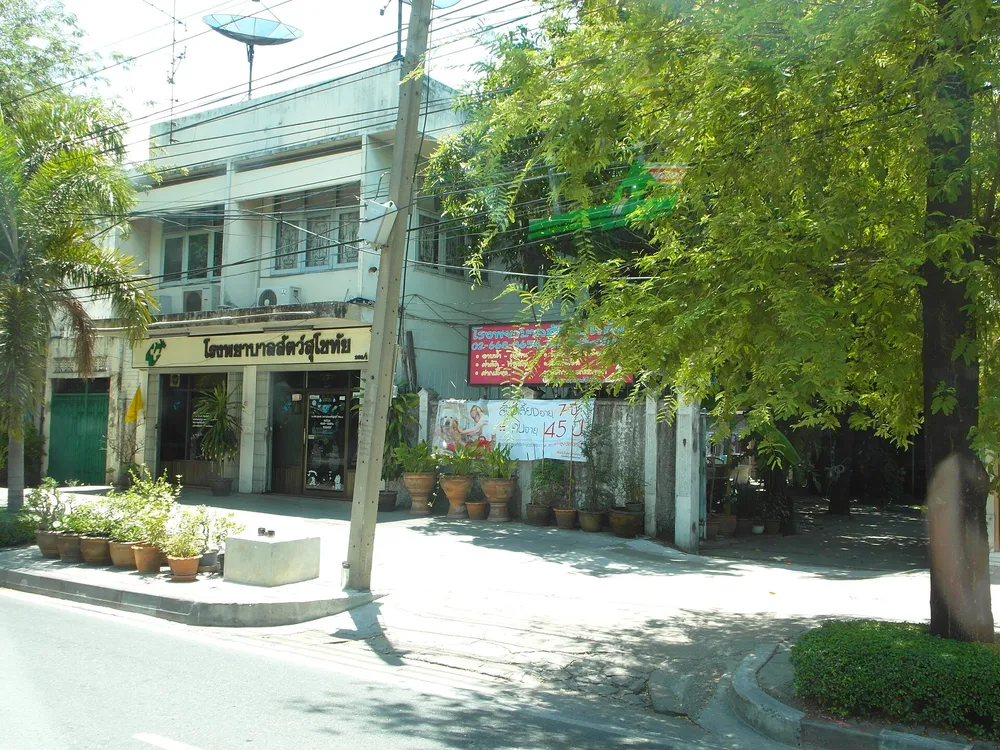 Illustrative: a community pharmacy in Bangkok — in-network pharmacies are the first point of care for minor illness — via Wikimedia Commons
Published figures show the new channels have already been used several million times, a sign the system isn't just policy on paper but is being used in daily life. Athaporn Limpanylers, deputy secretary-general of the NHSO, said that "integration of data systems and seamless information sharing between service providers is crucial for the success of this policy."
A record 2026 health budget
None of this is free. The government has confirmed it will keep going, allocating the NHSO about 265.295 billion baht for fiscal year 2026 — the largest amount since the scheme began. The money will upgrade services through technology, expand telemedicine (remote doctor consultations), add advanced treatments to the National Essential Medicines List, and push a campaign against non-communicable diseases (NCDs).
Government spokesperson Jirayu Huangsub confirmed the 30-baht scheme "will remain in place and continue to expand," while the Ministry of Public Health advances its "MOPH PLUS+" strategy that treats health as both a basic right and an economic engine. The news follows Thailand's recent ranking as the 8th-best health system in the world, reflecting the quality and accessibility of its public health care.
What it means for Thais — and what to watch
For people working away from home, students far from their hometown, or older people for whom travel is hard, "treatment anywhere" cuts time, travel costs and referral hassle dramatically. It turns an existing right into one that is far easier to actually use.
Challenges remain, though: a budget that grows every year, keeping linked health data safe and high-quality, and fairly reimbursing private in-network providers so the system stays sustainable.
The gold-card scheme mainly covers essential care, so additional planning — such as health insurance matched to your risk and budget — remains a sensible way to cover costs beyond your entitlement or treatment at private hospitals. See our health insurance page to compare plans.
Figures in this story — participating units, usage counts and budget — reflect reports from early-to-mid 2025–2026 by the sources cited and may change as the programme runs.
Sources
Frequently asked questions
- Where can I use '30-baht treatment anywhere'?
- Gold-card (UCS) holders can get care at any NHSO in-network unit nationwide — quality pharmacies, general clinics, dental clinics, nursing clinics, physiotherapy clinics, traditional-Thai-medicine clinics and labs — using just their national ID card. Check participating units at nhso.go.th or call the 1330 hotline.
- Do I really pay 30 baht?
- '30 baht' is the scheme's original name from 2002. Today most gold-card holders pay no service fee at all, but the name has stuck.
- What documents do I need?
- Just your national ID card at an in-network unit — you no longer need a referral letter from your registered hospital (as of June 2026).
- When did nationwide coverage take effect?
- The final phase that completed nationwide coverage began on 1 January 2025; the pilot first launched in four provinces on 7 January 2024.
- How big is the 2026 health budget?
- The government allocated the NHSO about 265.295 billion baht for fiscal year 2026 — the largest amount since the scheme began.
Related news
 Thailand
Thailand Ranks 8th in the World for Healthcare, 1st in Southeast Asia (2026)
Numbeo's 2026 Health Care Index places Thailand 8th globally with a score of 77.5 and 1st in Southeast Asia, ahead of several European systems.
 World
WorldHistoric First: No Women Under 25 Died from Cervical Cancer in England for Five Straight Years
A Lancet study confirms zero cervical cancer deaths among women aged 20–24 in England from 2020 to 2024, the first proof HPV vaccination prevents deaths.
 World
WorldTwo Shots a Year, Near-Total HIV Protection: 'Lenacapavir' Rolls Out Across Countries in 2026 — Including Thailand
Lenacapavir (Yeztugo), a twice-yearly HIV prevention shot over 99.9% effective in trials, rolls out across countries in 2026, with a Thai pilot in July.