Car Tyre Guide 2026: Specs, Sizes, DOT Dates and When to Replace

Your tyres are the only part of the car that actually touches the road. The total contact patch of all four tyres together is smaller than four of your palms, yet every bit of braking, steering and stability rides on it. Most people still choose tyres on price alone, never reading the numbers on the sidewall or checking the manufacture date. This guide will teach you to read tyre specs, pick the right size, decode the DOT date, check tread and pressure yourself, recognise when it's time to replace, and understand 2026 prices — so you buy the best value and the safest tyre for your car.
Why tyres matter more than you think
People happily spend on a sound system, window tint or pretty alloy wheels but cut corners on tyres — even though tyres decide whether the car stops in time. On a wet road, a tyre worn close to the 1.6 mm limit needs nearly twice the braking distance of a fresh tyre with full tread. That's the difference between stopping short and a full-speed collision.
In a country with long rainy seasons and slick roads, worn or under-inflated tyres are even more dangerous. Standing water causes aquaplaning — the tyre rides up on a film of water and you lose control. Deep tread channels the water away in time; shallow tread aquaplanes at much lower speeds.
Tyres also affect fuel economy. Running just 5–6 psi low can raise fuel use by around 2–3% and wear the tyres abnormally fast. Looking after your tyres properly is both a safety issue and a money issue.
How to read the numbers on the sidewall
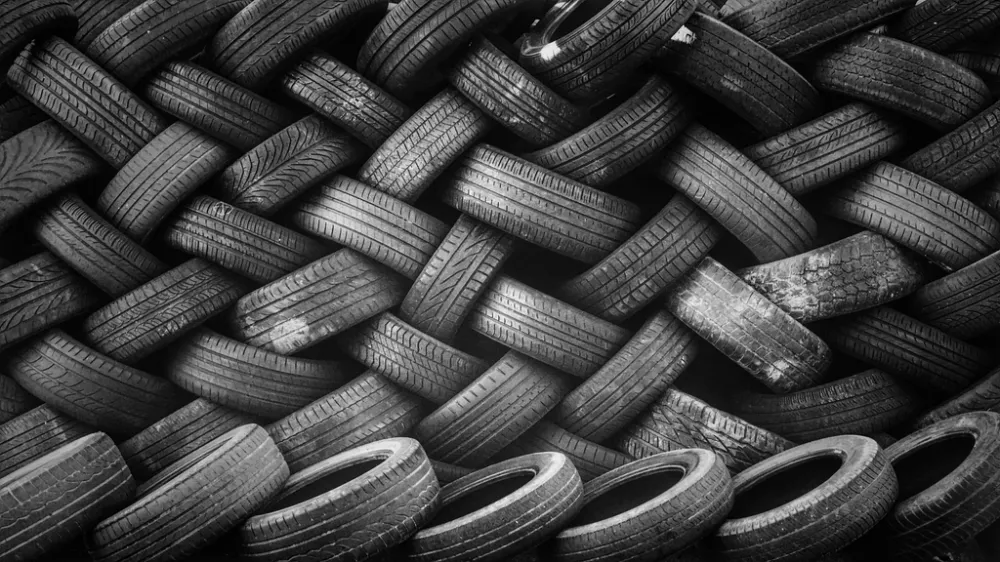 Photo: stack of tyres — CC0 via rawpixel
Look at the sidewall and you'll see a string of numbers and letters like 205/55 R16 91V. It looks like a secret code, but it tells you everything you need. Here's each part broken down.
| Code | Meaning | Example: 205/55 R16 91V |
|---|---|---|
| First number | Tread width (millimetres) | 205 mm |
| Second number | Aspect ratio / sidewall height (% of width) | sidewall = 55% of 205 = ~113 mm |
| Letter R | Radial construction | R |
| Next number | Wheel rim diameter (inches) | 16 inches |
| Load index | Max weight one tyre can carry | 91 = 615 kg per tyre |
| Speed rating | Max speed the tyre can sustain | V = 240 km/h |
A wider tread grips better and looks sporty but uses more fuel and is noisier. Aspect ratio — the lower the number, the shorter the sidewall (e.g. 45, 40), which gives sharper handling but a harsher ride and more bent-rim risk in potholes. A taller sidewall (e.g. 65, 70) rides softer and survives rough roads better, which suits uneven local roads.
Load index and speed rating are safety figures you must not ignore. The table below decodes the most common values.
| Load index | Capacity (kg/tyre) | Speed | Max speed | |
|---|---|---|---|---|
| 82 | 475 | S | 180 km/h | |
| 88 | 560 | T | 190 km/h | |
| 91 | 615 | H | 210 km/h | |
| 94 | 670 | V | 240 km/h | |
| 95 | 690 | W | 270 km/h | |
| 98 | 750 | Y | 300 km/h |
The iron rule: never fit a tyre with a load index or speed rating below what the car specifies — it may not carry the weight, or it can overheat and fail at speed. Matching or exceeding is fine; going lower is not.
Need to convert psi to bar, inches to centimetres, or kilometres to miles? Try our free unit converter.
Choosing the right tyre size
The surest source is the tyre information placard on the driver's-side door edge (open the door and look at the pillar or door frame). It lists the front and rear tyre sizes and the manufacturer's recommended pressures — more reliable than the figure on your current tyre, because that tyre might have been fitted in the wrong size by a previous owner. The owner's manual is another source.
If you want to change size (called plus sizing — e.g. going from 16" to 17"), the simple rule is to keep the overall rolling circumference close to the original, generally within ±3%. Beyond that, your speedometer reads wrong, the odometer drifts, and the ABS/ESP systems can miscalculate. The principle: when you increase rim diameter, lower the aspect ratio to compensate — for example 205/55 R16 plus-sizes neatly to 215/45 R17.
A few special markings worth knowing:
- M+S (Mud and Snow) — usable in mud and light snow.
- XL (Extra Load) — reinforced construction for heavier loads, suited to SUVs and loaded pickups.
- 3PMSF (three-peak mountain with a snowflake) — meets a real winter-tyre standard (not needed in a hot climate, but it indicates cold-weather capability).
- A national standards mark — always choose tyres that carry the proper local industrial-standard certification.
Check the manufacture date: the DOT code most people forget
A tyre isn't always "better the newer it looks on the shelf." A tyre that has sat in storage for years is an old tyre that has never even rolled. Rubber begins degrading from the inside the moment it's made — it hardens and develops fine cracks as it ages, even with full tread.
Look for the DOT code on the sidewall, ending in a four-digit number inside an oval:
- First 2 digits = week of manufacture (01–52)
- Last 2 digits = year of manufacture
Example: DOT XXXX XXX 2425 means the tyre was made in week 24 of 2025 (around mid-June 2025). A three-digit code means the tyre was made before the year 2000 — far too old, no question.
A buying tip: ask the staff to bring out each tyre so you can see the DOT code before fitting. Choose tyres made no more than 1–2 years before purchase. If a tyre is heavily discounted as "old stock" or "last year's," work out whether the saving is worth the lost service life. A tyre that's already three years old before it touches your car has thrown away years of life for nothing.
Check tread and pressure yourself
 Photo: car on mountain road — CC0 via rawpixel
How much tread is safe?
Every tyre has tread wear indicators — small raised bars set in the bottom of the main grooves. When the tread wears flush with these bars, you have 1.6 mm of depth left, the legal minimum, and the tyre is finished — replace it now.
But experts recommend replacing before you reach the minimum:
| Tread depth | Condition | Recommendation |
|---|---|---|
| 6 mm or more | Excellent | Drive with confidence |
| 3–4 mm | Wet performance starting to drop | Start planning a replacement |
| 2.4 mm (3/32") | Wet braking noticeably worse | Replace, especially before the rainy season |
| 1.6 mm | Legal minimum / worn out | Replace immediately |
A quick coin check: insert a coin into the tread groove. If the outer rim of the coin is fully visible above the tread, the tread is too shallow and you should have it measured properly. A cheap pencil-style tread gauge is also worth keeping in the glovebox.
Pressure: the small thing that's the most dangerous
Under-inflation is the leading cause of blowouts — the sidewall flexes so much it builds up heat, and the tyre wears abnormally at the edges. Over-inflation wears the centre fast and makes the ride harsh.
The right way to inflate:
- Use the value on the driver's-door placard, not the "Max Pressure" stamped on the sidewall (that figure is the maximum the tyre can take, not what you should run).
- Inflate when the tyres are cold — parked 3+ hours or driven less than 1.6 km — because hot tyres expand and give a false reading.
- Check at least once a month and before every long trip. Don't forget the spare.
- Most cars run around 30–35 psi, but always follow the placard. If you're carrying a heavy or full load, use the "full load" figure listed there.
For every 10°C drop in temperature, tyres lose roughly 1 psi, so check more often when it gets cooler. And if your car has a tyre-pressure warning system (TPMS), never ignore the warning light.
Signs it's time for new tyres
 Photo: motorway safe-tyres sign — CC0 via rawpixel
Beyond tread worn to the wear bars, watch for these signs — if you spot any, have a technician check the tyres promptly:
- Age over 6 years — inspect closely; over 10 years, replace immediately even with tread left, because the rubber degrades with time (check the DOT code).
- Cracking on the sidewall or in the groove bottoms — a sign the rubber has gone brittle from age, sun or ozone.
- Bulges or blisters on the sidewall — very dangerous; the internal casing has failed and a blowout is likely. Replace at once.
- Uneven wear — worn on one side or in patches usually means the wheel alignment is off, the pressure is wrong, or the suspension is worn. Fix the cause too.
- Vibration through the wheel or body at certain speeds — could be a bulged tyre, an out-of-balance wheel, or a tyre that has lost its shape.
- Unusual noise or feeling the car slip more easily in the rain.
If you only need to replace two tyres, always fit the new pair on the rear axle (regardless of whether the car is front- or rear-wheel drive) — better grip at the back keeps the tail from sliding out on wet roads. And rotate your tyres roughly every 10,000 km so all four wear evenly. We cover this in detail in our car maintenance and oil-change guide.
2026 tyre prices and value
Prices depend on size, brand and model. The table below shows approximate per-tyre ranges (data as of June 2026, excluding fitting/balancing, which many shops include free when you buy a full set).
| Tier | Example brands | Approx. price/tyre | Best for |
|---|---|---|---|
| Budget | Deestone, Maxxis entry models | 1,500–2,500 baht | City driving, tight budget |
| Mid-range value | Yokohama, Dunlop, Hankook | 2,200–3,500 baht | General use, price-quality balance |
| Premium | Michelin, Bridgestone, Continental, Goodyear | 3,000–6,000 baht+ | Quietness, wet braking, long life |
Real prices seen in the 2026 market: Yokohama 195/65 R15 around 2,250 baht each and 205/55 R16 around 3,000 baht each; Hankook 185/55 R16 around 2,500 baht each (promotional prices — figures change).
Think in cost per kilometre. A premium tyre at 5,000 baht that lasts 60,000 km works out to about 0.08 baht/km, while a budget tyre at 2,000 baht lasting 40,000 km is about 0.05 baht/km. On paper the cheap tyre wins — but factor in the shorter braking distance of a premium tyre saving you from a single accident, and it more than pays for itself. So if you drive long distances or face heavy rain regularly, spending more on good tyres is spending on safety.
Remember that no tyre, however good, can guarantee against the unexpected. The right car insurance for how you actually drive cushions the repair and medical bills. If you're unsure which class makes sense, read our take on whether class 1 car insurance is worth it.
Common tyre mistakes
Even long-time drivers slip up on these:
- Buying on price, ignoring the date — you get a cheap tyre that's old stock, throwing away service life. Always check the DOT code.
- Inflating to the sidewall number — that's the maximum, not the recommended value; it makes the ride harsh and wears the centre fast. Follow the door placard.
- Mixing different brands/models/tread patterns — unbalanced grip, especially when the front and rear pairs differ a lot.
- Forgetting to rotate — the front pair (which handles more steering and braking) wears faster than the rear, forcing earlier replacement.
- Putting the new pair on the front when replacing two — they belong on the rear to prevent the tail sliding out.
- Ignoring the TPMS light or thinking "I'll top it up later" — even a few days of low pressure can permanently damage a tyre.
- Not checking the spare — you only discover the spare is flat or perished when your main tyre fails on the road.
- Choosing low-profile tyres for looks while forgetting how many potholes the roads have — low profiles bend rims and bulge more easily.
Conclusion: buy and maintain tyres like a pro
A good tyre isn't the most expensive one — it's one with the correct size for your car, recently made (DOT within 1–2 years), a load index and speed rating no lower than specified, and kept properly inflated. For city use on a budget, a mid-range tyre from a trusted brand with the proper standards mark is safe and plenty. But if you drive long distances or face heavy rain often, paying more for a premium tyre with better wet braking and lower noise is money well spent.
Remember three simple rules: learn to read the specs, check pressure and tread regularly, and never push a tyre past its age limit. Do that and you'll drive with confidence and safety all year round.
Sources
- Understanding Tyre Size, Load Index and Speed Rating — Tyre Reviews
- Tyre DOT Code: what is and how to read it — Pirelli
- When Should You Replace Your Tires — Discount Tire
- How to Check Tire Tread Depth: The Penny Test — Pirelli
- Recommended Tire Pressure — Pirelli
- Thai tyre prices 2026 — Autotirechecking
Frequently asked questions
- How often should I replace my car tyres?
- Generally replace at 6 years of age (even with tread left) or when the tread wears down to the wear bars (1.6 mm), whichever comes first. By mileage that's usually around 40,000–60,000 km depending on how and where you drive. Any tyre over 10 years old must be replaced immediately even if it looks new, because the rubber degrades with age.
- How do I read the DOT date on a tyre?
- Find the four-digit number in an oval on the sidewall. The first two digits are the week, the last two are the year — e.g. 'DOT...2425' means it was made in week 24 of 2025. Aim to buy tyres made no more than 1–2 years before purchase.
- Can I fit a different size from the original?
- Stick to the size on the driver's-door placard or owner's manual. Never use a lower load index or speed symbol than specified. If you plus-size, keep the overall rolling circumference within about ±3% of original so the speedometer stays accurate and the ABS/ESP systems read correctly.
- What pressure should I use, and when do I check it?
- Use the value on the driver's-door placard (typically around 30–35 psi), not the maximum figure stamped on the sidewall. Check when the tyres are cold (parked 3+ hours or driven under 1.6 km) at least once a month and before any long trip.
- Is there a big difference between premium and budget tyres?
- The difference shows in wet braking distance, noise, lifespan and cornering grip. Premium tyres usually stop shorter and wear slower, but a mid-range tyre from a trusted brand is plenty safe for city use. What you should never risk is an old, long-stored tyre or one with no proper standards mark.
Related articles

Pai, Mae Hong Son Travel Guide 2026: Sights, Stays & 3-Day Plan
Complete 2026 guide to Pai, Thailand: the 762-curve drive, must-see sights, stays for every budget, real costs, and a working 3-day itinerary.
How to Save Fuel in Thailand 2026: Real Tips as Gas Prices Rise
Thailand fuel prices rose Sep 2026. Proven ways to cut fuel costs, a real cost-impact table, and whether switching to an EV finally pays off.

M6 & M82 Motorways Open Free 2026: Routes, Ramps, Rules
Thailand's M6 (Bang Pa-in–Pak Chong) and M82 (Bang Khun Thian–Ban Phaeo) open toll-free in Aug 2026. Dates, ramps, vehicle rules, speed limits and driving tips.