Car maintenance 2026: the schedule, and the free habit worth 575 baht a year

Most car maintenance is about following a schedule and not forgetting, not about deep mechanical knowledge.
So this article gives two things: an interval table you can work from, and — the part usually missing — what neglecting each item actually costs per year. Seen as money, checking your tyres once a month starts to look a lot more worthwhile.
The free habit that costs most when skipped: tyre pressure
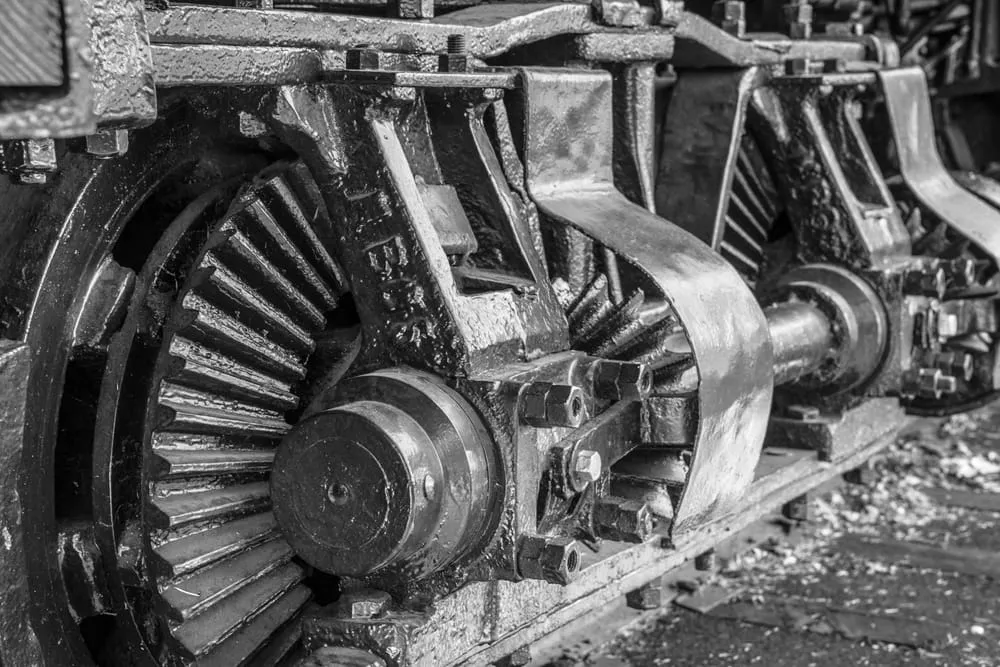 Photo: R. Henrik Nilsson — CC BY 4.0 (Wikimedia Commons)
Start with the thing that costs nothing and has the clearest evidence behind it.
The US Department of Energy puts fuel economy loss at roughly 0.2% for every 1 psi below the correct pressure, averaged across all tyres, and says correct inflation improves economy by 0.6–3%.
In money, for someone driving 1,500 km a month at 15 km/l on gasohol 95 (about 47,900 baht of fuel a year):
| Tyres below spec by | Extra fuel used | Extra cost per year |
|---|---|---|
| 2 psi | 0.4% | 192 baht |
| 4 psi | 0.8% | 383 baht |
| 6 psi (the common case) | 1.2% | 575 baht |
| 8 psi | 1.6% | 767 baht |
| 10 psi | 2.0% | 959 baht |
⚠️ 6 psi is not an extreme figure. Tyres lose roughly 1–2 psi a month naturally, so a car that has not been topped up for three or four months is normally in that range — and swings between hot and cool weather widen it further.
Beyond fuel, low pressure wears both shoulders of the tyre faster and raises the risk of a blowout on a long run through heat build-up. See our tyre guide.
The correct pressure is on the placard in the driver's door jamb, not the number moulded on the tyre wall. That number is the tyre's maximum, not what your car should run.
Service intervals
These are middle-of-the-road figures for an ordinary sedan in Thailand. Your own manual always outranks this table.
| Item | Typical interval | Notes |
|---|---|---|
| Mineral engine oil | ~5,000 km or 6 months | Whichever comes first |
| Semi-synthetic oil | 7,000–10,000 km or 1 year | |
| Fully synthetic oil | 10,000–15,000 km or 1 year | |
| Oil filter | With every oil change | |
| Engine air filter | ~20,000 km | Thailand is dusty; may need shorter |
| Cabin air filter | ~10,000–20,000 km | Directly relevant to PM2.5 inside the car |
| Tyre rotation | ~10,000 km | Keeps wear even, extends tyre life |
| Tyre replacement | ~50,000 km or 3–5 years | Tyres age out even with deep tread |
| Brake pads | 30,000–70,000 km | Depends on driving and traffic |
| Brake fluid | ~2 years | Absorbs moisture, lowering the boiling point |
| Battery | 2–4 years | Thai heat shortens it against cold climates |
| Coolant | ~2–4 years | Depends on type |
| Spark plugs | 30,000–100,000 km | Varies greatly by plug type |
⚠️ Note the word "or" on several lines. These items degrade with time as well as distance. A car driven 3,000 km a year still needs an annual oil change, and a six-year-old tyre still needs replacing however deep the tread, because rubber ages through oxidation and heat.
Manual versus the service centre — who is right
The most common confusion: the manual says 10,000 km, the centre puts a sticker on at 5,000.
The principle is to follow the manual, since that is the document the manufacturer sets and warrants against.
But manuals usually carry two schedules — normal and severe service — and the severe-service conditions typically describe what Thai drivers face daily:
- City driving with long periods stuck in traffic and idling
- Frequent short trips where the engine never reaches operating temperature
- Dusty conditions
- Heavy loads or towing
- Sustained high ambient temperatures
So the precise answer is: open the manual, see whether your use meets its severe-service definition, and use that schedule. If a centre recommends shorter than both, ask what they are basing it on.
Choosing engine oil
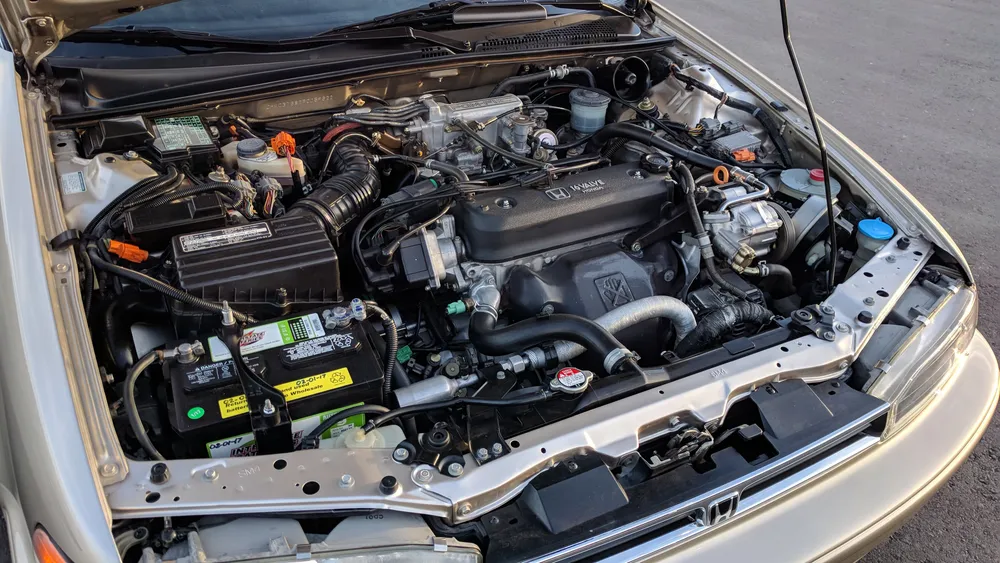 Photo: Hip~commonswiki — CC BY-SA (wikimedia)
| Type | Interval | Suits |
|---|---|---|
| Mineral | ~5,000 km | Older cars, older engine designs, tight budgets |
| Semi-synthetic | 7,000–10,000 km | General use; the balance of price and interval |
| Fully synthetic | 10,000–15,000 km | Modern engines, turbos, long distances, hot climates |
More important than the type is the viscosity grade — 5W-30, 0W-20 and so on — which must match what the manual specifies.
- The number before the W is cold viscosity. Lower flows faster at start-up, which is when engines wear most.
- The number after the W is hot viscosity, and must match what the engine was designed for.
⚠️ A common misconception: "thicker means more protection." Not for modern engines, whose oil galleries are designed around a specific viscosity. Oil that is too thick reaches the bearings more slowly at start-up and adds friction, which costs fuel.
Five checks a month, ten minutes
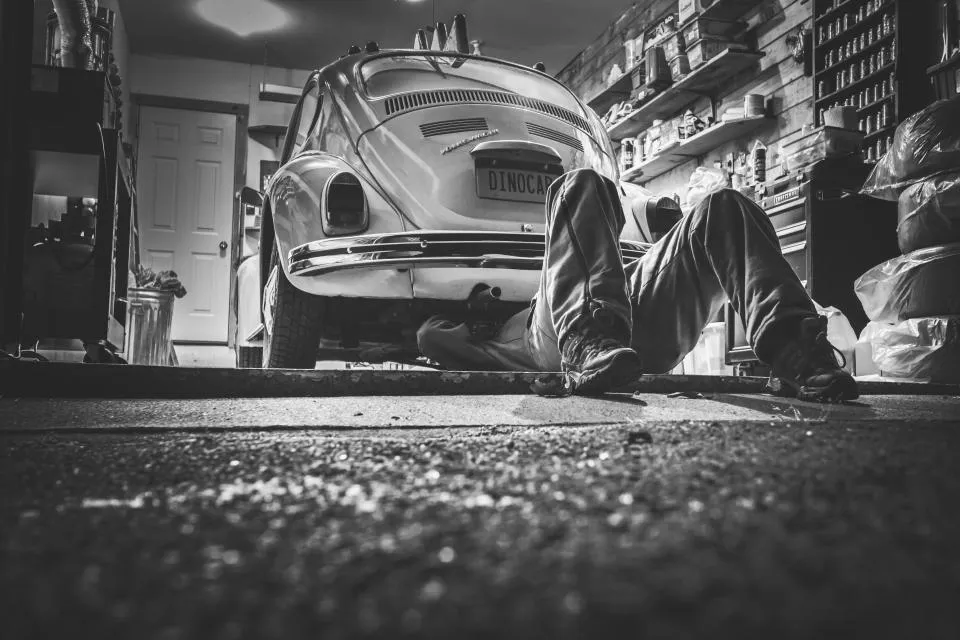 Photo: Ryan McGuire — CC CC0 (stocksnap)
This is the highest return on time of anything here:
- Tyre pressure, including the spare — see the table above for what it is worth. Check cold, before driving.
- Engine oil level — dipstick, engine cold, car level. Oil that keeps dropping means a leak or consumption.
- Coolant level in the expansion tank — read the side tank; never open a hot radiator cap.
- All lights working — head, tail, brake, indicators. Have someone watch while you press the brake.
- Tread and damage — uneven wear means alignment or pressure problems, and look for bulges or cuts in the sidewall.
⚠️ Point 5 prevents the most accidents. A bulge in the sidewall means the internal structure has already failed and it can let go at speed or on a long run. That needs replacing immediately, not at the next service.
What proper maintenance actually saves
Maintenance does not make a car "better" — it stops you paying a large bill, which is a different thing:
- Skipping oil changes → deposits build up, cooling suffers, and the end of that road is engine damage costing tens of thousands to six figures.
- Running brake pads to nothing → scored discs, so a pad job becomes a pad-and-disc job.
- Not changing brake fluid → moisture lowers the boiling point, and the brakes fade on a descent or under repeated use. That is safety, not just money.
- Not rotating tyres → uneven wear means replacing them early, throwing away tyre life.
- Leaving tyres soft → 575 baht a year as above, plus faster wear.
Annual car costs that are not repairs
Planning the year's costs avoids sudden scrambles. These arrive every year regardless:
| Item | Frequency | Notes |
|---|---|---|
| Compulsory motor insurance (Por Ror Bor) | Annual | Required before renewing road tax |
| Annual road tax | Annual | Based on engine size and vehicle age; older cars pay less |
| Voluntary insurance | Annual | Class 1/2+/3+ as chosen — see choosing class 1 cover |
| Roadworthiness test | Cars over 7 years old | Must pass before renewing road tax |
| Scheduled servicing | 1–3 times a year | Depending on distance driven |
⚠️ Compulsory insurance is not cover for your car. Many people assume having it means being insured. It covers injury to people up to limited amounts, and repairs no vehicle at all — neither yours nor the other party's.
Driving habits that cut fuel with no spending
Maintenance is half the story; how you drive is the other half, and it costs nothing:
- Accelerate and brake gently. Hard acceleration and sudden braking are the biggest fuel cost in city driving.
- Hold a steady speed. On highways, cruise control genuinely helps.
- Do not carry heavy items you do not need. Weight in the boot costs fuel every kilometre.
- Take the roof rack off when not in use — it adds meaningful drag at speed.
- Do not idle for long periods. Idling uses fuel and covers no distance.
- Plan around congestion, which is the worst possible condition for consumption.
See our fuel-saving driving article, and if you are weighing up whether an electric car is cheaper, our EV vs petrol comparison.
Common mistakes
Changing oil more often than needed. If the manual says 10,000 km and you are not in severe service, changing at 5,000 doubles the cost for nothing.
Watching tread and ignoring age. Tyres carry a DOT week/year code on the sidewall. Past five or six years, replace regardless of tread.
Inflating to the number on the tyre. That is the tyre's maximum, not the car's specification, which is on the door jamb.
Checking pressure when tyres are hot. A tyre just driven on reads 3–5 psi higher, so you end up under-inflating.
Ignoring the cabin filter. In a country with a PM2.5 problem, the cabin filter is what cleans the air the occupants breathe. See provincial dust levels on our PM2.5 page.
Assuming a new car needs nothing. New cars need scheduled oil changes too, and skipping intervals during the warranty period can affect the warranty itself.
Summary
- Check tyre pressure monthly. Free, five minutes, and worth about 575 baht a year at 6 psi low.
- Open your manual and see whether you meet its severe-service definition; use that schedule.
- Match the viscosity grade, which matters more than brand or oil type.
- Remember the word "or" — several items age out even when the car sits.
- Do the five monthly checks. The best return on time in car ownership.
Sources
- U.S. Department of Energy — fueleconomy.gov: maintenance and fuel economy
- Today's fuel prices — tetono.com (used to value the fuel wasted)
- KTC — engine oil change prices and which type is worth it
- Sanook Auto — dealer service centre or independent garage?
Intervals in the table are middle-of-the-road figures for an ordinary sedan; your own manual always outranks them, particularly under warranty. Fuel-cost figures use the gasohol 95 price as of 15 September 2569, at 1,500 km a month and 15 km/l, so they are estimates for comparison.
Frequently asked questions
- How often should I change the engine oil?
- Always follow the owner's manual. Broadly: mineral oil around 5,000 km, semi-synthetic 7,000–10,000 km, fully synthetic 10,000–15,000 km. If you drive in severe conditions — long periods in traffic, dusty roads, heavy loads — the interval should be shorter.
- I hardly drive. Do I still need oil changes?
- Yes. Engine oil degrades with time whether or not the car moves, through moisture and oxidation. Change it at least once a year even if the distance interval has not been reached.
- How much does low tyre pressure cost in fuel?
- Measurably. The US Department of Energy puts it at roughly 0.2% worse fuel economy for every 1 psi below spec, averaged across the tyres. At 6 psi low — common — that is about 1.2% more fuel, or roughly 575 baht a year at 1,500 km a month.
- The service centre says change oil every 5,000 km but the manual says 10,000. Which is right?
- The manual, unless you meet the severe-service conditions it defines itself. The manual is the document the manufacturer warrants against. If a centre recommends much shorter, ask which condition in the manual they are applying.
- Does using the wrong oil viscosity matter?
- It affects cold-start lubrication, hot-running protection and fuel consumption. Modern engines are designed around a specific viscosity, and thicker oil does not mean better protection.
- How long does a car battery last?
- Typically 2–4 years in Thailand's heat, shorter than in cold climates — heat ages batteries faster than cold. The warning signs are slower cranking in the morning and headlights dimming at idle.
Related articles

Car Tyre Guide 2026: Specs, Sizes, DOT Dates and When to Replace
Car tyre guide: read sidewall specs, pick the right size, check the DOT date, tread and pressure, and see 2026 tyre prices in baht.

Class 1 car insurance in Thailand 2026: a small claim can cost more than not claiming
What class 1 covers against 2+ and 3+, and the arithmetic showing whether the no-claim discount you lose on one claim costs more than the repair you claimed for.

Chanthaburi Travel Guide 2026: Riverside, Phliu Falls, Khao Khitchakut
Chanthaburi travel guide 2026: the cathedral, Chanthaboon riverside, Namtok Phliu and Khao Khitchakut with fees, hours, best season and a 3-day plan.