EV vs petrol in Thailand 2026: costed on today's real prices

"Is an EV cheaper than petrol?" has a short answer — always — but that is not a useful question. The useful question is by how much, and the answer varies by a factor of two for the same car.
Because the deciding variable is not the model. It is where you charge.
This article works from real prices: pump prices effective 15 September 2569, and the current electricity tariff — not round numbers.
What a petrol car costs per kilometre
Prices are Bangkok retail, effective 15 September 2569 (the latest are on our fuel price page, updated daily).
| Fuel | Price/litre | 12 km/l | 15 km/l | 18 km/l | 20 km/l |
|---|---|---|---|---|---|
| Gasohol 95 | 39.94 | 3.33 | 2.66 | 2.22 | 2.00 |
| Gasohol 91 | 39.57 | 3.30 | 2.64 | 2.20 | 1.98 |
| Gasohol E20 | 34.94 | 2.91 | 2.33 | 1.94 | 1.75 |
| Diesel | 40.69 | 3.39 | 2.71 | 2.26 | 2.03 |
(baht per kilometre)
An ordinary Thai sedan managing around 15 km/l on gasohol 95 therefore costs about 2.66 baht per kilometre.
What an EV costs per kilometre — entirely down to where you charge
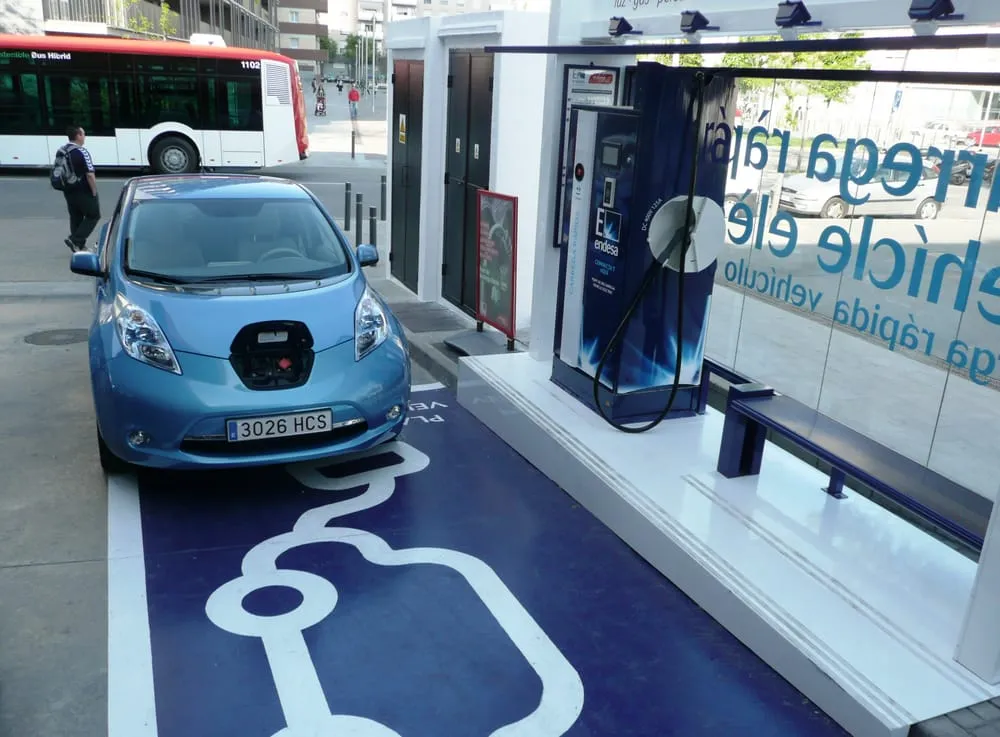 Photo: RudolfSimon — CC BY (wikimedia)
This is where most articles go wrong: they take "home electricity, 4 baht" and multiply. Real charging costs vary by almost four times between the cheapest and dearest options.
| Where you charge | Baht/unit | 5 km/kWh | 6 km/kWh | 7 km/kWh |
|---|---|---|---|---|
| Home, TOU meter, off-peak | ~2.64 | 0.53 | 0.44 | 0.38 |
| Home, standard meter, 201–400 tier | 4.62 | 0.92 | 0.77 | 0.66 |
| Home, standard meter, 401+ tier | 4.84 | 0.97 | 0.81 | 0.69 |
| Public DC station, typical | ~7.90 | 1.58 | 1.32 | 1.13 |
| Public DC station, premium | ~9.70 | 1.94 | 1.62 | 1.39 |
(baht per kilometre; most EVs in Thailand manage roughly 5–7 km per unit)
⚠️ Note that home electricity is not one number either, because Thai tariffs are tiered. Adding 250 units a month for the car can push your household from the 201–400 tier into 401+ for the whole bill, not just the charging portion — see our electricity saving article for how to find your own marginal rate.
In real money: driving 1,500 km a month
A petrol car at 15 km/l on gasohol 95, against an EV managing 6 km per unit:
| Per month | Per year | Saved vs petrol | |
|---|---|---|---|
| Petrol (G95) | 3,994 baht | 47,928 baht | — |
| EV, home TOU off-peak | 659 baht | 7,911 baht | 40,017 baht/yr (83%) |
| EV, home 201–400 tier | 1,155 baht | 13,860 baht | 34,068 baht/yr (71%) |
| EV, home 401+ tier | 1,210 baht | 14,520 baht | 33,408 baht/yr (70%) |
| EV, public DC typical | 1,975 baht | 23,700 baht | 24,228 baht/yr (51%) |
| EV, public DC premium | 2,425 baht | 29,100 baht | 18,828 baht/yr (39%) |
The number to remember: the saving runs from 18,828 to 40,017 baht a year — more than twice the range, for the same car over the same distance.
The only thing that changed is where it charges. Which means the first question before buying an EV is not "which model" but "where do I park, and can I plug in?"
Is a TOU meter worth it?
A TOU (Time of Use) meter charges differently by time of day. Off-peak — covering nights and holidays — is much cheaper, with figures reported as low as about 2.64 baht a unit, which is why the top row of that table is so low.
But TOU has trade-offs worth understanding:
- On-peak is more expensive than a standard meter, so a household that uses a lot of electricity during the day — someone home, air conditioning running — can lose more than the car charging saves.
- You have to apply to the utility to change the meter, with an installation cost.
- It suits households that go out to work and charge overnight, which is exactly the pattern TOU rewards.
⚠️ Homes that already have rooftop solar need to think this through carefully, because solar generates during the day — which is on-peak. The two can work against each other or together depending on your usage pattern.
Maintenance: where an EV is cheaper, and where it is not
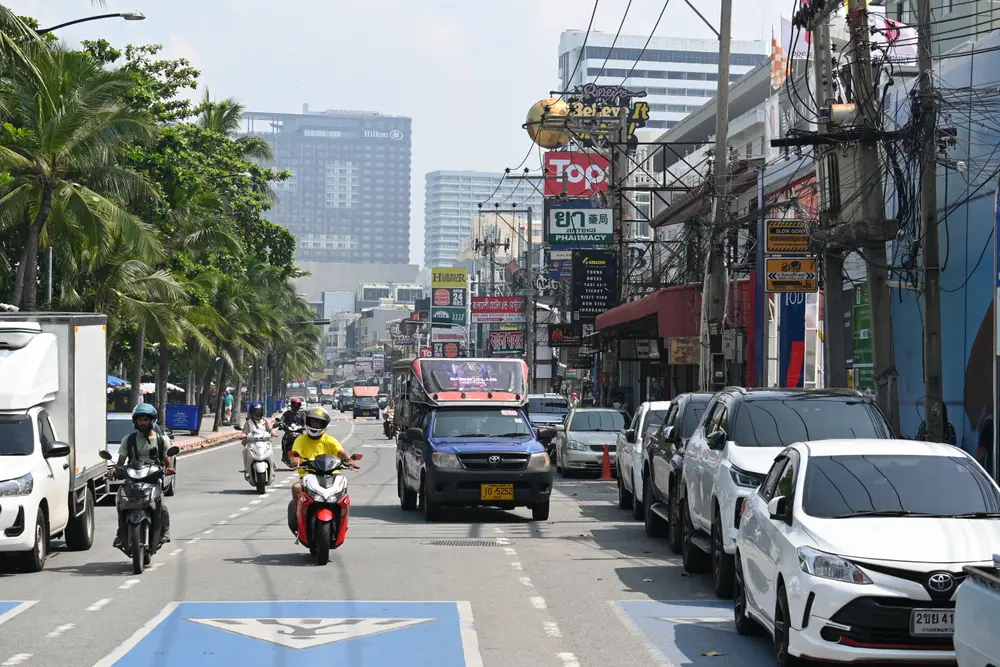 Photo: PattayaPatrol — CC BY-SA (wikimedia)
| Item | Petrol | EV |
|---|---|---|
| Engine oil and oil filter | Every 5,000–15,000 km | None |
| Spark plugs, belts, engine air filter | Replaced on schedule | None |
| Exhaust, radiator, clutch, gearbox | Present, needs servicing | Absent or far simpler |
| Brake pads | Normal wear | Wear more slowly, thanks to regenerative braking |
| Tyres | Normal | Wear faster — heavier car, more torque |
| Traction battery | None | Present, and the most expensive component |
| AC gas, brake fluid, bulbs, wipers | Same | Same |
So an EV removes almost all the engine-side costs, which is the largest block of petrol-car maintenance — but not everything, and it adds one large risk item in the battery.
⚠️ Tyres are the cost people forget. An EV is heavier than the equivalent petrol car because of the battery, and delivers full torque from a standstill, so tyres wear faster. See our tyre guide, and the full service schedule in our car maintenance article.
Read the battery warranty properly
 Photo: PattayaPatrol — CC BY-SA (wikimedia)
Most makers warrant the battery for around 8 years or a set distance, whichever comes first. But the number that matters more than "8 years" is the minimum retained capacity guaranteed.
Battery warranties usually read something like "guaranteed not to fall below 70% capacity within 8 years", which means:
- If the battery degrades to 75% in year six — that is not a valid claim, even though the range loss is noticeable.
- Degradation is gradual, not sudden failure.
- The figure varies by brand, and it is a better question to ask before buying than maximum range.
EVs cost more up front — how long to recover it
A fuel saving of thirty-odd thousand baht a year sounds large, but EVs usually start at a higher price than an equivalent petrol car. The real question is how many years the price premium takes to come back.
These are the years for the fuel saving to cover the price difference, at 1,500 km a month:
| Where you charge | EV costs 100,000 more | 150,000 | 200,000 | 250,000 | 300,000 |
|---|---|---|---|---|---|
| Home TOU (saves 40,017/yr) | 2.5 yrs | 3.7 yrs | 5.0 yrs | 6.2 yrs | 7.5 yrs |
| Home standard (saves 34,068/yr) | 2.9 yrs | 4.4 yrs | 5.9 yrs | 7.3 yrs | 8.8 yrs |
| Public DC (saves 24,228/yr) | 4.1 yrs | 6.2 yrs | 8.3 yrs | 10.3 yrs | 12.4 yrs |
This makes the picture much clearer. Someone who can charge at home and is paying up to 200,000 baht more recovers it in five to six years, which is within how long Thais actually keep cars. Someone who cannot charge at home and is paying 200,000 more needs to keep the car past eight years — longer than many people plan for.
⚠️ This counts fuel only. It excludes the maintenance saving (which shortens it) and the wall charger installation and battery risk (which lengthen it). Drive more than 1,500 km a month and every cell shortens proportionally.
The time cost of refuelling
A cost that appears in no table but is felt every week:
| Method | Time taken | Nature |
|---|---|---|
| Filling with fuel | ~5 minutes | Requires a detour, but quick |
| Home AC charging overnight | 6–10 hours | No waiting — you plug in and sleep |
| Public DC charging | ~30–40 minutes (10–80%) | You wait at the station |
This is where home charging wins in a way the numbers do not show. Someone charging at home does not "lose 8 hours" — they lose about 30 seconds a day plugging in and unplugging, and wake up to a full car. That is faster than stopping at a petrol station.
Conversely, relying on DC stations means 30–40 minutes per session plus planning where to charge — a burden petrol cars do not have, and the reason "can I charge at home?" outweighs everything else here.
What the numbers do not capture
Four things that carry real weight and cannot be calculated:
Resale value is still an open question. Thailand's used-EV market is very new, and resale depends on two hard-to-predict things: the battery's condition at sale, and how much cheaper newer models have become meanwhile. Petrol cars have decades of resale data; EVs do not. This is a risk to be aware of, not a number to guess at.
The driving experience genuinely differs. EVs are quiet and deliver full torque the instant you press the pedal, which in Bangkok traffic is an advantage you feel daily. People who switch often say that, rather than the money, is why they would not go back.
Range anxiety fades. New EV drivers watch the percentage constantly, but once they learn their own pattern most find charging a few times a week at home is plenty. What remains is genuine concern about long trips outside familiar routes.
Independent repair is still limited. Any garage in the country can work on a petrol car; EVs still depend largely on dealer service centres, especially for high-voltage systems — a real constraint if you live far from a city.
Where people get the sums wrong
Using home electricity rates while planning to charge at stations. The number one error, and it is almost a factor of two.
Forgetting the tiered tariff. Adding 250 units a month can push the whole bill into a higher tier, making the rest of the household's electricity dearer too.
Comparing fuel only, not purchase price. A 34,000 baht annual saving looks big, but if the EV costs 200,000 more, break-even is around six years. See EVs under one million baht for real prices.
Assuming maintenance is zero. It is not zero, just lower — and tyres can be dearer.
Not budgeting for the wall charger, a one-off but not small cost, and some homes need a larger supply too.
Summary
- Answer the charging question first. Charging at home is worth 34,000–40,000 baht a year; relying on stations is worth 19,000–24,000.
- Use your own real prices, not advertising round numbers — both your household's marginal rate and the stations you would actually use.
- If you can charge at home and drive a lot, the EV wins clearly, on fuel and on engine-side maintenance.
- If you cannot charge at home, think it through carefully. Still cheaper, but not by the advertised figure, and you trade time for it.
- Read the battery warranty's retained-capacity clause, not just the number of years.
Sources
- Today's fuel prices — tetono.com (data from PTT OR and Bangchak, effective 15 Sep 2569)
- PEA VOLTA — latest 2569 EV charging rates
- CAP Solar — EV station charging cost compared with home charging
- MEA — current Ft announcement
- CAP Solar — Thai electricity tariff guide, 2569
Fuel prices are Bangkok retail effective 15 September 2569 and change weekly. Electricity uses the marginal rates for the September–December 2569 period. Station charging prices are ranges that vary by operator and time of day. Every car's consumption differs with driving style and traffic, so all figures are estimates for comparing options, not what your own car will use.
Frequently asked questions
- Is an EV really cheaper to run than petrol?
- Always, but by very different margins. At September 2026 fuel and electricity prices, a petrol car at 15 km/l costs about 2.66 baht/km, while an EV ranges from 0.44 baht/km (home charging on a TOU meter) to 1.62 baht/km (an expensive DC station). The difference comes from where you charge, not from the car.
- Is it still worth it if I cannot charge at home?
- You still save roughly 39–51% against petrol, but not the 70–80% usually advertised. If you live in a condo or have no private parking, calculate from DC station prices (about 5.90–9.70 baht a unit), not from home electricity rates.
- What is a TOU meter and is it worth it for an EV?
- TOU bills electricity differently by time of day. Off-peak — nights and holidays — is much cheaper, with figures as low as about 2.64 baht a unit, which suits anyone charging overnight. But on-peak is more expensive than a standard meter, so it only pays for households that use little electricity during the day.
- Is EV maintenance really cheaper?
- Cheaper on everything engine-related: no engine oil, oil filter, spark plugs, belts or exhaust system. But tyres, brake fluid, air-conditioning and inspections are the same — and EV tyres tend to wear faster because the car is heavier and delivers full torque instantly.
- How expensive is replacing the battery?
- Expensive, but most makers warrant the battery for around 8 years or a set distance, and degradation is gradual rather than sudden. The number worth asking about is the minimum retained capacity the warranty guarantees, which matters more than the number of years.
- I drive long distances often — what should I pick?
- If you drive long distances regularly and would depend on public charging, the gap narrows to roughly 39–51% and you trade it for waiting time. A petrol or hybrid car remains more flexible. If you drive far only occasionally and charge at home the rest of the time, an EV still works out well.
Related articles
10 Best Electric Cars Under 1 Million Baht in Thailand (2026)
10 best-value EVs under 1 million baht in Thailand for 2026 — price, real-world range, battery specs, and home-charging cost, plus how to pick by budget.
How to Save Fuel in Thailand 2026: Real Tips as Gas Prices Rise
Thailand fuel prices rose Sep 2026. Proven ways to cut fuel costs, a real cost-impact table, and whether switching to an EV finally pays off.

10 Best Electric Scooters in Thailand 2026: Prices, Range & Real Savings
The 10 best electric scooters in Thailand 2026, compared by price, range, charging time and service network — plus real savings vs petrol.