Cutting your Thai electricity bill 2026: what each fix is really worth

Most articles about saving electricity tell you to turn off unused lights and unplug things, and stop there. The problem is that they never say what each fix is worth in baht, so you have no idea where to start.
This one does the arithmetic on all of it, using Thailand's actual 2026 tariff — and the first finding already contradicts what every other page says: electricity does not cost 4 baht a unit for everybody, and that difference changes how much any saving measure is worth to you.
What a unit really costs — there is no single number
Household electricity is billed in tiers, like income tax: the more you use, the more the last units cost. A typical household using more than 150 units a month falls under type 1.2, at these rates (effective from the September 2569 billing cycle):
| Consumption band | Energy charge | + Ft | + 7% VAT = what you actually pay |
|---|---|---|---|
| First 200 units | 3.0000 | 0.1623 | 3.38 baht |
| Units 201–400 | 4.1584 | 0.1623 | 4.62 baht |
| Units 401 and above | 4.3583 | 0.1623 | 4.84 baht |
Plus a monthly service charge of 24.62 baht for type 1.2. Households under 150 units a month fall under type 1.1, which starts much lower at 2.3488 baht with an 8.19 baht service charge.
Ft is the fuel adjustment charge, reset every four months. For September to December 2569 it is 0.1623 baht per unit.
⚠️ The number to reason with is the marginal rate, not the average. If you save one unit, the unit that disappears is the last one on the bill — always the most expensive. A household using 450 units a month therefore saves 4.84 baht per unit, not the bill's average, which might look like only 4.1.
What saving one unit a day is worth per year
Turn that into a number you can decide with. If you find a way to use one unit less per day, all year, what comes back depends entirely on which tier you sit in:
| Your household is in | Saving 1 unit/day is worth |
|---|---|
| The first 200 units (light user) | 1,235 baht a year |
| 201–400 units (typical) | 1,687 baht a year |
| 401 units and above (heavy user) | 1,766 baht a year |
That is a 43% spread for exactly the same measure. It means a household with an already-high bill recovers the cost of everything — a new fan, an inverter AC, roof insulation, solar — significantly faster than one with a low bill. And conversely, if your bill sits at 150–200 units a month, big-ticket energy-saving purchases are usually less worthwhile than the advertising suggests, because advertising always assumes the top rate.
Where your bill sits, and why a heavier month costs more than expected
This is the full bill (energy + Ft + service charge + VAT) for a type 1.2 household. Use it to locate yourself:
| Monthly usage | Approximate total bill | Average per unit |
|---|---|---|
| 300 units | 1,165 baht | 3.88 baht |
| 380 units | 1,535 baht | 4.04 baht |
| 400 units | 1,628 baht | 4.07 baht |
| 450 units | 1,870 baht | 4.15 baht |
| 500 units | 2,111 baht | 4.22 baht |
Notice the average per unit climbing even though no rate changed. That is the tiers at work, and it explains the most common question people have about their bill.
Example: 380 units last month, 420 this month.
- Usage up by 40 units, or 10.5%
- But the bill goes from 1,535 to 1,724 baht — up 189 baht
- So the extra units cost 4.73 baht each, against the old bill's average of 4.04
- The marginal units cost 17% more than the bill's own average
This is why "leaving the AC on a bit longer" raises the bill more than it feels like it should. It is also why saving pays better than you would guess — the units you cut are always the dearest on the bill.
What each appliance costs per month
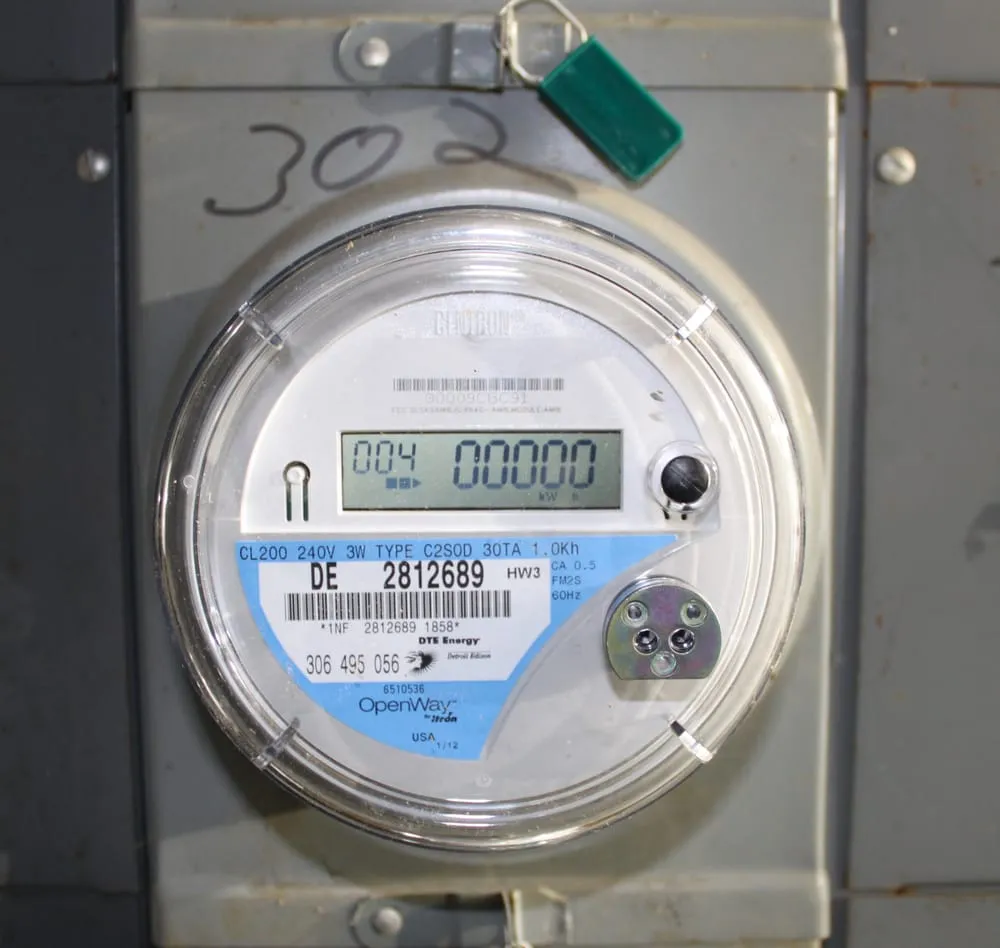 Photo: Dinkun Chen — CC BY-SA 4.0 (Wikimedia Commons)
The formula is one line:
Units per day = watts × hours running ÷ 1,000
This table uses appliance wattage ranges published by Kasetsart University, costed at the 4.62 baht marginal rate (the 201–400 tier).
| Appliance | Watts | Hours/day | Units/month | Baht/month |
|---|---|---|---|---|
| Air conditioner | 1,200–2,300 | 8 | 288–552 | 1,331–2,552 |
| Refrigerator, 7–10 cu ft | 70–145 | 24 (running ~40%) | 20–42 | 93–193 |
| Water heater | 900–4,000 | 0.5 | 14–60 | 62–277 |
| Iron | 750–2,000 | 0.5 | 11–30 | 52–139 |
| Rice cooker | 450–800 | 1 | 14–24 | 62–111 |
| Television | 80–180 | 5 | 12–27 | 55–125 |
| Washing machine | 400–1,400 | 0.5 | 6–21 | 28–97 |
| Floor fan | 25–75 | 8 | 6–18 | 28–83 |
| Hair dryer | 400–1,000 | 0.25 | 3–8 | 14–35 |
The table answers "where do I start" immediately: the air conditioner alone costs more than everything else combined. Unplugging the TV and the hair dryer for a whole month returns less than 100 baht; changing how you run the AC returns thousands.
⚠️ The AC figure is an upper bound, not what will actually happen. It multiplies the nameplate wattage by the full running time. An inverter unit throttles its compressor once the room reaches the set temperature, so it draws considerably less in practice. To get your own number, read the watts on the label or in the manual and put it into the formula above.
Air conditioning: deal with this before anything else
Now that the money is located, here is what each measure is actually worth.
Running it one hour less per day
The measure that costs nothing at all, and pays best for the effort. For a 1,200 W unit:
| Your tier | Saved per month | Saved per year |
|---|---|---|
| 201–400 units | 166 baht | 2,025 baht |
| 401 units and above | 174 baht | 2,119 baht |
Setting the timer to switch off an hour before you wake is the version of this you do once and benefit from every day without having to remember.
26–27°C with a fan, and a service every six months
The Metropolitan Electricity Authority recommends both, and puts each at roughly 10% of the air conditioner's electricity cost. Filters should be rinsed yourself once or twice a month.
| Your AC's monthly cost | Saving 10% is worth |
|---|---|
| 1,000 baht | 100 baht/month = 1,200 baht/year |
| 2,000 baht | 200 baht/month = 2,400 baht/year |
| 3,000 baht | 300 baht/month = 3,600 baht/year |
The fan helps not by cooling the room but by moving air across your skin, which carries heat away and makes the room feel about two degrees cooler. You can therefore set the thermostat higher for the same comfort — and a fan draws 25–75 watts against the AC's 1,200 and up.
⚠️ The figure "every 1°C lower costs 5–10% more electricity", which circulates widely online, is one we could not trace to a reliable source, so it is not used here. What MEA actually publishes is the 26–27°C-with-a-fan advice and the ~10% figures above.
If you are replacing the unit
An air conditioner over ten years old and not an inverter is usually where replacement genuinely pays, especially if your household sits in the 401+ tier where each unit saved is worth 4.84 baht. For sizing, SEER and which models are actually efficient, see our air conditioner buying guide.
Refrigerator, water heater and the rest
 Photo: PattayaPatrol — CC BY-SA (wikimedia)
The refrigerator (93–193 baht/month) is the only appliance running 24 hours, so it is worth maintaining. Leave 10–15 cm behind it so it can shed heat, do not pack it so full that cold air cannot circulate, and check the door seal — if a sheet of paper slides out easily, the seal has gone and cold is leaking continuously. For a replacement, see our refrigerator buying guide.
The water heater (62–277 baht/month) draws enormous power per minute because it heats on demand. Cutting two or three minutes off a shower does more than anything you can adjust on the unit, and sizing the tank to actual use matters more than people expect — see our water heater guide.
The iron (52–139 baht/month) — do everything in one session, since most of the energy goes into heating it up from cold each time.
The washing machine (28–97 baht/month) — on machines with a heater, most of the energy goes into heating water rather than turning the drum. Cold washes save a lot without hurting results for everyday clothes.
The small things that add up
 Photo: Jules Verne Times Two — CC BY-SA 4.0 (Wikimedia Commons)
Switch to LED. An incandescent bulb like the one above turns most of its energy into heat rather than light. An LED gives the same brightness on about a fifth of the power. Ten fittings of 60 W running five hours a day use 90 units a month, roughly 416 baht. The same ten as 10 W LEDs use 15 units, about 69 baht — a saving of roughly 347 baht a month, from bulbs that now cost tens of baht each. It pays for itself in the first month.
Standby power. The TV, the set-top box, chargers left plugged in, the microwave showing a clock — together these usually come to tens or low hundreds of baht a month. Worth doing, but not before the air conditioning, because the difference is dozens of times larger. The practical version is a switched power strip for a group of devices that can all go off together, rather than unplugging things one at a time every night.
Things that sound efficient but do not pay
Switching the AC off when you leave the room briefly. For anything under 15–20 minutes, switching off and back on makes the compressor pull the whole room's temperature down again, which uses more than simply holding it.
Unplugging everything every night. See the standby figures above — tens of baht a month, against daily inconvenience and sockets that wear out faster from repeated use. Pick the groups that are worth it.
"Energy saving devices" you plug in. Gadgets claiming to cut a household bill by 30–50% just by being plugged in have no physical mechanism behind them for residential supply. The utility's meter measures real energy (kWh), not the quantity these devices claim to correct.
Replacing an air conditioner that is still fine. If the existing unit is an inverter under five to seven years old and gets serviced, the difference rarely repays a new unit plus installation in any reasonable time.
If you are going to spend money, spend it here
Ranked by how fast it pays back, for a typical household:
- LED bulbs — pays back within the first month.
- Servicing the AC — a few hundred baht, worth 1,200–3,600 baht a year.
- Another fan, so you can set the AC higher — hundreds to about a thousand baht.
- Roof insulation or window film — reduces the AC's load at source.
- Replacing an old AC with an inverter — worth it once the old unit is past ten years.
- Rooftop solar — a six-figure outlay, but for 2569 there is a tax deduction of up to 200,000 baht, which moves the payback point considerably. Work it out first in our rooftop solar article, and check the deduction conditions in the personal income tax guide.
⚠️ Every item above pays back faster if your household is in the 401+ tier and slower if you are in the first — go back to the "one unit a day" table before committing serious money.
Summary
- Look at your bill first and see how many units a month you use, because that tells you whether your marginal unit is 3.38, 4.62 or 4.84 baht — and that is the multiplier on everything else you do.
- Deal with the air conditioner first, always: it costs more than everything else combined, and one hour less a day is worth about 2,000 baht a year for free.
- Service it, set 26–27°C, run a fan — roughly 10% each, per MEA.
- Switch to LED — the fastest payback of any measure here.
- Collect the standby savings afterwards. They are real, but dozens of times smaller than the four points above.
Sources
- Metropolitan Electricity Authority (MEA) — current Ft announcement
- Provincial Electricity Authority (PEA) — Ft
- CAP Solar — Thai electricity tariff guide and per-unit rates, 2569
- Kasetsart University — typical wattage of household appliances
- MGR Online — MEA's advice: 26°C, and service the AC every six months
- Energy Research and Development Institute, Chiang Mai University — calculating your own electricity cost
Per-unit rates and Ft are as of September 2026 (the September–December 2569 period). Ft is reset every four months, so check the current rate with your utility before calculating. The per-appliance costs here multiply reference wattage ranges by the assumed running hours shown in the table, so they are estimates for ranking priorities, not what your own appliance will draw.
Frequently asked questions
- How much does a unit of electricity cost in Thailand in 2026?
- There is no single figure. Households using more than 150 units a month (type 1.2) are billed in tiers: 3.0000 baht for the first 200 units, 4.1584 for units 201–400 and 4.3583 above 400. Adding the 0.1623 baht Ft and 7% VAT, the real marginal cost is about 3.38 to 4.84 baht depending on which tier you are in.
- What temperature should I set the air conditioner to?
- The Metropolitan Electricity Authority recommends 26–27°C with a fan running, which saves around 10% and feels cooler than 23–24°C without a fan, because moving air carries heat away from your skin.
- Does cleaning the air conditioner really save electricity?
- Yes. MEA recommends a service every six months, worth roughly 10% of the AC's electricity cost, because accumulated dust restricts airflow across the coil and makes the compressor work harder. Filters should be rinsed once or twice a month.
- Is unplugging appliances worth the effort?
- It helps, but it is worth tens to low hundreds of baht a month, not thousands. If you only do one thing, managing the air conditioning is worth dozens of times more. Do the AC first, then collect the small stuff.
- How do I calculate an appliance's running cost myself?
- Units per day = watts × hours used ÷ 1,000. Multiply by your household's marginal rate. A 1,200 W air conditioner running 8 hours is 9.6 units a day; at 4.62 baht that is about 44 baht a day, or 1,331 baht a month.
- Why is this month's bill higher when I used about the same?
- Usually the tiers. If last month was 380 units and this month 420, the 20 units above 400 are charged at the top rate, so the bill rises more than the extra usage suggests. The other cause is Ft, which is reset every four months.
Related articles

Top 10 Electric Heaters for Cool Season 2026 — Thailand Buying Guide
Compare 10 electric heaters for 2026, every budget ฿277-4,413, with heater types explained, real electricity cost under Thailand's new tariff, and safety tips.

How to Choose a Mattress in 2026: Spring, Pocket Spring, Latex & Memory Foam
2026 mattress buying guide — spring, pocket spring, latex and memory foam compared, firmness by sleeping position, Thai bed sizes, and prices.

How to choose a microwave 2026: solo vs grill vs convection, capacity & wattage
The complete 2026 microwave buying guide — how solo, grill and convection differ, how many litres and watts you need, running costs, and prices in Thailand.