How to Choose a Water Heater in 2026: Safe, Energy-Efficient Guide

A good bathroom starts with hot water that's safe and doesn't blow up your electricity bill — but a water heater is one of the highest "electric shock" risk appliances in any home, because it brings high-power electricity into direct contact with water. Choosing wrong isn't just wasteful; it can be life-threatening. This guide covers everything: the types (single-point / multi-point / heat pump), how many watts to match your electric meter, the safety systems you must have (ELCB anti-shock + grounding), and the real monthly running cost — so you buy once and use it safely for years. (Prices as of June 2026.)
Water warmer vs water heater — what's the difference?
In Thailand people lump these together, but they actually differ by temperature and the number of outlets served:
- Single-point water warmer: heats water to about 35–45°C for one showerhead. It's the "instant flow-through" type — by far the most popular in Thailand because it's cheap, easy to install, and there's no wait for hot water.
- Multi-point water heater: feeds several outlets at once — showerhead, basin, and bathtub — through hot-water pipes and mixing valves. Best for homes with multiple bathrooms or several hot-water points in use simultaneously; it needs more power as the number of points grows.
- Storage tank heater: keeps a reserve of hot water, so you wait for warm-up but get steady, consistent heat. It takes up space and loses some energy keeping the tank hot.
- Heat pump: works like an air conditioner in reverse (it pulls heat from the air to warm the water), using about 3–4 times less electricity than an electric element — but the unit is expensive. Best for large homes, resorts, or anywhere with high daily hot-water demand.
Quick rule: condo / rental / one-bathroom home = a single-point warmer is enough · a 2–3 bathroom home used simultaneously = multi-point · heavy daily hot-water use with the budget for it = a heat pump pays off long term.
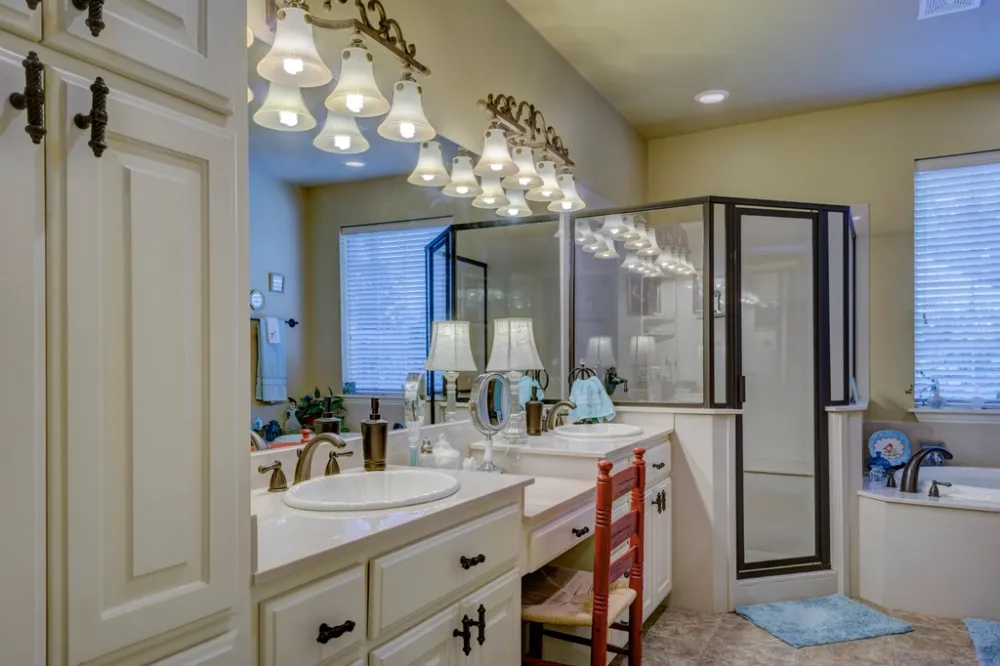 Photo: a bathroom served by a single-point water warmer — CC via Openverse
Wattage — always check your "electric meter" first
The number-one mistake is buying a unit with more wattage than your home's wiring can handle. The result: voltage drops, tripping breakers, or wires hot enough to be a fire risk. The principle is simple: the unit's power must not exceed what your meter and main feed can carry.
| Electric meter size | Recommended unit wattage |
|---|---|
| 5(15) amp | up to ~3,500W |
| 15(45) amp | 4,500–6,000W |
| 30(100) amp | supports multi-point / heat pump |
Beyond the meter, factor in your climate:
- Bangkok and central Thailand: tap water isn't very cold, so 3,500–4,500W is usually enough.
- Northern / cold-season regions: very cold water — choose 6,000W so the water heats instantly without throttling the flow.
Wire size must match the wattage. A quick rule is wattage ÷ 1,320: a 3,500W unit ÷ 1,320 = 2.65, so you need at least 3 mm² wire. A 4,500–6,000W unit typically needs 4–6 mm² wire, and you should run a dedicated circuit with its own breaker for the water heater rather than sharing with other outlets.
The safety systems you "must have" — not optional extras
Because a water heater brings high-power electricity to water, protection matters more than price or looks. Before you buy, confirm all four layers:
- ELCB / ELB (anti-shock breaker): cuts power automatically when current leaks at about 15mA, within 0.01–0.1 seconds. This is the most important defense against electrocution. Press its TEST button monthly to confirm it still trips.
- ELSD / ESD (electronic leakage circuit inside the unit): reacts to small leaks even faster than an ELCB. Good units have both.
- Ground wire: the most overlooked yet most critical piece — if current leaks, the ground carries it to earth instead of through your body. Never use a water heater without grounding. Old houses without a ground must have one added.
- Thermal cut-off and no-run-dry protection: cuts power when water gets too hot or no water flows through the element, preventing the unit from burning out.
Also check for the TIS (มอก.) standard and an IP (water-resistance) rating of at least IP24, IPX4 or IP25 (higher numbers resist water better) for a splash-prone bathroom.
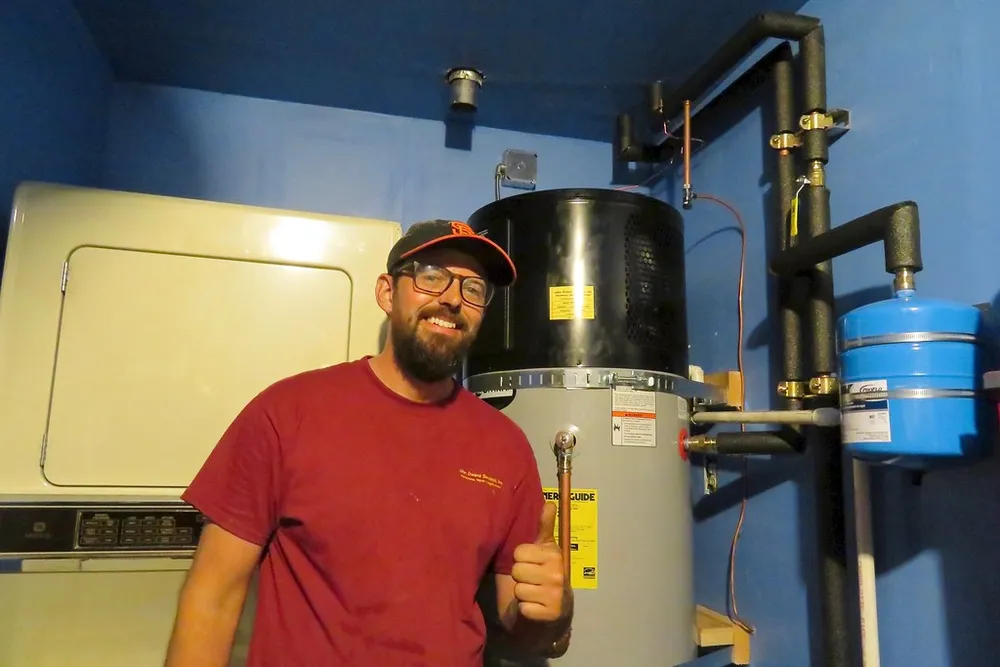 Photo: a water heater being installed by a skilled technician — CC via Openverse
Copper tank vs nylon tank — which to pick?
The part where water flows through and gets heated (the heating chamber/tank) strongly affects lifespan and safety:
- Copper tank: conducts heat well and is durable, but in hard-water areas (with scale) it can build up deposits and needs periodic cleaning.
- Nylon / Grilon (Nylon 66) tank: a quality synthetic that withstands heat up to ~260°C, doesn't rust, and resists scale — but low-grade plastic versions risk leaking.
Choose a brand that clearly states copper or quality nylon, and check the warranty — typically at least 1 year on the element/electronics and at least 5 years on the tank marks a quality unit.
Water heater prices in Thailand, 2026
Single-point units in Thailand are very affordable, from low thousands of baht up to digital-display models. The table below shows popular models and approximate price ranges (data as of June 2026 — prices fluctuate with promotions):
| Model | Power | Tank | Approx. price (THB) | Highlights |
|---|---|---|---|---|
| Haier EI35M1 | 3,500W | copper | 1,580+ | energy rating 5, entry price |
| Clarte' WHM4501 | 4,500W | nylon | 1,730+ | built-in ELCB, 55°C limit |
| SHARP WH-34 | 3,500W | copper | 1,898+ | ELCB, IP25, Flow Switch |
| Electrolux EWE351GX | 3,500W | gallon tank | 1,890+ | 15-stage safety system |
| MEX COCO 450 | 4,500W | copper | 2,449+ | flow-detection sensor |
| Stiebel Eltron AQE 45E | 4,500W | — | ~2,490 | works at low water pressure, TIS |
| Mazuma INTRO S | 4,500W | copper | 2,790+ | linear temperature control |
| Panasonic DH-4NS1TW | 4,500W | copper | 4,990+ | antibacterial showerhead |
| Hitachi HES 45VDS | 4,500W | copper | 8,390+ | LCD digital display, 3 presets |
Heat-pump water heaters are a different segment — units start in the high tens of thousands and run into six figures depending on capacity, but their per-unit running cost is 3–4 times lower than an electric element, so they pay back in homes with heavy daily hot-water use.
If you're buying a pricier system (a heat pump or multi-point setup) and want to spread the cost, run the numbers with our loan / installment calculator to see the monthly payment before you commit.
 Photo: a bathroom that may need hot water at several points — CC via Openverse
Real monthly running cost — and how to cut it
A single-point electric water heater only draws power "while you're using it" — nothing when off. The rough math:
Cost = power (W) × hours ÷ 1,000 × tariff per unit
Take a 4,500W unit, showering 15 minutes a day (0.25 hr):
- 4,500 × 0.25 ÷ 1,000 = 1.125 units/day
- × ~5 THB/unit ≈ 5–6 THB/day, or about 170–180 THB per person per month
A family of four, one shower each per day, runs about 700 THB/month — not as high as an air conditioner, but you can trim it further:
- Don't set it hotter than you need — keep it comfortably warm; hotter means more power.
- Keep showers short — cutting 5 minutes drops this cost by roughly a third.
- Choose an energy rating 5 model with an Eco mode that limits power automatically.
- For homes with heavy daily hot-water use, investing in a heat pump cuts this cost 3–4 times.
To cut your whole home's bill, not just the water heater, read how to save electricity at home 2026, and if you're kitting out a new home, pair it with how to choose an energy-efficient air conditioner — the AC and the water heater are a home's two biggest power draws.
Pros and cons of each type
| Type | Pros | Cons | Best for |
|---|---|---|---|
| Single-point (instant) | cheap, easy install, no standby draw | one outlet only, moderate warmth | condo / rental / one-bathroom home |
| Multi-point | feeds several outlets, hotter | pricier, more power, complex piping | 2–3 bathroom homes, with a tub |
| Storage tank | steady, consistent heat | takes space, standby heat loss | homes wanting a steady hot supply |
| Heat pump | 3–4× more efficient | high unit cost, complex install | large homes / resorts, heavy use |
Common mistakes when buying and installing
From technicians' experience and real user reviews, these are the slip-ups that waste money or endanger you:
- Picking wattage beyond your meter's capacity — causes voltage drops, frequent breaker trips, or hot wiring. Always check your meter size first.
- Installing without a ground wire — the most dangerous of all; with no ground, leaking current goes through a person. Old houses must always have grounding added.
- Using undersized wire or breaker — wire thinner than the load builds up heat and risks fire; run a dedicated circuit.
- Never pressing the ELCB TEST button — the anti-shock system can degrade unnoticed; test it monthly.
- Ignoring water pressure — instant units need a minimum of about 0.1 kg/cm²; if pressure is weak, pick a low-pressure model or add a pump.
- Self-installing to save on labor — anything combining high-power electricity and water should be installed by an electrician or the retailer's fitter, with grounding fully checked. Don't risk it.
- Forgetting to clean/replace the filter — models with an inlet filter need periodic cleaning, or flow weakens and the unit works harder.
Verdict: how to choose safely and smartly
The rule is simple — start with safety, then weigh wattage and price:
- Condo / rental / one-bathroom home: a single-point 3,500–4,500W unit with ELCB + grounding + energy rating 5. A budget of 1,800–3,000 THB buys a solid unit — think SHARP, Clarte', Stiebel Eltron, Mazuma.
- 2–3 bathroom home, simultaneous hot water: consider a multi-point or storage system, and confirm your meter is 15(45) or larger.
- Large home / heavy daily use, with budget: a heat pump pays off long-term thanks to running costs 3–4 times lower.
Whatever you choose, never cut these three: the TIS (มอก.) standard, an ELCB anti-shock system, and a ground wire — because a good water heater is one that lets the whole household shower with peace of mind, not a gamble every time you turn on the water.
Sources
- Baanlaesuan — How to choose a water heater: https://www.baanlaesuan.com/86038/home-maintenance/home-appliance/water-heater-3/
- Stiebel Eltron Thailand — Tips to select an instantaneous water heater: https://www.stiebel-eltron.co.th/th/home/products-solutions/articles/Tips-to-select-instantaneous-water-heater-for-your-home.html
- Shopkub — Top 10 water heaters 2026: https://shopkub.com/best-water-heater/
- ProductNation — 12 water heaters 2026 with prices: https://productnation.co/th/7866/
- OfficeMate — How many watts of water heater is suitable for home use: https://www.ofm.co.th/blog/how-many-watts-of-water-heater-is-suitable-for-home-use/
Frequently asked questions
- How many watts should a water heater be?
- Match it to your electric meter first. A 5(15) meter handles up to about 3,500W; a 15(45) meter supports 4,500–6,000W. In Bangkok and central Thailand 3,500–4,500W is usually enough, but in the cold northern winter go up to 6,000W for instant hot water.
- What's the difference between ELCB and ELSD?
- Both cut power when current leaks (anti-shock). An ELCB is a mechanical breaker that trips at roughly 15mA leakage within 0.01–0.1 seconds — press its TEST button monthly. An ELSD is an electronic circuit inside the unit that reacts faster to small leaks. The best units have both, plus a ground wire.
- Is a 'water warmer' different from a 'water heater'?
- It comes down to temperature and outlets. A single-point warmer heats water to about 35–45°C for one shower. A multi-point heater (or a storage tank or heat pump) gets hotter and can feed several outlets at once — ideal for homes with multiple bathrooms or a bathtub.
- Is a heat pump really more efficient, and is it worth it for an ordinary home?
- A heat pump uses about 3–4 times less electricity than an electric element, but the unit costs tens of thousands to over a hundred thousand baht. It pays off in homes that use a lot of hot water daily or have several bathrooms. For a condo or small family showering at one point, a standard electric water heater is better value.
- Do I really need a ground wire, and what if my old house has none?
- Always. The ground wire is the single most important safety layer for a water heater. If an old house has none, have an electrician run a dedicated ground to an earth rod. Never use a water heater without grounding — if current leaks with no path to earth, it travels through your body instead.
- How much does a water heater add to the electricity bill?
- Roughly: power × hours ÷ 1,000 × tariff. A 4,500W unit used 15 minutes a day (0.25 hr) = 1.125 units/day × ~5 THB ≈ 5–6 THB/day, or about 170–180 THB per person per month.
Related articles

Rooftop solar in 2026: is it worth it & what's the payback?
Is home rooftop solar worth it? Installation cost, monthly savings, payback period, and which homes benefit most.

Buying an air conditioner 2026: how many BTU + saving power
How to choose an air conditioner for your room size, pick the right BTU, compare inverter vs fixed-speed, and judge running cost.

How to Choose a Mattress in 2026: Spring, Pocket Spring, Latex & Memory Foam
2026 mattress buying guide — spring, pocket spring, latex and memory foam compared, firmness by sleeping position, Thai bed sizes, and prices.