10 Best Electric Scooters in Thailand 2026: Prices, Range & Real Savings

If you're thinking about switching from a petrol motorcycle to electric — or looking for a cost-efficient commuter — this guide covers everything: exactly how much you save, what to look for, and the 10 best electric scooters you can actually buy in Thailand right now, with honest specs, prices in THB, and real-world trade-offs.
Why 2026 Is the Right Moment
Thailand's electric scooter market is growing fast, and the options in 2026 are genuinely better than they were just two years ago. Three things make now a good time:
- Government subsidies cut prices: Several Thai brands receive government support, reducing prices by 20–30%. Some models that cost 57,900 THB now sell for 38,640 THB — no special deal needed.
- Thai brands are strong: EM Motor has 120+ service centres nationwide. AJ EV has 5,000+ charging points. The infrastructure is real.
- Petrol is expensive: Thailand's fuel prices remain elevated. A single full charge of an electric scooter costs 5–15 THB versus 150–200 THB to fill a petrol tank.
Real Money: Electric vs Petrol Cost Comparison
The numbers that drive most people's decision to switch:
| Item | Petrol Scooter | Electric Scooter |
|---|---|---|
| Fuel/electricity per km | ~0.90–1.05 THB/km | ~0.08–0.10 THB/km |
| Cost per full tank/charge | 150–200 THB | 5–15 THB |
| Monthly fuel cost (30 km/day) | 800–1,200 THB | 75–150 THB |
| Annual fuel cost | ~11,000–15,000 THB | ~900–1,800 THB |
| Engine oil changes | ~500–800 THB each | None |
| Spark plugs, air filters | ~200–500 THB/year | None |
Bottom line: For a rider doing 30 km per day, switching to electric saves roughly 10,000–14,000 THB/year in fuel alone, plus significantly lower maintenance costs. A 60,000 THB scooter pays back its fuel cost in 4–6 years.
Prices as of June 2026. Fuel and electricity tariffs may change.
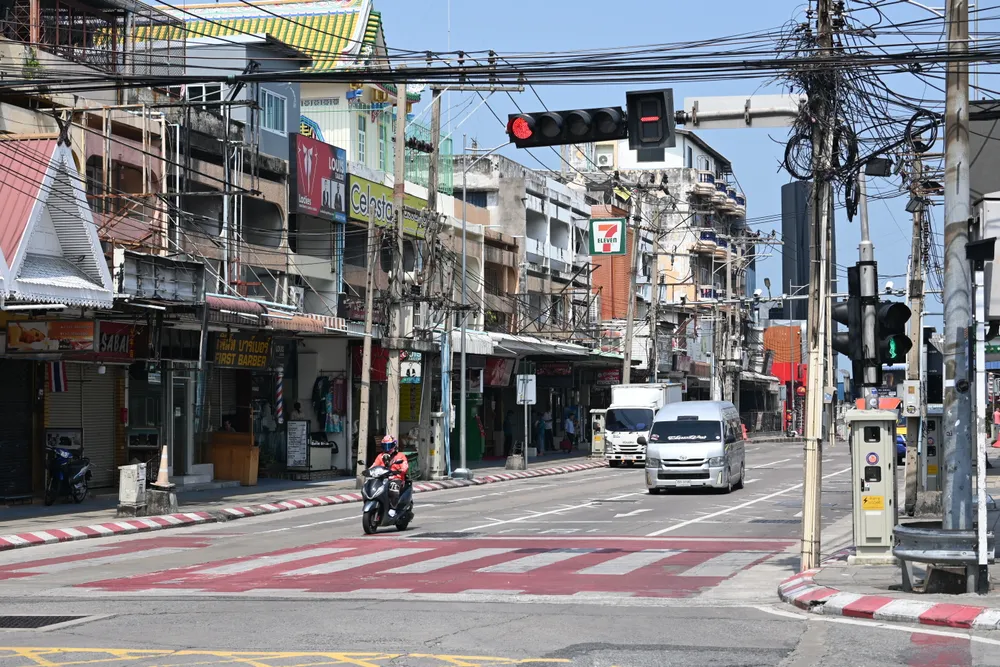 Illustrative: Thai urban street with motorcycles — CC0 via Openverse
What to Check Before You Buy
Before the ranked list, here's what actually matters for Thai riders:
- Real-world range: Manufacturer figures are measured in ideal conditions. Subtract 20–30% for Thai heat, traffic, and higher speeds. A bike claiming 80 km typically delivers 55–65 km in practice.
- Motor power (watts): Under 1,000W = too slow for main roads. 2,000W+ is the minimum for comfortable highway riding.
- Charging time: Cheap models: 6–9 hours. Mid-range: 2–4 hours. Premium: 60–80 minutes with fast charging. Critical if you need the bike all day.
- Battery chemistry (NMC vs LFP): LFP (Lithium Iron Phosphate) lasts 2–3× longer than standard NMC — 2,000+ cycles vs 500–1,000. iMOTOR uses LFP, which matters for total cost of ownership.
- Service network: Often overlooked. Smaller brands may only have Bangkok coverage; rural riders need a local centre.
Top 10 Electric Scooters to Buy in Thailand 2026
#1: AJ BEATS — 59,990 THB
Best overall for city commuters. AJ EV is a Thai brand that stands out for its infrastructure: 5,000+ charging points nationwide — more than any competitor. The BEATS delivers solid specs at a competitive price.
- Price: 59,990 THB
- Motor: 3,000W
- Range: 75–100 km/charge
- Top speed: 85 km/h
- Highlights: NFC keyless ignition, USB port, UNR136-certified battery
- Pros: Great value-for-money, strong specs, best charging network
- Cons: Official charging time not clearly stated in specs
Best for: Daily urban commuters who want a reliable network behind them
#2: iMOTOR Thunder — 65,000 THB
Longest range at this price. iMOTOR is a Thai brand that uses LFP (Lithium Iron Phosphate) batteries, which last 2–3× longer than standard lithium-ion.
- Price: 65,000 THB
- Motor: 3,000W IP67
- Range: 220 km/charge (dyno tested)
- Top speed: 80 km/h
- Charging: 2 hr 10 min (22.5A fast charge) / 5.5 hr standard
- Weight: 110 kg
- Battery: LFP 73.6V / 45Ah (2,000+ charge cycles)
- Features: Cruise control, 4 riding modes (ECO/STD/PWR/Reverse), CBS disc brakes
- Pros: Exceptional range, long-lived battery, no range anxiety
- Cons: Heavy (110 kg), 5.5 hr standard charge
Best for: Long-distance commuters or anyone worried about range
#3: EM Legend G.2 — 38,640 THB (subsidised price)
Best value budget option. EM Motor is the Thai brand with the largest service network — 120+ centres nationwide. The Legend G.2 normally costs 57,900 THB, dropping to 38,640 THB with government support.
- Price: 38,640 THB* (*subsidised; standard 57,900 THB)
- Motor: 2,000W
- Range: 50–70 km/charge
- Top speed: 70 km/h
- Charging: 2–3 hours
- Battery: Li-ion 72V 24Ah, 1,000-cycle warranty
- Design: Vintage/classic
- Pros: Lowest price after subsidy, most service centres, fast charge
- Cons: Shorter real-world range (~40–55 km)
Best for: Budget buyers, short urban commutes under 40 km/day, prioritising service coverage
#4: AJ Goddess — 69,990 THB
Fastest charging in the Thai market. The Goddess adds a 5-inch TFT touchscreen and AC Type 2 fast charging (60–80 minutes to full) over its BEATS sibling.
- Price: 69,990 THB
- Motor: 3,000W
- Range: 75–80 km/charge
- Top speed: 90 km/h
- Charging: 60–80 minutes (AC Type 2)
- Display: 5-inch TFT touchscreen + wireless map display
- Pros: Fastest charging available, smart features, large display
- Cons: 10,000 THB more than BEATS for similar range
Best for: Smart feature lovers who want to top up quickly during the day
#5: Honda EM1 e: — ~59,000–96,000 THB
Most trusted service network. Honda won't give you the fastest or the longest range, but it brings thousands of AP Honda service points across Thailand and manufacturing quality you know.
- Price: ~59,000–96,570 THB (official Thai pricing still unclear — info as of June 2026)
- Motor: 1.7 kW brushless DC (in-wheel)
- Range: 41–48 km/charge (ECO mode)
- Top speed: 45 km/h
- Charging: 6 hours (0–100%)
- Battery: Honda Mobile Power Pack e: — removable for in-room charging
- Pros: Huge service network, high reliability, removable battery
- Cons: Short range, low top speed, expensive for the specs, long charge time
Best for: Riders who prioritise after-sales service and ride under 35 km/day
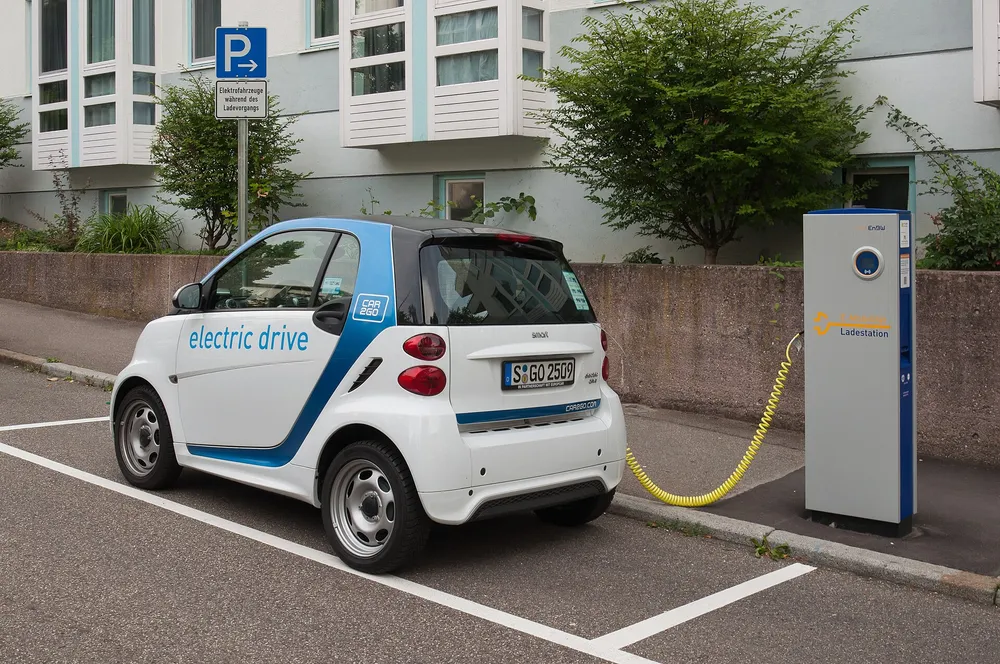 Illustrative: EV charging station — CC BY-SA via Wikimedia Commons
#6: Sleek Type-S — 49,900–55,900 THB
No waiting to charge — just swap the battery. Sleek EV is building "S Pods" battery swap stations at petrol stations, malls, and cafés across Thailand — similar to Gogoro's model in Taiwan.
- Price: 49,900–55,900 THB
- Motor: 1,500–5,100W
- Range: 150 km/charge
- Top speed: 70 km/h
- Fast charge: 1.8 hours
- Special feature: S Pods battery swap network (expanding)
- Pros: Exceptional range for the price, swap option removes downtime
- Cons: S Pods network not yet nationwide
Best for: Riders near S Pods locations, or wanting maximum range at this price
#7: Deco SuperAce — 62,900 THB
Sporty styling at a mid-range price. Deco is a Thai brand with 100+ dealers. The SuperAce targets riders who want a sporty look with 80 km/h top speed.
- Price: 62,900 THB
- Motor: 2,000W
- Range: 70 km/charge
- Top speed: 80 km/h
- Charging: 4 hours
- Pros: Good-looking design, decent dealer network
- Cons: 4-hour charge, less competitive specs vs AJ BEATS at a similar price
Best for: Style-conscious commuters on short to medium daily distances
#8: ZEEHO AE2 — 29,900 THB
Cheapest certified entry into EV. ZEEHO is a Chinese brand with official Thai distribution. The AE2 is the best option if your budget is under 30,000 THB.
- Price: 29,900 THB
- Motor: 800–1,250W
- Range: 80 km/charge
- Top speed: 45 km/h
- Features: Digital twin display, Keyless 2.0
- Pros: Lowest price with warranty, surprisingly good range
- Cons: 45 km/h top speed uncomfortable on fast roads, fewer service centres
Best for: First-time EV buyers, low-budget riders, side-street commuting
#9: EM Owen Long Range — 78,640 THB (subsidised price)
For serious long-distance daily riders. Launched December 2024, the EM Owen Long Range packs a 72V 100Ah battery for 150–200 km per charge — the longest range in the Thai market.
- Price: 78,640 THB* (*subsidised; standard 97,900 THB)
- Motor: 3,500W
- Range: 150–200 km/charge (at 45 km/h)
- Battery: Li-ion 72V 100Ah
- Includes: 20A fast charger in box, front/rear disc brakes, YSS rear shock
- Pros: Longest range available, EM's 120+ service network
- Cons: Higher price, heavier with large battery
Best for: Riders covering 80–100+ km daily, or those in areas with limited charging
#10: Yamaha NEO — 59,700 THB
Japanese reliability with a 2-year warranty. Yamaha entered the Thai EV market in early 2026. The NEO brings a familiar brand name and a 2-year warranty backed by the Yamaha service network.
- Price: 59,700 THB
- Motor: 2.3 kW brushless DC
- Range: 72 km/charge (single battery, 30 km/h, 75 kg rider)
- Battery: Li-ion 51.1V / 23.2Ah, removable
- Charging: 9 hours (standard)
- Warranty: 2 years
- Pros: Trusted brand, removable battery, 2-year warranty
- Cons: Very slow charging (9 hours), underbone frame design (not a traditional scooter)
Best for: Riders who want a Japanese brand and have an overnight charging window
Full Comparison Table
| Model | Price (THB) | Range | Top Speed | Motor | Fastest Charge |
|---|---|---|---|---|---|
| ZEEHO AE2 | 29,900 | 80 km | 45 km/h | 800–1,250W | — |
| EM Legend G.2 | 38,640* | 50–70 km | 70 km/h | 2,000W | 2–3 hr |
| Sleek Type-S | 49,900–55,900 | 150 km | 70 km/h | 1,500–5,100W | 1.8 hr |
| Yamaha NEO | 59,700 | 72 km | — | 2.3 kW | 9 hr |
| AJ BEATS | 59,990 | 75–100 km | 85 km/h | 3,000W | — |
| Deco SuperAce | 62,900 | 70 km | 80 km/h | 2,000W | 4 hr |
| iMOTOR Thunder | 65,000 | 220 km | 80 km/h | 3,000W LFP | 2h10m |
| AJ Goddess | 69,990 | 75–80 km | 90 km/h | 3,000W | 60–80 min |
| EM Owen LR | 78,640* | 150–200 km | — | 3,500W | — |
| Honda EM1 e: | ~59,000–96,570 | 41–48 km | 45 km/h | 1.7 kW | 6 hr |
*Subsidised price (standard price is higher)
Legality: Licence and Registration in Thailand
Do you need a licence?
- Over 250W or top speed above 25 km/h = legally a motor vehicle → requires a Thai motorcycle licence and registration, same as a petrol bike
- Under 250W and under 25 km/h = classified as a bicycle — no licence required, but cannot be ridden on major roads
How to register: Apply at the Department of Land Transport (กรมการขนส่งทางบก, DLT). Required documents: purchase receipt, certificate of origin, compulsory insurance (Por Ror Bor), ID card. Fee: approximately 505 THB.
Critical: Models imported as grey-market goods without Thai TISI (มรท.) certification cannot be registered and are illegal on public roads. Fines up to 10,000 THB. Always verify TISI certification before purchasing.
Where to Charge: Thailand's EV Infrastructure
Thailand had 11,467+ public charging points at end of 2024, concentrated in Bangkok and the Eastern Seaboard.
- Home charging (standard 220V): The primary method for most riders. Charge overnight for 2–6 hours; cost is 5–15 THB per session.
- Removable battery: EM Legend G.2, Honda EM1 e:, and Yamaha NEO all have removable batteries — carry them to your room if you live in a condo.
- AJ EV Network: 5,000+ charging points nationwide, AC Type 2 compatible.
- Sleek S Pods: Battery swap stations at petrol stations and malls (network expanding).
- PTT EV Station PluZ: 650+ stations nationwide (primarily for cars, some two-wheeler compatibility).
Useful apps to find charging points: Place to Plug, PlugShare, Electromaps
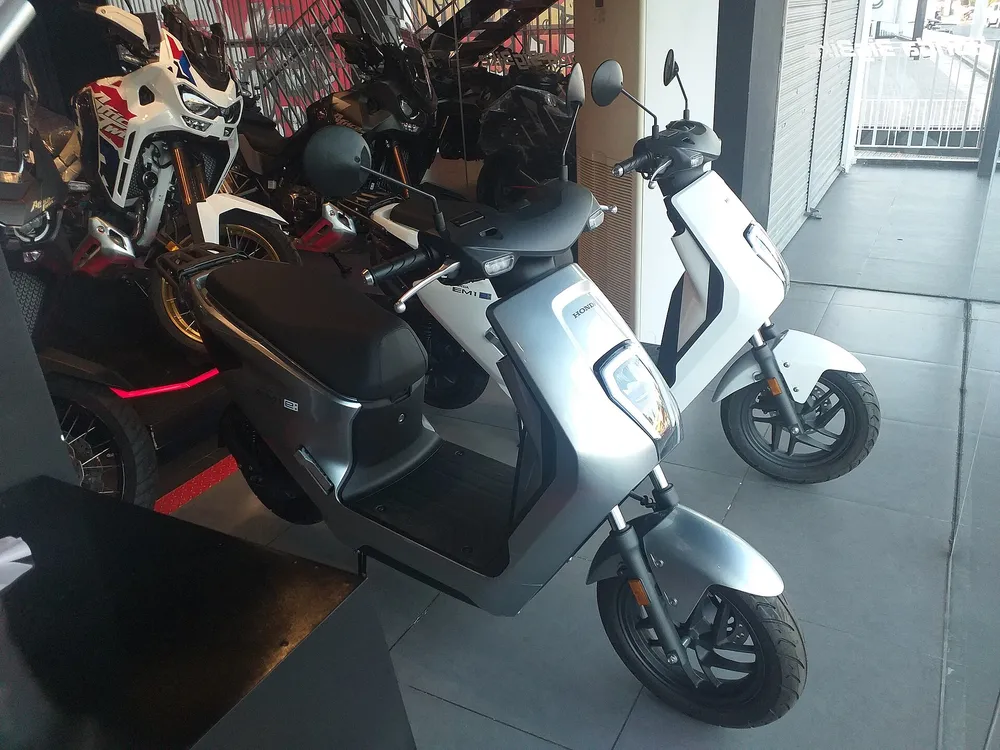 Photo: Honda EM1 e: at a motorcycle showroom — CC BY-SA via Wikimedia Commons
Rainy Season, Flooding, and Battery Degradation
Rain and flooding Most models are IP54-rated — splash resistant, not submersion-proof. The rule of thumb: don't ride through water deeper than 15–20 cm (roughly to the lower edge of the wheel). Deeper water risks flooding the motor or battery compartment; repairs can cost as much as the scooter itself. Before riding in heavy rain, confirm all battery covers and connection ports are properly closed.
Battery degradation in Thai heat Ambient temperatures of 35–40°C accelerate lithium-ion degradation. To slow this:
- Avoid leaving the battery at 100% charge for extended periods
- Try to keep charge levels between 20–80% for daily use
- Don't park in direct sunlight for hours
- Only use the charger supplied with the bike
Grey-market and non-TISI models The Thai market has many cheap Chinese imports online without TISI certification. These cannot be legally registered, and if you're caught riding one on public roads, the fine is up to 10,000 THB plus the bike can be impounded. The price saving is not worth the risk.
How to Choose by Budget and Use Case
| Your situation | Recommended model | Why |
|---|---|---|
| Budget under 30,000 THB | ZEEHO AE2 | Lowest certified price |
| Budget 35,000–50,000 THB | EM Legend G.2 (subsidised) | Best value + 120+ service centres |
| Budget 50,000–65,000 THB | AJ BEATS or Sleek Type-S | Well-rounded or best range |
| Live in a condo, no parking outlet | Honda EM1 / EM Legend G.2 / Yamaha NEO | Removable battery for room charging |
| Need to charge fast during the day | AJ Goddess | AC Type 2, 60–80 min to full |
| Long daily distance (80+ km/day) | iMOTOR Thunder or EM Owen LR | 150–220 km range |
| Want a trusted brand + big service net | Honda EM1 e: or Yamaha NEO | Major dealer networks |
| Want longest battery lifespan | iMOTOR Thunder/Vapor | LFP battery, 2,000+ cycles |
Common Mistakes When Buying an Electric Scooter
- Believing the advertised range in full: Manufacturer figures are best-case scenarios. Always deduct 20–30% for Thai conditions. A bike rated at 80 km typically delivers 55–65 km in real use.
- Not checking if the battery is removable: If you live in a condo without a parking socket, a non-removable battery means no easy charging. This is a deal-breaker for many riders.
- Buying from online sellers with no service centre nearby: If there's no service centre in your city, repairs become a logistics nightmare. Some models also may not be registerable.
- Forgetting to budget for battery replacement: Battery replacement is a real future cost — especially for NMC chemistry (degrades faster than LFP). A 15,000 THB replacement battery that lasts 3 years adds 5,000 THB/year to your true running cost.
- Skipping the TISI check: Non-certified electric scooters cannot be legally registered. Always verify TISI certification before committing.
Verdict: Which One Should You Buy?
Electric scooters in Thailand in 2026 have matured enough to suit almost every budget and lifestyle:
- Best overall: AJ BEATS (59,990 THB) — solid specs, best charging network in the market
- Best range: iMOTOR Thunder (65,000 THB) — 220 km/charge, LFP battery lasts years
- Best value: EM Legend G.2 (38,640 THB subsidised) — cheapest certified option, largest service network
- Best for condo dwellers: Honda EM1 e: or Yamaha NEO — removable battery for room charging
- Best smart features: AJ Goddess — fastest charging + 5-inch TFT display
If you're deciding between an electric scooter and buying your first car, see our guide to buying your first car in Thailand for a full cost comparison. And if you're looking to reduce your overall household bills while you commute on electric, our electricity-saving guide shows how to cut your home power costs alongside fuel.
Always test-ride before buying. Weight, seat height, and the feel while riding are personal — spec sheets can't replace the experience.
Sources
- NIU Thailand Official — prices and specs
- Autospinn — 10 Electric Motorcycles in Thailand 2026
- Kapook — Best Electric Motorcycles in Thailand 2026
- Thailand Starter Kit — Electric Motorcycle Laws
- TDL Service — Electric Bike Laws Thailand
- iMOTOR Thailand — Thunder & Vapor specs
- Falcon Go — Cost of transport: EV vs petrol in Thailand
- Checkraka — AJ EV BIKE Goddess
- Fasterwheeler TH — Yamaha NEO 2026
- Pantip — Real user experiences with electric scooters
Frequently asked questions
- Do you need a license to ride an electric scooter in Thailand?
- Yes. Any electric scooter over 250W or with a top speed above 25 km/h is classified as a motor vehicle requiring a standard Thai motorcycle license and registration — the same as a petrol bike.
- How much does it cost to charge an electric scooter per month?
- Roughly 75–150 THB/month for someone riding 30 km/day. Compare that to 800–1,200 THB/month for petrol — electricity is about 10x cheaper per kilometre.
- How long does an electric scooter battery last?
- Standard NMC lithium-ion: 500–1,000 charge cycles, or 2–4 years with daily use. LFP batteries (used in iMOTOR models): 2,000+ cycles, lasting 5–8 years. Replacement costs range from 3,000 to 25,000 THB depending on capacity.
- Can you ride an electric scooter in the rain in Thailand?
- Yes, most models are IP54-rated (splash resistant). But avoid riding through floodwater deeper than 15–20 cm — water can enter the motor or battery compartment, causing expensive damage.
- Which electric scooter is best if I live in a condo without a parking outlet?
- Choose a model with a removable battery: Honda EM1 e:, Sleek Type-S (swap network), EM Legend G.2, or Yamaha NEO. You can carry the battery up to your room to charge.
- Is buying an unregistered/grey-market electric scooter illegal in Thailand?
- Yes, if it's over 250W and you ride it on public roads without registration. Fines can reach 10,000 THB. Models without Thai TISI (มรท.) certification cannot be legally registered — always check before buying.
Related articles
How to Save Fuel in Thailand 2026: Real Tips as Gas Prices Rise
Thailand fuel prices rose Sep 2026. Proven ways to cut fuel costs, a real cost-impact table, and whether switching to an EV finally pays off.
10 Best Electric Cars Under 1 Million Baht in Thailand (2026)
10 best-value EVs under 1 million baht in Thailand for 2026 — price, real-world range, battery specs, and home-charging cost, plus how to pick by budget.

EV vs petrol in Thailand 2026: costed on today's real prices
Cost per kilometre worked out from Thailand's actual September 2026 pump and charging prices — and why the gap depends on your parking space far more than on the car.