Chiang Rai Travel Guide 2026: 3 Days 2 Nights, White Temple & More

Ask a frequent traveller in Thailand which northern province gives the most value for the time spent, and many will say Chiang Rai rather than Chiang Mai. This northernmost province packs a world-class white temple, an equally stunning blue one, a 12,000-rai hilltop park, a misty hilltribe coffee village, and a three-nation river confluence — all within 70 km of the city centre.
July puts Chiang Rai in its Green Season: rain turns the hillsides a deep, lush emerald, rice paddies shimmer, and morning mist clings to the peaks. Visitor numbers are roughly half those of the winter peak, queues are short, and hotel prices drop 20–40%. This guide covers everything you actually need — up-to-date admission prices, the best travel time, a realistic day-by-day plan, and the mistakes that cost other travellers time and money.
Why Chiang Rai in 2026
Chiang Rai is not a "half-day stop on the way to Chiang Mai" — it is a full destination in its own right. Here is what makes it worth the journey:
- Wat Rong Khun (White Temple): A living artwork covered in millions of mirror-glass fragments, still under construction — it is expected to be finished no earlier than 2027. Every year new details are added. There is nothing else like it in Asia.
- Wat Rong Suea Ten (Blue Temple): Built in 2016 by a student of the White Temple's creator. Admission is free and the interior is equally breathtaking.
- Singha Park: 12,000 rai of tea fields, flower meadows, and wildlife, owned by Singha Corporation. Entry is free.
- Doi Pha Hi: An Akha hilltribe village at 1,500 metres altitude, now famous for drip coffee with a valley view. In rainy season, the whole ridge is above the clouds.
- Golden Triangle: Where the Mekong meets the borders of Thailand, Myanmar, and Laos. The Hall of Opium museum here is one of the best in Southeast Asia.
All within three days. And typical costs run 20–30% lower than Chiang Mai.
Must-See Attractions — Real Details for 2026
Wat Rong Khun (White Temple)
One of the most photographed buildings in Southeast Asia, and rightly so. The temple exterior is clad in white-painted plaster studded with millions of mirror-glass pieces that catch the sun at every angle. The artist, Chalermchai Kositpipat, began construction in 1997 and continues to this day, funding it entirely himself.
Key facts (2026):
- Entrance fee: Free for Thai nationals | 200 THB for foreigners (increased from 100 THB, effective 1 January 2026)
- Hours: Monday–Friday 08:00–17:00 | Saturday–Sunday 08:30–17:30
- Dress code: Shoulders and knees must be covered (wraps available to borrow at the gate)
- Getting there: ~13 km from the city centre — songthaew route 1246 for 20 THB or Grab for 60–80 THB
Critical tip: Tour buses from Chinese and Western group tours pack the temple between 10:00 and 14:00. Arrive before 09:00 for near-empty photos; morning light is also kinder than midday sun reflecting off the white glass. The bridge into the temple, flanked by outstretched hands representing trapped souls, and the interior murals blending Buddhist iconography with popular culture figures (Neo from The Matrix, Iron Man) are the two most talked-about details.
Wat Rong Suea Ten (Blue Temple)
Built in 2016 by Puttawan Reungsri, a student of the White Temple's creator, this is an entirely different aesthetic: deep cobalt blue with gold trim, massive naga serpent sculptures flanking the entrance, and a ceiling covered in blue mosaic. Admission is free, and it is open daily 07:00–20:00.
The evening lighting (17:00–19:00) is exceptional — natural warmth from the setting sun, supplemented by the temple's own floodlights. This is a quieter visit than the White Temple even in peak season.
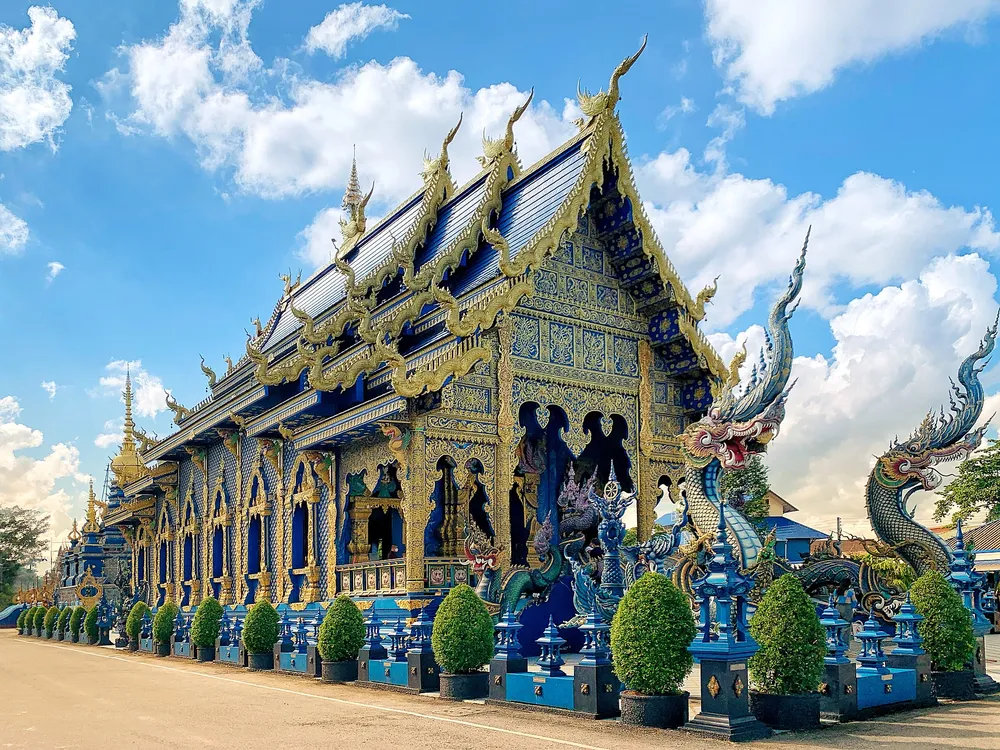
Getting there from the city: ~3 km, Grab 60–80 THB. The White Temple is to the south of the city, the Blue Temple to the west — plan them on separate trips rather than trying to chain them with one vehicle.
Singha Park and Choui Fong Tea Plantation
Both attractions are in the northern part of the province (~20 km apart) and work well together in one morning.
Singha Park — free entry, open daily 08:00–21:00. The 12,000-rai estate has tea fields, seasonal flower meadows, and free-roaming deer. Paid activities include cycling (50–100 THB/bike), ATV rides (150–300 THB), and a Farm Tour (200–350 THB). In rainy season the tea fields turn a deep bottle green ideal for photography.
Choui Fong Tea Plantation — free entry; plantation tour with tea tasting 100 THB per person. Among the best spots in Chiang Rai for landscape photography: rows of tea bushes on gentle slopes, brilliant green against a grey rainy sky. Open daily 08:00–17:30. About 30 km from the city centre.
Baan Dam Museum (Black House)
If the White Temple represents purity, Baan Dam (Black House) is its philosophical opposite. This is the life's work of artist Thawan Duchanee — a compound of dark timber buildings filled with animal hides, skulls, and carved bones. The effect is unsettling and beautiful in equal measure.
Entrance fee: 80 THB | Open daily 09:00–17:00 | ~13 km from the city
Wat Huay Pla Kang — Nine-Storey Guanyin
A Thai-Chinese temple with a massive white nine-storey Guanyin statue (69 metres tall). Take the lift (40 THB) to the upper floors for a panoramic view over Chiang Rai. Open daily 07:00–18:00.
Golden Triangle (Sop Ruak)
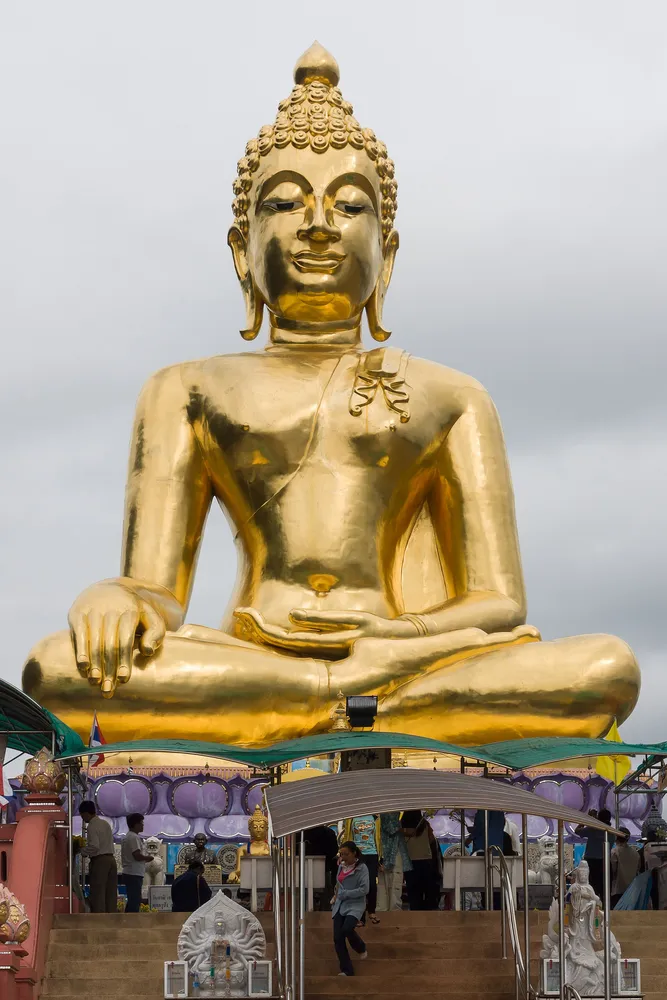
The confluence of the Mekong River where Thailand, Myanmar, and Laos meet. The viewpoint is free. The Hall of Opium next door is a genuinely excellent museum covering the history of the opium trade in the region. Entrance ~100–150 THB for Thai nationals. Open daily 09:00–17:00. Located 65 km north of Chiang Rai city, near Chiang Saen.
Doi Pha Hi — Akha Village Coffee with a Valley View
A hilltribe village at 1,500 metres altitude in Mae Sai district, about 1.5 hours' drive from the city. The attraction is simple: hand-drip Arabica coffee on a wooden terrace with a valley view that disappears into clouds. In July, the ridge is above the cloud layer from mid-morning onward.
Getting there: Private vehicle only — no Grab service. The road is paved but steep and winding; high-clearance or 4WD strongly recommended in wet weather. No ATMs on the mountain. Homestays available from ~1,000 THB per person including breakfast.
Getting There from Bangkok
| Method | Travel Time | Approximate Cost | Notes |
|---|---|---|---|
| ✈️ Flight | 1 hr 20 min | 2,000–5,000 THB return | Nok Air / AirAsia / VietJet — Mae Fah Luang airport (CEI) |
| 🚗 Car | 9–12 hours | ~1,100–1,400 THB fuel (sedan) | Highway 1 via Nakhon Sawan–Lampang–Phayao |
| 🚌 Bus | 10–12 hours | 650–900 THB | Nakhon Chai Air / Green Bus — overnight departure ~20:00 |
| 🚆 Train | ❌ No direct train | — | Railway ends at Chiang Mai; add 3 hours by bus |
Best option: Fly. Book 3–4 weeks ahead for 1,200–1,800 THB one-way. If driving with four people, the fuel cost (around 1,000–1,200 THB each way for a sedan) divided by four is very competitive — but budget for a 10-hour drive and leave Bangkok by 03:00–04:00 to clear city traffic.
Visiting in July — Green Season Truths
Most travellers dismiss the rainy season without thinking it through. July in Chiang Rai is genuinely different — not worse, just different.
What the rain actually brings:
- New rice seedlings on every hillside turn the landscape an intense, saturated green that dry-season visitors never see
- Tea fields at Choui Fong and Singha Park are at their most photogenic: rows of emerald against grey sky
- Doi Pha Hi is above the clouds most mornings — you drink coffee literally in the mist
- Hotel prices drop 20–40% from peak winter rates
- Visitor numbers at the White Temple are roughly half — you can walk to the bridge without jostling
What to prepare for:
- Rain falls on about 22 days per month, mostly in the afternoon. Plan outdoor attractions for the morning.
- A proper rain jacket matters more than an umbrella (sideways rain is common)
- Mountain roads (Doi Pha Hi, Doi Tung) can be slippery — take them slowly and in a suitable vehicle
- Temperature is a comfortable 24–32°C — no cold-weather gear needed
Entrance Fees and Budget
Admission Summary (2026)
| Attraction | Thai Nationals | Foreigners |
|---|---|---|
| Wat Rong Khun (White Temple) | Free | 200 THB |
| Wat Rong Suea Ten (Blue Temple) | Free | Free |
| Singha Park | Free | Free |
| Choui Fong Tea (tour + tasting) | 100 THB | 100 THB |
| Baan Dam Museum | 80 THB | 80 THB |
| Doi Tung Royal Villa | 90 THB | 90 THB |
| Doi Tung 4-site combo | 220 THB | 220 THB |
| Wat Huay Pla Kang (lift) | 40 THB | 40 THB |
| Hall of Opium | ~100–150 THB | ~150–200 THB |
Full Budget — 3 Days 2 Nights Per Person
| Item | Economy | Comfortable |
|---|---|---|
| Return flights Bangkok–Chiang Rai | 2,000–2,500 THB | 3,000–5,000 THB |
| Accommodation (2 nights) | 900–1,400 THB | 2,000–4,000 THB |
| Food (3 days) | 600–900 THB | 1,200–2,400 THB |
| Admission fees (combined) | 300–450 THB | 500–700 THB |
| Local transport (motorbike rental or Grab) | 400–600 THB | 600–1,200 THB |
| Souvenirs / shopping | 300–500 THB | 1,000–2,000 THB |
| Total | ~4,500–6,350 THB | ~8,300–15,300 THB |
If driving: remove the flight cost; add fuel at ~1,000–1,200 THB return for a sedan, divided by the number of passengers.
Day-by-Day Itinerary
| Day / Time | Activity | Cost |
|---|---|---|
| Day 1 morning | ✈️ Fly to Chiang Rai, check in | Flights 1,000–2,500 THB |
| 09:00–11:00 | Wat Rong Khun — arrive early, beat tour buses | Free (Thai) / 200 THB (foreign) |
| 11:00–12:30 | Wat Huay Pla Kang — nine-storey Guanyin, city view | 40 THB (lift) |
| 12:30–14:00 | Lunch — Khao Soi or Khao Mun Gai | 80–150 THB |
| 14:00–16:00 | Wat Rong Suea Ten — afternoon light is ideal | Free |
| 16:00–18:00 | Clock Tower + browse the night market area | — |
| 18:00–21:00 | Saturday Walking Street or Night Bazaar | Dinner 100–250 THB |
| Day 2 morning | 🌿 Choui Fong Tea Plantation — clear morning light | Free / 100 THB (tour) |
| 10:00–13:00 | Singha Park — walk, cycling, activities | Free / 150–300 THB activities |
| 13:00–14:30 | Lunch in Singha Park or nearby | 150–300 THB |
| 15:00–17:30 | Baan Dam Museum (Black House) | 80 THB |
| 18:00–20:00 | Dinner at a Lanna restaurant | 200–400 THB |
| Day 3 morning | 🚗 Drive north — Golden Triangle (65 km) | Hire a vehicle ~800–1,200 THB/car |
| 09:00–11:00 | Mae Sai border market — shopping | — |
| 11:30–13:00 | Golden Triangle viewpoint + Hall of Opium | 100 THB |
| 13:00–14:30 | Lunch at Chiang Saen — Mekong river fish | 150–300 THB |
| 15:30–17:30 | Return to city, prepare for departure | — |
| 18:00 | ✈️ Flight home, or stay another night for Doi Pha Hi | — |
Scheduling tip: If your flight home is midday on day 3, swap days 2 and 3 — do the Golden Triangle on day 2 morning when you have more energy and the full day.
Where to Stay
Chiang Rai has more accommodation variety than most visitors expect.
Budget (under 1,000 THB per night):
- Hop Inn Chiang Rai Clock Tower — 680–950 THB. New chain hotel, clean, excellent Wi-Fi, central location
- B2 Night Bazaar Hotel — 500–870 THB. Near the Night Bazaar, clean rooms
- Ann Guest House — 419–700 THB including breakfast; good for backpackers
Mid-range (1,000–3,000 THB per night):
- De Hug Hotel — 1,500–2,500 THB. Stylish design hotel with pool
- MORA Boutique Hotel — 1,500–2,500 THB. Boutique feel, strong reviews
- The Heritage Chiang Rai — 2,100–6,000 THB. Lanna-style resort, mountain views
Luxury (3,000+ THB per night):
- Le Méridien Chiang Rai Resort — 3,700–5,600 THB. Riverside, spa, pool
- Anantara Golden Triangle — 18,000–41,000 THB. Elephant-watching, three-country views, the most dramatic location in all of northern Thailand
Food Guide — Lanna Cuisine Essentials
Northern Thai (Lanna) food is distinct from central Thai cooking and genuinely excellent. Prices are low — a full lunch in the market runs 35–80 THB.
Essential dishes to try:
- Khao Soi — egg noodles in a rich coconut-curry broth with crispy fried noodles on top. Chiang Rai's version is slightly different from Chiang Mai's. Budget 80–150 THB per bowl.
- Khanom Jeen Nam Ngiao — rice noodles in a thick, tomato-red pork broth with blood cubes and dried flowers. Intense and warming. 35–50 THB. Try Nam Ngiao Pa Suk (50 years in business).
- Sai Ua — spiced Northern Thai pork sausage loaded with lemongrass and chilies. Buy from the market for 60–120 THB per portion.
- Kaep Moo — crispy pork skin. The local snack of the north. Usually eaten with Nam Prik Noom (roasted green chilli dip).
Recommended restaurants:
- PAAM (Pham Sai Ua) — Lanna grilled meats and sausages, 250–500 THB
- Chivit Thamma Da — waterfront café with outstanding atmosphere, 150–350 THB
- Canary Farm Cafe — micro-roaster specialty coffee, 60–120 THB per cup
- Sai Ua stalls at the Saturday Walking Street — the freshest batch of the week
10 Common Mistakes (and How to Avoid Them)
- Arriving at the White Temple between 10:00 and 14:00 — tour buses flood the site. Before 09:00 or after 14:30 is dramatically calmer.
- Wearing shorts or sleeveless tops to the temples — both the White Temple and Blue Temple require covered shoulders and knees. Wraps are available to borrow, but it slows you down.
- Assuming there is a direct train — there is not. The railway ends at Chiang Mai; you would need to bus another 3 hours from there.
- Taking a low-slung sedan up Doi Pha Hi in the rain — the road is paved but steep and wet. High clearance or 4WD only.
- Not withdrawing cash before leaving the city — no ATMs at Doi Pha Hi, limited card acceptance at the Mae Sai border market.
- Expecting the Walking Street on a weeknight — Saturday Walking Street is Saturdays only, Sunday street is Sundays only. The Night Bazaar runs every night but is much smaller.
- Leaving hotel bookings too late for long weekends — even in low season, good mid-range hotels fill 2–3 weeks out during Thai public holidays.
- Underestimating Golden Triangle day-trip time — it is 65 km each way from the city. Budget a full day for the round trip plus sightseeing.
- Relying on Grab outside the city — Grab works within the city centre but does not reach remote mountains. For Doi Pha Hi or Doi Tung, hire a local driver or self-drive.
- Skipping travel insurance for a mountain road trip — mountain roads in rain are unforgiving. A domestic travel insurance policy covers medical expenses, rental car damage, and delayed flights from a few hundred baht. Highly recommended; see our domestic travel insurance guide for how to compare options.
Verdict — Is Chiang Rai Worth It in 2026?
Yes, absolutely. The White Temple alone justifies the trip, but the full three-day circuit delivers at every stop. Chiang Rai has a remarkably high concentration of genuinely impressive sights within a compact area, it costs less than Chiang Mai or Bangkok, and the Green Season makes July one of the best times to visit — provided you pack a rain jacket.
Best suited to:
- Families (major temples and Singha Park are all easily accessible)
- Couples (boutique hotels, riverside cafés, dramatic landscapes)
- Friend groups (low costs, Walking Street, diverse activities)
- Photographers (every major site rewards a wide-angle lens)
- Budget travellers (most main attractions are free)
Not ideal if: You need big-city nightlife, international shopping malls, or frequent public transport to remote areas.
If Chiang Rai is your first taste of northern Thailand and you find yourself wanting more mountain scenery, add Khao Yai National Park to your Thailand travel plan — a completely different nature experience just 2 hours from Bangkok.
Sources
- Chiang Rai Focus — White Temple Doubles Admission Fee 2026
- Khaosod English — Wat Rong Khun Entrance Fee Announcement 2025
- Tourism Authority of Thailand — Choui Fong Tea Plantation
- Climate-data.org — Chiang Rai July Climate Data
- Roijang.com — Chiang Rai Hotels 2026
- Nok Air — Bangkok to Chiang Rai Routes
- Backpackers Wanderlust — White Temple Complete Guide
- Traveloka — 30 Places in Chiang Rai 2026
Frequently asked questions
- How far is Chiang Rai from Bangkok and what is the best way to get there?
- Chiang Rai is about 800–830 km from Bangkok. The fastest option is a 1-hour 20-minute flight; round-trip tickets cost 2,000–5,000 THB with Nok Air, AirAsia, or VietJet (to Mae Fah Luang airport, CEI). Driving takes 9–12 hours. There is no direct train to Chiang Rai — the railway ends at Chiang Mai, which adds another 3 hours by bus.
- How much does it cost to enter Wat Rong Khun (White Temple) in 2026?
- Free for Thai nationals. Foreign visitors pay 200 THB per person (doubled from 100 THB effective 1 January 2026). Children under 120 cm tall enter free. Seniors aged 70+ enter free. Open Monday–Friday 08:00–17:00 and weekends 08:30–17:30.
- Is July a good time to visit Chiang Rai? How rainy is it?
- July is excellent if you prepare well. It is Green Season — forests and rice paddies are intensely green, mountaintops are shrouded in mist, temperatures are a pleasant 24–32°C, and crowds are about half of the peak winter season. Rain typically falls in the afternoon; mornings are often clear. Bring a rain jacket and waterproof shoes.
- What is the total budget for 3 days 2 nights in Chiang Rai?
- Economy travellers spending about 4,500–6,500 THB per person (budget flights + cheap guesthouse + local food). Comfortable travellers spend 8,000–15,000 THB per person. The main costs are flights (2,000–5,000 THB round-trip) and accommodation (450–3,700 THB per night).
- Is Doi Pha Hi difficult to reach? What do I need?
- Doi Pha Hi is about 1.5 hours from Chiang Rai city by private vehicle. The road is paved but steep and winding. In the rainy season, a high-clearance vehicle or 4WD is strongly recommended — low-slung sedans can struggle on the slippery inclines. No Grab service reaches the village. Withdraw cash before you go; there are no ATMs on the mountain.
- How is Chiang Rai different from Chiang Mai? Which should I choose?
- Chiang Rai is smaller, quieter, cheaper on average, and has a higher density of iconic landmarks within a short drive (White Temple, Blue Temple, Golden Triangle, Singha Park). Three to four days is enough to see it well. Chiang Mai is larger with more restaurants, nightlife, and transport options, and suits 5–7 days. If your time is short, Chiang Rai gives more wow per baht. For a complete breakdown of Chiang Mai, see our [Chiang Mai travel guide 2026](/articles/chiang-mai-travel-guide-2026).
Related articles
Pai, Mae Hong Son Travel Guide 2026: Sights, Stays & 3-Day Plan
Complete 2026 guide to Pai, Thailand: the 762-curve drive, must-see sights, stays for every budget, real costs, and a working 3-day itinerary.

Krabi Travel Guide 2026 — Top Attractions, Costs & 3-Day Itinerary
Complete Krabi travel guide for 2026 covering every highlight: Railay Beach, Tiger Cave Temple, 4 Islands tour, Emerald Pool, real costs, transport, accommodation, and tips for the rainy season

Phuket Travel Guide 2026: Beaches, Attractions, Costs & Rainy Season Tips
Complete Phuket travel guide for 2026 covering every beach, top attractions, real costs, transportation, best areas to stay, and essential rainy season tips for a safe, budget-friendly trip.