Home Workouts 2026: Get Started Without a Gym (Beginner's Guide)

You've wanted to start exercising for ages, but you're stuck on "no time for the gym," "the membership is too expensive," or "I'm too self-conscious to work out in front of people." If that sounds like you, here's the good news: in 2026, working out at home — without a gym and with almost no equipment — genuinely works and gets real results. This guide walks you through it all: why home bodyweight training works, the basic moves one by one, a 7-day starter plan for beginners, the best budget gear, how to warm up safely, the mistakes that make people quit, and how to turn it into a lasting habit.
Important note: This article is for general understanding, not personal medical advice. If you have a health condition — heart disease, high blood pressure, diabetes, joint or bone problems — are pregnant, or recently had surgery, talk to your doctor before starting any exercise program, and begin at a gentle level.
Do home workouts really work, and why?
The first question every beginner asks is, "If I'm not at the gym lifting heavy, will it actually do anything?" The answer is yes — especially for ordinary people who are just starting. Because the heart of building strength isn't the machines in a gym; it's a principle called progressive overload — gradually making your muscles work a little harder over time so your body adapts and gets stronger. Your own bodyweight plus gravity is plenty of load to challenge your muscles fully.
Bodyweight training — push-ups, squats, lunges, planks — covers all the major muscle groups: legs, hips, chest, back, arms and the core. Done consistently, it improves strength, balance, heart health and metabolism. As you get stronger, you simply add reps, add sets, shorten rest, or switch to harder variations (knee push-up → full push-up → single-leg push-up) and keep progressing without buying a thing.
The advantage a gym can't match is convenience and low cost. No monthly fee of hundreds to thousands of baht, no commute, no waiting for a machine, and — for many beginners, most importantly — no one watching. That convenience is the real key. The number-one reason people quit exercising isn't laziness; it's small "friction" like having to travel somewhere. Working out at home removes that friction, and your odds of staying consistent go way up.
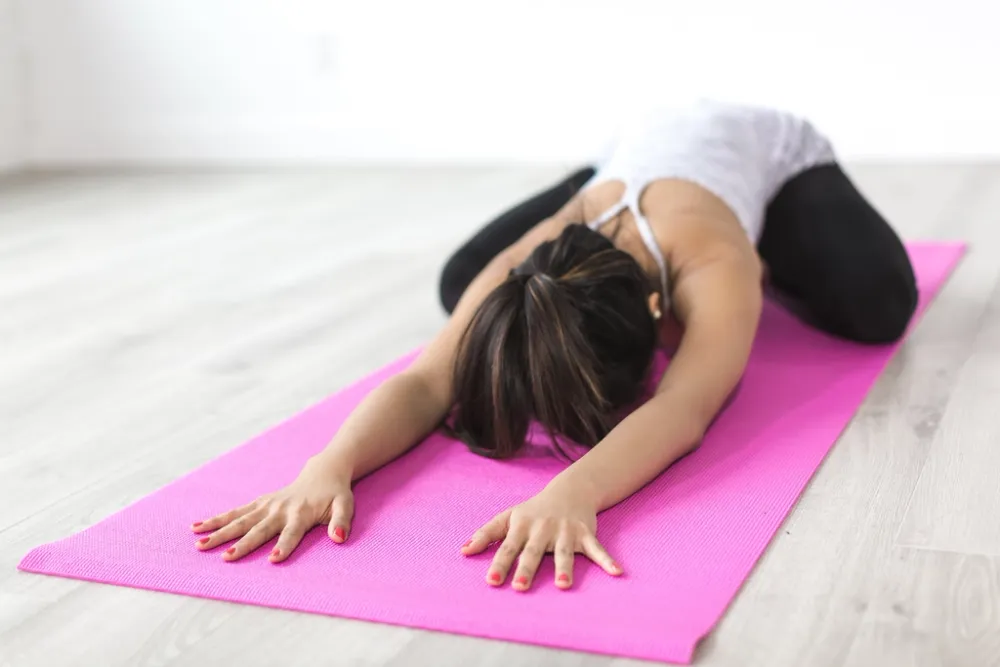 Photo: via Openverse (CC) — A small corner at home and a single mat is all you need to start.
How much should you exercise per week?
Before you start, here's the target the world's major health bodies recommend. The World Health Organization (WHO) and the U.S. CDC agree on this for adults:
- Cardio / aerobic: 150 minutes per week of moderate-intensity activity (e.g. brisk walking, dance aerobics), or 75 minutes of vigorous activity, or a mix.
- Strength training: Work all major muscle groups on at least 2 days a week.
150 minutes sounds like a lot, but it splits up easily — 30 minutes × 5 days, or 20–25 minutes × 6–7 days. And the bonus: doing more than that (say 300 minutes/week) brings extra health benefits.
But as a beginner, you don't need to hit 150 minutes in week one. Your first goal is simply to "start and keep going." A safe, realistic plan is to begin with 3 days a week, 20–30 minutes each, with rest days between, then build up to 4–5 days as you get stronger. Habit research is clear that consistency beats intensity — 15 minutes of light exercise every day builds the habit far better than one brutal hour every two weeks.
Basic moves for beginners (no equipment needed)
Here are the foundational bodyweight moves that cover your whole body — do them right at home. Each has an easier version if you're not there yet. The golden rule is "scale it to you," not forcing the full version until it hurts.
- Chair Squat — works legs and hips. Stand with your back to a chair, sink your hips down as if to sit until you lightly touch the seat, then drive up through your heels. As you get stronger, drop the chair for a free squat.
- Knee Push-up — works chest, shoulders, arms. From a plank on your knees, lower until your elbows are at about 45°, then push up. If that's still hard, push against the edge of a table or a wall first.
- Stationary Lunge — works legs and balance. Step one foot forward, bend both knees until the front thigh is nearly parallel to the floor, then push back. Do 10–15 per leg.
- Glute Bridge — works hips and lower back. Lie on your back, knees bent, push your hips up squeezing your glutes, then lower. Great for people who sit a lot.
- Plank — works the core. Rest on your forearms, body in a straight line from head to heels, brace your abs, and hold for 20 seconds to 1 minute.
- Bird Dog — works the core and back stability. On all fours, extend your right arm forward and left leg back at the same time, hold 2 seconds, then switch.
- Mountain Climber — gets your heart rate up and burns calories. From a high plank, alternate driving your knees toward your chest at a brisk pace.
- Bicycle Crunch — works the abs. Lie on your back, legs at a right angle, twist to bring opposite elbow to knee, alternating sides.
Beginners do 2 sets of 10–15 reps (planks counted in seconds), resting 30 seconds to 1 minute between moves — about 20–25 minutes total. If a move is too hard, use the easier version or fewer reps. "Something you can actually do every day" beats "perfect form that leaves you too sore to continue."
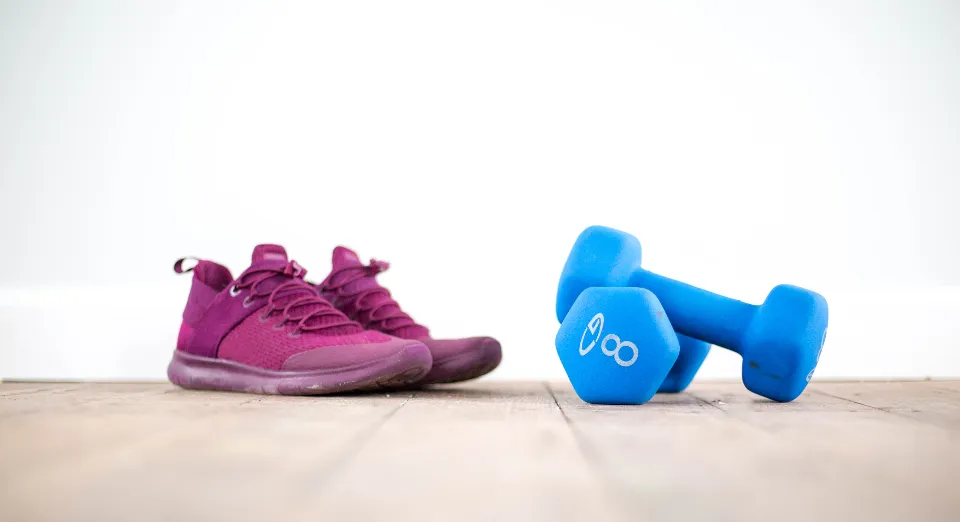 Photo: via Openverse (CC) — When bodyweight gets too easy, a pair of light dumbbells adds load.
A 7-day starter plan for beginners
This plan is ready to follow immediately. It mixes strength days, light cardio days, and rest days, using the moves above, 20–30 minutes each session (including warm-up and cool-down).
| Day | Focus | Sample activity |
|---|---|---|
| Mon | Full body (strength) | Squats + knee push-ups + glute bridge + plank (2 sets) |
| Tue | Light cardio + stretching | Brisk walk / follow-along dance 20–30 min + static stretches |
| Wed | Rest / recovery | Easy stroll or full rest |
| Thu | Full body (strength) | Lunges + push-ups + bird dog + bicycle crunch (2 sets) |
| Fri | Cardio + core | Mountain climber intervals + plank + crunches |
| Sat | Activity you enjoy | Cycling, hiking, swimming or dancing for 30 min |
| Sun | Rest | Full rest so muscles recover |
The key point of this plan is that rest days aren't lazy days — they're when your muscles repair and actually get stronger. Training hard every single day without rest makes you progress slower, get injured more easily, and burn out faster. In the first weeks, if you're very tired, cut back to 3 workout days (Mon/Thu/Sat) and add the cardio days once you're ready.
Want to know how many calories your body uses per day so you can manage weight alongside your training? Try our calorie calculator (BMR/TDEE), and check where your weight sits with our BMI calculator to set realistic goals.
Warm-up and cool-down: never skip them
Many people jump straight into the main moves, thinking warm-ups waste time — but that's one of the top causes of injury in beginners. A warm-up boosts blood flow, warms up muscles and joints, and lets you work harder and more safely.
Warm-up (5–10 minutes before) — focus on dynamic stretching: Start with 1–2 minutes of light movement like marching in place, then move into motions that mimic your workout — arm circles, front-to-back leg swings, gentle squats, hip rotations — about 10 reps each for 2–3 rounds. These stretches "move" rather than holding still, which prepares the muscles for real work.
Cool-down (5 minutes after) — focus on static stretching: When you're done, your body is warm — the ideal time for held stretches. Hold each for 15–60 seconds: quads, calves, hamstrings, shoulders. Stretching now improves flexibility and eases you back to rest. Note: Don't do heavy static stretches before a workout — research shows it can temporarily reduce power and strength. Save the held stretches for the end.
The best budget gear
You can start with nothing, but once you've been at it a while and want more challenge, these few items are great value, inexpensive, and easy to store even in a small house or condo. The table is ordered by value for beginners (prices are rough ranges as of June 2026 and vary by brand/store).
| Item | Approx. price | What it helps with | Who it's for |
|---|---|---|---|
| Yoga mat | ~200–500 THB | Grip and joint/back cushioning for floor moves | Everyone (the first thing to buy) |
| Resistance band set | ~150–500 THB | Adds resistance, trains many muscles, packs small | Anyone wanting cheap added load |
| Light / adjustable dumbbells | ~500–2,500 THB | Adds load to arm/leg/shoulder moves | People getting serious about muscle |
| Jump rope | ~100–300 THB | Intense cardio, high burn, tiny footprint | Anyone wanting home cardio |
| Stability ball | ~300–700 THB | Core, balance, stretching | People with back issues / core focus |
Once you've been training consistently and want to add serious cardio, a home treadmill delivers the highest calorie burn of any home fitness purchase — see the best treadmills in Thailand 2026 for a full comparison across all budgets.
If you can only pick one thing after a mat, a resistance band is the best value. Research and tests repeatedly find bands build strength and muscle "about as well as dumbbells" on many moves — while costing less, weighing almost nothing, and fitting in a drawer. Perfect for condos or tight spaces. Dumbbells suit people getting serious about building muscle who want to add load as a clear, trackable number.
Common mistakes — why people quit halfway
Many beginners start fired up but disappear within weeks, usually because of these traps. Know them so you can avoid them.
- Going too hard on day one. Hammering yourself so you're sore all over (or scared off) is the number-one reason people quit. Always start lighter than you think, then build.
- Skipping the warm-up. This risks injury — and once you're hurt, you have to stop for a long time and often quit entirely.
- Bad form, quantity over quality. Knees caving far past toes in a squat, a rounded back during push-ups — this causes pain and misses the target muscle. Slow, correct form beats fast, sloppy reps.
- Expecting results too fast. Wanting to be slim or muscular in 1–2 weeks, then losing heart when it doesn't show. Real visible change takes months; consistency is the key.
- Never increasing the difficulty. Doing the same move, same reps forever — your body adapts and you stop progressing. You must gradually add load (progressive overload).
- Exercising but ignoring diet and sleep. If your goal is weight loss, overeating erases all your effort, and poor sleep slows recovery and makes you hungrier.
- No set time or space. Working out randomly when the mood strikes usually ends in not working out. Pick a fixed time and a small corner of your home.
If you sit at a screen all day, also watch out for the neck, shoulder and back pain that comes with prolonged sitting. If that's you, read our guide on how to deal with office syndrome too — standing up and stretching through the day pairs perfectly with home workouts.
 Photo: via Openverse (CC) — Stretching before and after exercise helps prevent injury and soreness.
How to make the exercise habit stick
The hardest part of working out at home isn't the moves — it's consistency. Research finds it takes on average about 66 days for a new behavior to become automatic (some faster, some slower, anywhere from about 18 to 254 days). So in the early months you need to design your environment to help, not rely on willpower alone. Evidence-backed tips:
- Start smaller than feels necessary. Aiming for just 10 minutes a day still counts as starting. A goal so small it's hard to refuse means you do it every day.
- Same time, same place. Doing the same behavior in the same context (e.g. right after waking, or before your shower) helps your brain make it automatic faster.
- Mornings have an edge. Research finds habits done in the morning tend to form more reliably, because motivation is high and distractions are few.
- Stack it on an existing routine. "After I brush my teeth → 15-minute workout." Use a habit you already have as the trigger.
- Reward yourself. Watch your favorite show after a consistent week, for example — positive emotions help habits stick.
- Don't miss two days in a row. Missing one day isn't failure, but don't let two stack up — that's where quitting begins.
- Track it. Tick a calendar every day you work out. A long streak you don't want to break is a simple, genuinely effective motivator.
The single most important truth: consistency beats intensity. Light exercise every day always beats a brutal blast that then vanishes.
Verdict: start today, at home, no waiting to be "ready"
In 2026, home workouts are no longer the "inferior to the gym" option. For beginners and ordinary people, they're effective, cheap, and easier to sustain. Start with pure bodyweight using the basics — squats, push-ups, glute bridges, planks — three days a week for 20–30 minutes. Don't skip the 5–10 minute warm-up and the cool-down stretches, and gradually add difficulty as you get stronger.
When you're ready to invest, begin with a yoga mat and a resistance band — the best value items. After that, the most important thing is simply this: do it consistently until it becomes a habit. Remember, light every day beats hard then quitting. And if you have a health condition or you're unsure, checking with your doctor first is the best investment of all. Just start today — a small corner of your home and 20 minutes is enough to change your health.
แหล่งอ้างอิง / Sources
- WHO — Guidelines on Physical Activity and Sedentary Behaviour: https://www.ncbi.nlm.nih.gov/books/NBK566046/
- CDC — Adding Physical Activity as an Adult: https://www.cdc.gov/physical-activity-basics/adding-adults/index.html
- Healthline — At-Home Workouts (20-Minute Set, All Levels, No Equipment): https://www.healthline.com/health/fitness-exercise/at-home-workouts
- Daily Burn — The Complete Beginner's Guide to Working Out at Home: https://dailyburn.com/life/fitness/the-complete-beginners-guide-to-working-out-at-home-no-equipment-needed/
- Cleveland Clinic — Dynamic vs. Static Stretching: https://health.clevelandclinic.org/dynamic-stretching-vs-static-stretching
- Consumer Reports — Best Resistance Bands of 2026: https://www.consumerreports.org/health/resistance-bands/best-resistance-bands-a1034688665/
- The Conversation / ScienceAlert — How long it takes to form a habit (avg ~66 days): https://www.sciencealert.com/heres-how-long-you-need-to-form-a-habit-and-8-tips-to-stick-with-it
Frequently asked questions
- Do home workouts actually work with no equipment at all?
- Yes. For most people and beginners, your own bodyweight is enough resistance to build real strength, fitness and fat-burning. The key is to be consistent and to gradually make it harder (more reps, more sets, or harder variations) as you get stronger. People chasing large muscle gains long-term can add resistance bands or dumbbells later — there's no rush.
- How many days a week should a beginner work out at home?
- The WHO recommends adults get 150 minutes of moderate aerobic activity per week, plus muscle-strengthening of all major muscle groups on at least 2 days a week. For beginners, start with 3 days a week, 20–30 minutes each, with rest days in between, then build up as your body adapts.
- How long should I warm up before a workout?
- Spend 5–10 minutes warming up with light movement and dynamic stretching — arm circles, leg swings, gentle squats — to get blood flowing and joints ready. Static stretching (holding a stretch for 15–60 seconds) is best saved for after the workout, to help flexibility and cool down.
- Is it normal to be sore after the first few workouts?
- Muscle soreness after starting a new routine (DOMS) is normal. It usually shows up 1–2 days later and fades within 2–3 days. Manage it with light movement, plenty of water, and enough rest. But a sharp pain in a joint or tendon during exercise is not normal soreness — stop immediately, as that's a sign of injury.
- What equipment do I need if I want to get more serious?
- You can start with nothing. If you want the best-value additions, the first three are a yoga mat (grip and joint cushioning, ~200–500 THB), a resistance band set (~150–500 THB), and a pair of light or adjustable dumbbells. Research shows bands build strength about as well as dumbbells, making them a cheap, space-saving win for small homes.
- Can I work out at home if I have a health condition?
- Usually yes, and it's good for you — but if you have heart disease, high blood pressure, diabetes, joint or bone issues, are pregnant, or recently had surgery, talk to your doctor first so they can advise a safe level and style for you. Always start gently.
Related articles

10 Best Treadmills in Thailand 2026: Complete Buying Guide with Prices
Compare the 10 best treadmills in Thailand for 2026, from 7,990 THB to pro-grade — with real Continuous HP specs, belt sizes and picks for every budget.

Intermittent Fasting (IF) Done Right in 2026: A Plain-English Guide
How to do intermittent fasting safely in 2026 — 16/8 and 5:2 methods, evidence-based benefits, foods that work, common mistakes, and who should not try IF.

9 Best Mosquito Repellents 2026: Prevent Dengue This Rainy Season
9 top mosquito traps, sprays, nets and coils ranked by price and coverage, plus the free 5-step method to prevent dengue fever this rainy season 2026.