Hua Hin Travel Guide 2026 — Highlights, Real Costs & 3-Day Itinerary

HUA HIN: Best Place In Thailand in 2026 (Ultimate Guide) — Full highlights and travel tips
If you want a Thai beach break during rainy season without gambling on the weather, Hua Hin is the smart choice. While Phuket and Krabi are taking the full brunt of the Andaman monsoon, this Gulf coast resort town gets far less rain — with clear mornings most of July and August, a cool sea breeze, and all its attractions fully open.
But Hua Hin is more than just "closer than the south." It's Thailand's oldest beach resort, with a Victorian railway station, a royal wooden palace, world-class cave photography in Sam Roi Yot National Park, a legendary night seafood market, and the sophisticated Cicada art market — experiences you genuinely can't replicate in Phuket or Koh Samui. This guide covers everything you need for a complete, budget-smart trip.
Why Hua Hin Is Special (Not Just "Convenient")
Many visitors dismiss Hua Hin as a fallback option. That's a mistake. It has things no other Thai beach destination offers:
Royal heritage you can actually visit: The Hua Hin Railway Station (built 1911) is one of Asia's most beautiful train stations — Victorian gingerbread architecture in red and gold, with a royal pavilion where King Rama VI waited for his train. Twenty minutes north, Mrigadayavan Palace is a 1924 teak wood palace connecting 16 buildings on stilts, designed to catch every sea breeze. Neither experience exists at any other Thai beach.
No flight needed from Bangkok: Bangkok → Hua Hin in a minivan takes 3–3.5 hours. Leave at 6 AM and you're on the beach by 10 AM. Perfect for long-weekend trips without advance planning.
World-class nature day trips: Sam Roi Yot National Park, just 65 km away, contains Phraya Nakhon Cave — where sunlight pours through a massive ceiling opening to illuminate a royal pavilion inside. The resulting photograph is one of the most recognizable images in all of Thailand.
Great food at real prices: Fresh seafood, giant river prawns, dried meats, and local desserts — at prices 30–40% below Bangkok restaurants. Cicada Market brings a boutique night-market experience unlike anything else in the region.
Weather: Is July–August Actually Good?
This is the key insight most travel sites miss. Hua Hin sits on the Gulf of Thailand coast, with a monsoon season that runs roughly October–November — completely out of phase with the Andaman coast (Phuket, Krabi).
| Month | Hua Hin Rainfall | Phuket Rainfall | Summary |
|---|---|---|---|
| June | ~90 mm | ~200+ mm | Hua Hin clearly better |
| July | ~91 mm | ~230+ mm | Hua Hin much better |
| August | ~110 mm | ~230+ mm | Hua Hin much better |
| September | ~130 mm | ~170 mm | Hua Hin still better |
| October | ~250 mm | ~130 mm | Avoid Hua Hin |
| Nov–Jan | Very low | Low | Both fine |
What July actually looks like:
- ✅ Mornings (6 AM–11 AM): Usually clear and sunny — best time for the beach, photography, outdoor activities
- ✅ Temperature: 25–33°C, pleasant with sea breeze
- ✅ Prices: Hotels 30–40% cheaper than high season; much thinner crowds
- ⚠️ Afternoons: Brief rain showers, typically 30–60 minutes, then clears up — bring a light rain jacket
- ❌ Ocean activities: Boat trips to offshore islands may be cancelled on rougher days — check conditions with your hotel
Getting from Bangkok to Hua Hin
| Method | Departure Point | Cost | Journey Time | Best For |
|---|---|---|---|---|
| Minivan (recommended) | Southern Bus Terminal (Mo Chit 2) | 200–250 THB | 3–3.5 hrs | Solo/couple travelers |
| 3rd-class train | Hua Lamphong / Bang Sue | 45–90 THB | 4–4.5 hrs | Budget travelers, scenic ride |
| AC train (2nd class) | Hua Lamphong / Bang Sue | 90–150 THB | 4–4.5 hrs | Comfortable, mid-budget |
| Private car / taxi | Anywhere | 2,500–4,000 THB | 2.5–4 hrs | Groups of 3–5 |
| Bus (Roong Reuang) | Southern Bus Terminal | 200–400 THB | 3.5–4 hrs | Alternative option |
Critical warnings:
- Never buy minivan tickets on Khao San Road — you'll pay 600–1,200 THB for a 200–250 THB trip. Always buy at the official Southern Bus Terminal.
- Friday evenings and long weekends: Bangkok outbound traffic can make the trip 5–6 hours. Either leave before 6 AM or after 9 PM to avoid it.
- Trains: Book at railway.co.th in advance — popular trains sell out fast on holiday weekends.
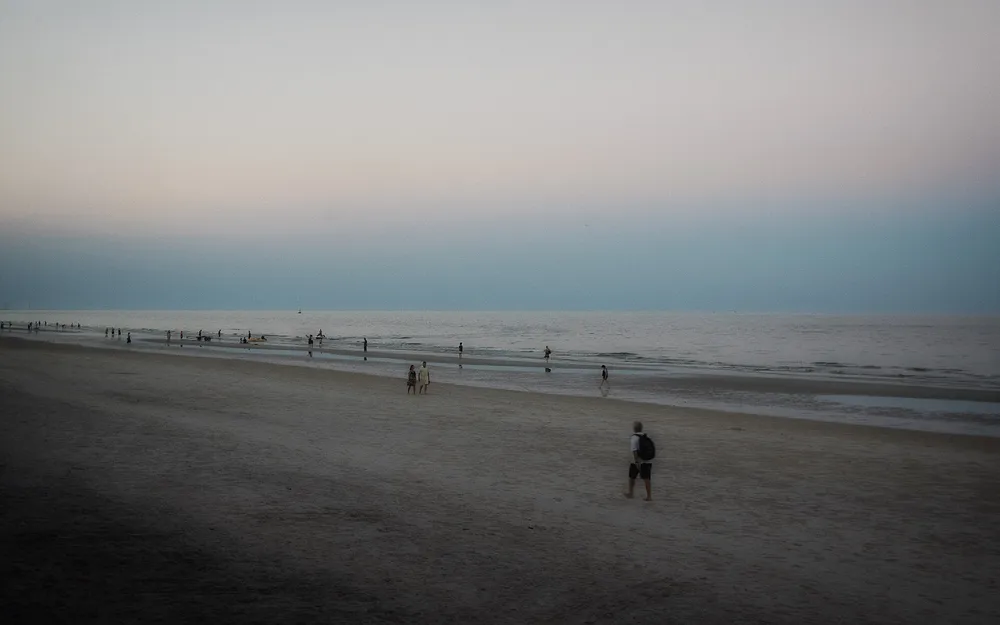 Photo: Hua Hin sunset beach — CC0/Wikimedia
Top Attractions in Hua Hin
1. Hua Hin Railway Station — One of Asia's Most Beautiful Stations
Built in 1911 during King Rama VI's reign, the Hua Hin Railway Station is a masterpiece of Victorian-era design — red-and-gold arched canopies, white ornate columns, and a royal waiting pavilion. It's still operational (real trains stop here), and visitors can walk the platform freely without buying a ticket. Free entry, open during train operating hours.
Tip: Come between 7–9 AM for the best light and fewest people — it's a popular photo stop for groups.
2. Khao Takiab Hill & Temple
Ten minutes south of town, Khao Takiab is a limestone hill rising from the coast. The temple on top features a large golden Buddha statue facing the sea, accessible via 128 steps (or by driving around the back). Along the way: dozens of macaque monkeys — keep valuables zipped away. At the base, Khao Takiab Beach is quieter than the main beach and ideal for swimming and sunset watching. Free entry; open 6 AM–5 PM.
3. Khao Hin Lek Fai Viewpoint
A hilltop public park with 360-degree views over Hua Hin town and the Gulf. Free, open daily. Best at dawn (6–8 AM) or sunset. Either walk up (about 30 minutes) or drive. This is one of Hua Hin's most underrated spots.
4. Wat Huai Mongkol — World's Largest Luang Pu Thuat Statue
About 20 km outside town, this important pilgrimage site houses the world's largest statue of Luang Pu Thuat, a revered monk believed to protect travelers and fishermen. The grounds also contain shrines to Thao Wessuwan and Ganesha. Free entry; open 5 AM–9 PM. Requires private transport (motorbike or car) — no direct public transport.
5. Mrigadayavan Palace — Royal Teak Masterpiece
Twelve kilometres north toward Cha Am, Mrigadayavan Palace (พระราชนิเวศน์มฤคทายวัน) was built in 1924 for King Rama VI — 16 connected teak buildings on stilts, designed to capture sea breezes from all directions. Calm, beautiful, and rich in detail.
Open: Friday–Sunday only, 9 AM–5 PM | Entry: 90 THB (ground floor) / 316 THB (full access including upper floors) | Dress code: No shorts — sarongs available at the entrance
Day Trips from Hua Hin
Sam Roi Yot National Park — World-Class Nature
65 km south of Hua Hin (1–1.5 hours), Sam Roi Yot ("300 Peaks") is a landscape of limestone karst hills rising from wetlands and mangroves — Thailand's version of Ha Long Bay, on land. It's one of the best birdwatching destinations in Southeast Asia, with over 300 species.
Entry fees: Thai adults 40 THB / Foreigners 200 THB / Vehicles 30 THB. Opening hours: 6 AM–6 PM; trails/caves 8 AM–3 PM.
Phraya Nakhon Cave — Thailand's Most Iconic Nature Photograph
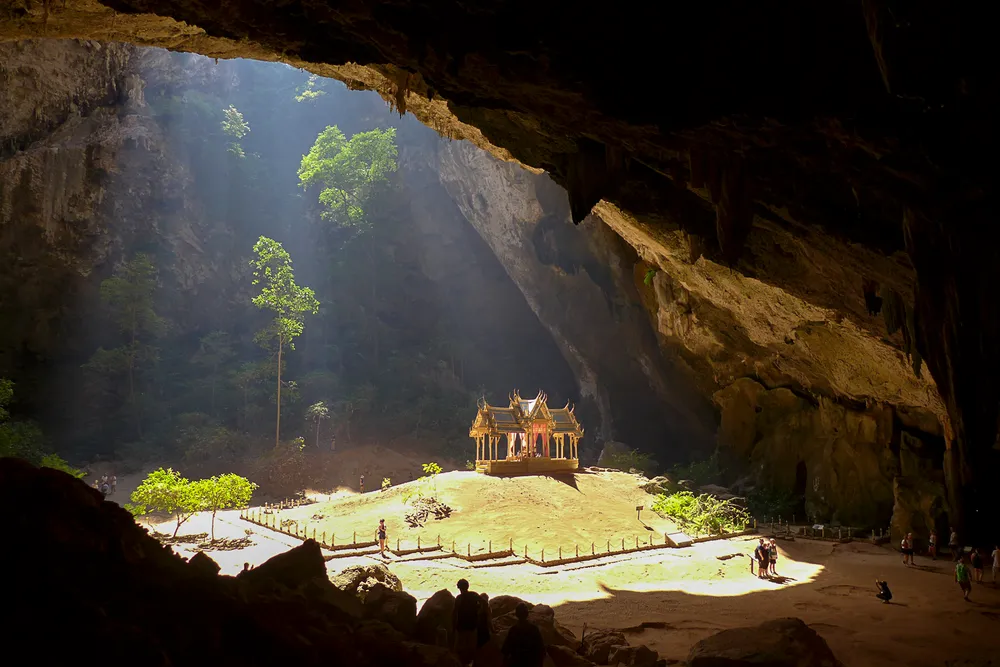 Photo: Phraya Nakhon Cave by David Metcalf — CC BY-SA 4.0 via Wikimedia Commons
Inside Sam Roi Yot National Park, Phraya Nakhon Cave is the one photograph that makes photographers fly to Hua Hin specifically. A massive hole in the cave ceiling lets sunlight pour down to illuminate the Kuha Kharuehat Throne Hall — a small royal pavilion built in 1890 for King Chulalongkorn. The dramatic beam of light on an ornate golden structure inside a vast cave is genuinely unlike anything else in Thailand.
How to get there:
- Drive to Bang Pu village inside the park
- Board a long-tail boat to Laem Sala Beach — approximately 400 THB per boat (~8 people, 15 minutes)
- Hike 500 m uphill from the beach to the cave entrance (sturdy shoes essential)
- Cave entry fee: additional 40 THB
The most important rule: Light inside the cave is best between 10:30–11:30 AM. The boat and cave close at 3 PM. To get good light with time to spare, leave Hua Hin no later than 7:30 AM. This is the one timing mistake that ruins the trip for people who set off mid-morning.
Kui Buri National Park — Wildlife Safari
50–60 km south of Hua Hin, Kui Buri is known as Thailand's "safari" — wild elephants, gaur (bison), and deer come out to feed at dusk, and visitors join evening jeep tours to spot them at close range (10–30 metres). Respectful wildlife watching at its best.
Hours: 2–6 PM (last entry 4:30 PM) | Fees: Vehicle 850 THB + Adults 40 THB | Contact: 085-266-1601
Food and Night Markets
Hua Hin's food scene is one of its biggest draws — and the market scene is genuinely exceptional.
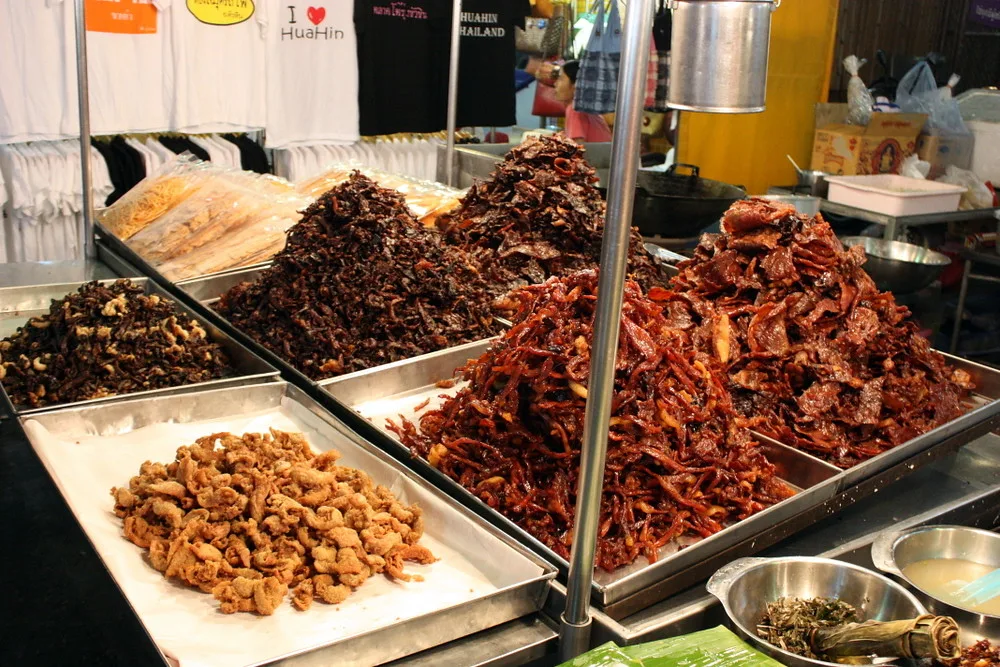 Photo: Hua Hin night market food by goodiesfirst — CC BY 2.0 via Flickr
Night Markets & Artisan Markets
| Market | Hours | Highlights | Price Range |
|---|---|---|---|
| Hua Hin Night Market (Chatchai) | Daily 6 PM–midnight | Fresh seafood, grilled prawns, sweets | 80–200 THB/dish |
| Cicada Market | Fri–Sun 4–11 PM | Crafts, live music, international food | 100–300 THB |
| Tamarind Market | Thu–Sun 5–11 PM | Local food, tamarind tree canopy | 50–150 THB/dish |
| Phae Mai Market | Tue + Thu 4–10 PM | Fresh local produce, cheap food | 20–80 THB |
Cicada Market is the standout — a boutique outdoor bazaar with live music every evening, curated handicrafts, jewelry, and international food stalls. It feels more like a European artisan fair than a typical Thai night market, and it peaks after 6 PM.
Must-Try Local Dishes
Giant river prawns (กุ้งแม่น้ำ): The signature dish of Hua Hin. Prawns weighing 200–400 grams each, grilled, in tom yum, or baked in butter. Expect to pay 150–400 THB per prawn depending on size.
Fresh seafood: Oysters, blue crab in yellow curry, grilled squid, steamed sea bass with lime — consistently cheaper than Bangkok equivalents.
Khao tom kaeng (ขนมหม้อแกง): A local dessert made from eggs, coconut milk, and palm sugar — dense, fragrant, and distinctly from Prachuap province.
Satay: Pork or chicken on skewers with peanut sauce — sold at night market stalls throughout the evening.
Recommended restaurants:
- Saen Suk Som Seafood (Khao Takiab): 180-degree sea views, famous for river prawn tom yum, daily 11 AM–10 PM
- Suk Suk Restaurant (Soi 45): 50-year-old family restaurant in a traditional Thai house, famous for the "suk niyom" fried rice (mixed seafood rice), Mon–Fri 10:30 AM–9 PM
- Jae Khiao Seafood (Takiab Rd): Squid, crab, seafood curries, daily 10 AM–10 PM
Accommodation for Every Budget
| Level | Examples | Cost (THB/night) |
|---|---|---|
| Budget | Soi Bintabath hostels, Naresdam Rd guesthouses | 400–900 |
| Mid-range | S3 Hua Hin Hotel, boutique hotels near beach | 900–3,000 |
| Upper | NH Hua Hin (opened Jan 2026), The Standard Hua Hin | 3,200–9,600 |
| Luxury | Anantara Hua Hin, Hyatt Regency, Marriott Hua Hin | 7,000–15,000+ |
New for 2026:
- NH Hua Hin opened January 2026 (Minor Hotels group) — 152 rooms, rooftop bar, 3 restaurants
- Anantara Hua Hin completed major renovation in 2025 for its 25th anniversary — new adult-only pool, CrossFit zone, kids' club
- The Barai by Hyatt — new wellness resort expected to open late 2026
Booking tips:
- Weekday rates are 30–50% below weekend rates — if your schedule allows it, that's significant savings
- Book 2–3 weeks ahead for holiday weekends — good hotels fill up fast
- The "town center" zone (near the Night Market and Railway Station) puts you within walking distance of everything
3-Day / 2-Night Itinerary from Bangkok
Day 1: Arrival — Beach — Railway Station — Night Market
| Time | Activity | Approximate Cost |
|---|---|---|
| 6:00–7:00 AM | Leave Bangkok (minivan/train) | 200–250 THB |
| 9:30–10:30 AM | Check in / freshen up | — |
| 10:30 AM–noon | Hua Hin main beach — horse riding | 200–400 THB (horse) |
| Noon–1:30 PM | Lunch: seafood | 150–300 THB |
| 2:00–3:30 PM | Hua Hin Railway Station | Free |
| 4:00–5:30 PM | Khao Hin Lek Fai viewpoint | Free |
| 6:00–9:00 PM | Chatchai Night Market — seafood dinner | 150–300 THB |
Day 2: Temple — Sam Roi Yot Day Trip — Cicada Market
| Time | Activity | Approximate Cost |
|---|---|---|
| 7:00–8:00 AM | Khao Hin Lek Fai sunrise | Free |
| 8:30–10:00 AM | Wat Khao Takiab — Khao Takiab beach | Free |
| 10:30 AM–3:00 PM | Sam Roi Yot NP + Phraya Nakhon Cave | 40 + 40 + 400 THB (boat) |
| 3:30–5:30 PM | Back to Hua Hin, rest, hotel pool | — |
| 6:00–11:00 PM | Cicada Market (Fri–Sun) or Tamarind Market | 200–500 THB |
Day 3: Wat Huai Mongkol — Mrigadayavan Palace — Return
| Time | Activity | Approximate Cost |
|---|---|---|
| 8:00–10:00 AM | Wat Huai Mongkol (world's largest Luang Pu Thuat) | Free |
| 10:30 AM–12:30 PM | Mrigadayavan Palace (Fri–Sun only) | 90–316 THB |
| 12:30–2:00 PM | Lunch + souvenir shopping | 150–300 THB |
| 3:00–4:00 PM | Check out — depart to Bangkok | 200–250 THB |
Budget Breakdown: 3 Days / 2 Nights (per person)
| Item | Budget | Mid-Range | Comfortable |
|---|---|---|---|
| Accommodation (2 nights) | 500–900 | 1,800–4,000 | 7,000–15,000 |
| Food (3 days) | 400–600 | 1,000–2,000 | 2,500–5,000 |
| Transport (BKK round trip) | 90–300 | 400–500 | 2,000–6,000 |
| Attraction entry fees | 200–400 | 400–900 | 900–1,500 |
| Motorbike rental (2 days) | 400–500 | 400–500 | — |
| Markets/shopping | 200–500 | 500–1,500 | 2,000+ |
| Total estimate | 1,790–3,200 | 4,500–9,400 | 14,400–28,500 |
Insider Tips and Common Mistakes
Mistakes that cost time or money:
-
Buying minivan tickets on Khao San Road (600–1,200 THB) — The correct price from the Southern Bus Terminal is 200–250 THB. You pay 4–5× more for the exact same trip.
-
Arriving at Phraya Nakhon Cave mid-morning — If you leave Hua Hin after 8 AM, you'll either miss the best light window (10:30–11:30 AM) or be rushed. Leave by 7:30 AM.
-
Driving to Hua Hin on Friday evening — Bangkok outbound traffic on Friday evenings adds 2–3 hours to the journey. Leave before 6 AM, or after 9 PM, or switch to Saturday morning.
-
Not agreeing on a tuk-tuk price before getting in — Some drivers will quote a higher price on arrival. Always confirm the fare before departure.
-
Expecting Andaman-quality blue water — Hua Hin's Gulf water is green and somewhat murky. If crystal-clear water is your priority, go to Krabi or Koh Samui instead. Hua Hin's appeal is culture, food, nature trips, and accessibility — not snorkeling water.
-
Wearing shorts to Mrigadayavan Palace — Shorts and short skirts are not allowed. Sarongs are available at the entrance, but it's more comfortable to come prepared.
-
Carrying no cash — Night market stalls, massage parlors, and small temples are cash-only. Withdraw at an ATM in Bangkok or at a Hua Hin bank branch.
Tips that give you an advantage:
- Weekdays over weekends — Quieter, cheaper hotels (30–50% less), better restaurant service, and no parking chaos. Worth rearranging your schedule for.
- Rent a motorbike (200–250 THB/day) — The best way to reach Khao Takiab, Wat Huai Mongkol, and rural areas. Requires a valid license.
- Blue songthaews (shared pickup trucks) run the main road for 10–20 THB per person — use them instead of pricey taxis within town.
- Cicada Market gets busy after 6 PM — arriving at 4 PM gets you a half-empty market; the atmosphere only builds after sunset.
- July–August has the lowest seafood prices of the year — restaurants compete harder during low season and portions are often more generous.
- Buy Vana Nava water park tickets on Klook or Traveloka — typically 900–1,100 THB vs 1,299 THB at the gate.
If you're driving and planning multiple stops, check out our guide to road-tripping around Thailand for route tips. And Kanchanaburi is just 3–4 hours away if you want to extend the trip inland.
Verdict: Who Should Go to Hua Hin?
| Traveler Type | Good Fit? | Reason |
|---|---|---|
| Families with children | ✅ Excellent | Calm sea, family temples, Vana Nava water park |
| Couples / honeymoon | ✅ Excellent | Romantic atmosphere, Cicada market, luxury resorts |
| Friend groups | ✅ Good | Markets, food, outdoor activities, reasonable prices |
| Nature lovers | ✅ Excellent | Sam Roi Yot, Kui Buri wildlife, Phraya Nakhon Cave |
| Photography enthusiasts | ✅ Excellent | Railway station, palace, cave, viewpoints |
| Clear-water beach seekers | ⚠️ Not ideal | Gulf water is murky green — choose Krabi or Samui |
| Nightlife seekers | ❌ Not ideal | Choose Pattaya or Phuket instead |
Hua Hin is not Thailand's most beautiful beach. But it might be Thailand's most complete beach destination — history, food, national parks, artisan markets, family activities, and accessibility, all within 3.5 hours of Bangkok. Go on a weekday, plan your cave visit for the right time, and don't expect Andaman-quality water — and you'll almost certainly want to come back.
Before you go, consider getting domestic travel insurance — especially if you plan to ride a motorbike, hike in national parks, or do any water activities. A policy covering accidents and medical costs starts at just a few dozen baht per day.
Sources
- Hua Hin Travel Guide 2026 — huahinvibes.com
- Things to Do in Hua Hin in July — thingstodoinhuahin.com
- Hua Hin Budget Travel Itinerary — byklo.rent
- Hua Hin Night Market Guide — loligoresort.com
- NH Hua Hin Hotel opening 2026 — huahintoday.com
- Anantara Hua Hin renovation 2025 — TTG Asia
- Bangkok–Hua Hin transport — 12go.com
- Weather in Hua Hin July — weather2travel.com
Frequently asked questions
- Is Hua Hin worth visiting in July or August?
- Yes — Hua Hin sits on the Gulf of Thailand coast, which has a different monsoon pattern than the Andaman (Phuket/Krabi) side. July mornings are usually sunny; rain typically comes in the afternoon as brief showers. Accommodation is 30–40% cheaper than high season, and crowds are much thinner.
- What is the cheapest way to get from Bangkok to Hua Hin?
- Third-class train (45–90 THB, 4–4.5 hours from Hua Lamphong or Bang Sue) is cheapest. For speed and convenience, the minivan from Southern Bus Terminal costs 200–250 THB and takes 3–3.5 hours. Avoid buying tickets at Khao San Road — you'll pay 600–1,200 THB for the same trip.
- How do you get to Phraya Nakhon Cave?
- Drive 65 km south to Sam Roi Yot National Park → take a long-tail boat from Bang Pu village to Laem Sala Beach (~400 THB per boat, ~8 people, 15 minutes) → hike 500 m uphill to the cave entrance. Cave entry is an additional 40 THB. Best light is 10:30–11:30 AM.
- How is Hua Hin different from Pattaya?
- Hua Hin is quieter, more family-oriented, and has a stronger cultural identity (royal heritage, historic railway station, art markets). The beach isn't as developed for nightlife. Pattaya has more nightlife and water activities but a more chaotic atmosphere. For relaxation, culture, and nature day-trips, Hua Hin wins.
- Do I need travel insurance for Hua Hin?
- Strongly recommended — especially if you plan to rent a motorbike, hike in national parks, or do water activities. Domestic travel insurance covers accidents, medical costs, and trip cancellation, and typically starts at just a few dozen baht per day.
Related articles
Pattaya Travel Guide 2026 — Highlights, Real Costs & a 3-Day Itinerary
Complete 2026 Pattaya travel guide: Koh Larn, Sanctuary of Truth, Nong Nooch, getting there, real budgets, hotels for every budget, plus a 3-day itinerary.

Chiang Mai Travel Guide 2026: Complete Guide to Doi Suthep, Doi Inthanon, Night Markets, 3-Day Itinerary & Real Costs
Complete Chiang Mai travel guide for 2026 — Doi Suthep, Doi Inthanon, Wachirathan Waterfall, Sunday Walking Street, northern Thai food, 4 ways to get there, accommodation for every budget, real costs, and a 3-day 2-night itinerary.

Koh Samui Travel Guide 2026: Complete 3-Day Itinerary, Real Costs & Tips
Koh Samui travel guide 2026 — why July is the best month to visit, getting there from Bangkok, real costs, where to stay, and a 3-day itinerary.