Kanchanaburi Travel Guide 2026: Complete 3-Day Itinerary — Erawan Falls, River Kwai Bridge & Real Costs

Watch more: Erawan National Park, Kanchanaburi — 7-tier waterfall by Bugaboo Travel
Few destinations within two hours of Bangkok offer the sheer variety of Kanchanaburi — a single province where you can swim in a turquoise seven-tiered waterfall, walk across a World War II railway bridge, ride a vintage train through a limestone gorge, and sleep on a floating raft house over the river, all in the same trip.
What surprises most visitors is that Kanchanaburi is actually at its most beautiful during rainy season (July–October). The Erawan waterfalls fill with deep jade-green water, the jungle turns a vivid green, visitor numbers drop significantly compared to the December–February peak, and raft-house accommodation costs 20–40% less.
This guide covers everything you need to plan your Kanchanaburi trip in 2026 — from entrance fees and transport options to accommodation at every budget, a realistic day-by-day itinerary, actual costs, and key tips for visiting in the wet season.
Why Rainy Season Is the Best Time to Visit Kanchanaburi
Kanchanaburi is one of the rare Thai destinations where the rainy season is genuinely better than the dry season — and the reason comes down to what makes it famous: waterfalls.
Erawan's famous colour: In the dry season (December–March), water levels drop, pools become shallow and the legendary turquoise colour fades. In rainy season, the pools fill completely, and the vivid blue-green you see in photos is at its most intense. Most of those photos were shot in July–September.
What rain actually looks like here: Unlike the Thai south, Kanchanaburi doesn't get all-day downpours. Typical rainy-season weather means clear mornings, with rain arriving in the afternoon (roughly 14:00–17:00) for one to two hours, then stopping. July averages around 216 mm of rain across 15–18 days — but not continuous all-day rain.
Advantages of visiting in rainy season:
- Waterfalls are full, vivid, and at peak beauty
- Jungle is intensely green; temperatures are more pleasant than March–April
- Far fewer tourists than peak season (Erawan doesn't feel crowded on weekdays)
- Accommodation prices 20–40% lower than the December–February high season
Key caveats: Tier 7 at Erawan may close temporarily after heavy rain. Some forest trails become muddy with leeches. River levels rise — don't swim in the main River Kwai after heavy rain. Plan outdoor activities for morning, and keep afternoons flexible.
Erawan National Park — Thailand's Most Beautiful Multi-Tier Waterfall
Erawan National Park is Kanchanaburi's number-one highlight and ranks among the most beautiful natural attractions in Southeast Asia. The seven cascading tiers produce pools of extraordinary turquoise water fed by mineral-rich limestone springs, surrounded by dense jungle.
Entrance Fees and Essential Information
| Item | Price |
|---|---|
| Adult (Thai national) | 60 THB |
| Child 3–14 (Thai national) | 30 THB |
| Adult (foreign visitor) | 300 THB |
| Child (foreign visitor) | 150 THB |
| Car parking | 30 THB |
| Motorbike parking | 20 THB |
| Golf cart ride within park | 20 THB per person |
Opening hours: 08:00–16:30 daily (last entry 15:30)
Important: The park has a visitor cap on busy days. Arrive before 08:00 and visit on weekdays to guarantee entry without waiting.
The Seven Tiers — What to Expect at Each
The trail from the car park to tier 7 covers about 1.5 km and takes 3–4 hours for the full return trip.
Tier 1 — Wide and family-friendly: A broad, shallow pool with sandy bottom. The easiest tier, accessible to everyone including small children. Shaded and comfortable for long stays.
Tier 2 — Doctor Fish Pool (Wang Macha): Hundreds of Garra rufa fish inhabit this pool and nibble dead skin from your feet and ankles — ticklish but harmless. This is the last tier where food is permitted. Deposit your drinks bottles (20 THB refundable per bottle) before going higher.
Tier 3 — The Photographer's Tier: A tall cascade with an excellent pool below. Moderately steep trail but well-maintained with handrails. The most-photographed view in the park.
Tier 4 — Natural Rock Slide: A smooth limestone chute that visitors use as a natural waterslide into the pool below. One of the most popular tiers with groups.
Tiers 5–6: Very clear water, fewer people, genuine wilderness feeling. Great for a quiet swim.
Tier 7 — The Summit: Panoramic views and pristine pools, but requires scrambling up steep rock faces. May be closed during heavy rain. If open, wear proper water shoes (not flip-flops) and take extreme care.
Park rules:
- No food above tier 2
- Plastic bottles require a 20 THB refundable deposit per bottle
- No sunscreen in the water (protects the ecosystem)
- Water shoes or grip sandals strongly recommended for all tiers
Wildlife you'll encounter: Crab-eating macaques (common — don't feed them), water monitor lizards up to 1.5 m long (harmless), hornbills, and gibbons deep in the forest.
Bridge on the River Kwai and the Death Railway
The Bridge on the River Kwai in Kanchanaburi town is one of Thailand's most internationally recognised landmarks. Built by Allied POWs forced to labour under brutal conditions during the Second World War, the bridge still carries trains along what was known as the Death Railway.
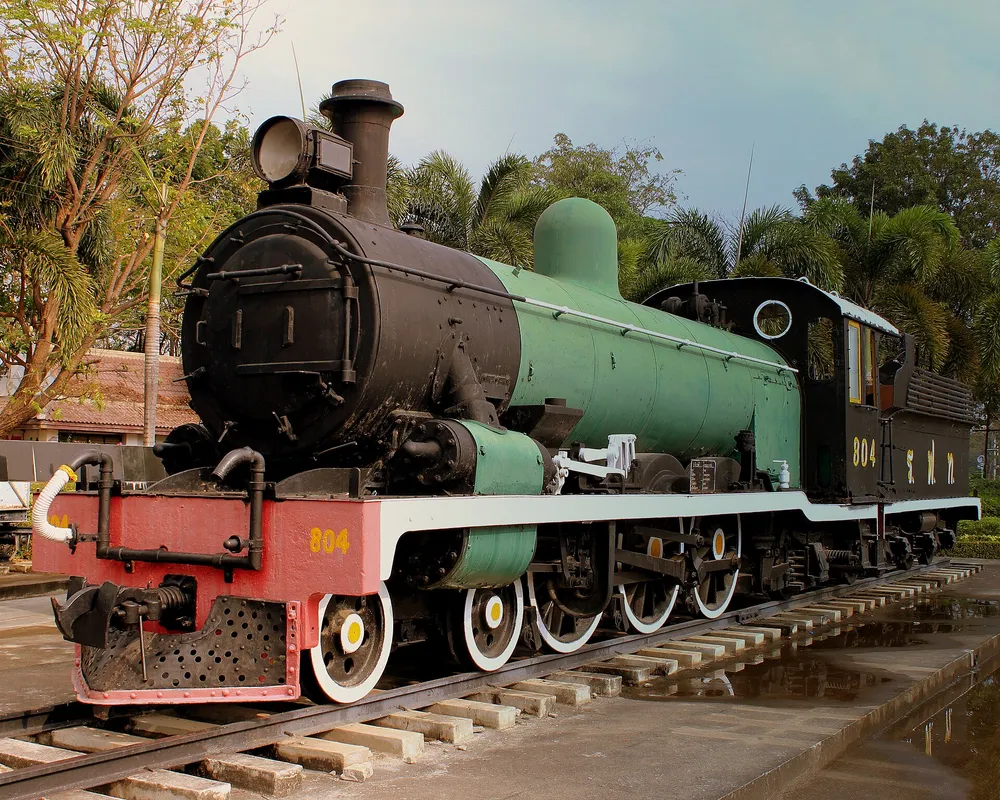 Photo: Steam locomotive, Kanchanaburi — Wikimedia Commons
Entrance fee: Free. The bridge is open 24 hours and free to walk across.
What to do:
- Walk across the bridge — about 300 metres, 15–20 minutes (listen for the bell when a train approaches)
- Look closely at the curved steel spans: arches 4 and 6 (counting from the west bank) are original World War II construction; the remaining spans were rebuilt after Allied bombing
Riding the Death Railway — The Real Experience
The true essence of the Death Railway isn't just the bridge: it's riding the train from River Kwai Bridge station westward to Nam Tok station, following the original wartime railway through limestone gorges, over the stunning Wangpo Viaduct (which juts out over the river on a sheer cliff face), and through sections of dense jungle that no road reaches.
| Route | Price | Journey time |
|---|---|---|
| Bangkok (Thonburi) → Nam Tok | 100 THB | ~4.5 hours |
| Bangkok (Thonburi) → Kanchanaburi | 100 THB | ~2.5 hours |
| Kanchanaburi/River Kwai Bridge → Nam Tok | 100 THB | ~2 hours |
Departure times from Bangkok Thonburi Station:
- Train 1: Departs 07:50 → Kanchanaburi 10:25 → River Kwai Bridge 10:44 → Nam Tok 12:30
- Train 2: Departs 13:55 → Kanchanaburi 16:24 → River Kwai Bridge 16:33 → Nam Tok 18:30
Buying tickets: Purchase in person at Bangkok Thonburi Station or Kanchanaburi Station on the day of travel. No online advance booking is available. Third class only — open seating with windows you can lean out of. Sit on the right side heading out from Bangkok for river views.
Hellfire Pass (Konyu Cutting) — The Most Moving Historical Site
Hellfire Pass — officially the Konyu Cutting — is one of the most challenging sections of the Death Railway, a 25-metre-deep cut blasted and chiselled by hand through solid granite. Allied POWs worked night shifts by torchlight in conditions so grim that the site was nicknamed "Hellfire Pass" by the prisoners themselves. Thousands died here.
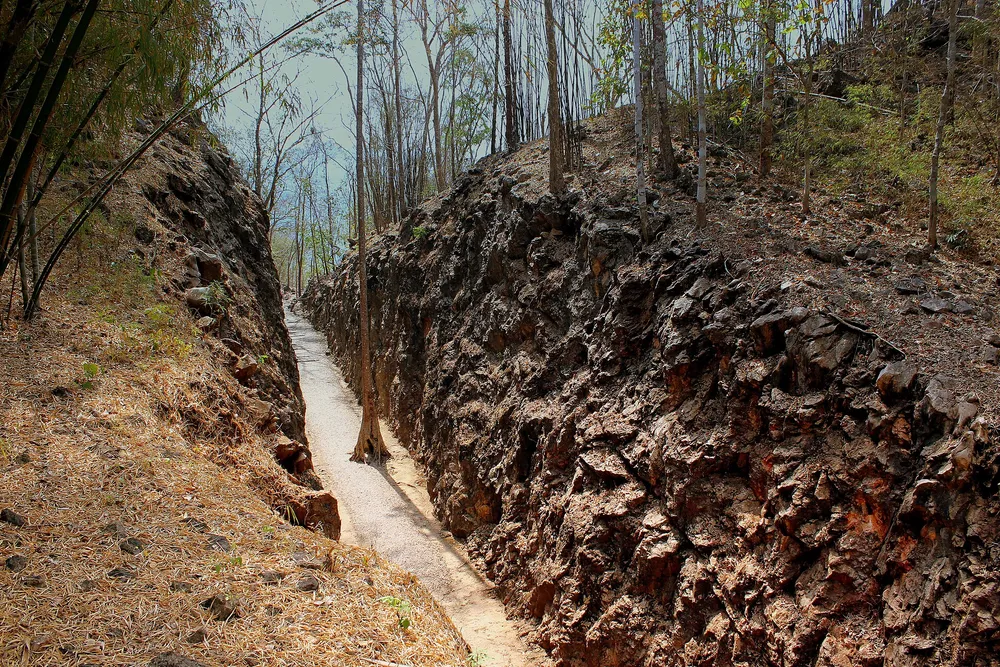 Photo: Hellfire Pass, Konyu Cutting, Kanchanaburi — Wikimedia Commons
Entrance fee: Free | Audio guide: 200 THB refundable deposit
Opening hours: 09:00–16:00 daily (closed Christmas Day)
Distance from Kanchanaburi town: ~80 km along Route 323 heading north (~1.5–2 hours by car)
What You'll See and Do
The museum: Before descending to the cutting, pass through a small but powerful interpretive museum — housed in the former Imperial Japanese Army headquarters — with personal testimonies from survivors, tools, maps, photographs, and recorded accounts. Allow 30–45 minutes. The audio guide is worth the deposit.
Walking trails:
- Blue Trail (Short): ~1 km / 35 minutes — walks you through the cutting itself and back. Accessible for everyone, manageable even in light rain.
- Green Trail (Long): ~6 km / 3 hours — follows the original railway through forest. Rewarding for hikers; bring water and insect repellent, no toilets on trail.
Practical notes: Bring water, DEET-based insect repellent, and proper closed shoes. Allow at least 2 hours total for the museum plus short trail.
Getting to Hellfire Pass
- By car: Take Route 323 north from Kanchanaburi town, past Sai Yok Noi (60 km), continuing a further 34 km to the site. Straightforward but has winding sections through the hills.
- By public transport: Bus 8203 from Kanchanaburi Bus Station, or take the morning train to Nam Tok station and connect by songthaew.
Other Kanchanaburi Highlights Worth Visiting
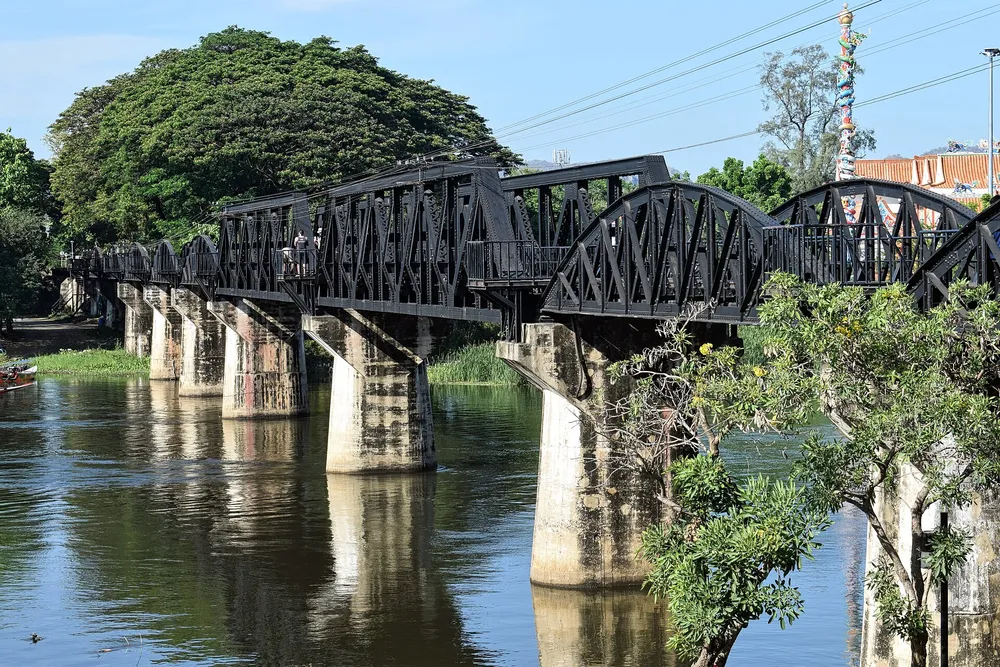 Photo: Bridge on the River Kwai, Kanchanaburi — Wikimedia Commons
Sai Yok Noi Waterfall — Free and Accessible by Train
Located about 60 km northwest of Kanchanaburi town, Sai Yok Noi has a unique characteristic: the railway station is built right beside the waterfall. Step off the Death Railway train and you're a two-minute walk from a wide cascade that tumbles directly into the River Kwai. In rainy season the flow is powerful and dramatic. No entrance fee. The train is the most scenic and convenient way to get here.
Sai Yok National Park — The Bigger Falls and Caves
A further 40 km past Sai Yok Noi (about 100 km from Kanchanaburi town), Sai Yok National Park contains the larger Sai Yok Yai waterfall, raft houses on the river, Daowadung Cave with impressive stalactites, and the only habitat of Kitti's Hog-nosed Bat — the world's smallest mammal, found exclusively in caves along this stretch of the Kwai Noi River. Entrance fee: 300 THB (foreigners) / 60 THB (Thai nationals).
Kanchanaburi War Cemetery (Don Rak)
Located in the town centre, this immaculately maintained cemetery holds 6,982 graves of Allied prisoners of war — British, Australian, and Dutch — who died during the construction of the Death Railway. Maintained by the Commonwealth War Graves Commission. Allow 30–45 minutes; the impact is deeply felt.
| Attraction | Fee | Hours |
|---|---|---|
| Kanchanaburi War Cemetery | 50 THB | 08:00–16:00 |
| Thailand-Burma Railway Centre (TBRC) Museum | 160 THB adults / 80 THB children 7–12 | 09:00–16:00 |
| JEATH War Museum | 40–50 THB | 08:30–18:00 |
Recommendation: If you only have time for one museum, choose TBRC — the most comprehensive exhibition on the railway's history, housed in the original Japanese army headquarters building. Budget 1.5–2 hours.
How to Get from Bangkok to Kanchanaburi
| Method | Cost | Travel time | Best for |
|---|---|---|---|
| Own car (M81 Motorway) | Max ~150 THB toll | 1.5–2 hours | Groups/families, maximum flexibility |
| Bus from Southern Terminal (Sai Tai Mai) | 110 THB/person | 2.5–3 hours | Solo or couple, budget-conscious |
| Minivan from Mo Chit | 120–150 THB/person | ~2.5 hours | Slightly faster than bus |
| Train from Thonburi Station | 100 THB/person | 2.5–3 hours | For the experience; only 2 departures/day |
Driving — The Most Flexible Option
Use the M81 Motorway from the Bang Yai interchange (Nonthaburi), opened in late 2025. It runs 96 km straight to Tha Muang/Kanchanaburi at 120 km/h. Maximum toll for the full route is around 150 THB, payable by M-Flow (electronic) or cash. Total drive time from central Bangkok: approximately 1.5–2 hours in normal traffic.
The big advantage of driving is flexibility: you can cover Erawan, Hellfire Pass, and Sai Yok in a single trip without waiting for public transport. Rent a motorbike in town (250–350 THB/day) for easy access within Kanchanaburi itself.
Bus — Cheapest and Most Frequent
Southern Bus Terminal (Sai Tai Mai) operates buses every 20 minutes from 04:00–20:00 for 110 THB. Journey takes 2.5–3 hours to Kanchanaburi Bus Terminal. From there, connect by songthaew or motorbike taxi to your accommodation or the bridge area.
Train — Slow, Scenic, Memorable
Worth experiencing even if you're not a rail enthusiast — this is one of the most beautiful rail journeys in Thailand. Departs from Bangkok Thonburi Station (not Hua Lamphong). Only 2 services per day (07:50 and 13:55), third class only, tickets on the day only. Sit on the right side heading outbound from Bangkok for river views through the gorge section.
Strategy: Take the 07:50 train from Bangkok, arrive at River Kwai Bridge ~10:44, explore the bridge and have lunch, then take the train onward to Nam Tok for the dramatic gorge scenery in the afternoon — returning to Kanchanaburi by songthaew for the night.
Accommodation in Kanchanaburi — Every Budget
Kanchanaburi's standout accommodation experience is the raft house — a floating bungalow moored on the river or a reservoir — an experience unique to this province.
Budget (Under 1,500 THB/night)
| Property | Starting price | Type | Highlights |
|---|---|---|---|
| Lake Heaven Resort | ~780 THB/night | Raft house, Srinakarin Dam | Mountain views, serene nature setting |
| Ruknam Resort | ~890 THB/person | Maldives-style riverside | Very Instagram-friendly |
| The Water Park Resort | ~890 THB/person | Raft + water activities | Kayaking, great for kids |
| Kwainoi Resort | ~1,000 THB/night | Raft + pool | Breakfast included |
| The Zeit River Kwai | ~1,200 THB/night | Boutique hotel near bridge | Pet-friendly, riverside café |
Mid-Range (1,500–4,000 THB/night)
| Property | Starting price | Highlights |
|---|---|---|
| Heaven Kwai Resort | ~1,300 THB/night | Mountain views, ATV, rock climbing, paintball |
| Princess River Kwai Hotel | ~1,700 THB/night | Standard hotel, river view, pool, breakfast |
| The Tryst River Kwai | ~2,200 THB/night | Forest Loft raft, private balconies, bathtubs, buffet breakfast |
| Raintree Boutique | ~3,400 THB/night | Boutique riverside, private balconies |
| Historykan | ~3,500 THB/night | Natural stone architecture, pool, river views |
Luxury (4,000+ THB/night)
| Property | Starting price | Highlights |
|---|---|---|
| Cross River Kwae | ~4,200 THB/night | Chic riverside, floating breakfast service |
| Sunburst Resort | ~4,000 THB/night | Mid-river raft, private Jacuzzis on balconies |
| Tara Villa River Kwae | ~5,400 THB/night | Minimalist pool villas, afternoon tea, fitness centre |
Tip: Book raft houses in advance even in low season — the most popular properties sell out on weekends and public holidays.
Sample 3-Day, 2-Night Kanchanaburi Itinerary
Day 1: Bangkok → Kanchanaburi → Bridge and Museums
| Time | Activity | Estimated cost |
|---|---|---|
| 07:00 | Depart Bangkok (car/bus/train) | 100–150 THB/person |
| 09:30–10:30 | Arrive Kanchanaburi, check in | — |
| 10:30–12:00 | Bridge on the River Kwai + riverside walk | Free |
| 12:00–13:00 | Lunch at Taraburee or Keeree Tara | 100–250 THB |
| 13:00–15:00 | Thailand-Burma Railway Centre Museum | 160 THB |
| 15:30–16:30 | Kanchanaburi War Cemetery | 50 THB |
| 17:00 | Evening market / JJ Night Market | 100–200 THB |
| 18:30 | Dinner + relaxation at raft house | 150–300 THB |
Day 2: Erawan National Park (Full Day)
| Time | Activity | Estimated cost |
|---|---|---|
| 07:00 | Depart accommodation by motorbike/car | 30 km / ~30 minutes |
| 07:45 | Arrive at park gate, queue for opening | 60 THB Thai / 300 THB foreign |
| 08:00–12:00 | Walk tiers 1–7 (or 1–6 if tier 7 closed) | — |
| 12:00–13:00 | Lunch at stalls outside the park | 80–150 THB |
| 13:00–15:00 | Return to tiers 1–2 for swimming and doctor fish | — |
| 15:30 | Return to accommodation | — |
| 18:30 | Dinner + optional sunset boat cruise | 150–500 THB |
Day 3: Hellfire Pass → Return to Bangkok
| Time | Activity | Estimated cost |
|---|---|---|
| 07:30 | Checkout, breakfast | — |
| 08:00 | Drive north to Hellfire Pass (~80 km, 1.5 hours) | Fuel ~100 THB |
| 09:30–12:00 | Hellfire Pass — museum + Blue Trail (1 km) | Free |
| 12:00–13:00 | Lunch en route | 80–150 THB |
| 13:30 | Return drive to Bangkok, arrive ~15:30–16:00 | — |
Optional stop: Sai Yok Noi waterfall is on the way back (free, roadside) — worth a 30-minute stop if you have time.
Budget Summary — 3 Days, 2 Nights (Per Person)
| Item | Budget traveler | Comfortable |
|---|---|---|
| Bangkok ↔ Kanchanaburi transport (round trip) | 220 THB (bus) | 300–500 THB (minivan/fuel share) |
| Accommodation (2 nights, per person) | 800–1,200 THB | 2,200–4,000 THB |
| Park entrance fees (Erawan + War Cemetery + TBRC) | 270 THB Thai / 510 THB foreign | Same |
| Food (3 days × 200 THB) | 600 THB | — |
| Food (3 days × 500 THB) | — | 1,500 THB |
| Local transport (motorbike rental etc.) | 200–300 THB | 500–700 THB |
| Hellfire Pass | Free | Free |
| Miscellaneous (souvenirs, water, snacks) | 200 THB | 500 THB |
| Total | ~2,600–3,200 THB | ~6,000–8,000 THB |
Local Food and Recommended Restaurants
Kanchanaburi has a distinct food culture built around its abundant freshwater rivers. Don't leave without trying:
Local specialties to order:
- Pla Kang (Giant Catfish): The province's signature fish, weighing up to 150 kg in the wild. Sold by the kilo (~270 THB/kg), prepared fried with garlic, grilled, or in spicy herb soup.
- Pla Chon Ob Fang (Straw-baked Snakehead): A traditional cooking method — the fish is wrapped in straw and baked over fire, sealing in moisture with a distinctive aroma. Must-try.
- Jungle Curry (Kaeng Pa): Herb-intense Thai curry without coconut milk, made with local river fish and foraged vegetables. More complex flavour than standard curries.
- Khao Soi: Northern Thai-style coconut curry noodles, widely available in Kanchanaburi restaurants.
- Khanom Chin Nam Ya: Rice noodles with fish curry gravy, sold at morning markets for 30–40 THB per bowl.
Recommended restaurants:
| Restaurant | Style | Estimated spend |
|---|---|---|
| Taraburee (ธาราบุรี) | Authentic local Thai, riverside | 80–150 THB/person |
| Keeree Tara | Thai, premium riverside setting | 150–300 THB/person |
| Good Times Restaurant | Thai + Western, live music evenings | 150–250 THB/person |
| On's Thai-Issan Vegan | Vegetarian/vegan, good value | 60–120 THB/person |
| JJ Night Market | Street food, evening market | 30–80 THB/dish |
JJ Night Market near Kanchanaburi train station is the best option for affordable authentic dinners — dozens of stalls selling som tam, grilled fish, pla kang, and more for 30–80 THB per dish.
Practical Tips and Safety Advice for Rainy Season
What to pack:
- Compact rain jacket or poncho — don't leave home without one
- Water sandals with ankle grip or water shoes (essential for waterfall trails)
- Long-sleeved shirt (mosquitoes and UV protection)
- DEET-based insect repellent (leeches are active in jungle trails during rainy season)
- Two spare sets of quick-dry clothing (you will get wet from the waterfalls as well as rain)
- Waterproof bag or dry bag for your phone, wallet, and camera
- Cash — most national park entrances, raft houses in remote areas, and rural restaurants don't accept cards
Safety during rainy season:
- Check weather forecasts the night before visiting Erawan. If heavy rain fell overnight, reconsider ascending above tier 4.
- Never swim in the River Kwai or its tributaries immediately after heavy rain — currents become very strong and water turns murky with debris.
- On mountain roads to Hellfire Pass and Sai Yok: reduce speed significantly, watch for surface water, potholes, and occasional landslip debris.
- Apply sunscreen before going out, but do not enter Erawan's water after applying (park rules; also harms the ecosystem).
Logistical tips:
- Erawan is least crowded Tuesday–Wednesday; arriving at 08:00 on weekdays means no queue.
- Book raft-house accommodation in advance even in low season — the good properties fill on long weekends.
- Mobile signal is good in Kanchanaburi town and around Erawan. Signal weakens considerably in the Hellfire Pass and deep Sai Yok areas.
- Rent a motorbike in town (250–350 THB/day) for maximum flexibility — many of the best spots are awkward to reach by public transport.
For road trip preparation and driving in the wet season, see our guide to driving safely in rainy season Thailand. If you're planning Gulf coast travel, Hua Hin is just 3–4 hours from Kanchanaburi and makes a great add-on.
Verdict: Is Kanchanaburi Worth Visiting in Rainy Season?
Yes — emphatically. And if you haven't been, Kanchanaburi deserves a top spot on your Thailand bucket list regardless of the season.
What makes Kanchanaburi exceptional is the breadth of what it offers: world-class natural beauty (Erawan), historically significant and emotionally resonant sites (the bridge and Hellfire Pass), and one of the most authentic overnight experiences in Thailand (sleeping on a raft house over the river). All within 130 km of Bangkok.
Best for:
- Families with children: Erawan's lower tiers, the bridge, the train ride — children love all of it
- Couples: Raft houses with private balconies, sunset over the river, excellent river-view restaurants
- Friend groups: Activity-packed, affordable, accessible — easy to fill three days without running out of things to do
- Solo travellers: Safe, well-trodden, with a large international visitor community — easy to find company
The only real limitation in rainy season: Tier 7 at Erawan may be closed, and outdoor activities need to be planned for morning hours. Neither is a reason not to go — adjust the itinerary accordingly.
Before you leave, make sure you have domestic travel insurance in place. Rainy season means increased risk from road accidents on slippery mountain roads, flash floods, and sudden illness — a policy covering medical costs, emergency evacuation, and trip interruption costs surprisingly little and provides real peace of mind for the whole trip.
For more Thailand travel inspiration, see our guides to Khao Yai National Park, Koh Samui in July, the best domestic travel insurance options, and Ubon Ratchathani + Candle Festival 2026.
Sources
- Royal Forest Department, Thailand — Erawan National Park information
- Hellfire Pass Memorial Museum, Tourism Authority of Thailand
- State Railway of Thailand — Southern line (Death Railway) timetables
- Commonwealth War Graves Commission — Kanchanaburi War Cemetery
- Thailand-Burma Railway Centre (TBRC Museum), Kanchanaburi
- Paiduaykan — Rainy Season Travel in Thailand 2026
- Gother — Best Places to Visit in Rainy Season Thailand
Frequently asked questions
- Is Erawan National Park safe to visit during rainy season?
- Yes — the park stays open year-round. Tiers 1–6 are fully accessible in rainy season. Tier 7 may close temporarily if there has been heavy overnight rain. Visit on weekday mornings and check the weather forecast the evening before. Avoid heading to upper tiers if paths are wet and slippery.
- How much does a 3-day, 2-night trip to Kanchanaburi cost?
- Budget traveler: approximately 2,600–3,200 THB per person (shared guesthouse/raft-house, bus transport, eating at markets). Comfortable: approximately 6,000–8,000 THB per person (mid-range riverside raft resort, motorbike rental, sit-down restaurants). Foreign visitors pay slightly more due to national park dual-pricing (300 THB vs 60 THB at Erawan).
- What is the cheapest way to get from Bangkok to Kanchanaburi?
- The cheapest option is the bus from Bangkok's Southern Bus Terminal (Sai Tai Mai) for 110 THB, taking 2.5–3 hours. The train from Thonburi Station costs 100 THB but only has 2 departures daily (07:50 and 13:55). Driving your own car via the M81 Motorway takes 1.5–2 hours with a maximum toll of around 150 THB.
- How much does a raft house in Kanchanaburi cost?
- Budget raft houses start from 780–1,500 THB per night (e.g. Lake Heaven Resort, Ruknam Resort near Srinakarin Dam). Mid-range options run 1,500–4,000 THB per night. Luxury river villas (Cross River Kwae, Tara Villa) start from 4,000–5,400 THB per night.
- How do I buy Death Railway train tickets and what is the cost?
- Tickets are 100 THB one-way (third class only). Buy them in person at Bangkok Thonburi Station or Kanchanaburi Station on the day of travel — there is no online advance booking. The Bangkok → Nam Tok train departs at 07:50 and 13:55 from Thonburi Station (not Hua Lamphong).
- Is Kanchanaburi suitable for families with young children?
- Excellent for families. Erawan tiers 1–2 have shallow, calm water that children love. The River Kwai Bridge is easy to walk across. Hellfire Pass has a short 1 km trail suitable for children aged 5+. The 6 km longer trail is better for older children and adults.
Related articles

Krabi Travel Guide 2026 — Top Attractions, Costs & 3-Day Itinerary
Complete Krabi travel guide for 2026 covering every highlight: Railay Beach, Tiger Cave Temple, 4 Islands tour, Emerald Pool, real costs, transport, accommodation, and tips for the rainy season

Phuket Travel Guide 2026: Beaches, Attractions, Costs & Rainy Season Tips
Complete Phuket travel guide for 2026 covering every beach, top attractions, real costs, transportation, best areas to stay, and essential rainy season tips for a safe, budget-friendly trip.

Koh Samui Travel Guide 2026: Complete 3-Day Itinerary, Real Costs & Tips
Koh Samui travel guide 2026 — why July is the best month to visit, getting there from Bangkok, real costs, where to stay, and a 3-day itinerary.