Car Flood Emergency Guide: What to Do First + Does Car Insurance Cover It? (2026)

Watch: 5-Level OIC Flood Damage Assessment Guide by THE STANDARD WEALTH
Every July and August, Bangkok's afternoon downpours leave streets knee-deep in water — and every rainy season, thousands of car owners face an expensive lesson they wish they'd learned before it happened.
Three questions every car owner should know the answers to before the rain comes: Does my insurance cover flood damage? If my engine stalls in floodwater, what do I do first? And if repairs are needed, how much will it cost?
This guide answers all three — everything from protecting your car before the rain, to filing an insurance claim correctly when things go wrong.
Which Car Insurance Covers Flood Damage?
This is the question most owners don't know the answer to until it's too late:
| Insurance Class | Flood Coverage | Notes |
|---|---|---|
| Class 1 | ✅ Yes — automatic | Flood = natural disaster, not driver's fault. Doesn't affect no-claim bonus |
| Class 2+ | ⚠️ Requires natural disaster add-on | Check your policy — some include it, some require a separate add-on |
| Class 3+ | ❌ No | Covers third-party collision, fire, and theft only |
| Class 3 | ❌ No | Third-party liability only |
| Compulsory (พ.ร.บ.) | ❌ No | Covers bodily injury to third parties only |
Special EV/Hybrid rule (OIC 2025 announcement): Electric and hybrid vehicles that suffer flood damage receive an additional 100,000 THB on top of standard claim coverage. This reflects the fact that EV flood repairs cost 54% more on average than ICE vehicles (approximately 24,000 THB vs 15,500 THB) due to high-voltage battery and drive system costs.
How to check your own policy: Look for the terms "ภัยธรรมชาติ" (natural disaster) or "ภัยอุทกภัย" (flood hazard) in your policy document, or call your insurer directly.
If your current policy is Class 3+, upgrading to Class 2+ with natural disaster coverage before rainy season typically costs only 500–2,000 THB per year — but protects you against six-figure repair bills.
The OIC's 5-Level Flood Damage Assessment
The Office of Insurance Commission (OIC) defines five official damage levels that all insurers must reference:
| Level | Water Reached | Estimated Repair Cost | Notes |
|---|---|---|---|
| A | Floor mats / undercarriage | 8,000–10,000 THB | Cleaning, drying, electrical check |
| B | Seat level / electrical systems | 15,000–25,000 THB | Electrical repairs, seat replacement |
| C | Center console / dashboard | 25,000–80,000 THB | Heavy electrical damage |
| D | Engine bay | 80,000–200,000+ THB | High risk of engine replacement |
| E | Fully submerged | Full insured value payout | Vehicle declared Total Loss |
Total Loss threshold: When repair costs exceed 70% of the vehicle's insured value, the insurer pays the full policy amount and takes ownership of the wreck. In many cases, this is actually the better outcome — because Level D–E repair costs frequently exceed the car's value.
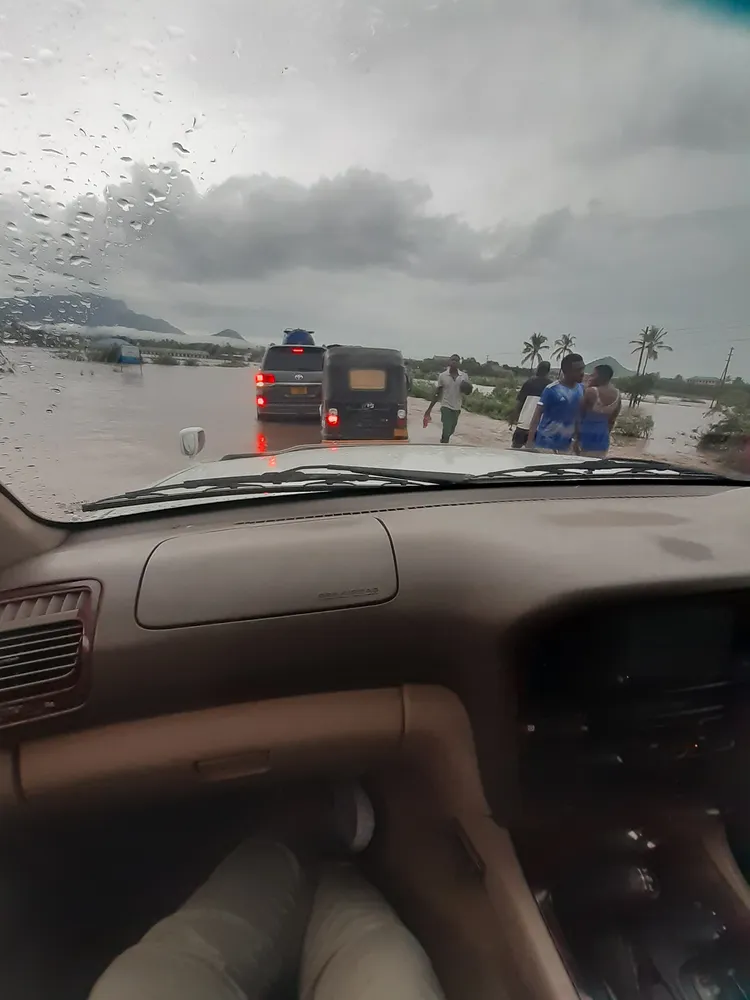 Photo: The driver's perspective when facing a flooded road — the moment when making the right decision matters most (CC BY-SA 4.0 via Wikimedia)
⚠️ Water Hammer — Why You Must Never Restart the Engine
This is the most expensive and most common mistake — restarting the engine when water has entered it.
What is water hammer (hydraulic lock)?
When water enters the combustion chamber through the air intake, the piston attempts to compress it. Unlike air, water is incompressible — so the piston stops abruptly. The result:
- Connecting rod bends or snaps
- Valves warp or break
- Cylinder head cracks
- Crankshaft damaged
Cost if water hammer occurs: 80,000–200,000+ THB, or full engine replacement. In many cases, the repair bill exceeds the car's value.
Warning signs you must stop immediately:
- Engine stalls while driving through floodwater — don't turn the key again
- Unusual knocking or grinding sound from engine
- Engine feels like it's struggling abnormally while in water
The golden rule when the engine stalls in water: Remove the key from the ignition. Don't touch it again. Get out of the car safely, disconnect the battery cable if possible, then call a tow truck.
What to Do (and Not Do) When Your Car Floods
Scenario 1: Engine still running while driving through water
If the engine is running and the car is still moving:
✅ Do:
- Maintain 1,500–2,000 RPM consistently — don't let the revs drop
- Use 1st gear (manual) or L/1 (automatic) and drive slowly
- Lower windows slightly to monitor water level
- Drive to higher ground immediately — don't stop in the water
❌ Don't:
- Turn on the air conditioning (the compressor can draw water into the fan)
- Drive fast (waves push water into the air intake)
- Stop unnecessarily in the floodwater
Safe water depth limit: When water reaches the bottom of the bumper or approaches the exhaust pipe (approximately 30 cm for a standard sedan) — stop and find an alternative route.
Scenario 2: Engine stalls in floodwater
This is an emergency — follow this sequence exactly:
- Stop trying to restart immediately — don't turn the key even once more
- Remove the key from the ignition
- Exit the vehicle if water level is manageable (be aware of current)
- Disconnect the battery cable if you can do so safely (prevents electrical short circuits)
- Call a tow truck — don't let anyone push or pull the car through water
- Call your insurance company — before the car enters any workshop
Scenario 3: Car was parked and got flooded
When you return to find your parked car in floodwater:
- Check engine oil first — pull the dipstick out. If it's milky white = water in the engine. Do NOT start the car.
- Check transmission fluid — strawberry yogurt appearance = water in the gearbox. Do NOT start.
- Photograph everything — water level marks on the car, interior, engine bay, license plate in frame
- Disconnect the battery to prevent short circuits
- Don't dry the carpets in direct sunlight (foam padding and carpet warp and grow mold faster)
- Call your insurer before moving the car
How to File a Flood Insurance Claim Correctly
The correct claim process starts with calling before doing anything else:
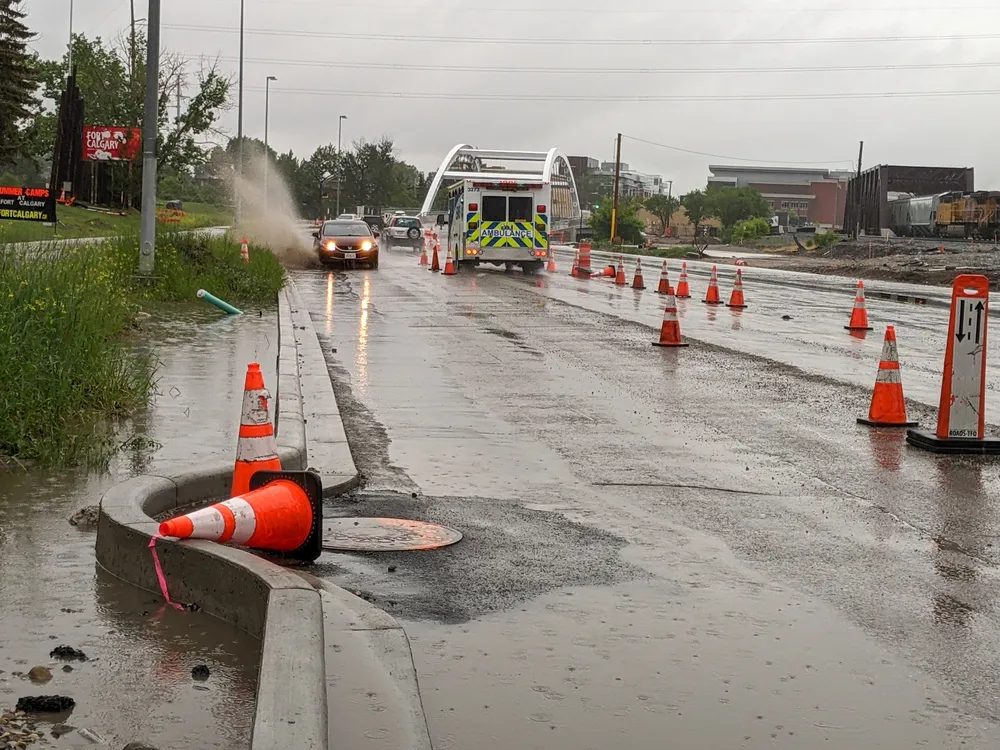 Photo: Urban flooding conditions — situations where calling your insurer first makes all the difference (CC BY-SA via Wikimedia)
Step 1: Notify your insurer immediately (within 24–48 hours)
- Call your insurer's claims hotline (most run a 24-hour line)
- Report the location, time, and approximate water depth
- The insurer will send a claims adjuster to assess the damage
Step 2: Gather documents
- National ID card (copy)
- Driver's license (copy)
- Vehicle registration booklet
- Insurance policy document
- Photos/videos of damage (with timestamp)
- Written description of the incident (date, time, location, water level)
Step 3: Wait for the adjuster
- Don't take the car to a workshop before receiving approval
- If the car must be moved, notify your insurer first
Step 4: Proceed with approved repairs
- If using an in-network workshop → proceed directly
- If using a dealer/authorized center → confirm coverage with insurer first
Processing timeline: Normally 15–30 business days; during major disasters, 2–6 months is possible. The OIC requires insurers to settle within 15 days of agreeing on the compensation amount.
When Insurance Won't Pay: Know These Exclusions
Knowing these in advance is far better than being surprised later:
- Driving into a visibly flooded road when warning signs were posted — classified as negligence
- Restarting the engine in water and causing additional damage — insurer may deny the added damage
- Having the car repaired before notifying the insurer — unauthorized repairs can void the claim
- Premium payments overdue — policy lapsed at time of flood
- Pre-existing damage — insurers won't cover damage that predated the flood
- No flood coverage in the policy — Class 3, 3+, or Class 2+ without the natural disaster add-on
- Commercial use when insured as private use
- Non-natural water sources — burst pipes, roof leaks, sewage; some policies specify "natural flood" only
The clear-cut case: a car that was parked and flooded (not driven into the flood) is the easiest claim to win. There's no negligence question — the car was simply in the wrong place.
How to Protect Your Car in Rainy Season
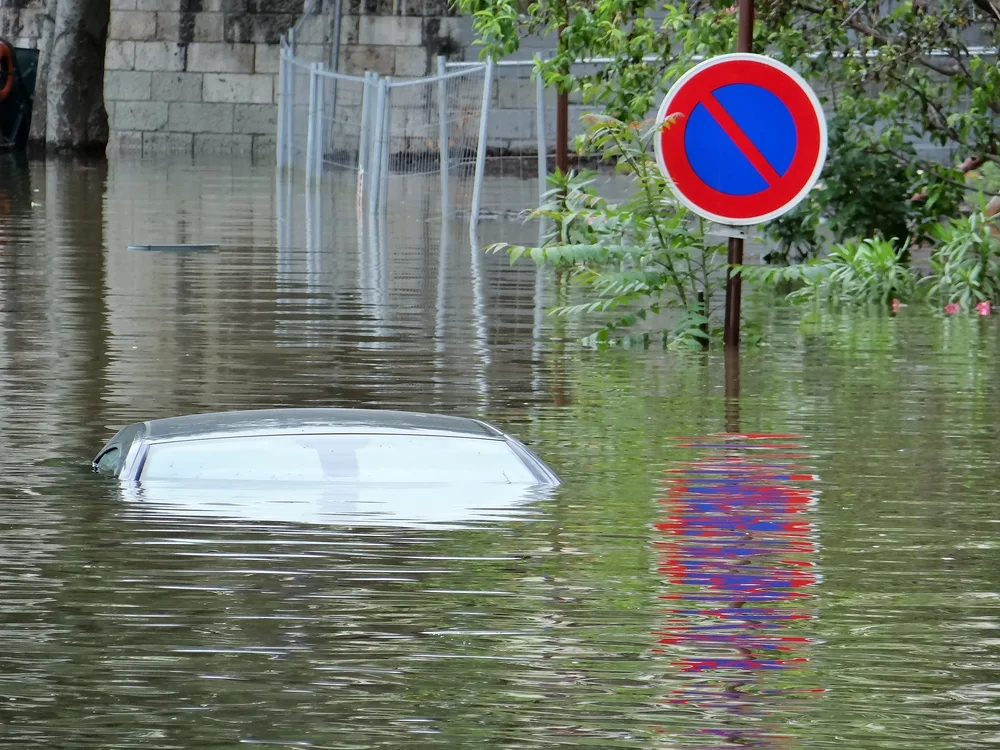 Photo: A car fully submerged in floodwater — Level E damage results in full insured value payout (CC BY-SA 4.0 by Ibex73 via Wikimedia)
1. Choose parking spots wisely
- Multi-storey car parks (2nd floor and above) are the best option during heavy rain warnings
- Avoid: ground-level parking in basements, under elevated expressways, near canals, low-lying areas, and dirt lots in flood-prone zones
- Track real-time data: Traffy Fondue app (community flood reports) and the Bangkok GIS flood map (bmagis.bangkok.go.th)
2. Monitor weather forecasts
- The Thai Meteorological Department app issues heavy rain warnings in advance
- If heavy rain is forecast, move your car to higher ground proactively — don't wait and watch
3. Pre-rainy-season car check
- Tyres: Tread depth should be at least 3mm for effective wet-road drainage (see our full tyre guide)
- Brakes: Wet-road braking distances are significantly longer — check brake pads and fluid
- Lights: Headlights, taillights, indicators must all function properly (visibility is critical in heavy rain)
- Dash cam: Installing a dashcam provides key evidence in both flood situations and accidents
4. Water depth: when to stop
| Depth | Indicator | Recommendation |
|---|---|---|
| < 15 cm | Water not reaching wheel hubs | Drive carefully, maintain steady RPM |
| 15–30 cm | Water reaching part of the wheel | Very slow, max 10 km/h |
| > 30 cm | Reaching the bumper | Stop — find an alternative route |
| > 50 cm | Reaching door level | Danger — exit the vehicle |
5. Emergency kit for rainy season driving
- Torch / power bank
- Emergency window hammer (for rapid exit)
- Tow rope / recovery strap
- Insurer's phone number and roadside assistance saved in your phone
Bangkok Flood-Prone Zones to Avoid
| Zone | High-Risk Areas |
|---|---|
| East | Lat Krabang, Prawet, Saphan Sung, Min Buri, Nong Chok, Khlong Samwa |
| North | Don Mueang, Sai Mai, Bang Khen, Chaengwattana Rd, Phahon Yothin, Vibhavadi |
| Central | Din Daeng (Prachachuen, Ratchadaphisek), Phaya Thai (Pradiphat), Huai Khwang |
| West | Bang Khae, Taling Chan, Bang Khun Thian (near major canals) |
| Riverside | Dusit, Bang Rak, Khlong San (along Chao Phraya River) |
Based on 2024–2025 Bangkok flood incident data
Real Cost Breakdown: Beyond Just the Repair Bill
Flood damage costs go beyond the workshop bill:
| Item | Estimated Cost |
|---|---|
| Towing | 500–2,000 THB depending on distance |
| Damage assessment (uninsured) | 500–1,500 THB |
| Mold treatment and deep cleaning | 2,000–8,000 THB |
| Drying (industrial blowers/dehumidifiers) | 1,500–4,000 THB |
| Engine oil / transmission fluid replacement | 2,000–5,000 THB per service |
| Alternative accommodation while car is in the shop | Several thousand to tens of thousands THB |
Prices as of July 2026, may vary by provider and location
Without insurance coverage, total costs for a Level D–E flood event can reach 150,000–500,000 THB — often exceeding the car's entire market value. This is why Class 1 insurance isn't a luxury — it's basic risk management.
For comprehensive car maintenance during rainy season, see our complete car maintenance guide. If you're considering upgrading your insurance, compare Class 1 options in our Class 1 car insurance guide.
And don't forget your own health — wading through floodwater also risks leptospirosis and several other rainy-season diseases. Read our guide to the 7 rainy-season diseases to watch, their symptoms and how to prevent them to protect both your car and yourself this rainy season. If you want to prepare your whole home for flooding, not just your car, see Thailand Flood Prep Checklist 2026: What to Do Before, During & After.
Summary: What Every Car Owner Should Do Before Rainy Season
Check your policy today:
- ✅ Confirm it's Class 1 or Class 2+ with natural disaster coverage
- ✅ Save your insurer's emergency claims number in your phone
- ✅ Know the flood-prone areas near your home and workplace
- ✅ Have a plan for moving your car before a flood warning
- ✅ Know that "don't restart the engine" is the first rule if it stalls in water
If your insurance doesn't currently cover floods, this rainy season is the time to upgrade — before you need it.
Sources:
- Office of Insurance Commission (OIC) Thailand — 5-Level Flood Damage Assessment Framework
- Roojai Thailand — Car Insurance Flood Coverage Guide 2025
- GettGo — What to Do When Your Car Floods (2025)
- DrMCars — Water Hammer Prevention Guide
- TQM Insurance — Flood Claim Process Thailand
- GPA Autoparts — Flood Damage Repair Costs Thailand
- Prachachat — EV Flood Damage Claims Statistics 2025
- THE STANDARD WEALTH — 5-Level Flood Assessment for Car Insurance (Dec 2025)
Frequently asked questions
- Does Class 3+ car insurance cover flood damage?
- No — Class 3+ only covers collisions with a third party, fire, and theft. For flood coverage, you need to upgrade to Class 1 or Class 2+ with natural disaster add-on.
- My car stalled in floodwater and won't start — what do I do first?
- Never try to restart it. If water entered the engine through the air intake, restarting causes water hammer (hydraulic lock) which can destroy the engine entirely. Disconnect the battery cable, then call your insurer immediately before touching anything else.
- How much does flood damage repair cost in Thailand?
- It depends on water level: floor mat (Level A) around 8,000–10,000 THB; seat/electrical level (Level B) 15,000–25,000 THB; dashboard level (Level C) 25,000–80,000 THB; engine bay (Level D) 80,000–200,000+ THB; fully submerged (Level E) usually results in full payout of insured value.
- How soon do I need to report flood damage to my insurer?
- As soon as possible — ideally within 24–48 hours. During major disasters, the OIC may extend this deadline. Reporting quickly helps the adjuster assess damage before evidence disappears.
- What situations will invalidate a flood damage insurance claim?
- Claims get denied if: you drove into a visibly flooded road ignoring warning signs, you restarted the engine in floodwater causing further damage, the car was repaired before the insurer approved it, premiums were overdue, or the policy doesn't include flood coverage.
- Which parts of Bangkok flood most often during rainy season?
- High-risk zones: East (Lat Krabang, Prawet, Min Buri, Nong Chok), North (Don Mueang, Sai Mai, Chaengwattana Road), Central (Din Daeng, Ratchada, Phaya Thai), and West (Bang Khae, Taling Chan).
Related articles
Top 10 Motorcycle Raincoats 2026 — Waterproof, Durable, Best Value
Top 10 motorcycle raincoats for Thailand in 2026 — poncho vs 2-piece suits, waterproof mm rating, prices, a comparison table, and how to choose.

Krabi Travel Guide 2026 — Top Attractions, Costs & 3-Day Itinerary
Complete Krabi travel guide for 2026 covering every highlight: Railay Beach, Tiger Cave Temple, 4 Islands tour, Emerald Pool, real costs, transport, accommodation, and tips for the rainy season

Phuket Travel Guide 2026: Beaches, Attractions, Costs & Rainy Season Tips
Complete Phuket travel guide for 2026 covering every beach, top attractions, real costs, transportation, best areas to stay, and essential rainy season tips for a safe, budget-friendly trip.