Thailand Flood Prep Checklist 2026: What to Do Before, During & After
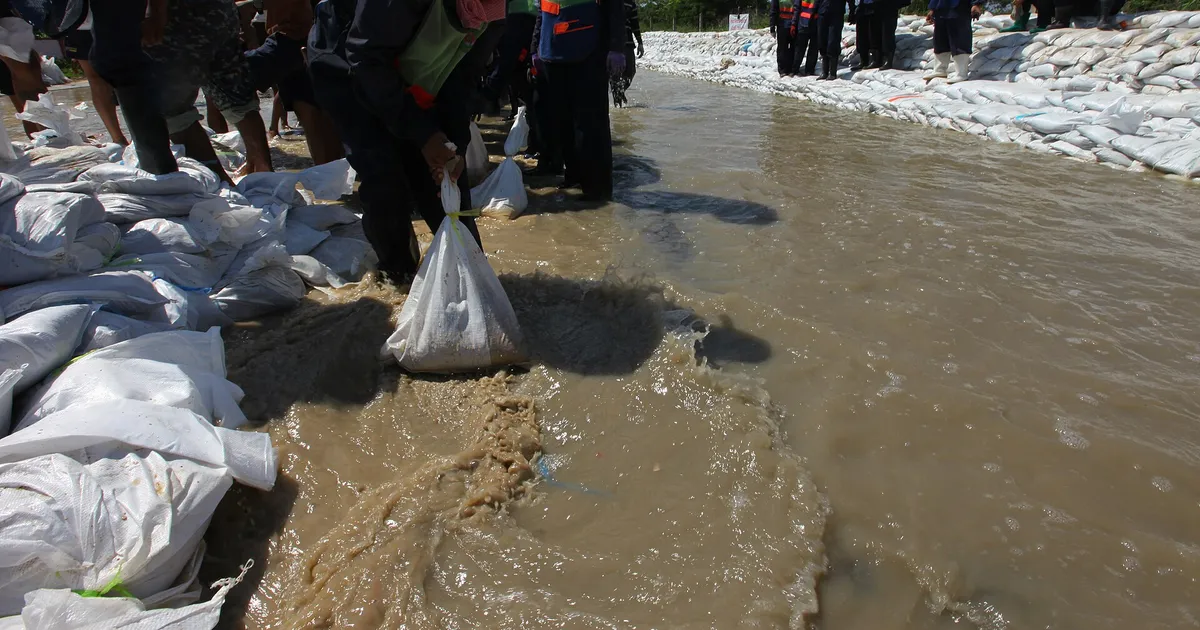
Days of continuous rain, flood warnings on every news broadcast — but most people still can't answer the real question: "What am I actually supposed to do?" What to buy, when to cut the power, which number to call, and what to watch for once the water recedes.
This guide answers all of it in one place — based on official guidance from Thailand's Department of Disaster Prevention and Mitigation (DDPM), the real flood situation as of August 2026, and verified health/pricing figures, so you finish reading ready to act, not needing to search anywhere else.
What's the flood situation right now (as of August 2026)?
Before anything else, the most important thing to understand is that this year does not look like 2011, either in cause or scale.
In early August 2026, the DDPM and the national water-management task force issued advisories for flash floods, sudden flooding, and urban waterlogging covering more than 49 provinces nationwide, including Bangkok. The main risk zones break down as:
- 6 southern provinces (Ranong, Phang Nga, Phuket, Krabi, Trang, Satun) — flash floods/landslides/rough seas from a strengthening southwest monsoon
- 17 northern provinces — ordered to accelerate preparations for above-average August rainfall
- Mekong-side provinces (Nong Khai, Bueng Kan, Nakhon Phanom) — watching rising river levels
- Bangkok and 6 central provinces (Pathum Thani, Nonthaburi, Nakhon Pathom, Samut Sakhon, Samut Songkhram, Samut Prakan) — repeated tidal-surge advisories, most recently covering 10-17 August, which can push Chao Phraya river levels high enough to overflow low-lying riverside banks
Here's the context that matters for keeping perspective: national dam-level data from early August 2026 shows 13 major dams nationwide are still below normal levels, and more than 68 medium-sized reservoirs sit below 30% capacity. In plain terms: this is not a year where dams are overflowing and forced to release water the way they were in 2011. The main risk right now is urban waterlogging from intense localized rain, flash flooding in upland/headwater areas, and tidal surge in riverside zones — not a basin-wide mega-flood.
That doesn't mean you should relax, though — urban waterlogging alone can still cause real damage to homes, cars, and belongings. It's just a different shape of risk than 2011.
Who should prepare the most?
If you're in one of these risk categories, prepare gear and plans further ahead than the general public:
| Risk group | Details |
|---|---|
| Chronically flood-prone Bangkok districts | Chatuchak (Ratchadaphisek Rd. near Bangkok Bank), Bang Sue (Pracharat Rd. 2, Tao Poon intersection), Lak Si (Chaeng Watthana Rd.), Dusit (Ratchawithi Rd. at Sang Hi Bridge), Ratchathewi (Phayathai Rd. near the Livestock Department) — all flagged by Bangkok's Drainage Department as recurring waterlogging spots every year |
| Chao Phraya riverside / low-lying areas in 6 central provinces | Pathum Thani, Nonthaburi, Nakhon Pathom, Samut Sakhon, Samut Songkhram, Samut Prakan — at risk from tidal surge pushing river levels over the banks |
| 17 northern provinces | At risk from above-average rainfall and flash floods from upland areas |
| 6 southern Andaman-coast provinces | Ranong, Phang Nga, Phuket, Krabi, Trang, Satun — flash flood/landslide risk from the monsoon |
| Mekong-side provinces | Nong Khai, Bueng Kan, Nakhon Phanom — watching rising Mekong river levels |
Even outside these zones, don't be complacent — intense localized rain can overwhelm drainage on any street or soi with little warning.
Emergency kit checklist: what to have ready before the water arrives
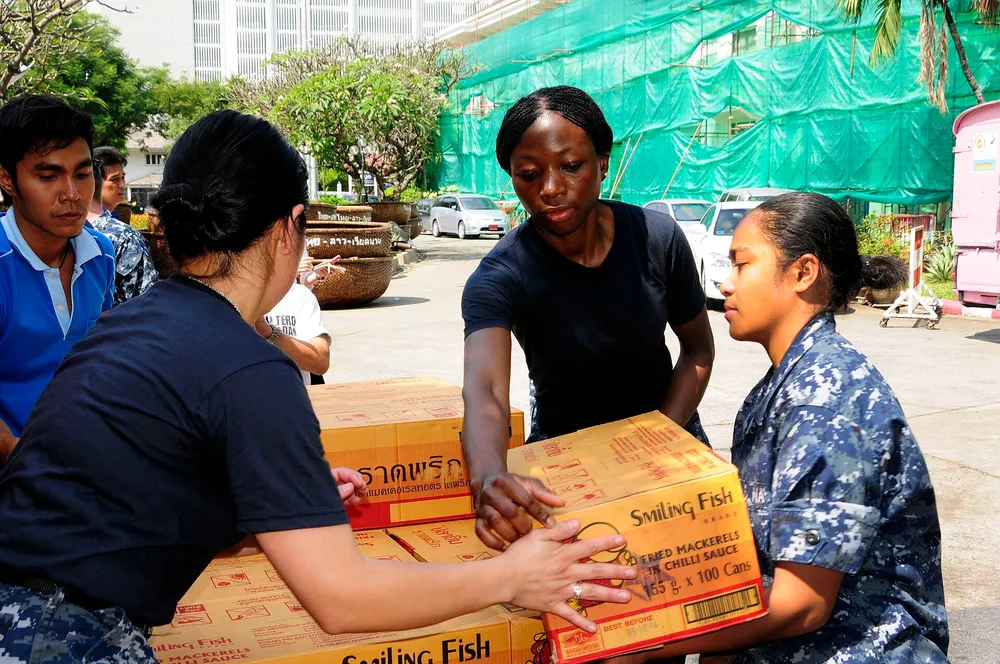 Illustrative: emergency-supply distribution in Bangkok during the 2011 floods — the same category of items every household should keep stocked in its own emergency kit
DDPM recommends every household keep an emergency kit ("ถุงยังชีพ") somewhere easy to grab, ready for immediate evacuation if needed, covering 5 main categories:
- Drinking water & food — bottled water, dry/canned food that needs little or no cooking
- Medicine & medical supplies — personal prescription medication (especially for chronic conditions), basic household medicine, a first-aid kit, mosquito repellent
- Important documents — ID card, house registration, bankbooks, insurance policies (in a waterproof ziplock bag)
- Flashlight/communication gear — flashlight, spare batteries, matches/lighter, a fully charged power bank/power station, a portable radio, a whistle
- Clothing/personal items — spare clothes, blankets/sleeping bags, tissue, sanitary pads, rubber boots, black plastic bags, rope, tape, a pocket knife, and a life jacket if there are children or elderly people in the household
Key point: DDPM also recommends continuously watching water levels and the colour of the water (murky, soil-like water is an early warning sign), and clearing drains and debris around your home well before the rain arrives.
Flood-protection gear worth having at home (with approximate prices)
Beyond the basic emergency kit, the following gear meaningfully reduces damage and hassle — especially if you're in a chronically flood-prone area:
| Gear | Approximate price | Why you need it |
|---|---|---|
| Submersible/floating water pump (750W-1HP) | ~฿1,790-2,700 | Pumps water out of your home/parking area far faster than manual bailing — essential if your house sits below street level — see the 10 best water pumps for flood season to pick the right one |
| High-capacity power bank (20,000-30,000mAh) | ~฿700-1,500 | Power outages are common during flooding; keeps your phone/flashlight running so you can call for help |
| Portable power station | From ~฿1,800-5,000 (compact models) up to tens of thousands for larger units | Keeps a fridge/fan/lighting running far longer than a standard power bank — worth it if outages in your area are frequent |
| Waterproof dry bags | Widely available on Shopee/Lazada across many brands/sizes, price varies a lot by capacity | Protects documents, your phone, and valuables while wading or evacuating |
| First-aid kit (e.g. Thai Red Cross size L) | ~฿1,790 | Essential for wounds from debris in floodwater — exactly the entry point for leptospirosis/melioidosis |
| Sandbags | Often distributed free by district offices in at-risk areas, or inexpensive to buy | Builds an instant barrier around doors/entry points |
| Water purification tablets/portable filter | Widely available on Lazada, price varies by brand | For when tap water gets contaminated during flooding |
Prices are indicative, based on online retailers as of August 2026, and vary by promotion and seller.
One thing worth knowing about sandbags: some countries sell "sandless sandbags" that self-inflate when they absorb water, which are easier to handle than traditional sand. A market check found these are not yet widely stocked by Thai online retailers — traditional sand-filled sandbags, often distributed free by local district offices in at-risk areas, remain the most accessible option here.
Before the water arrives: protecting your home step by step
- Keep monitoring official warnings continuously via the Traffy Fondue app, DDPM's channels, or local news — don't wait until water is at your door to start looking for information.
- Clear drains and gutters around your home of debris and leaves — clogged drainage is the main cause of most urban waterlogging.
- Place sandbags as a barrier at likely entry points — front doors, drains that could back-flow into the house.
- Move valuables and appliances to higher ground well before water actually reaches your home — don't wait until you see water inside to start lifting things.
- Move your car to higher ground than the expected water level — a multi-storey car park or a road that isn't in a low-lying area.
- Fully charge your power bank/power station and fill up your car/generator with fuel in advance, in case outages last several hours.
- Keep your emergency kit somewhere easy to grab, not buried in a top cabinet, in case you need to evacuate suddenly.
During a flood: what to do, and what never to do
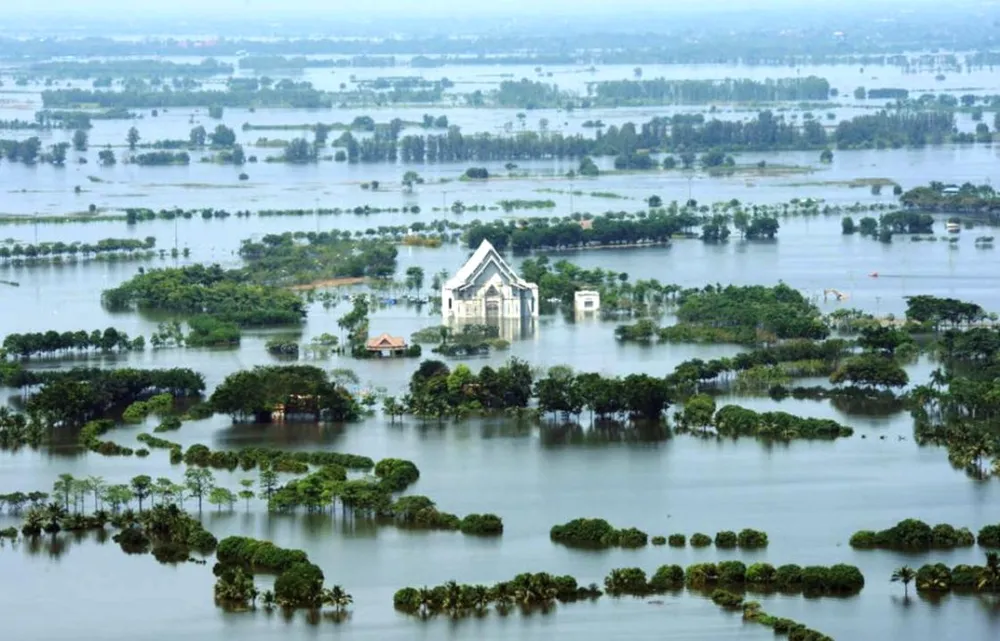 Illustrative: the scale of the 2011 mega-flood in Central Thailand — a reminder of why advance preparation matters, even though this year's situation hasn't reached that level
What to do:
- Cut power at your main breaker immediately once it looks like water could reach outlet height — don't wait until water actually arrives, since you can't know exactly when moisture will reach the wiring.
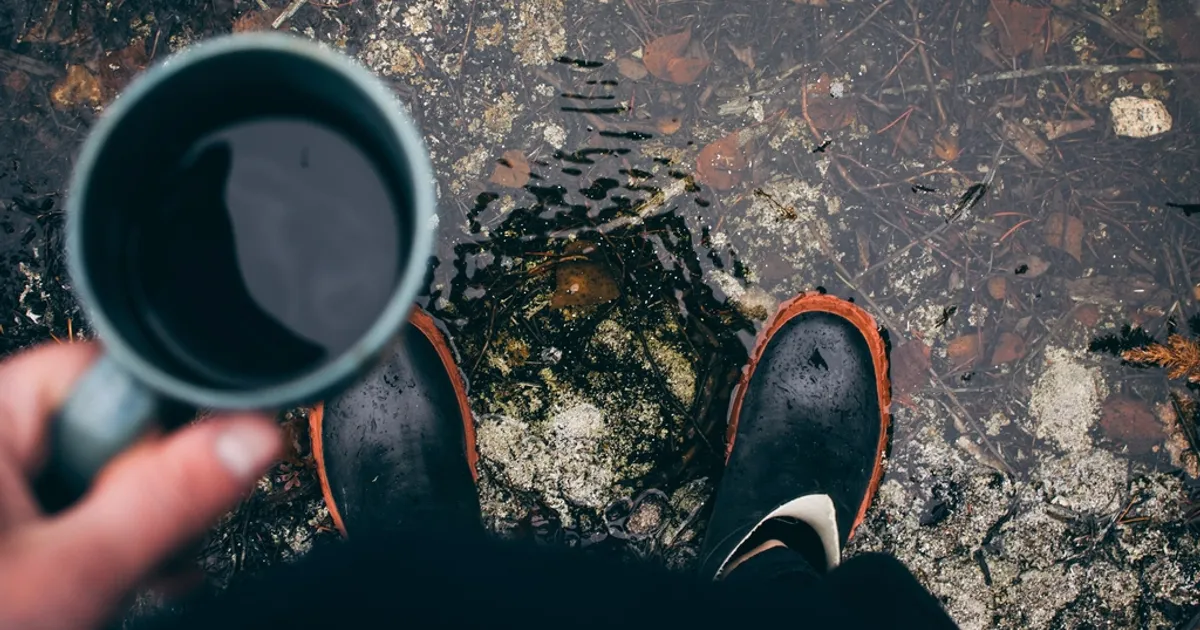
- Always wear rubber boots when wading — protection against both sharp debris and pathogens in the water. See our 10 best waterproof rain boots for 2026 to pick the right pair for your situation.
- Evacuate pets and move vehicles to safety early.
- Avoid areas with fast-flowing water, on foot or by car — you can't see obstacles hidden beneath the surface.
- Call 1784 (DDPM) or 192 (National Disaster Warning Center) for help; in Bangkok, use 1555 or the Traffy Fondue app/LINE.
What you must never do:
- Never touch electrical appliances while wet or standing in water, and never use any appliance while your home is flooded.
- Never approach a fallen power pole or a submerged live wire — call PEA 1129 (nationwide) or MEA 1130 (Bangkok) immediately.
- If you feel a tingling or itching sensation while wading, get out of the water immediately — it can signal an electrical leak.
- Never swim for fun or fish in floodwater, no matter how calm it looks.
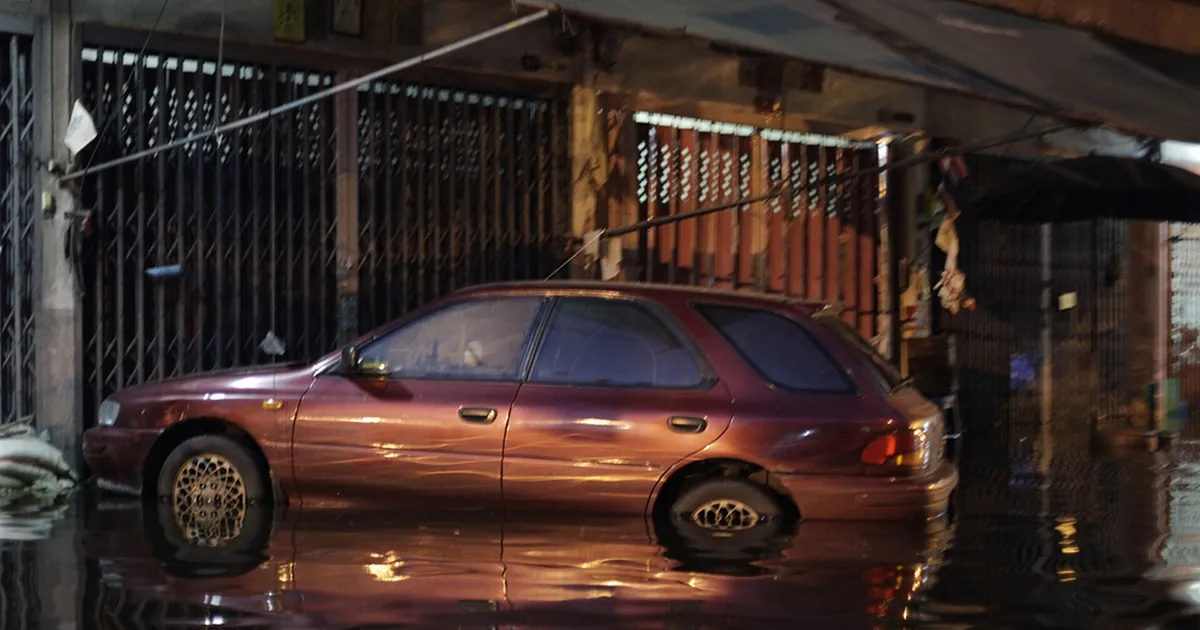
- Never repeatedly try to restart a car whose engine stalled in water — this risks hydrolock and far worse engine damage. See the correct steps in our guide: What to do first when your car floods — emergency guide.
For medical emergencies, call 1669, available 24 hours.
After the water recedes: cleaning up safely + watching for flood-related disease
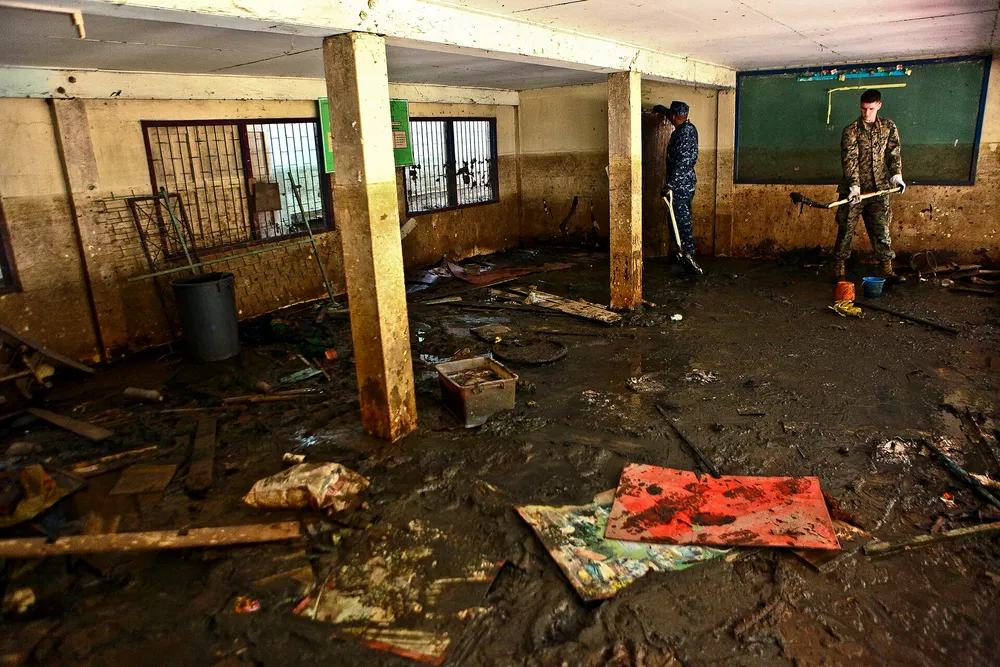 Illustrative: cleaning up mud and debris after floodwater recedes — the point at which mold and flood-related infections pose the greatest risk
The water going down doesn't mean the danger is over — the cleanup period is actually when most flood-related injuries and infections happen.
Before going back in / turning the power back on:
- Never re-energize your breaker box yourself until an electrician or the utility company has inspected it, if it or any outlets were submerged.
- Any appliance that was flooded needs a technician's check before use — don't risk plugging it in to "test" it yourself.
Deal with moisture as fast as possible: mold can start colonizing wet surfaces within 24-48 hours (based on international building-restoration research). The faster you dry and wipe surfaces down, the lower your chance of mold taking hold. If mold has already set in, see our detailed guide: Fixing damp & mold at home — find the cause, remove it, prevent it long-term.
Watch for diseases that come with flooding and mud:
- Leptospirosis — Thailand's Ministry of Public Health reported 2,002 cumulative cases and 30 deaths between 1 January and 8 July 2026, mostly among people aged 60+ and those working in agriculture. It spreads through wounds exposed to water/mud contaminated with animal urine (rats, pigs, cattle, buffalo). Prevent it by always wearing rubber boots and keeping wounds away from direct contact with floodwater.
- Melioidosis — caused by bacteria found in soil and water, most common in Northeast Thailand. It enters through skin wounds, inhaling contaminated dust, or ingesting contaminated food/water. The severe bloodstream-infection form has a fatality rate as high as 40-60% — if you have an open wound, avoid direct contact with mud/floodwater, or wear gloves and keep the wound fully covered.
Both diseases are largely preventable with ordinary boots and gloves, but people often skip that protection while rushing to clean up.
Does insurance cover flood damage?
A question most people only think about once the water is already in their house — and the honest answer is it depends on your policy type and its conditions:
- Home fire insurance in Thailand usually bundles "natural disaster" coverage, including flood, as an add-on. Premiums typically start around ฿900-1,000/year for coverage in the hundred-thousand-baht range, but the payout cap for flood damage is often far below your actual insured value — some plans cap flood claims at ฿20,000/year, or 10% of the total sum insured.
- Catastrophe insurance, which covers flood/windstorm/earthquake specifically, often has a condition that it only pays out once the Cabinet has formally declared the area a disaster zone — ordinary urban waterlogging that never gets that declaration may not qualify.
- Car insurance — only Class 1 and Class 2+ policies with natural-disaster coverage protect against flood damage; Class 3/3+ does not. See the full breakdown in What to do first when your car floods — is it covered by insurance?
Before flooding hits, pull out your home/car policy and read the "natural disaster" and "flood coverage limit" sections carefully, so you know exactly what's covered before you need to file a claim.
Common mistakes people make when preparing for floods
- Waiting until water is at the door to start buying supplies — stores and online retailers often sell out fast once warnings go out. Prepare your kit and gear at the start of every rainy season, not mid-crisis.
- Not cutting power before water reaches outlet height — thinking you can "wait and see," when electrical shock can happen faster than expected.
- Wading without rubber boots because it's "just a quick trip" — this is the main entry point for leptospirosis.
- Repeatedly trying to restart a car that stalled in water, turning a repair bill from the thousands into tens of thousands of baht.
- Assuming home insurance covers flood damage in full, when most policies cap the payout far lower than people expect.
- Turning the power back on immediately once water recedes, without waiting for an electrician's inspection — risking a repeat short circuit.
- Cleaning up mud without gloves while carrying open wounds, opening a direct entry point for leptospirosis/melioidosis.
The bottom line: prepare early, always
The 2026 flood situation hasn't reached the scale of the 2011 mega-flood — most major dams nationwide are still running below normal levels, and the main risk right now is localized heavy-rain waterlogging and tidal surge, not a basin-wide catastrophe. That's not a reason to be complacent, though — urban flooding alone can genuinely damage homes, cars, and belongings.
What you can do starting today: assemble all 5 categories of your emergency kit, buy essential gear (water pump/power bank/first-aid kit) in advance, memorize the key emergency numbers, and read your home/car insurance policy's flood terms until you actually understand them. Do all of that, and whatever the rain brings this season, you'll face it with a lot more composure.
For more rainy-season help, read Common rainy-season illnesses and how to prevent them, and if outages are frequent enough that you want something more serious than a power bank, see Best portable power stations 2026. And if flooding has already caused real damage to your home, read how to check your eligibility and register for the 2026 flood relief payment of 9,000 baht per household next.
Sources
- MGR Online — DDPM's before/during/after flood guidance
- The Standard — Bangkok's 50-district flood response plan
- Nation Thailand — DDPM warns 49 provinces and Bangkok to watch for flooding
- Thai PBS — Tidal-surge advisory, 10-17 August 2026
- Bangkok Biz News — National dam-level status, early August 2026
- Wikipedia — 2011 Thailand floods
- hfocus.org — 2026 leptospirosis situation report
- Bangkok Health — Melioidosis — a rainy-season risk
- Muang Thai Insurance — Property/home insurance product
- Bangkok Biz News — 5 chronic waterlogging districts in Bangkok
Frequently asked questions
- Is the 2026 flood situation as severe as 2011?
- Not yet. The 2011 mega-flood was caused by dam overflow feeding the entire Chao Phraya basin, with the river mouth peaking at 2.53 metres and 26 provinces flooded. August 2026 data shows most major dams are still running BELOW normal levels, so the current risk comes from localized heavy rain, flash floods, and tidal surge in specific provinces — real, but not a nationwide mega-flood like 2011.
- When should I cut the power, and when is it safe to turn it back on?
- Switch off your main breaker as soon as it looks like water could reach your outlets — don't wait until water actually arrives, since you can't predict exactly when moisture will reach the wiring. After the water recedes, never re-energize a breaker box or outlets that were submerged until a licensed electrician or the utility company has inspected them.
- Can I use a car or appliance right after it's been flooded?
- No — never immediately. A flooded appliance needs a technician's inspection before use, since trapped moisture can cause a short circuit or shock. For a car whose engine stalled in water, never repeatedly try to restart it — water in the engine causes hydrolock, which can destroy the engine. See our full car-flood guide below for the correct steps.
- What health risks should I watch for after the water recedes?
- The biggest concern is leptospirosis, which has already infected over 2,000 people and killed 30 in Thailand in 2026 — it spreads through wounds exposed to water/mud contaminated with animal urine. Melioidosis (a soil/water bacterial infection, common in the Northeast) is the other major risk, with a fatality rate of 40-60% in severe bloodstream infections. Both are largely preventable by wearing rubber boots and gloves and keeping open wounds away from floodwater.
- Does regular home insurance cover flood damage?
- Many Thai home fire-insurance plans bundle flood as part of a 'natural disaster' add-on, but the payout is usually capped well below your actual insured value — some plans cap flood claims at ฿20,000/year or 10% of the total sum insured. Separate catastrophe insurance policies often only pay out once the Cabinet formally declares the area a disaster zone. Always check your policy's flood cap and payout conditions before you need to claim.
- What numbers should I call to report flooding or ask for help?
- Call the DDPM hotline 1784 or the National Disaster Warning Center at 192 nationwide. In Bangkok, use the BMA hotline 1555 or the Traffy Fondue app/LINE. For downed power lines or exposed live wires, call PEA 1129 (nationwide) or MEA 1130 (Bangkok). For medical emergencies, call 1669.
Related articles
10 Best Water Pumps for Flood Season Thailand 2026: What Not to Buy
10 best water pumps for Thailand's 2026 flood season, from ฿600 submersible pumps to ฿9,000+ petrol engines, with a price/power/flow comparison table and buying advice.
10 Best Waterproof Rain Boots 2026 in Thailand for Floods & Rainy Season
10 best waterproof rain boots in Thailand for 2026, from 149 to 690 baht, with a spec comparison table, sizing chart, budget-by-use-case picks, and why doctors say to always wear boots in floodwater.

Dehumidifiers in Thailand 2026: what size, and the real running cost
How to size a dehumidifier to your room, compressor versus desiccant, and the monthly electricity cost — the number almost no review mentions and the one that changes the decision.