2026 Thailand Flood Relief: How to Get the 9,000 Baht Payment
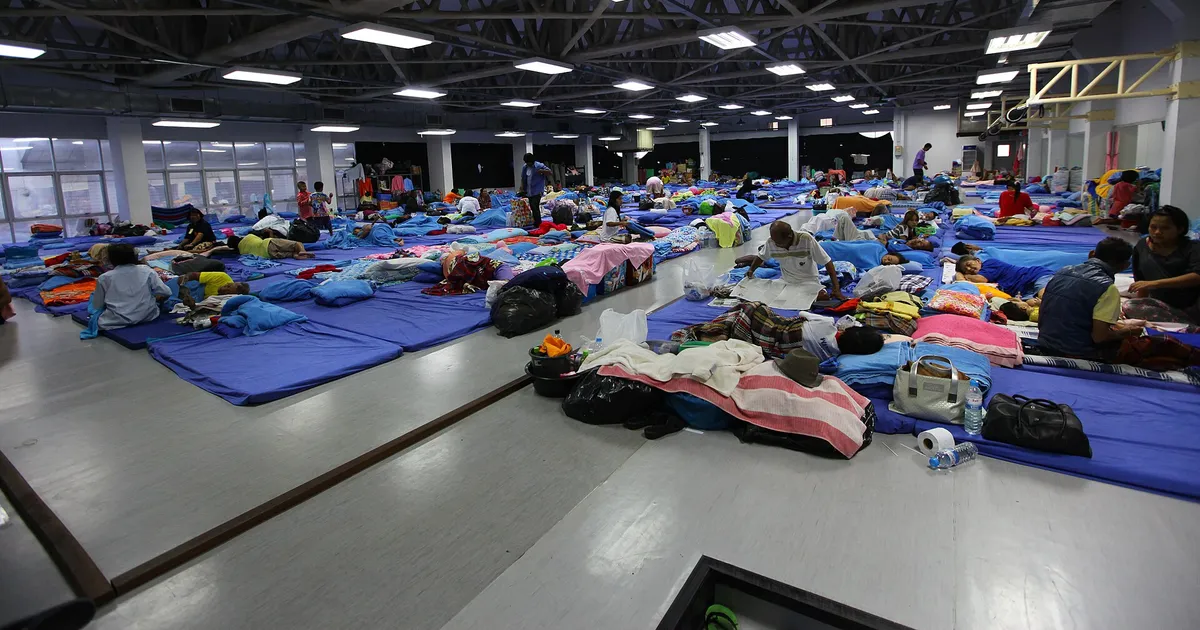
Weeks of heavy rain have left multiple provinces across Thailand dealing with flash flooding and prolonged standing water through August and September 2026 — and the government's relief money is already being paid out for real. But the question most people still can't answer is simple: "Does my household qualify, what exactly are the rules, and where do I actually register?"
This guide covers everything you need in one place: the detailed eligibility criteria, exactly how much money you'll receive, both registration channels step by step, how to make sure PromptPay is set up correctly so the money actually lands, how to check your application status, and the scam patterns to watch for right now. Read it through and you shouldn't need to look anywhere else.
This article is based on Cabinet resolutions and announcements from Thailand's Department of Disaster Prevention and Mitigation (DDPM/ปภ.), plus reporting from established Thai news outlets, as of 21 September 2026. Rules and timelines may be updated further — always confirm against the latest official announcement before acting.
What happened: the budget, and how many households it covers
On 25 August 2026, Thailand's Cabinet approved the criteria, conditions, and disbursement method for helping people affected by the 2026 rainy-season floods, with a budget of 558,739,000 baht drawn from the central emergency reserve fund. It covers officially declared disaster zones across more than 41 provinces nationwide.
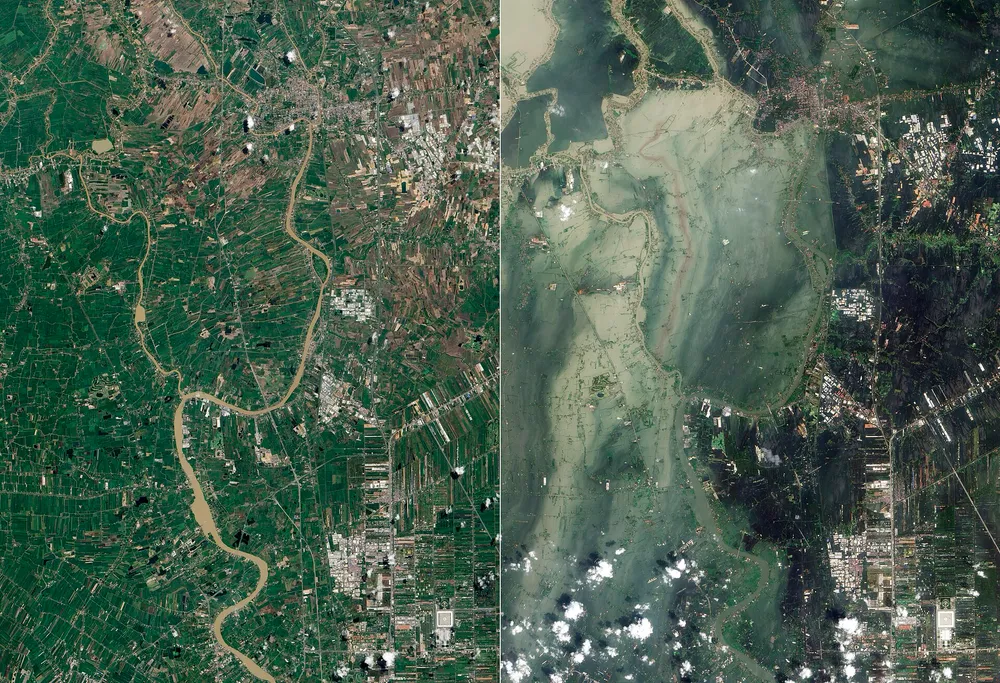 Photo: NASA Earth Observatory image created by Jesse Allen and Robert Simmon, using EO-1 ALI data provided courtesy of the NASA EO-1 team and the United States Geological Survey. — Public domain (Wikimedia Commons)
That figure isn't a round number pulled out of thin air — it's built from an actual estimate of eligible households, and the arithmetic lines up almost exactly:
| Item | Count | Cost |
|---|---|---|
| Estimated eligible households | ~60,971 households | 60,971 × 9,000 ≈ 548,739,000 baht |
| Deaths from landslides (Nan province case) | 5 people | 5 × 2,000,000 = 10,000,000 baht |
| Estimated total | ≈ 558,739,000 baht |
That matches the actual approved budget almost to the baht, which tells us two things: first, this budget was calculated from a real household survey at the time, not an open-ended pool of money; and second, if the actual number of applicants ends up higher than this estimate — which is plausible, since flooding continued after the Cabinet approval date — the government will need to approve an additional budget round, which is the normal pattern whenever a disaster situation drags on.
Who qualifies for the 9,000 baht relief payment
The core eligibility rule has two alternative conditions — you only need to meet one of them — plus a location condition that applies either way:
- Your primary residence was flooded for up to 7 days, and your property suffered real damage — damaged appliances, furniture, or flooring from the water counts, even if the flooding only lasted a day or two, as long as the damage is real.
- Or your primary residence was flooded continuously for more than 7 days — this path qualifies on the duration of the flooding alone, with no separate requirement to prove property damage, because living through more than a week of standing water is treated as hardship in itself.
And both paths also require meeting these location conditions:
- Your home must be in an area officially declared a disaster zone or an emergency-assistance area by the government. Not every flooded home automatically qualifies — if your province or district hasn't been declared a disaster zone yet, you need to wait for that declaration first.
- Only one payment per household, no matter how many times that same household is affected within the year, and regardless of how many people live there.
Deaths are handled as a completely separate category: anyone who died directly from flooding or a related landslide (drowning, being swept away, electrocution during flooding, etc.) qualifies their family for 2,000,000 baht per person in funeral-related assistance, on top of — and entirely separate from — the household's 9,000 baht. The real-world case behind this year's budget calculation is a landslide in Nan province that killed 5 people.
 Photo: U.S. Marine Corps photo by Cpl. Robert J. Maurer — Public domain (Wikimedia Commons)
Do renters qualify the same as homeowners?
The announced criteria focus on "a primary residence that suffered damage," without explicitly stating that you must be the registered homeowner. What matters more is that you actually live there full-time and genuinely suffered the damage. If you rent your home or condo and it was genuinely flooded and damaged, the recommended approach is to apply directly at your local ตำบล/เทศบาล office so staff can review your specific case — details like this can vary by local practice.
How to register through the "ทางรัฐ" app
The fastest channel is the government's "ทางรัฐ" (Thang Rat) app (download for Android or iOS), because the system connects directly to the civil registry database, verifying your identity and address in real time instead of waiting for a human to check each application by hand.
The rough steps:
- Download and verify your identity — open the app; if this is your first time using it, you'll need to verify your identity with your national ID card.
- Go to the flood-relief application menu — the system will ask for the address that was affected and details of the damage.
- Automatic eligibility check — your information is compared against the civil registry and the disaster-zone declaration for that area instantly.
- Track your application status in real time inside the app — no need to call or visit an office to check on progress.
- Wait for the transfer to your PromptPay account once your application clears verification and the budget has been allocated.
This channel is fast and requires no travel, but it does need a smartphone and reasonably stable internet access. If your home still has no electricity or internet because of the flooding, use the second channel instead.
No smartphone, or not comfortable with the app? Apply in person
If you're not comfortable using the app, or have no internet access, you can apply in person at the Subdistrict Administrative Organization (อบต.) or municipal office (เทศบาล) covering the area where your home is located, bringing your original national ID card. Staff will enter your information into the exact same central verification system the app uses — meaning whichever channel you use, your application is checked against the same database, so neither one has an advantage in how your case is decided.
What's changed from previous years: no more photocopies
In previous years, flood victims had to prepare photocopies of their national ID card, house registration document, and other paperwork — a real burden for people already dealing with a crisis (and photocopiers may not even work if the power is out). For 2026, the Department of Disaster Prevention and Mitigation removed this step entirely, instructing district offices and local administrative organizations to verify eligibility, accuracy, and duplicate claims directly through the civil registry database instead of checking paper documents. This makes the process considerably faster and removes a real hassle for people already in crisis.
Linking PromptPay to your national ID — the step you cannot skip
This is where people most often lose out even after qualifying: every relief payment is transferred through the PromptPay system linked to your 13-digit national ID number only. The Government Savings Bank, which handles the transfers, will not pay into an account whose PromptPay registration is linked to a phone number, or into an account with no PromptPay link at all.
How to check and fix this:
- Open the banking app for any deposit account you actively use
- Go to the "PromptPay" menu
- Check whether it's linked to your "national ID number" (not your phone number)
- If it isn't linked, or your ID number is linked to an old account you no longer use, unlink the old registration and re-link it to the account you currently use
Do this before applying for the relief payment. If your application clears eligibility but your PromptPay isn't linked correctly, the transfer will simply fail and bounce back, and you'll have to wait for the next disbursement round — a delay that's entirely avoidable.
 Photo: PattayaPatrol — CC BY-SA (Wikimedia Commons)
Has the money actually moved yet? The Nan province example
Many people reasonably wonder whether this is just an announcement on paper or whether real transfers have happened — and the answer is that real money has already moved. On 8 September 2026, between 2:00 and 6:00 AM, the Government Savings Bank transferred the first round of relief payments to flood victims in Nan province: 15,215 households, totaling 136,935,000 baht, all through the PromptPay system linked to national ID numbers.
This is the first of several rounds that will be paid out province by province as verification is completed, because the new system no longer waits for an entire village, subdistrict, or province to be fully processed before submitting to the central system — batches go out the moment each one clears verification. Other provinces among the 41 declared disaster zones will receive their payments in the order their verification finishes, not necessarily in the order the flooding happened or by province size.
How to check your relief payment status
Three main ways to track your application:
- The ทางรัฐ app — if you registered through the app, your status updates in real time on your own application history page, no extra step needed.
- Ask your ตำบล/เทศบาล office — if you applied in person, you can call or visit to ask about progress directly; staff can see the same status in the central system.
- DDPM hotline 1784 — the Department of Disaster Prevention and Mitigation's hotline, available 24 hours a day for reporting flooding and asking about relief assistance.
In general, once your application clears eligibility and your data has been submitted to the central system, budget allocation and the transfer itself typically take anywhere from a few days to one or two weeks, depending on how quickly your local office processes cases and the government's budget-disbursement cycle. If it takes significantly longer than that with no update, it's worth actively following up through one of these channels rather than simply waiting.
Watch out for scammers exploiting the flood relief news
Every time government relief money is in the news, scammers follow close behind. Thailand's Anti Online Scam Operation Center (AOC) has flagged two main patterns seen during the 2026 floods:
- Fake donation appeals — scammers create pages impersonating government agencies or charities, using real photos of flood victims to look credible, then solicit donations into fake accounts — meaning money that should reach real victims never arrives.
- Personal-data harvesting — fake SMS messages or links claiming to be from officials, asking you to click a link to "register for relief payment," then requesting your national ID number, a face scan, or access to your LINE account. Some even demand an upfront "fee" before releasing the payment — something that does not exist anywhere in the real government process.
AOC's "4 Don'ts" worth remembering:
- Don't click links sent from unfamiliar or unverified sources (SMS or LINE messages from unknown numbers/accounts)
- Don't believe offers that sound too good to be true, or unverified claims of being a government official
- Don't rush a decision under pressure or urgency the scammer creates (e.g. "confirm today or lose your eligibility")
- Don't transfer money before thoroughly verifying the information and the destination account
If you've already sent money and realize it was a scam, contact your bank immediately to freeze the account, file a police report with all evidence saved (transfer slips, chat logs, links), and call the AOC hotline at 1441.
Keep this firmly in mind: a legitimate relief application never requires paying any fee whatsoever, and it only ever happens through the official ทางรัฐ app (downloaded from the genuine Google Play/App Store listing) or in person at your local ตำบล/เทศบาล office.
Common misunderstandings worth clearing up
| Misunderstanding | Reality |
|---|---|
| "My house only flooded for a few hours, so I probably don't qualify." | If your property genuinely suffered damage and your home is in a declared disaster zone, you can qualify even if the flooding lasted less than a day — there's no minimum number of hours required. |
| "I have to wait until everyone in my village has registered before anyone gets paid." | Not anymore for 2026 — data is now submitted in batches the moment it clears verification, with no need to wait for an entire village. |
| "I already link PromptPay to my phone number, so I should be able to receive government payments the same way." | Government relief payments are only ever sent according to your national ID number link. Linking only to a phone number means you won't receive the payment. |
| "Every flooded home in my subdistrict gets paid automatically without applying." | You always have to apply or submit a claim yourself — there is no automatic payment without a submitted application. |
| "Once I apply, the money is guaranteed to arrive within a few days." | Timing depends on your area's verification round and the budget-disbursement cycle — it can take anywhere from a few days to one or two weeks. If it takes much longer, follow up actively rather than just waiting. |
| "The 2-million-baht death benefit and the 9,000-baht household payment are combined into one payment." | They are two entirely separate payments under separate conditions — the household gets 9,000 baht based on residential eligibility, while the 2 million baht is a per-person death benefit paid independently. |
If you're dealing with flooding right now
Relief payments are financial help after the fact — but if water is still rising or about to reach your home, you should also be actively limiting further damage. See the detailed preparation checklist in our 2026 flood preparedness guide; if your home has standing water that needs to be pumped out fast, our ranking of the top 10 water pumps for flooding can help you pick the right one for your situation; and if your car has been submerged or stalled in floodwater, read the correct recovery steps in our flooded-car guide before attempting to restart the engine.
And if you're a lower-income household facing the double burden of flooding and rising living costs, it's also worth checking your eligibility for the 2026 State Welfare Card — a completely separate monthly benefit from flood relief. You can qualify for both at the same time if you meet both sets of criteria.
Verdict
Thailand's 2026 flood relief payment isn't as complicated as it might seem. Boiled down to steps: (1) check whether your area has been declared a disaster zone, (2) make sure PromptPay is correctly linked to your national ID number first, (3) register through the ทางรัฐ app, or apply in person at your ตำบล/เทศบาล office if you don't have a smartphone, (4) track your status through the app or by calling the relevant office, and (5) stay alert for scammers exploiting this news — never click unsolicited links, and never transfer money to anyone before verifying them.
This year's system has clearly been sped up and simplified compared to previous rounds — both by removing the photocopy requirement and by paying out in batches instead of waiting for entire areas to be processed together — and it's already been proven to work in practice, with Nan province alone receiving over 136 million baht in the first round. If you qualify, all that's left is registering through the right channel and waiting out the system's normal processing time.
Sources
- DDPM explains flood relief eligibility for the 9,000 baht payment — Thai PBS
- Summary of 2026 flood relief criteria: how many days of flooding qualify for 9,000 baht? — Bangkok Biz News
- Check! 2026 flood relief: 9,000 baht per household, 2 million per death — Bangkok Biz News
- Latest 2026 flood relief update: apply via "Thang Rat," no need to wait for a whole village — Bangkok Biz News
- No more photocopies! New, faster flood relief application process — Bangkok Biz News
- 2026 flood relief: eligibility and registration channels for the 9,000 baht payment — Thansettakij
- Money arrives tomorrow! DDPM to transfer 9,000 baht flood relief, Nan first in line — Bangkok Biz News
- Latest Nan flood relief: Government Savings Bank transfers 9,000 baht to 15,000 households today — Thansettakij
- AOC warns of scammers exploiting flood relief news to solicit donations and steal data — Bangkok Biz News
- How to apply for 2026 flood relief via the Thang Rat app — Kontueleks
Frequently asked questions
- How much is the 2026 Thailand flood relief payment, and how many times can I get it?
- Each eligible household receives 9,000 baht, paid only once no matter how many times the same home floods that year. If someone in the household died directly from the flood or a related landslide, there is a separate 2,000,000 baht death benefit per person for funeral costs — this is a completely separate payment from the household's 9,000 baht.
- My house was only flooded for a day or two before the water went down — do I still qualify?
- Yes, as long as your property actually suffered damage from the flooding and your home is inside an area officially declared a disaster zone. There is no minimum number of hours or days required for this category — that condition only applies to the second eligibility path, where continuous flooding beyond 7 days qualifies a household on its own, without needing to prove separate property damage.
- I can't use the ทางรัฐ app or don't have a smartphone — how do I apply?
- Go in person to the Subdistrict Administrative Organization (อบต.) or municipal office (เทศบาล) covering the area where your home is located, bringing your original national ID card. Staff will enter your information into the same central verification system the app uses, and — under the 2026 process — no photocopies of your documents are required anymore.
- I already registered — why hasn't the money arrived yet? Do I have to wait for my whole village to be processed?
- No, you don't need to wait for the whole village anymore. For 2026, the Prime Minister ordered agencies to submit verified applicant data to the central system immediately in batches, rather than waiting for an entire village or subdistrict to be fully processed before sending anything forward. Remaining delays usually come down to how quickly your local ตำบล/เทศบาล office verifies and submits your case, and the government's budget-disbursement cycle — typically a matter of days to one or two weeks.
- How do I link PromptPay to my national ID if I haven't done it yet?
- Open your banking app (any bank where you hold a deposit account), go to the "PromptPay" menu, and check whether it is linked to your "national ID number" — not your phone number. Government relief payments are only ever sent to the ID-linked PromptPay registration. If it is linked only to a phone number, or linked to an old account you no longer use, unlink it and re-register with the ID number pointing at your current active account before you apply for the relief payment.
- I got an SMS or LINE message claiming to be from a disaster-relief officer with a link to claim my payment — is it real?
- Don't click it. Thailand's Anti Online Scam Operation Center (AOC) has warned that scammers are exploiting the flood relief news with fake links that harvest personal data, request face scans, or demand an upfront "fee" before releasing the payment — none of which any genuine government process ever requires. The only legitimate ways to apply are the official ทางรัฐ app (downloaded from the real Google Play/App Store listing) or an in-person visit to your local อบต./เทศบาล office. If you've already sent money to a scammer, contact your bank immediately to freeze the transaction, file a police report, and call the AOC hotline at 1441.
Related articles
Thailand's 2026 Welfare Card: New Rules, Dates, How to Check Status
New 2026 State Welfare Card rules: income/asset limits, how to check your status, appeal deadlines, and the real 1 Oct 2026 start date.
Thailand Home Loan Guide 2026: Rates, Approval, Affordability
2026 Thailand home loan guide: compare bank rates, check DSR affordability, LTV rules, transfer/mortgage fees, and the mortgage interest tax deduction.

Crypto for Beginners 2026: Start Smart and Stay Safe
Beginner's crypto guide 2026 — what crypto is, the real risks, Thai SEC-licensed exchanges, the 2025–2029 tax exemption, and scams to avoid.