Thailand Road Trip 2026: Plan Your Trip, Top Routes + Pre-Departure Checklist

Driving yourself gives a freedom that a tour or a flight can't: stop for photos wherever you like, sleep in any town, change the plan mid-route. But the difference between a dream trip and a nightmare comes down to a handful of things you prepare in advance. This article gathers everything a 2026 Thailand road-tripper needs in one place — the routes people actually drive, how to plan day by day, the pre-departure car checklist, fuel and toll budgeting, plus safety and the insurance worth having. Read it and you're ready to go.
Why 2026 is a great year to road-trip Thailand
Thailand's road network has improved a lot in recent years, especially two new motorways that clearly cut travel time: M6 (Bang Pa-In–Nakhon Ratchasima), about 196 km, which makes the trip into the Northeast much faster, and M81 (Bang Yai–Kanchanaburi), which makes Kanchanaburi far easier to reach. Both are often opened toll-free during festivals (New Year and Songkran) to ease congestion, so a long-weekend trip can also save on tolls.
Planning tools are smarter too. Map apps show real-time traffic, rest stops, fuel stations and roadside eateries, and checking the weather at your destination before you leave takes seconds (try the weather forecast tool to see whether it'll rain at your destination and decide if you need to pack rain gear). All that's left is getting the car — and yourself — ready.
Fuel and toll figures here are estimates as of June 2026. Check current prices again before you leave, as fuel prices move up and down constantly.
8 of Thailand's most popular road-trip routes for 2026
The routes below are drawn from what Thai road-trippers talk about most, spanning mountains, coast and riverside roads. They're grouped by region so you can pick by your starting point.
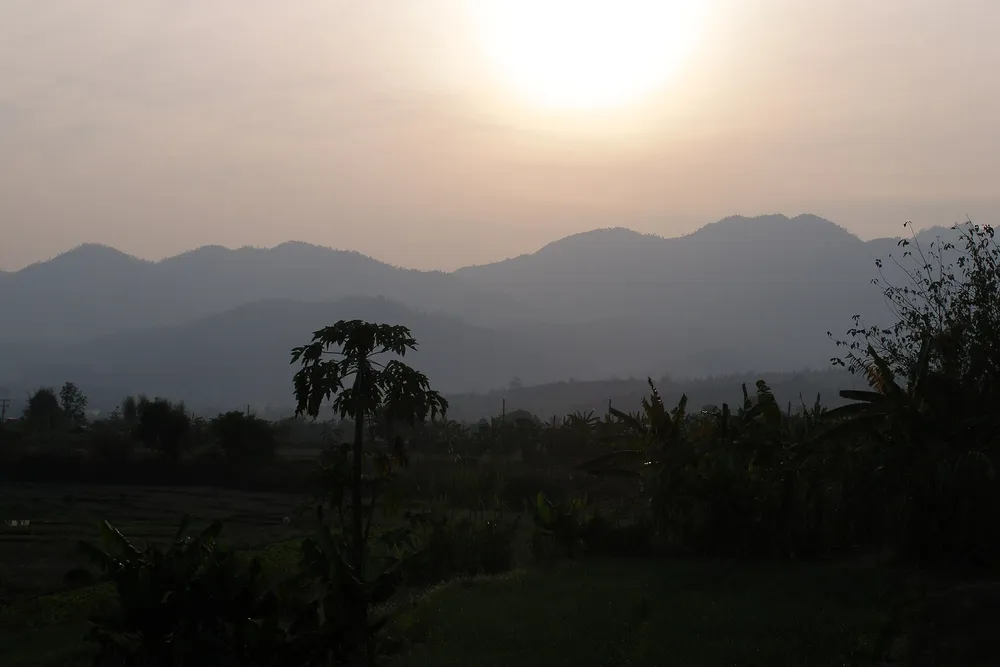 Photo: Evening mountain views near Pai, one of the prettiest stretches of the Mae Hong Son Loop (Wikimedia Commons)
| Route | Highlights | Approx. distance/time |
|---|---|---|
| Mae Hong Son Loop (Chiang Mai–Pai–Mae Hong Son–Khun Yuam–Mae Sariang–back via Doi Inthanon) | Mountains, mist, villages, the legendary "1,864 curves" | ~600 km loop, 4–6 days recommended |
| Chiang Mai–Chiang Rai | Wat Rong Khun, Wat Rong Suea Ten, tea plantations | ~3 hrs (then 2–3 days exploring) |
| Nan–Bo Kluea | Winding mountain roads, misty views, quiet villages | half a day–1 day |
| Loei–Chiang Khan | Mekong riverside road, sunrise, morning alms-giving | ~1–2 days |
| Bangkok–Khao Yai | Forests, waterfalls, cafés, cool air close to the city | ~2.5–3 hrs (ideal for 2 days) |
| Bangkok–Hua Hin–Prachuap Khiri Khan | Beaches, seaside cafés, photo spots | ~2.5–3 hrs |
| Bangkok–Chanthaburi (eastern coastal road) | Noen Nang Phaya viewpoint, sea, seasonal fruit | ~3–4 hrs |
| Phuket–Phang Nga | Samet Nangshe viewpoint, Phang Nga Bay, Andaman sea | ~1–2 hrs (then several days exploring) |
The Mae Hong Son Loop is the dream route for many: a roughly 600 km circuit with 1,864 catalogued curves on the Chiang Mai–Mae Hong Son leg alone (riders who complete it can even claim a certificate). It suits travellers who aren't in a hurry, have 4–6 days, and are confident on mountain bends. Beginners should start with a close route like Khao Yai or Hua Hin, where the roads are good and the distance is short.
If you've only got a short long weekend rather than a multi-day trip in you, check out 6 trips near Bangkok for the Aug 12–16 long weekend, which sticks to routes under a 4-hour drive from Bangkok with real per-destination costs.
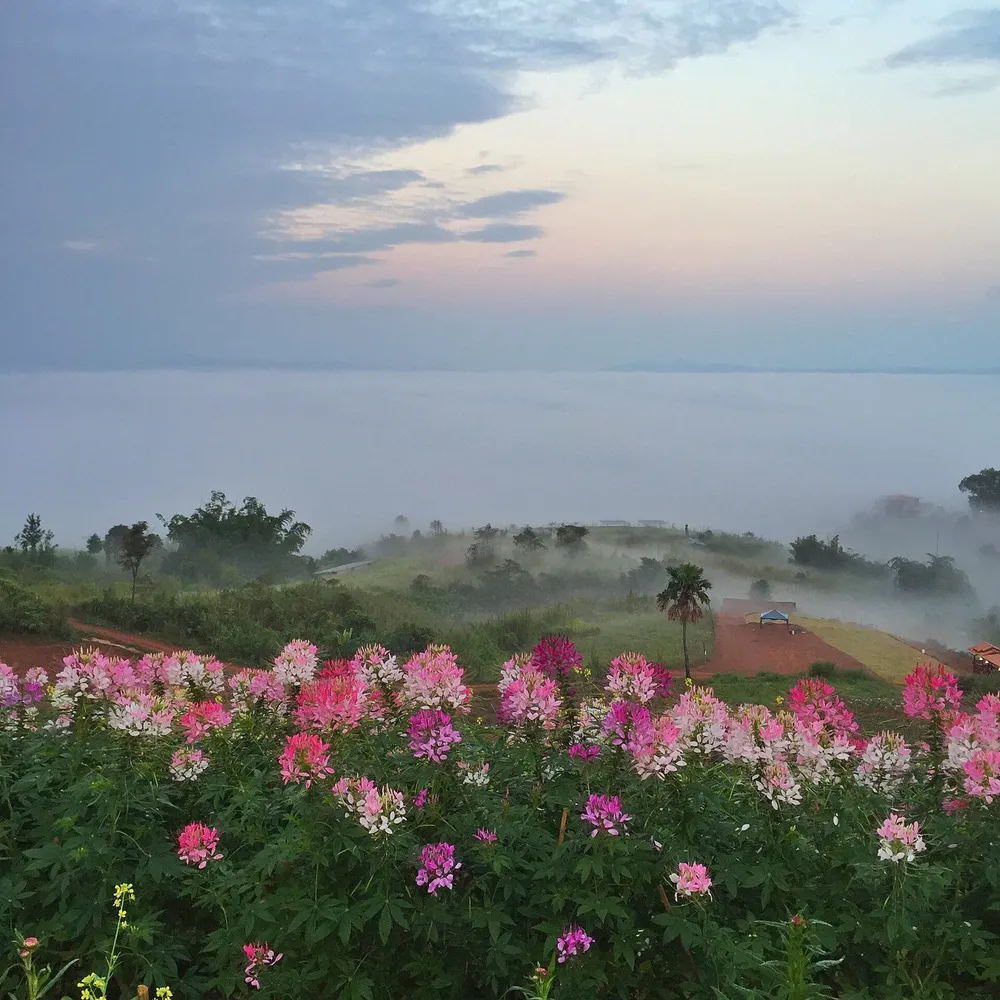 Photo: A morning sea of mist around Khao Kho, a favourite of road-trippers in the upper central region (Wikimedia Commons)
How to plan your trip, step by step
A good plan doesn't mean scheduling every minute — it means managing risk and keeping each day from being exhausting. Follow these six steps.
- Choose a theme and the number of days first — cool mountains, beaches, or a food-and-café trail — then match it to a route above. On your first trips, don't cram many provinces into a few days.
- Set a realistic daily driving distance. Aim for no more than 300–400 km/day on regular highways, and far less on twisty mountain roads (Chiang Mai–Pai is only 135 km but takes as long as 250 km of flat highway).
- Book key accommodation in advance, especially during festivals and the northern high season (Nov–Feb) when rooms fill fast. Lock in the first night and your destination night; the in-between nights can stay flexible.
- Map out stops and rest breaks roughly every 2 hours — pin fuel stations or viewpoints ahead so you never have to push on while tired.
- Check the destination weather 1–2 days before you leave. In the rainy season (May–Oct) mountain roads can be slick and foggy, so you can reroute or postpone in time.
- Have a backup plan for rain, road closures or heavy traffic — always keep a plan B for nearby sights and food.
If you want details on insurance and cover specifically for trips within Thailand, see our article on domestic travel insurance, which explains what it covers and who it suits.
Pre-departure car checklist (the most important part)
This is the heart of a safe trip. Check 3–7 days ahead, not on departure morning, so you have time to fix anything you find. Many items you can check yourself; for anything you're unsure about, visit a service centre/garage or use the free vehicle-check stations that government agencies and partners often run during festivals (covering 20+ items).
| Item | What to check | Watch for |
|---|---|---|
| Tyres & pressure | Tread, cracks/bulges, inflate to the door-jamb spec | Low tread or tyres older than ~3–5 years should be replaced — blowout risk at speed |
| Spare tyre + jack | Spare's pressure, complete wheel-change tools | Easy to forget; a flat spare when you need it is a nightmare |
| Brakes | Pads, brake fluid (between Min–Max) | Noise or a soft/long pedal = check now |
| Engine oil | Level on the dipstick, not too dark | If it's near its change interval, do it before you go |
| Coolant/radiator | Level in the reservoir, no rust discolouration | An unexplained drop may mean a leak |
| Battery | 2–4 years old, terminals free of corrosion | Slow starting is a warning sign |
| All lights | Head/tail, indicators, brake, hazards | Critical for night and rain driving |
| Wipers + washer fluid | Blades not hardened, no streaks | A lifesaver in the rainy season |
| Documents | Compulsory (PRB) insurance, road tax, policy, licence | Expiring mid-trip is a big problem |
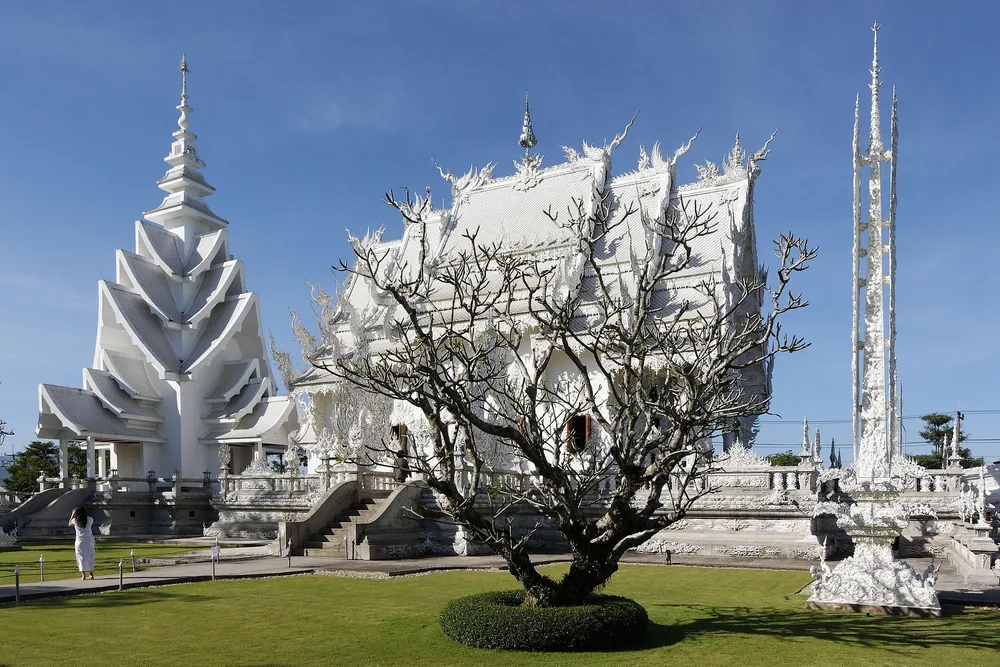 Photo: Wat Rong Khun, Chiang Rai — a classic stop on the Chiang Mai–Chiang Rai route (Wikimedia Commons)
Beyond the car itself, don't forget an in-car emergency kit: jumper cables, a torch, a reflective warning triangle, a tow rope, a first-aid kit, drinking water and an in-car phone charger. And if you're unsure about routine maintenance intervals, read our summary on car maintenance and oil changes before planning a big trip.
Road safety: the numbers to know
The figures from Thailand's "seven dangerous days" over Songkran 2026 (April) are a sobering reminder: 1,242 accidents, around 1,200 injuries and 242 deaths. The leading causes were speeding (~43.6%) and drunk driving (~25.6%), while motorcycles were involved in ~67.8% of accidents.
What you can control, and what genuinely reduces risk:
- Buckle up in every seat, and always use a child seat for young children.
- Don't speed, especially on mountain bends and in the rain when braking distances grow.
- Never drink and drive — if you plan to drink at your destination, let someone else drive or use a ride service.
- Guard against micro-sleep: sleep enough beforehand, rest every ~2 hours, and avoid long stretches in the drowsy late-afternoon and late-night hours.
- Keep your distance from the car ahead and use lights as required when visibility is poor.
Emergency numbers to save: 1669 emergency medical · 1193 highway police · 1586 Department of Highways hotline (motorways/highways) · 1543 Expressway Authority (expressways) · 1146 rural roads · 191 general emergencies.
Budget: fuel, tolls and living costs
A great thing about road trips is fine-grained budget control. Estimate it in three main buckets.
1) Fuel is simple to work out: (round-trip distance ÷ fuel economy in km/litre) × price per litre. For an 800 km round trip, a car doing 15 km/litre, fuel at ~THB 35/litre, that's about THB 1,870, plus a 10–20% buffer for traffic or heavy air-con use. (Small-engine cars/eco-cars cost less; larger cars and mountain climbs burn more.)
2) Tolls/motorway fees depend on the route, usually tens to a few hundred baht per leg. But during New Year/Songkran festivals, new motorways like M6 and M81 are often opened toll-free to ease traffic, so a long-weekend trip can save here — check the announcements before you leave.
3) Accommodation, food and entry fees is the most flexible bucket, from camping/hostels to mountain-view resorts. Set a rough per-night budget and add buffers for snacks, cafés and national-park fees (parks charge an entry fee — check ahead).
| Bucket | How to calculate | Tip |
|---|---|---|
| Fuel | round-trip distance ÷ km/litre × price/litre | Fill up before remote stretches where stations are sparse |
| Tolls/motorways | per toll plaza passed | Often free during festivals — check announcements |
| Stay/food/entry | per-night budget × nights + buffer | Booking ahead beats walk-up rates |
Extra preparation for peace of mind
Beyond a ready car and a ready budget, one layer many people overlook is cover for the travellers themselves. Car insurance mainly protects "the vehicle" and third-party liability — but if there's an accident during the trip and the people in the car are injured, domestic travel insurance adds medical costs and compensation for "you and your passengers", with premiums from just tens of baht per trip, bought per trip for your actual travel dates. That's excellent value for the peace of mind, especially on long trips or trips with children and elderly passengers.
A good trip is one that builds in a buffer everywhere — the car's condition, time, budget and cover. Better to have a buffer you don't use than to need one you don't have.
Common mistakes (and how to avoid them)
- Packing the itinerary too tight — too many provinces in too few days leads to fatigue and micro-sleep risk. Cut the number of stops; quality over quantity.
- Checking the car on departure morning — you find problems too late to fix. Check 3–7 days ahead.
- Forgetting the spare tyre and tools — a flat with no spare or jack is a nightmare. Verify everything before you go.
- Underestimating mountain driving time — 100 km of curves takes as long as 200 km of flat road. Allow plenty of buffer.
- Skipping the weather check — in the rainy season mountain roads are slick and foggy. Check before leaving and have a plan B.
- Driving long stretches without rest — accumulated fatigue causes accidents. Rest every ~2 hours even when you feel fine.
- Refuelling too late on remote roads — mountain/rural stations are far apart. Always top up before remote stretches.
- Relying on GPS alone in dead zones — save offline maps and memorise the main roads.
Verdict: set off with confidence
Road-tripping Thailand in 2026 is more fun and better value than ever, as long as you do three things: pick a route and plan day by day realistically (start close to Bangkok if you're new), check the car ahead of time against the checklist with an emergency kit on board, and drive safely — no speeding, no drinking, regular breaks — backed by a sufficient budget and the right cover. Do that and you're ready to soak up the views, from the sea of mist over Mae Hong Son to the Mekong riverside road at Chiang Khan, with peace of mind the whole way. Safe travels.
Sources
- Motorist Thailand — Thailand scenic and 2026 New Year road-trip routes: https://www.motorist.co.th/article/5412/road-trip-thailand-10-scenic-routes-you-must-experience-once
- Mae Hong Son Loop guide (route, distance, 1,864 curves): https://catmotors.net/routes/mae-hong-son-loop/
- TQM — 8 car checks before a long trip: https://www.tqm.co.th/articles/หมีรักรถ/8จุดเช็กสภาพรถก่อนเดินทางไกล
- Bangkok Biznews — free vehicle-check stations before long trips: https://www.bangkokbiznews.com/news/news-update/1226240
- Thairath — Songkran 2026 "seven dangerous days" accident summary: https://www.thairath.co.th/news/crime/2926946
- The Nation / THAI.NEWS — M6/M81 motorways toll-free during festivals: https://www.nationthailand.com/blogs/news/general/40064637
- Highway Police Division — hotline 1193 and emergency numbers: https://hwpd.go.th/archives/383
Frequently asked questions
- How many days before a long trip should I check my car?
- At least 3–7 days ahead, so there's time to order and fit parts like tyres, brake pads or a battery. If you only check on departure morning and find a problem, you usually can't fix it in time and have to postpone.
- How much fuel budget should I set for a Thailand road trip?
- Estimate it from the round-trip distance ÷ fuel economy (km/litre) × price per litre. Example: an 800 km round trip, a car doing 15 km/litre, fuel at ~THB 35/litre ≈ THB 1,870, plus tolls/motorway fees and a 10–20% buffer for traffic.
- Which emergency numbers should I save for a long drive in Thailand?
- 1669 emergency medical (injury/accident), 1193 highway police, 1586 Department of Highways hotline (motorways/highways), 1543 Expressway Authority (expressways), 1146 rural roads, and 191 general emergencies.
- Which route should a first-time road-tripper start with?
- Start with a close, well-paved route from Bangkok such as Bangkok–Khao Yai or Bangkok–Hua Hin (about 2.5–3 hours) before tackling mountain loops like the Mae Hong Son Loop, which has endless curves and demands more concentration.
- Do I need domestic travel insurance if I already have car insurance?
- They cover different things. Car insurance protects the vehicle and third-party liability; domestic travel insurance focuses on 'you and your passengers' — for example, medical costs from an accident during the trip — with premiums from just tens of baht per trip, so they complement each other well.
- How often should I rest on a long drive?
- Every roughly 2 hours or 150–200 km, stop to stretch, use the restroom and drink water. Fatigue and 'micro-sleep' are major causes of long-distance accidents, especially in the late afternoon and late at night.
Related articles
Pai, Mae Hong Son Travel Guide 2026: Sights, Stays & 3-Day Plan
Complete 2026 guide to Pai, Thailand: the 762-curve drive, must-see sights, stays for every budget, real costs, and a working 3-day itinerary.
M6 & M82 Motorways Open Free 2026: Routes, Ramps, Rules
Thailand's M6 (Bang Pa-in–Pak Chong) and M82 (Bang Khun Thian–Ban Phaeo) open toll-free in Aug 2026. Dates, ramps, vehicle rules, speed limits and driving tips.
Pattaya Travel Guide 2026 — Highlights, Real Costs & a 3-Day Itinerary
Complete 2026 Pattaya travel guide: Koh Larn, Sanctuary of Truth, Nong Nooch, getting there, real budgets, hotels for every budget, plus a 3-day itinerary.