10 Best Cool-Season Trips in Thailand: Sea of Fog & Flower Fields 2026
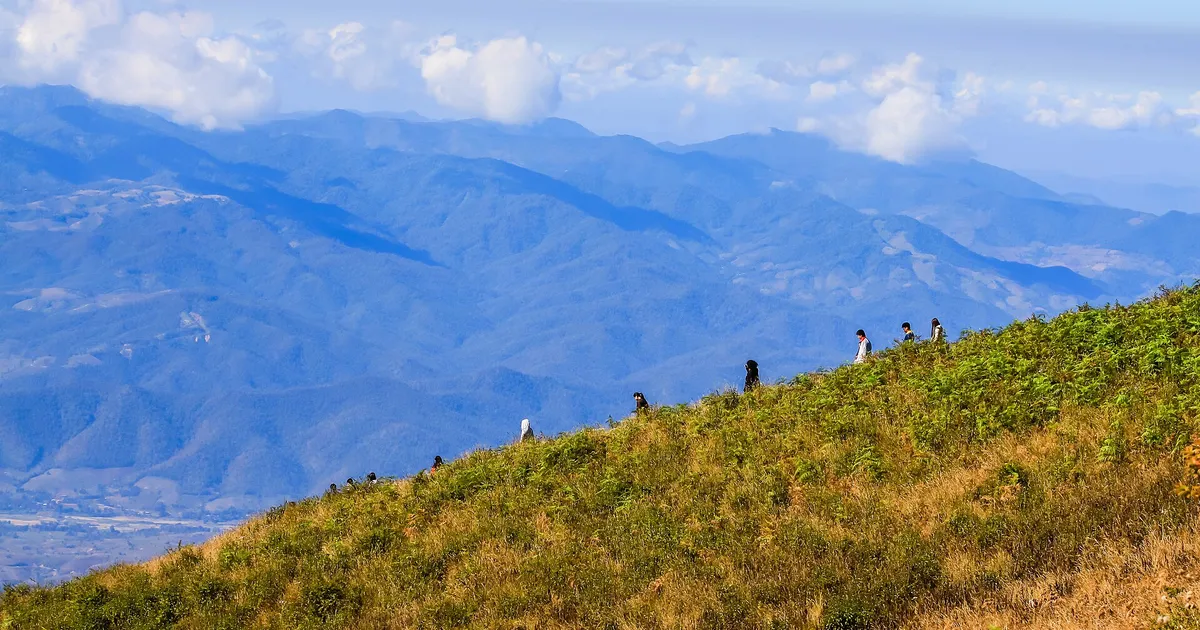
If your social feed right now is full of photos of white sea-of-fog rolling over mountain ridges and hillsides blanketed in yellow flowers, that's because Thailand's cool season is arriving — and this year carries an especially clear signal: Phu Kradueng National Park in Loei just announced it reopened for the trekking-and-camping season on 1 October 2026, after being closed all rainy season to let the forest recover. That means right now is the best moment to start planning a cool-season trip, before lodges near the most popular viewpoints fill up during the November-January peak.
The question everyone's asking is where to go, how each place differs, what to prepare, what it actually costs, and when exactly to go to catch the fog or the flowers at their best. This article rounds up the 10 best cool-season destinations in Thailand for 2026 in one place — ranked from the most complete all-rounder down to the most niche — with real entrance fees, lodging costs, distances, and how to pick the one that fits your budget and travel style. Finish reading and you won't need to look anywhere else.
Fees, distances, and opening/closing dates in this article are based on official national park announcements and credible news coverage as of early October 2026. Lodging prices are approximate ranges that vary by season and provider — call the park/lodge to confirm before you travel.
How this list was ranked
Before diving in, here's what "best cool-season destination" was weighed against, since it means something different to everyone — some just want an easy drive-up view of the fog, others want to summit a mountain on foot. This list scores on four things:
- Beauty and uniqueness — sea of fog, flower fields, or a view you can't get anywhere else
- Value for access — entrance fees and lodging weighed against the experience
- Range of things to do — photo spots, lodging and food, not just a single viewpoint
- A clear best time to go — so you know which month actually delivers what you came for (blooms/fog/cold weather), not a guess
The list spans the north (6 spots), the northeast (1 spot) and the lower-north/central region (3 spots), so there's an option whether you're starting from Bangkok, Chiang Mai, or the northeast.
#1: Doi Inthanon (Chiang Mai)
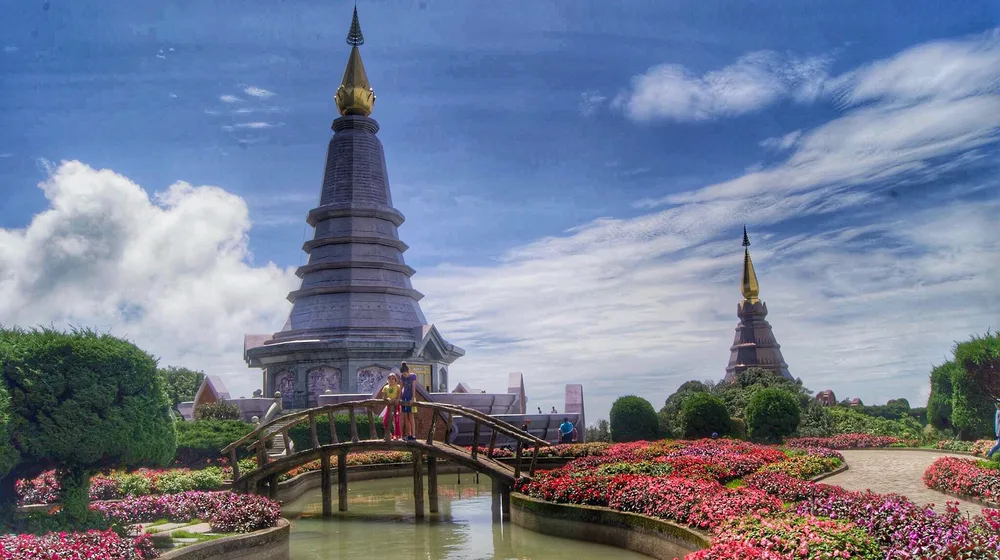 Photo: ElliotJW — CC BY-SA 4.0 (Wikimedia Commons)
Why it's #1: Doi Inthanon is Thailand's highest peak (2,565m) and the only entry on this list that bundles everything into one trip — waterfalls, a nature trail, sea-of-fog viewpoints, the iconic twin pagodas, and cold enough air to occasionally dip below freezing in some years. It's also the easiest to reach from a city base, out of everything on this list.
Highlight: The Kew Mae Pan nature trail, 3.2 km long and taking 2-4 hours, sits at 2,000-2,400m elevation and winds through montane forest into open grassland with a 360-degree view of the fog sea and the summit. ⚠️ It only opens 1 November to 31 May (closed in the rainy season for forest recovery). A park guide is required — 200 THB per group of up to 10 — paid on the day, no advance booking needed.
Temperature: Around 11-12°C in November, dropping to as low as 7°C at Kew Mae Pan in January, the coldest month of the year.
Doi Inthanon National Park entrance fees:
| Group | Fee |
|---|---|
| Thai adult | 60 THB |
| Thai child | 30 THB |
| Foreign adult | 300 THB |
| Foreign child | 150 THB |
| Car (additional) | 30 THB |
Getting there: About 90 km from Chiang Mai city, roughly a 2-hour drive. No direct public transport — charter a car (800-1,200 THB round trip) or book a day-tour (400-800 THB/person). From Bangkok, fly to Chiang Mai (1h20) and continue by road.
Best for: First-timers who want everything in one trip, families with children or elderly members (the main viewpoints need no trekking unless you go to Kew Mae Pan), and anyone short on time who still wants Thailand's classic cool-season postcard.
For a full 3-day, 2-night Chiang Mai itinerary covering Doi Suthep, the night market and northern food, see our Chiang Mai travel guide.
#2: Phu Kradueng (Loei)
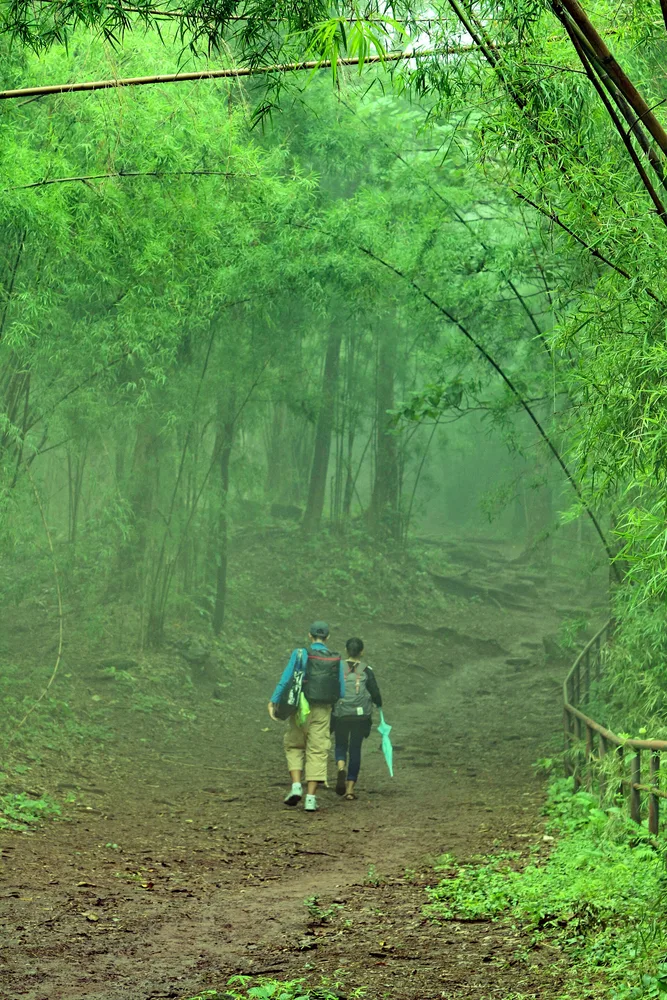 Photo: Mmonthon — CC BY-SA 4.0 (Wikimedia Commons)
Why #2: Phu Kradueng is the trip many Thai travelers consider a rite of passage — not just a viewpoint, but a full 2-3 day trekking experience with camping on a cold, breezy plateau. This year is especially timely: it just reopened for the season on 1 October 2026 (running through 31 May 2027) after a full rainy-season closure for forest recovery.
The trek: From the visitor centre up to "Lang Phae" (the plateau rim) is about 5 km — the steepest, most tiring stretch, taking 3-5 hours depending on fitness. From there it's another 3-4 km of flat walking across the plateau to the camping/lodging zone, for roughly 9 km total. ⚠️ You may only ascend between 06:00-12:00 and descend between 07:00-13:00.
Costs:
| Item | Price |
|---|---|
| Park entrance (adult/child) | 40 / 20 THB |
| Porter service | 30-40 THB/kg |
| Park tent rental | 225-600 THB/tent |
| Sleeping bag / pad / pillow rental | 30 / 20 / 10 THB |
| Pitching your own tent | 30-60 THB/person/night |
Getting there: About 496 km from Bangkok. A direct bus runs from Bangkok to Phu Kradueng district (around 455 THB), or fly to Loei and continue by bus, then a local pickup truck into the park.
Best for: Hikers, backpackers, and anyone after a full camping experience. Not suited to anyone with knee or hip issues, or without at least 2-3 full days to spare.
#3: Phu Thap Boek (Phetchabun)
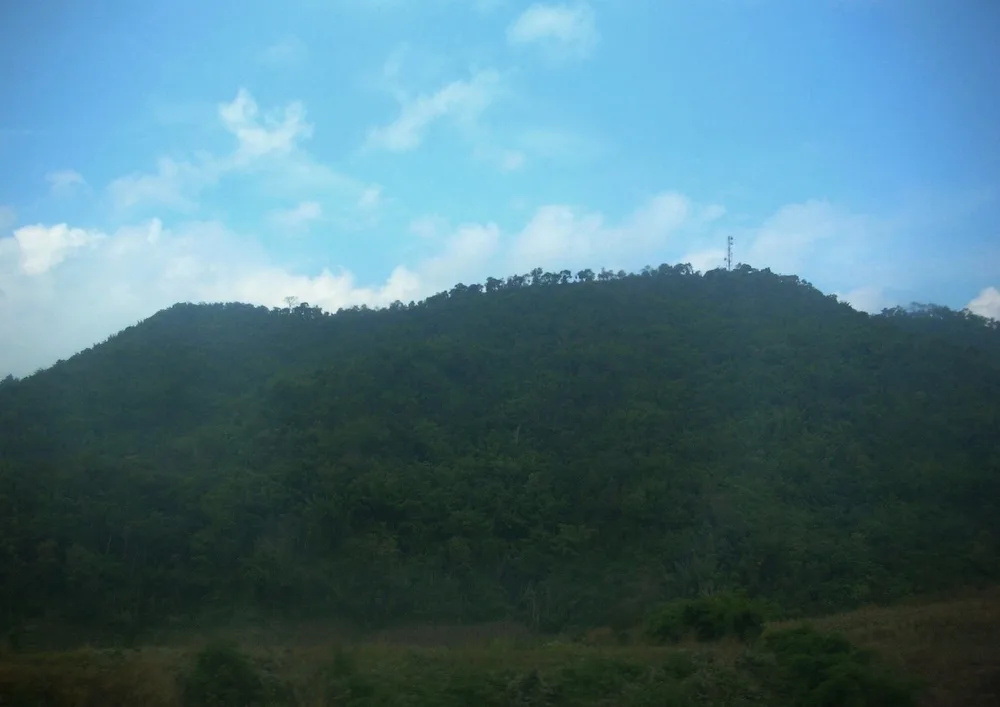 Photo: Xufanc — CC BY-SA 3.0 (Wikimedia Commons)
Why it's on the list: Phu Thap Boek is the most popular sea-of-fog destination among younger travelers, thanks to terraced strawberry and cabbage farms stacked across the hillside like a painting, plus cafes and lodges in every price bracket scattered across the slopes. It's a strong pick for a short trip built around photos, with no trekking required.
Lodging and prices (per night, 2+ guests):
| Lodge | From |
|---|---|
| Rai Neua Talay Mok | 800 THB |
| Rai Rim Pha Phu Thap Boek | 1,000 THB |
| Rai Talay Mok | 1,200 THB |
| Kod Mok Phu Thap Boek Resort (breakfast incl.) | 1,300 THB |
| Im Un Phu Thap Boek (breakfast incl.) | 2,900 THB |
Getting there: About 430 km from Bangkok, roughly 6-7 hours' drive (via Phetchabun-Lom Sak, turning onto Route 2372 then Route 2331). Leave early to beat traffic on the way back and arrive before dark. No public transport — drive yourself or charter a car.
⚠️ Caution: The road up Phu Thap Boek is steep and winding throughout — check your car's condition, especially brakes and brake pads, before a long mountain drive (see our pre-trip car maintenance checklist). Lodging fills up fast around cool-season long weekends — book at least 2-4 weeks ahead.
Best for: Couples and groups of friends who want great photos without trekking, and who enjoy cafe-hopping with a view.
#4: Mon Jam (Chiang Mai)
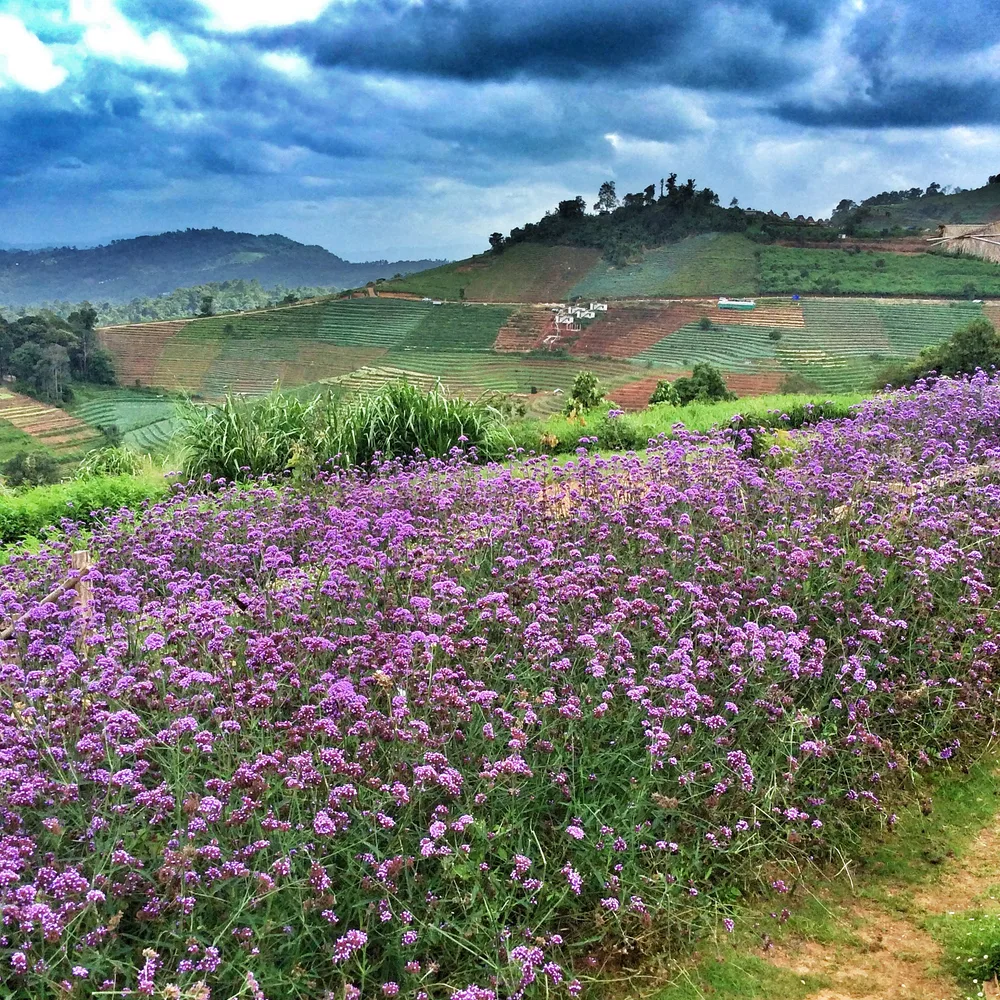 Photo: ::::=UT=:::: — CC BY-SA 3.0 (Wikimedia Commons)
Why it's on the list: Mon Jam is the easiest to reach on this entire list for anyone based in or passing through Chiang Mai — just ~36 km (about 1.5 hours) from the city, with cars driving right up to the viewpoints, no trail needed. Flower fields, campgrounds and lodging are spread across the hillside at every budget.
Best time to go: It's cool and foggy nearly year-round at this elevation, but the prettiest window is the end of the rains into early cool season (September-November), when mixed flower fields bloom together and fog settles in for most of the day. December-January is colder but some flowers may have already faded.
Lodging: From around 1,400 THB (hillside homestays) up to 2,000 THB+ for view resorts with large glass windows, mostly bookable through standard booking platforms.
Getting there: From Chiang Mai city via Mae Rim district, paved the whole way — no 4WD needed, a standard sedan is fine. It's a common stop combined with a Doi Ang Khang and Pai loop trip ("the three-mountain circuit"), since they sit along the same route.
Best for: Families with young children or elderly members, anyone with only half a day to a full day, and international visitors who'd rather not trek.
#5: Doi Ang Khang (Chiang Mai)
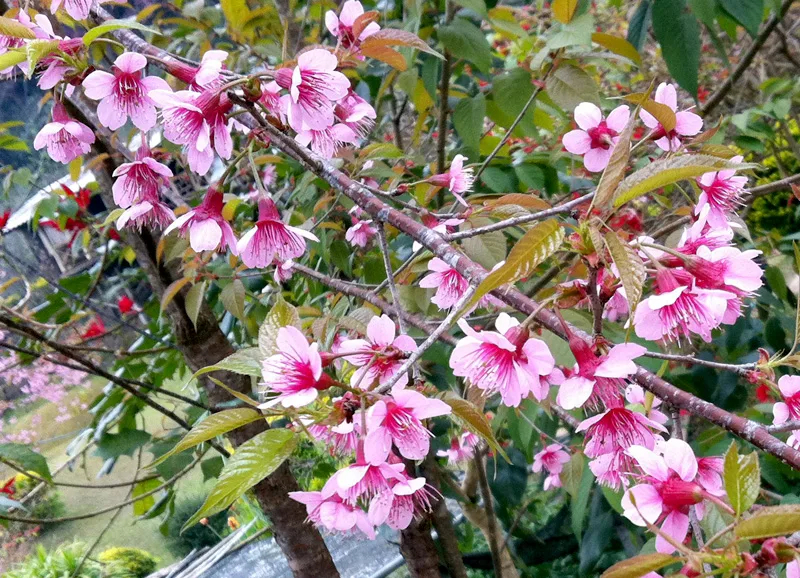 Photo: Manop — CC BY-SA 3.0 (Wikimedia Commons)
Why it's on the list: Doi Ang Khang is the only Royal Project agricultural station on this list, not a pure nature park — it grows temperate flowers and crops that can't be grown elsewhere in Thailand. The highlight is the Prunus cerasoides, or "Thailand's sakura" trees, which bloom in full pink only during late December to early January, the single busiest window of the year.
Entrance fee: 50 THB per person
Lodging: The Royal Project's own lodges require a written request to the Royal Project Foundation office in advance, at around 1,250 THB for two people. Nearby private resorts such as Angkhang Nature Resort start around 1,000 THB per night and are easier to book through standard channels.
Getting there: In Fang district, about 160 km from Chiang Mai city, roughly a 3-4 hour drive. The final stretch is steep and winding — drive slowly, especially in heavy fog.
Best for: Flower and garden lovers, families who want to show kids temperate crop fields, and anyone after more than just the fog.
#6: Phu Chi Fa (Chiang Rai)
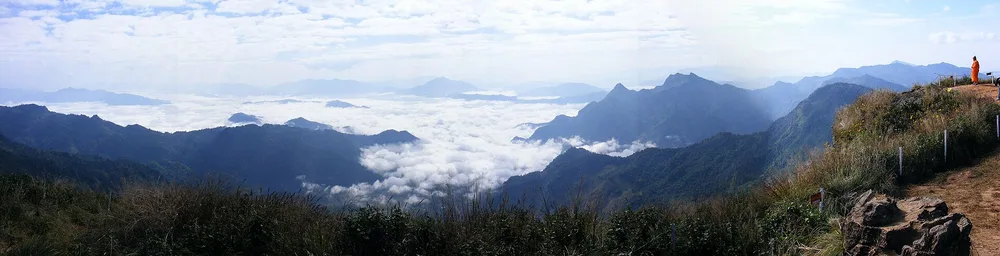 Photo: ผู้สร้างสรรค์ผลงาน/ส่งข้อมูลเก็บในคลังข้อมูลเสรีวิกิมีเดียคอมมอนส์ - เทวประภาส มากคล้าย — CC BY 3.0 (Wikimedia Commons)
Why it's on the list: Phu Chi Fa is considered one of Thailand's finest sunrise-over-fog viewpoints, sitting right on the Thai-Laos border at 1,628m, with ridgelines stacked into the distance as far as the eye can see. Its sharp, distinctive peak shape is something no other spot on this list offers.
Catching the sunrise: You need to leave your lodge by 5am and walk about 1.7 km to the summit viewpoint to catch first light — around a 40-50 minute walk. The trail isn't steep, but it's dark and cold, so bring a flashlight and warm layers.
Lodging and tents: Tent rental at the campground runs about 250 THB/tent (2 people); lodges and resorts near the base range from 500 THB up to 4,900 THB/night depending on size and comfort.
Getting there: About 144 km from Chiang Rai city, via Theong and Wiang Kaen districts, roughly a 2.5-3 hour drive. From Bangkok, fly to Chiang Rai (~1h20) and continue by road for about 3 hours.
Best for: Sunrise chasers, campers willing to wake before dawn, and anyone who's already done Phu Thap Boek or Mon Jam and wants a different angle.
#7: Bua Tong Field, Doi Mae U Kho (Mae Hong Son)
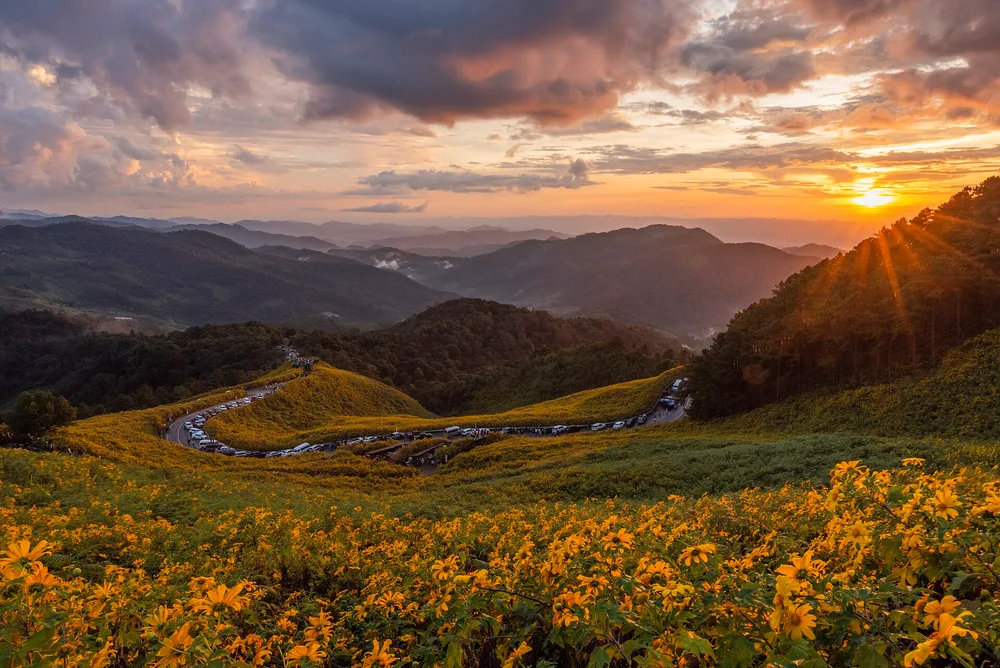 Photo: Prawit thawonsak — CC BY-SA 4.0 (Wikimedia Commons)
Why it's on the list: This is the "miss it and wait a year" entry on the list — Thailand's largest Bua Tong field (Mexican sunflower, Tithonia diversifolia) on Doi Mae U Kho blooms a brilliant yellow across the whole valley only once a year, in the brief window between the end of the rains and the start of the cool season. This year it officially opens 11 November 2026, with the peak bloom usually falling between 17-23 November, before the flowers start fading in early December.
Getting there: From Chiang Mai city, first head to Khun Yuam district, about 67 km (roughly 1.5 hours) along Route 108. Turn onto Route 1263 at kilometre marker 201 for about 12 km, then onto the Ban Ngiw-Ban Hua Ha road for another 14 km to reach the field — about 100 km (~2 hours) total from Chiang Mai. No direct bus — drive yourself or charter a car from Khun Yuam.
⚠️ Caution: During the peak bloom week (17-23 Nov), traffic and crowds are heavy and some roads are narrow. Arrive early or book lodging in Khun Yuam district well ahead, since on-mountain lodging is very limited.
Best for: Travelers who can plan precisely, photographers chasing a rare flower field, and anyone already in the Chiang Mai-Mae Hong Son area. For a full Mae Hong Son trip, see our Pai, Mae Hong Son travel guide.
#8: Doi Samer Dao (Nan)
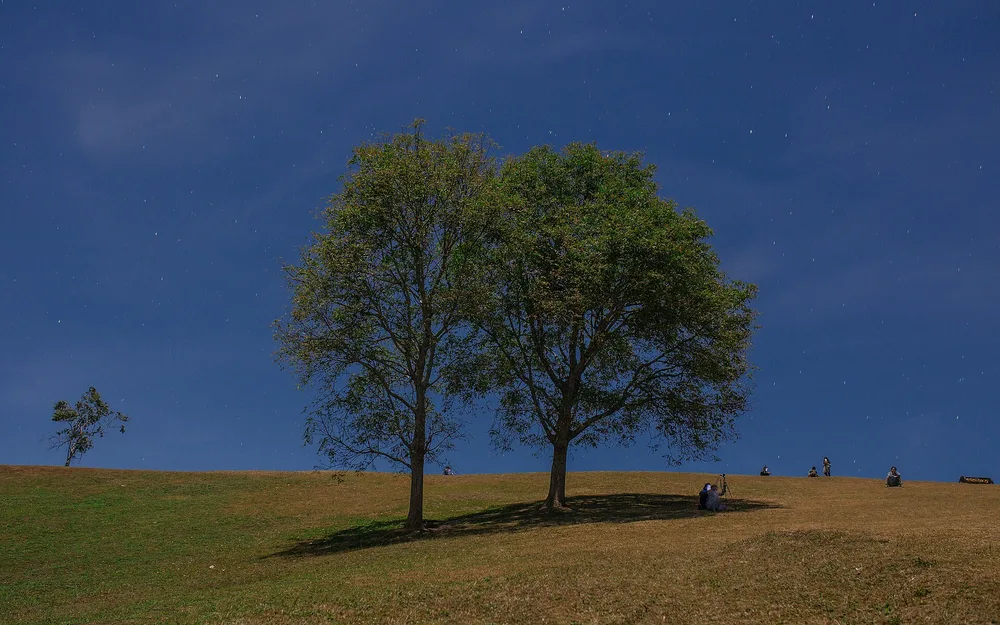 Photo: Nuttasak — CC BY-SA 4.0 (Wikimedia Commons)
Why it's on the list: Doi Samer Dao is the cheapest entry on this list — entry, vehicle fee and camping combined still come to under 100 THB per person — yet it delivers sea of fog, grassy meadows, wildflowers, and skies clear enough to see a full field of stars at night. It sits inside Sri Nan National Park in Na Noi district, at 888m elevation.
Costs: Park entry 20-30 THB + vehicle fee 20-30 THB + camping 30 THB/person/night (bring your own tent or rent one from the park).
Best time to go: November-February is the main season, with the clearest skies and the best odds of a strong sea of fog.
Getting there: About 78 km from Nan town, roughly a 1.5-hour drive, with a choice of two routes (via Wiang Sa district, or via Rong Kwang district in Phrae province). From Bangkok it's about 668 km — fly to Nan (around 1h15) and continue with a rental car.
Best for: Budget-conscious campers, stargazers, and anyone who wants to go deeper into Nan than just the old town.
#9: Khao Kho (Phetchabun)
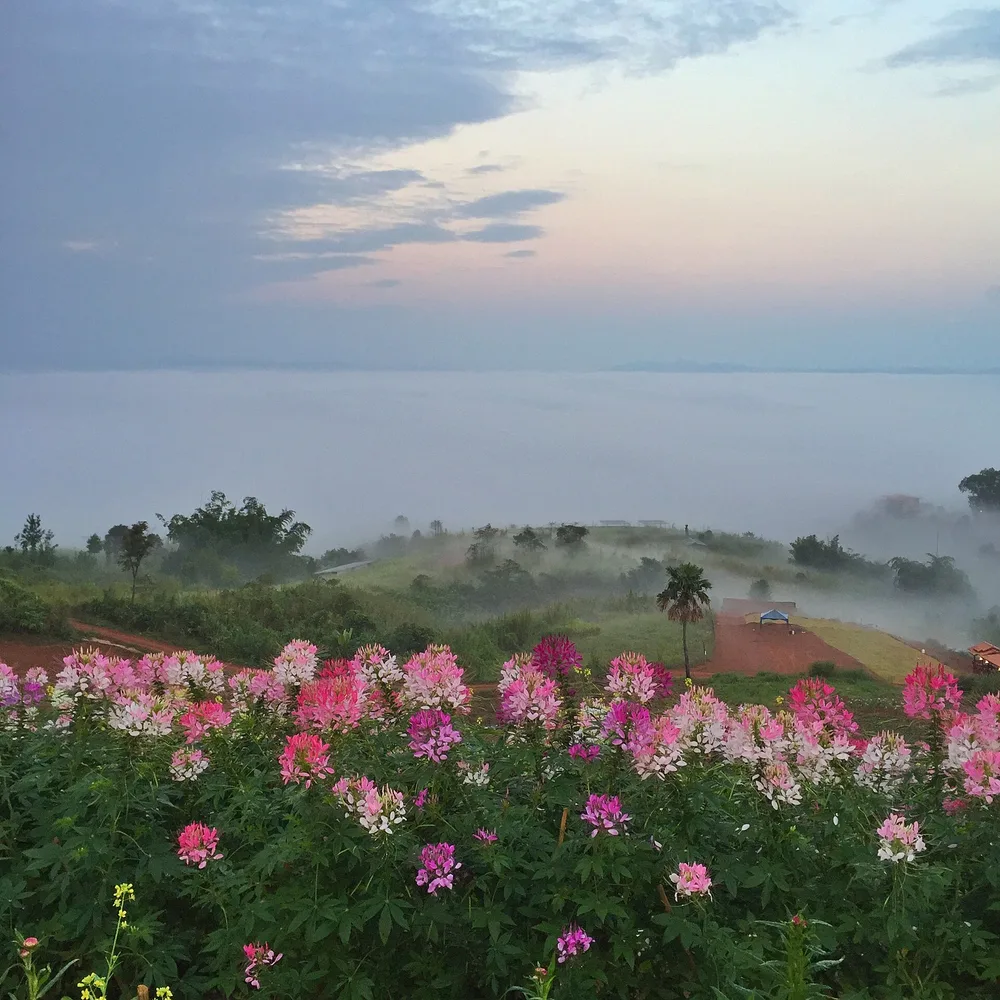 Photo: ::::=UT=:::: — CC BY-SA 3.0 (Wikimedia Commons)
Why it's on the list: Khao Kho is nicknamed "Thailand's Switzerland" for its rolling hills and mountains, cool air, and white mist that lingers nearly year-round — but the real reason it makes this list is that it's the closest to Bangkok of any destination at this level, making it a genuine weekend trip with no flight required.
What's there: Thung Salaeng Luang National Park, wind turbine fields, Wat Phra That Pha Son Kaeo, and cafes with mountain views lining the route.
Getting there: About 340-350 km from Bangkok, roughly a 5-hour drive in normal traffic (as fast as ~4h50 with no stops), via Saraburi-Lom Sak. No flight or tour needed — a standard sedan handles it fine.
Best for: Bangkok residents with only a Saturday-Sunday to spare, families who don't want to drive more than 5-6 hours, and anyone considering Khao Kho as a warm-up before tackling the farther Phu Thap Boek on the same route.
#10: Phu Soi Dao (Uttaradit)
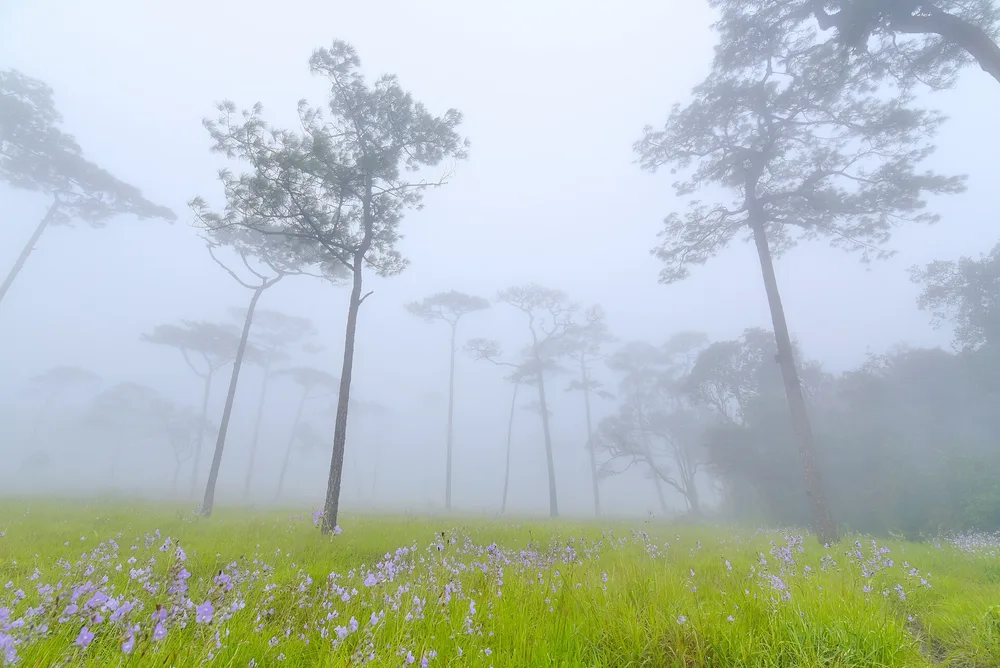 Photo: Beijingbing — CC BY-SA 4.0 (Wikimedia Commons)
Why it's on the list: Phu Soi Dao is the only entry on this list known for changing autumn leaf colour — a rare sight in Thailand — thanks to maple and Bhutan oak trees that turn red and orange in the late-rains, early-cool-season window (October-November), on a pine meadow at 2,102m elevation. It's a slightly tougher trek than Phu Kradueng and needs the most advance planning of anything on this list.
The trek: About 6.5 km up, taking 4-6 hours depending on fitness, with several steep sections and 5 main rest points along the way.
Booking and costs: ⚠️ You must book through the QueQ app no more than 15 days in advance. Park entry is 40 THB, porter service 30 THB/kg, plus a 200 THB refundable trash deposit returned once you carry your rubbish back down. ⚠️ The park closes every year from 1 February to 30 June for forest recovery — check the opening announcement carefully before planning.
Getting there: About 490-500 km from Bangkok (Uttaradit itself is 491 km by road from Bangkok), or fly to Phitsanulok first and continue by road for about another 170 km.
Best for: Experienced hikers who want a foliage-season feel without flying abroad, and anyone willing to plan and book a slot in advance.
Comparison table — all 10 destinations
| Rank | Destination | Province | Approx. entry fee | Best time | Difficulty |
|---|---|---|---|---|---|
| 1 | Doi Inthanon | Chiang Mai | 60 THB | Nov-Jan | Easy-moderate |
| 2 | Phu Kradueng | Loei | 40 THB | Nov-Jan | Hard (2-3 day trek) |
| 3 | Phu Thap Boek | Phetchabun | None (lodging only) | Dec-Jan | Easy |
| 4 | Mon Jam | Chiang Mai | None (lodging only) | Sep-Nov | Easy |
| 5 | Doi Ang Khang | Chiang Mai | 50 THB | Late Dec-early Jan | Easy |
| 6 | Phu Chi Fa | Chiang Rai | None (tent fee only) | Nov-Jan | Moderate |
| 7 | Bua Tong Field | Mae Hong Son | None | 17-23 Nov only | Easy |
| 8 | Doi Samer Dao | Nan | 20-30 THB | Nov-Feb | Moderate |
| 9 | Khao Kho | Phetchabun | None | Dec-Jan | Easy |
| 10 | Phu Soi Dao | Uttaradit | 40 THB | Oct-Nov | Hard (trek) |
How to choose, by budget and travel style
- Tight budget, under 1,500 THB/person: Doi Samer Dao (Nan) or Phu Kradueng (Loei) — cheap entry if you bring your own tent, though Phu Kradueng needs far more time and fitness.
- Only a weekend, driving from Bangkok within 5-6 hours: Khao Kho or Phu Thap Boek (Phetchabun) — no flight needed, there and back in a weekend.
- Already in or flying to Chiang Mai, with half a day to a day: Mon Jam or Doi Ang Khang — drive right up to the viewpoint, no trail required.
- Want a photo nobody else has, and can plan ahead precisely: the Bua Tong field at Doi Mae U Kho (once-a-year bloom) or Phu Soi Dao (changing leaves).
- Want to summit on foot, ready for a 2-3 day trek: Phu Kradueng or Phu Soi Dao — bring hiking boots, layered warm clothing, and a properly fitted backpack.
- Chasing sunrise over the fog: Phu Chi Fa (Chiang Rai) — but be ready for a 5am start and walking in the dark.
- Traveling with young children or elderly family members: Doi Inthanon (skip the trekking parts), Mon Jam, or Khao Kho.
If you're driving an EV up a distant mountain and worried about range, plan your charging stops with our EV trip planner, which calculates where and how long to charge along the way before the battery runs low.
Common mistakes people make on a mountain cool-season trip
- Not checking a trail's open season first — the Kew Mae Pan trail on Doi Inthanon is closed in the rainy season (July-October), and Phu Soi Dao closes February-June. Many travelers drive all the way there before learning the main trail is shut.
- Underestimating the cold — mountain temperatures can run 10-15°C colder than the city forecast. Pack layered warm clothing rather than a single thick jacket. If your accommodation has no heating (common on the mountain), consider bringing a small portable heater along.
- Not booking lodging ahead during peak season — lodging around Phu Thap Boek, Mon Jam and the Bua Tong field fills up fast during long weekends and bloom season; some places need booking 1-2 months out.
- Driving up a mountain without checking your car — most mountain roads are steep and winding for miles at a stretch. Worn brake pads can overheat and lose effectiveness (brake fade) — always check your brakes and brake fluid before a long drive.
- Forgetting essentials for areas with no phone signal — many campgrounds (Phu Kradueng, Phu Soi Dao, Doi Samer Dao) have weak or no signal. Download offline maps and tell someone your route in advance.
- Arriving too late for the fog — the sea of fog usually clears after 9am, especially on sunny days. If fog is the whole point of your trip, be at the viewpoint before 7am.
Verdict: which cool-season trip is right for you
If you want the single most complete all-rounder for most travelers, the answer is Doi Inthanon — waterfalls, a nature trail, and viewpoints all in one place, easy to reach from Chiang Mai, and suited to every age group. If you want a once-in-a-while multi-day trekking-and-camping experience, the newly reopened Phu Kradueng is the clearest answer. And if your budget is genuinely tight but you still want a beautiful sea of fog, Doi Samer Dao is the best value on this entire list.
Whichever you choose, the most important thing is planning ahead — check trail opening dates, book lodging before peak season, and prepare your body and gear to match each destination's difficulty level. Thailand's cool season only lasts a few months; miss it this year and it's another year's wait.
Frequently asked questions
See the detailed answers in the FAQ section below the article.
Sources
- Department of National Parks, Wildlife and Plant Conservation — opening announcements for Phu Kradueng and Phu Soi Dao National Parks
- Thai Meteorological Department — seasonal cool-season weather outlook for Thailand
- Travel and park-fee reporting from Sanook Travel, Kapook Travel, Thairath, Bangkok Biznews, MGR Online and Trip.com, as of September-October 2026
Frequently asked questions
- When does Thailand's cool season start in 2026, and what's the best time to go?
- The Thai Meteorological Department expects the cool season to arrive slightly later than usual this year, with the upper north and northeast turning cold around late October 2026 and the cool spell lasting through late February 2027. The coldest weather and the best sea-of-fog views usually fall between mid-December and mid-January, but late October through November (the "end of rains, start of cool season" window) already delivers great fog with far smaller crowds.
- Can I visit these places without a car?
- Some, yes, but most need a rental car or tour for the last stretch, since the best viewpoints sit well outside town with no direct public transport. Doi Inthanon, Mon Jam and Doi Ang Khang can be reached from Chiang Mai by rental car or a day-tour package (400-800 THB/person). Phu Kradueng has a direct bus from Bangkok to the district (around 455 THB) followed by a local pickup truck into the park. Phu Thap Boek, Phu Chi Fa, Doi Samer Dao and the Bua Tong field really do need your own or a rented car — the roads are winding with no scheduled service to the viewpoints.
- Which of these are good for first-timers with no hiking experience?
- Mon Jam, Phu Thap Boek, Doi Ang Khang and Khao Kho are the easiest — you can drive right up to the viewpoint, no trail required. Phu Chi Fa and Doi Samer Dao need a short walk of a few hundred metres to about 1-2 km, manageable for anyone with reasonable fitness. Phu Kradueng and Phu Soi Dao are a different tier entirely — multi-day treks that need real fitness and proper gear, and aren't recommended for anyone with knee or hip problems, or no hiking experience at all.
- What time do I need to wake up to see the sea of fog?
- The fog is usually at its best from sunrise until around 8-9am, before the sun burns it off. Aim to reach the viewpoint before 6am to allow time to walk in and find parking or a shooting spot. Phu Chi Fa requires leaving your lodge by 5am for a roughly 1.7 km walk to the viewpoint in time for first light; places you can drive straight up to, like Mon Jam or Phu Thap Boek, are fine with a 5:30-6am start.
- How much should I budget for a 2-day, 1-night cool-season trip?
- A budget trip (camping or a cheap homestay, driving yourself) runs about 1,500-2,500 THB per person, covering fuel, park entry, lodging and food. A more comfortable trip (a view resort in the low thousands plus a rental car) runs roughly 4,000-7,000 THB per person. Add round-trip flights to Chiang Mai, Chiang Rai or Nan and budget another 2,000-5,000 THB per person depending on how far ahead you book.
- Are there any long weekends coming up that suit a cool-season trip?
- The nearest is Chulalongkorn Day, Friday 23 October 2026, running into the weekend for a 3-day break. After that is the substitution holiday around Father's Day/National Day, which this year falls on Monday 7 December, again creating a 3-day weekend from Saturday 5 to Monday 7 December. See the full year of public and bank holidays, plus every long weekend, with our [holiday calendar tool](/holidays).
Related articles
Chiang Khan & Loei Travel Guide 2026: Phu Kradueng, Phu Ruea, Sea of Fog
Complete 2026 guide to Chiang Khan, Loei — Phu Kradueng, Phu Ruea, the walking street, Kaeng Khut Khu, the skywalk, getting there, real costs, and a 3-day itinerary

Chiang Mai Travel Guide 2026: Complete Guide to Doi Suthep, Doi Inthanon, Night Markets, 3-Day Itinerary & Real Costs
Complete Chiang Mai travel guide for 2026 — Doi Suthep, Doi Inthanon, Wachirathan Waterfall, Sunday Walking Street, northern Thai food, 4 ways to get there, accommodation for every budget, real costs, and a 3-day 2-night itinerary.
Pai, Mae Hong Son Travel Guide 2026: Sights, Stays & 3-Day Plan
Complete 2026 guide to Pai, Thailand: the 762-curve drive, must-see sights, stays for every budget, real costs, and a working 3-day itinerary.