Chiang Khan & Loei Travel Guide 2026: Phu Kradueng, Phu Ruea, Sea of Fog
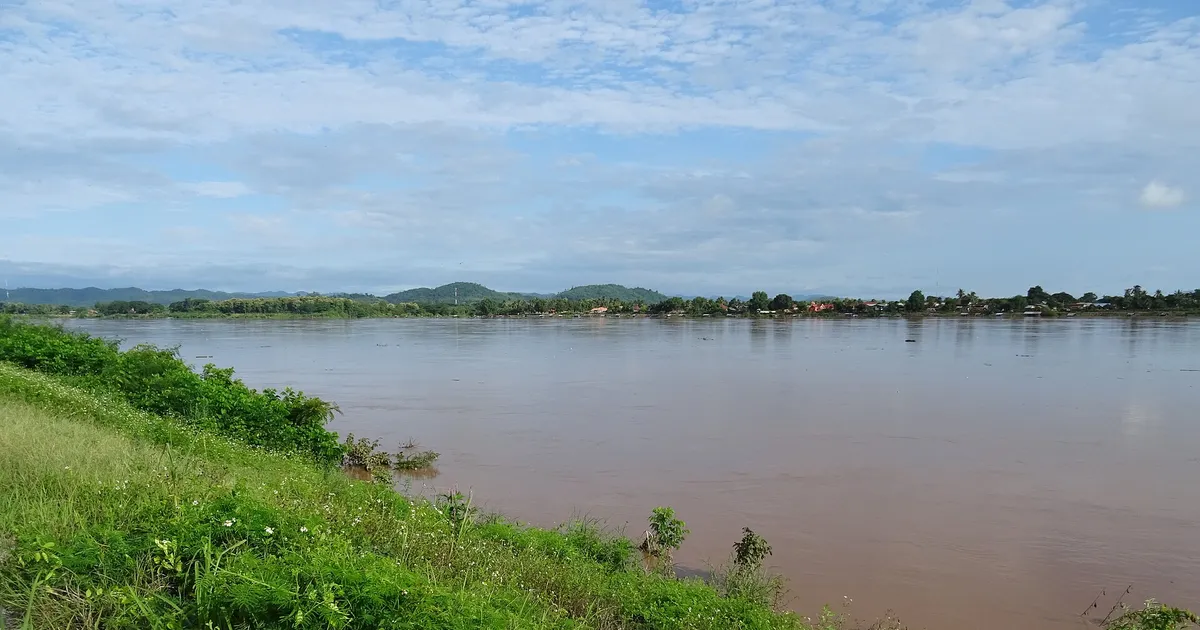
Watch more: 10 places to visit in Loei & Chiang Khan — nature, sea of fog and Isaan mountains, by Bugaboo Travel
Every year, Thai headlines run the same story: Loei province just recorded the country's coldest morning. Chiang Khan, its riverside district on the Mekong, has become the go-to escape for Bangkok residents chasing genuinely cold air, century-old wooden shophouses, and a sea of fog you simply can't find at a southern beach or a northern hill town.
But Chiang Khan is more than "the walking street that sells grilled sticky rice." The whole province of Loei is one of Thailand's densest clusters of sea-of-fog viewpoints — Phu Kradueng, a sandstone plateau you have to hike up and camp on; Phu Ruea, with its cold-climate flower gardens; and a dozen lesser-known peaks besides. This guide walks through the full trip in detail: getting there, real costs, and the mistakes most first-timers make.
Why Chiang Khan-Loei Is Special (Not Just "Foggy Photos")
Cold you can actually measure. Loei tops Thailand's coldest-province rankings almost every year, and Phu Kradueng in particular can see morning temperatures approach 0°C in December–January — an experience most Thais never get anywhere else in the country, and the reason people flock here every winter.
Riverside life that hasn't been over-developed. Unlike Chiang Mai or Phuket, which have grown far beyond their original character, Chiang Khan is still a small river town: century-old wooden houses, monks walking the morning alms round with sticky rice instead of cooked rice, and residents going about ordinary life alongside the tourist season.
Genuine variety within one province. No other Thai province packs in a wide Mekong river, a 1,300+ metre mountain you hike and camp on, a natural rock garden nicknamed "Thailand's Kunming," and an ancient stupa that once symbolized peace between two historic kingdoms — all reachable on a single trip.
Prices far friendlier than other hot destinations. Rooms start from 550 THB a night, almost every park entry fee is under 40 THB, and local food runs a few dozen baht a dish — a 3-day trip here costs a fraction of a comparable trip south.
Chiang Khan Highlights: Walking Street, Alms Round, Kaeng Khut Khu, and the Skywalk
Chiang Khan district itself is the trip's home base — everything below is within easy reach on foot or a short ride.
The Chiang Khan Walking Street (Chai Khong Road)
The heart of town is Chai Khong Road, lined with century-old wooden shophouses now converted into guesthouses, cafés, and souvenir stalls. Friday through Sunday evenings — and most nights during the December–January peak — the whole street becomes a pedestrian market.
Don't miss: khao ji (grilled sticky-rice skewers brushed with egg), Isaan sausage, fermented fish, and Chiang Khan-style Chinese sausage, plus mango sticky rice for dessert. Most items run 20–100 THB, and a relaxed stroll takes 2–3 hours.
Sticky-Rice Alms Round — A Tradition Found Nowhere Else
What sets Chiang Khan apart is that monks are offered sticky rice instead of cooked rice, following the old Isaan riverside custom. Monks walk a long line down Chai Khong Road from roughly 6:00–6:30 AM, and visitors can buy a sticky-rice set from roadside vendors for 20–50 THB to join in. A thin morning mist over the Mekong makes this the single reason many visitors fly out here.
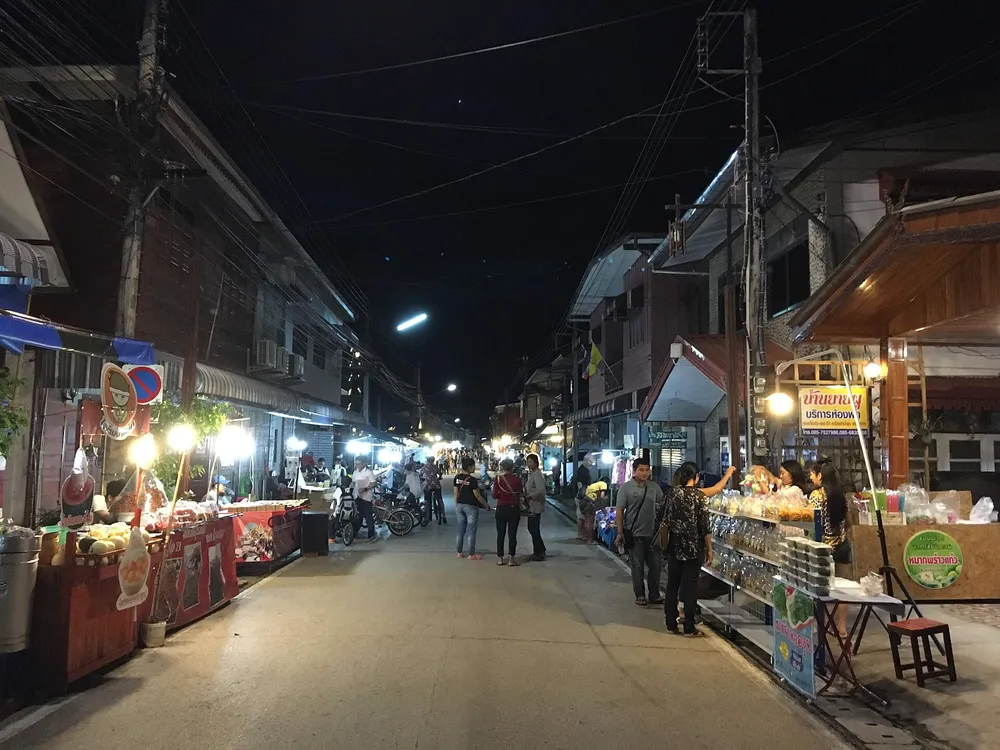 Photo: Chiang Khan walking street at night — CC BY-SA / Wikimedia Commons
Kaeng Khut Khu — The Most Famous River Viewpoint
About 3 km east of town, Kaeng Khut Khu is where the Mekong runs over a large rock formation, creating fast rapids and dramatic exposed rock during dry season (November–April) when water levels drop. The spot gained national fame after a royal visit and is now a must-stop photo location.
Stalls along the bank sell mango sticky rice and Isaan food. Viewing the rapids is free; a short boat ride costs roughly 300–400 THB per boat. Best visited in the early morning or late afternoon when the light is softer.
Chiang Khan Skywalk (Phu Khok Ngio)
The newest and most talked-about viewpoint is the Chiang Khan Skywalk at Phu Khok Ngio, Pak Tom subdistrict — a 100-metre glass walkway, 2 metres wide, suspended 80 metres above the Mekong (about as high as a 30-storey building). Its signature view is two rivers meeting in different colors — the clearer Heuang River joining the murkier Mekong, forming a natural boundary between Thailand and Laos.
Entry: roughly 20 THB for the shuttle up/down plus 30 THB for required shoe covers on the glass (sometimes bundled as 60 THB) | Hours: daytime only, closed during rain or high wind for safety.
Phu Thok — A Sea-of-Fog Viewpoint Inside Chiang Khan Itself
No long drive required — Phu Thok sits within Chiang Khan district and offers a sunrise and sea-of-fog view overlooking the town and the Mekong. Arrive before 6:00 AM to catch the sun breaking through the mist. It's the easiest fog viewpoint for anyone short on time, and entry is free.
Phu Kradueng: Hiking Up to a Misty Plateau
If Chiang Khan is comfort, Phu Kradueng is the challenge — and the reason many Thais put it on a lifetime bucket list. This national park sits in Phu Kradueng district, roughly 80–100 km from Chiang Khan (1.5–2 hours by car). It's a sandstone mountain topped by a broad plateau, ranging 400–1,200 metres in elevation, with its highest point (Khok Mo) at 1,316 metres.
⚠️ Open only from 1 October to 31 May. The park closes entirely from 1 June to 30 September every year to let the forest recover after the rains — always check this before planning around it.
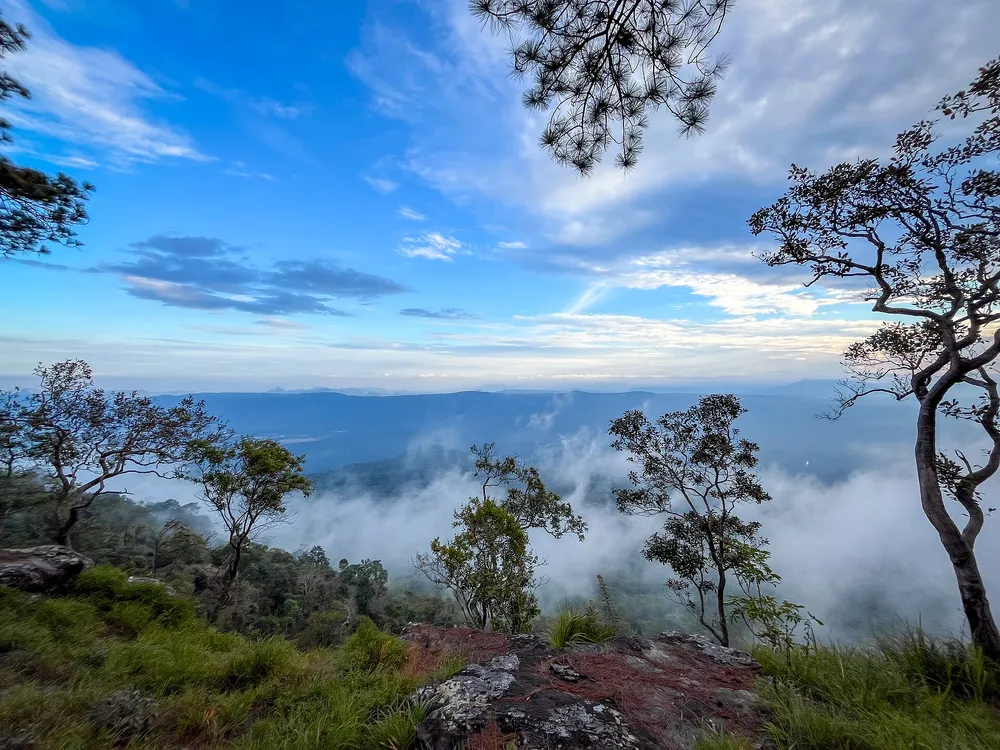 Photo: Cliff view from Phu Kradueng National Park — CC0/Wikimedia Commons
Costs and Preparation
| Item | Price |
|---|---|
| Park entry (Thai adult) | 40 THB |
| Park entry (Thai child) | 20 THB |
| Park entry (foreign adult) | ~200 THB |
| Porter queue ticket | 5 THB |
| Porter fee (carries gear up/down) | 30 THB/kg |
| Tent + bedding rental on the plateau | Varies by size — ask at the service point |
The trek: From the Si Than trailhead to Lang Kaeng (the plateau's rest stop), it's about 5.5 km, taking 4–6 hours depending on fitness. The final, steepest kilometre — known as "Sam Khae" — comes right before the top. Rest stops sell water and snacks along the way, so you don't need to carry every supply yourself.
From Lang Kaeng, it's another ~3 km to the campsite and viewpoints on the plateau (waterfalls, Pha Nok Aen, Pha Mak Duk). Plan to stay overnight at least once — hiking up, sightseeing, and hiking down in a single day is nearly impossible.
⚠️ Summit weather: From November to January, nighttime temperatures can drop near 0°C. Bring a heavy jacket, a cold-rated sleeping bag, and a wind-resistant tent. Porters and plateau services are limited, so book accommodation/tent rental directly with the park ahead of time, especially over long weekends.
Phu Ruea and Other Sea-of-Fog Viewpoints in Loei
Phu Ruea district is the second most popular fog-chasing destination, mainly because you can drive right up to the viewpoints without a long hike like Phu Kradueng's.
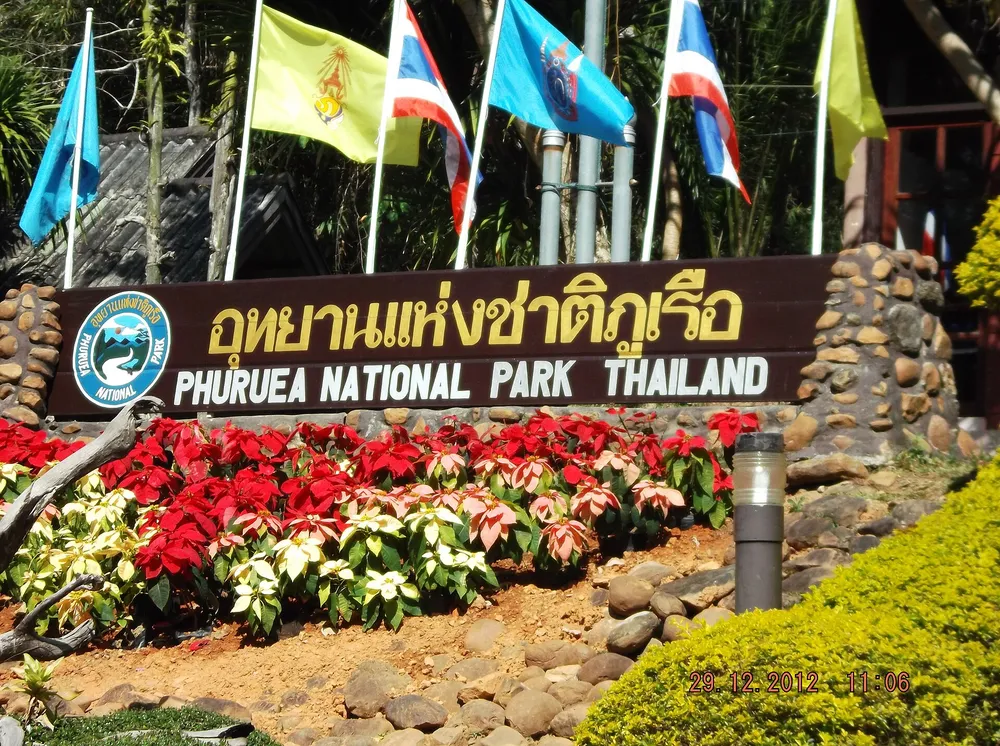 Photo: Phu Ruea National Park entrance — CC BY-SA/Wikimedia Commons
Phu Ruea National Park averages around 10°C in cool season and features cold-climate flower gardens in full bloom. The main viewpoints, Pha Decho and Pha Lon Noi, look out over a valley blanketed in fog. Entry fees match Phu Kradueng's (40/20 THB), but there's no long trek required, making it a better fit for families or anyone short on time.
Suan Hin Pha Ngam is nicknamed "Thailand's Kunming" for its collection of oddly-shaped limestone rock formations resembling a miniature mountain range. It stays cool year-round, even in the hot season, and makes a great stop on the way to Phu Ruea.
Phu Pa Peo and Phu Bo Bit are two more fog viewpoints favored by locals — far less crowded than Phu Kradueng or Phu Ruea, and a good pick for anyone who wants the same view without the crowds.
Dan Sai: Phra That Si Song Rak, Wat Neramit Wipassana, and the Phi Ta Khon Legend
Dan Sai district, about 50 km from Chiang Khan, holds some of the region's richest cultural history and is worth the detour if you have time.
Phra That Si Song Rak was built in 1560 as a symbol of peace between the Ayutthaya Kingdom and the Lan Xang Kingdom (Vientiane), forged during their joint resistance against Burmese forces. The white, Lan Xang-style lotus-topped stupa stands alone in open fields and has been revered by people on both sides of the Mekong for nearly 500 years.
Wat Neramit Wipassana is built entirely from laterite stone, giving it an architectural style unlike any typical Thai temple. Inside are murals depicting the life of the Buddha, and the atmosphere is quiet and meditative.
The Phi Ta Khon Museum displays the masks and costumes from Dan Sai's most famous festival, held once a year according to the lunar calendar (typically around June–July). Even outside festival season, the museum gives a real sense of how spectacular the event is.
Getting There from Bangkok
| Method | Route | Cost | Time | Best for |
|---|---|---|---|---|
| Direct bus (recommended) | Mo Chit 2 → Chiang Khan | 511–596 THB | 9–10 hours | Simplest, no transfers |
| Train + bus + songthaew | Bangkok→Udon Thani→Loei→Chiang Khan | ~350 THB (204+108+40) | 10–12 hours | Budget travelers who enjoy the ride |
| Flight + rental/taxi | Bangkok→Loei Airport→Chiang Khan (~50 km) | Airfare + local transfer | ~1.5 hr flight + 1 hr drive | Fastest, higher budget |
| Private car | Highway 21 or Route 2 | ~1,000–1,500 THB fuel+tolls | 7–9 hours | Groups of 3–5, most flexible |
⚠️ Things to watch for:
- Direct buses run limited departures (morning 7:00 AM, evening 8:00/10:00 PM) — book ahead, especially over November–January long weekends, since seats fill fast.
- Roads from Loei to Chiang Khan and up the mountains involve many steep curves. If self-driving, take extra care at night or in early-morning fog.
- If continuing to Phu Kradueng, you'll need your own car or a rental — there's no direct public transport from Chiang Khan.
Best Time to Visit: Why "Cool Season" Is Everything
| Period | Weather | Sea of fog | Phu Kradueng open? | Verdict |
|---|---|---|---|---|
| Nov–Jan | Cool to genuinely cold (5–20°C) | Best, most mornings | ✅ Yes (peak season) | Best time |
| Feb–Mar | Warming up (20–28°C) | Still occasional | ✅ Yes | Good runner-up |
| Apr–May | Hot (28–36°C) | Almost none | ✅ Yes (near closing) | Not recommended |
| Jun–Sep | Heavy rain | None | ❌ Closed | Avoid |
| Oct | Starting to cool, some rain | Beginning to appear | ✅ Just reopened | Improving |
Bottom line: if fog and cold weather are your goal, November through January is the only window where everything lines up — climate, mist, and Phu Kradueng's opening dates all align. Long weekends in this period get very crowded; book accommodation at least 3–4 weeks ahead.
Real Costs for 3 Days / 2 Nights (Per Person)
| Item | Budget | Mid-range | Comfort |
|---|---|---|---|
| Round-trip transport | 350–400 (train/bus combo) | 511–596 (direct bus) | 3,000–5,000 (flight + rental) |
| Lodging (2 nights) | 1,100–1,800 (hostel/guesthouse) | 2,000–4,000 (mid hotel) | 5,000–10,000 (river-view resort) |
| Food (3 days) | 400–600 | 800–1,500 | 1,800–3,000 |
| Entry fees + activities | 200–400 (skywalk + Kaeng Khut Khu boat) | 400–700 (incl. Phu Kradueng/Phu Ruea) | 700–1,200 |
| Motorbike/car rental (2 days) | 400–500 | 800–1,200 (car) | 1,500–2,500 |
| Souvenirs/misc | 200–400 | 400–800 | 800–1,500 |
| Estimated total | 2,650–4,100 | 4,900–8,800 | 12,800–23,200 |
Sample 3-Day/2-Night Itinerary (Chiang Khan + Phu Ruea + Dan Sai)
Day 1: Bangkok → Loei → Suan Hin Pha Ngam → Phu Ruea
| Time | Activity |
|---|---|
| 6:00–7:00 AM | Depart Bangkok (bus/private car) |
| Afternoon | Arrive Loei; stop at Suan Hin Pha Ngam for photos |
| Evening | Continue to Phu Ruea district, check in |
| Night | Dinner in town, rest before an early sea-of-fog morning |
Day 2: Pha Decho/Pha Lon Noi → Dan Sai → Chiang Khan
| Time | Activity | Est. cost |
|---|---|---|
| 5:30–7:00 AM | Sea of fog at Pha Decho/Pha Lon Noi, Phu Ruea NP | 40 THB |
| 8:00–9:30 AM | Cold-climate flower gardens in the park | Included |
| 10:30 AM–1:00 PM | Stop in Dan Sai: Phra That Si Song Rak + Wat Neramit Wipassana | Free |
| 2:00–4:00 PM | Drive on to Chiang Khan, check in | — |
| 4:30–6:00 PM | Chiang Khan Skywalk (Phu Khok Ngio) | 50–60 THB |
| 6:30–10:00 PM | Walking street: khao ji, Isaan sausage | 150–300 THB |
Day 3: Alms Round → Kaeng Khut Khu → Back to Bangkok
| Time | Activity | Est. cost |
|---|---|---|
| 6:00–6:30 AM | Sticky-rice alms round by the Mekong | 20–50 THB (rice set) |
| 7:00–8:30 AM | Stroll and photograph the old wooden shophouses | Free |
| 9:00–11:00 AM | Kaeng Khut Khu, mango sticky rice | 100–200 THB |
| 12:00–1:00 PM | Lunch, pack up, check out | 100–200 THB |
| 1:30 PM | Head back to Bangkok | Same as inbound fare |
(To add Phu Kradueng, extend to 4 days/3 nights and insert a full day for the hike up, overnight camping, and hike down.)
Where to Stay, Every Budget
| Tier | Location | Price (THB/night) |
|---|---|---|
| Budget | Guesthouse/hostel in central Chiang Khan | 550–900 |
| Mid-range | Small hotel/resort on Chai Khong Road | 900–2,000 |
| Comfort | Direct Mekong river-view resort | 2,000–4,000 |
| Phu Ruea (any tier) | Resort/homestay near the national park | 800–3,500 |
Most accommodation clusters along Chai Khong Road, an easy walk to the walking street and the alms-round route. Book via Agoda/Booking.com ahead of time, especially over November–January long weekends when rooms sell out fast.
What to Eat in Chiang Khan-Loei
Khao ji — grilled sticky rice brushed with egg over charcoal, the walking street's signature dish, 15–25 THB per skewer.
Mango sticky rice at Kaeng Khut Khu — the viewpoint's famous dish, sweet mango over coconut-milk sticky rice, 60–100 THB.
Isaan sausage / fermented fish — a classic souvenir with a tangy, well-fermented flavor, keeps for several days, 60–150 THB/kg.
Local grilled pork skewers, old-style noodle soup — local favorites in central Chiang Khan, 40–80 THB per plate.
Tips and Common Mistakes
Mistakes travelers frequently make:
-
Visiting in rainy or hot season and being disappointed by no sea of fog — fog forms only under the right humidity and temperature, which happens in cool season. If fog is the goal, go November–January.
-
Not checking Phu Kradueng's opening calendar first — the park closes for a full four months (June–September); showing up then means a wasted trip.
-
Underestimating the Phu Kradueng hike time — the steep 5.5 km climb genuinely takes 4–6 hours, not the 2 hours some expect. Start hiking no later than 9:00–10:00 AM so you're not still climbing after dark.
-
Not packing enough warm clothing — many assume Thailand never gets truly cold, then get caught off guard by 5–10°C mornings on Phu Kradueng or Phu Ruea.
-
Traveling on a long weekend without booking ahead — Chiang Khan and Phu Ruea accommodation sells out fast from November to January, especially weekends.
-
Showing up too late for the alms round — monks start walking around 6:00–6:30 AM; arriving at 7:00 AM often means missing the main procession.
-
Driving unfamiliar mountain roads at night or pre-dawn — the roads are steep and winding with heavy morning fog; slow down and use fog lights if available.
Tips that pay off:
- Weekdays beat weekends — cheaper rooms, fewer crowds, and clearer shots of the walking street without people in the way.
- Always carry a flashlight or phone light for pre-dawn fog viewing.
- Rent a motorbike in Chiang Khan (150–250 THB/day) — far more convenient than walking for reaching Kaeng Khut Khu and Phu Thok.
- Hire a porter for the Phu Kradueng hike if you're carrying heavy gear — you'll enjoy the views far more without a loaded pack.
- Call your accommodation to check fog conditions before heading out — even in cool season, an overcast or windy morning can mean no fog at all.
If you're planning a long drive like this, read the complete Thailand road trip guide for route planning and packing essentials, and make sure your tires are ready for a long-distance drive, especially on mountain roads with frequent braking. If you like this kind of nature escape but want something closer to Bangkok, Khao Yai offers its own sea of fog with a much shorter drive.
Verdict: Who Is Chiang Khan-Loei Really For?
| Traveler type | Good fit? | Why |
|---|---|---|
| Cold-weather seekers | ✅ Excellent | One of the few places in Thailand with genuinely cold mornings |
| Photographers / fog chasers | ✅ Excellent | Phu Kradueng, Phu Ruea, and Phu Thok all offer strong viewpoints |
| Families with young kids | ⚠️ Selective | Chiang Khan is easy, but Phu Kradueng's long hike isn't kid-friendly |
| Couples / honeymooners | ✅ Good | Romantic riverside atmosphere, scenic resorts |
| Hikers / adventure travelers | ✅ Excellent | Phu Kradueng is a bucket-list hike for many Thai trekkers |
| Beach lovers | ❌ Not a match | This is a river and mountain destination, no sea |
| Budget travelers | ✅ Good | Notably cheaper than other popular destinations |
Chiang Khan-Loei isn't the most convenient trip — it's a long haul from Bangkok, and you'll spend real hours on the road. But it rewards that effort with something you can't buy elsewhere: genuinely cold air, real sea-of-fog mornings, riverside life that hasn't been over-commercialized, and prices that stay easy on the wallet. Plan it for cool season (November–January) and pack properly for the cold, and every kilometer of the trip pays off.
Before a long-distance trip like this, consider domestic travel insurance — especially if you'll be hiking Phu Kradueng or self-driving mountain roads. It costs only a few dozen baht a day but can cover hundreds of thousands in medical costs if something goes wrong.
Sources
- Chiang Khan travel guide 2026 — Whanjai
- Complete Phu Kradueng travel guide 2026 — Trip.com
- National park entry fees 2025 — Kapook
- Phu Kradueng 3-day/2-night cost breakdown — Lemon8
- Phu Ruea, Loei cool-season guide — TrueID
- Chiang Khan Skywalk — TrueID
- Mekong riverside life: Chiang Khan/Phu Thok/Kaeng Khut Khu — Loei Province
- Bangkok–Chiang Khan bus tickets — Bus Online Ticket
- 3-day/2-night Loei, Chiang Khan, Phu Ruea itinerary — Chillpainai
Frequently asked questions
- What's the cheapest way to reach Chiang Khan from Bangkok?
- The cheapest route is a train from Bangkok to Udon Thani (~204 THB), then a bus from Udon Thani to Loei (~108 THB), then a shared songthaew from Loei to Chiang Khan (~40 THB) — roughly 350 THB total, though it takes longer with multiple transfers. For convenience, a direct bus from Mo Chit 2 costs 511–596 THB and takes 9–10 hours, with morning and evening departures.
- How many days should I spend in Chiang Khan?
- 2–3 days is enough for just Chiang Khan itself — the walking street, morning alms round, Kaeng Khut Khu, and the skywalk. If you want to add Phu Kradueng or Phu Ruea, plan 3–4 days, since each site sits 40–120 km apart and hiking Phu Kradueng alone takes half a day just going up.
- What are Phu Kradueng's opening dates and hours?
- Phu Kradueng National Park opens for roughly 8 months a year, from 1 October to 31 May, and closes from 1 June to 30 September to let the forest recover after the rainy season. Always check the park's own announcement before travelling, since exact dates can shift slightly year to year.
- Can I visit both Chiang Khan and Phu Kradueng on one trip?
- Yes — both are in Loei province, roughly 80–100 km apart (about 1.5–2 hours by car). A 4-day/3-night trip works well: day 1 in Chiang Khan, day 2 driving to Phu Kradueng and starting the hike up in the afternoon to camp overnight, day 3 hiking down and exploring Loei town, and day 4 heading home.
- What's the best time of year to visit Chiang Khan and Loei?
- November through January is the best window — cool to genuinely cold weather, the finest sea-of-fog views, and the only period when Phu Kradueng is guaranteed to be open. February–March is still pleasant but warming up. The rainy season (June–September) closes Phu Kradueng entirely and turns the Mekong a murky brown.
- Do I really need warm clothing?
- Yes, absolutely, if you're visiting between November and January — especially for a pre-dawn hike up Phu Kradueng or Phu Ruea, where temperatures can drop to 5–10°C or lower at the summit. Pack a thick jacket, gloves, a beanie, and a cold-rated sleeping bag if you're camping overnight on Phu Kradueng's plateau.
Related articles
Pai, Mae Hong Son Travel Guide 2026: Sights, Stays & 3-Day Plan
Complete 2026 guide to Pai, Thailand: the 762-curve drive, must-see sights, stays for every budget, real costs, and a working 3-day itinerary.
How to Save Fuel in Thailand 2026: Real Tips as Gas Prices Rise
Thailand fuel prices rose Sep 2026. Proven ways to cut fuel costs, a real cost-impact table, and whether switching to an EV finally pays off.
M6 & M82 Motorways Open Free 2026: Routes, Ramps, Rules
Thailand's M6 (Bang Pa-in–Pak Chong) and M82 (Bang Khun Thian–Ban Phaeo) open toll-free in Aug 2026. Dates, ramps, vehicle rules, speed limits and driving tips.