Phu Kradueng 2026-27 Guide: Trail, Costs, 2-Day 1-Night Plan

Phu Kradueng is one of the few Thai attractions you have to earn: you walk up to a plateau of more than 1,200 metres. People still crowd in every year, to the point that you must book ahead. The reasons are simple — sea-of-mist sunrises at Pha Nok Aen, windswept rock cliffs, and the pride of having climbed it on your own legs. The season opened on 1 October 2026. This guide covers the trail, entry times, this season’s rules, costs and a 2-day 1-night plan that works in practice.
The 2026-27 season: when it opens and closes
Phu Kradueng National Park is open for summit tourism and overnight stays from 1 October 2026 to 31 May 2027 — eight months — and closes 1 June to 30 September every year under a Department of National Parks notice, so the summit ecosystem can recover and to avoid the slippery rainy season.
| Item | Figure |
|---|---|
| Park area | about 217,576 rai |
| Summit plateau | about 60 sq km (about 37,500 rai) |
| Daily visitor cap | about 3,500 people |
| Opening day | about 350 people registered to climb |
| Summit elevation | about 1,288 m |
Rangers may close any route they judge unsafe, so check the latest notice before you travel.
Best time to go
- November–February is the sweet spot. Dry, clear air; summit days around 20–25°C and nights as low as 5–10°C. On 5 December 2021 the summit hit 6.5°C in the morning during a frost event.
- October is the opening month: green after the rains, waterfalls still running, thinner crowds, but possible cloud and drizzle.
- March–May is hot and dry; the grass turns yellow and falls are weaker, but it is cheaper and quieter — and the climb is much harder.
Long weekends are the enemy of peace. Over the late-2021 long weekend more than 4,000 visitors were reported heading up in a day and porters ran short, so some people carried their own bags. If you can, go midweek. Check dates on the holiday calendar and in 2027 long weekends.
The climb: distance, time and what you pass
The main route is on foot from the base visitor centre to Lang Pae, about 5.5 km and 3–5 hours, passing several rest stops ("sam") between steep stretches. Then it is about 3.5 km across the plateau to Wang Kwang visitor centre, where the lodging and camping areas are — roughly 9 km in total.
Times to remember this season:
| Activity | Time |
|---|---|
| Start the ascent | 06:00–12:00 |
| Start the descent | 07:00–13:00 |
| Cliff viewpoints (incl. Pha Lom Sak) | open from 08:00 |
| Sunset at the cliffs | leave viewpoints by 18:00 |
| Pairat Thanchai reservoir (independent) | 06:30–17:00 |
| Tham Yai waterfall + Phra Phuttha Metta (independent) | 08:30–14:00 |
Start as close to 06:00 as you can: it is cooler, the steep section is emptier, and you reach lodging before the tent areas and toilets fill up.
What to see on the summit, ranked by value
1. Pha Nok Aen — sunrise and mist. This season it is ranger-guided, meeting at Wang Kwang at 05:00, about 05:00–07:00, one round a day. Wear a warm layer and bring a headlamp.
2. Pha Lom Sak — the park’s icon. It sits at the end of the cliff-edge walk from Wang Kwang and opens at 08:00. Be off the viewpoint by 18:00.
3. Pha Mak Duk — sunset. On the same cliff trail that passes Pha Mesa, Pha Mak Duk, Pha Jamsin, Pha Nanoi, Pha Yiap Mek, Pha Daeng and Pha Lom Sak. The evening light on the cliffs makes it the favourite photo spot.
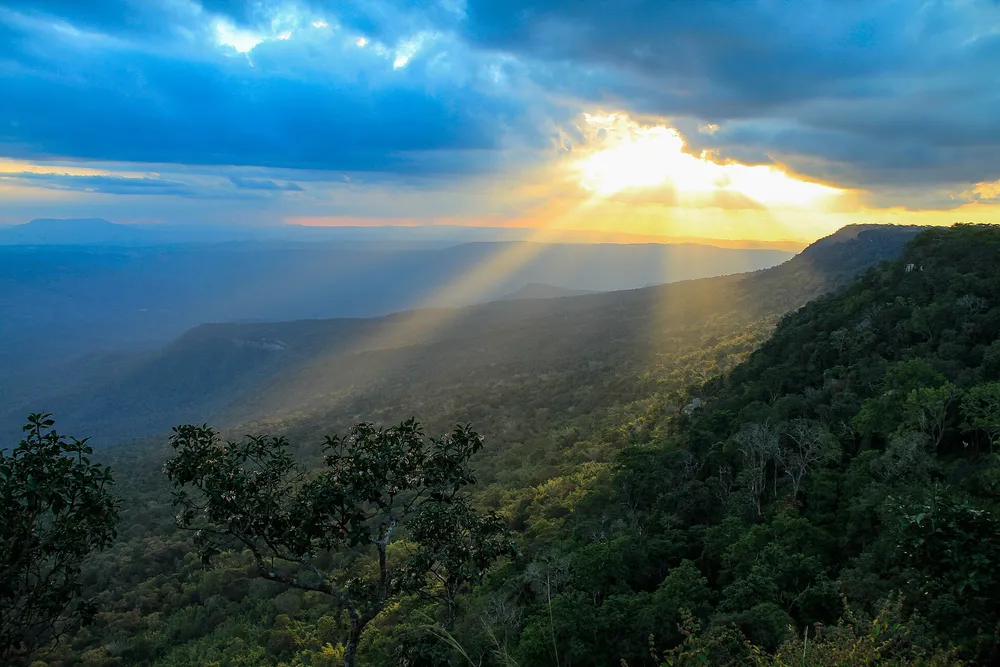 Photo: Romejuly — CC BY-SA 4.0 (Wikimedia Commons)
4. The waterfalls. A ranger-led round leaves Wang Kwang at 08:30 for Phen Phop Mai, Phon Phop and Phen Phop, returning about 14:00, one round a day. Tham Yai can be visited independently within its hours.
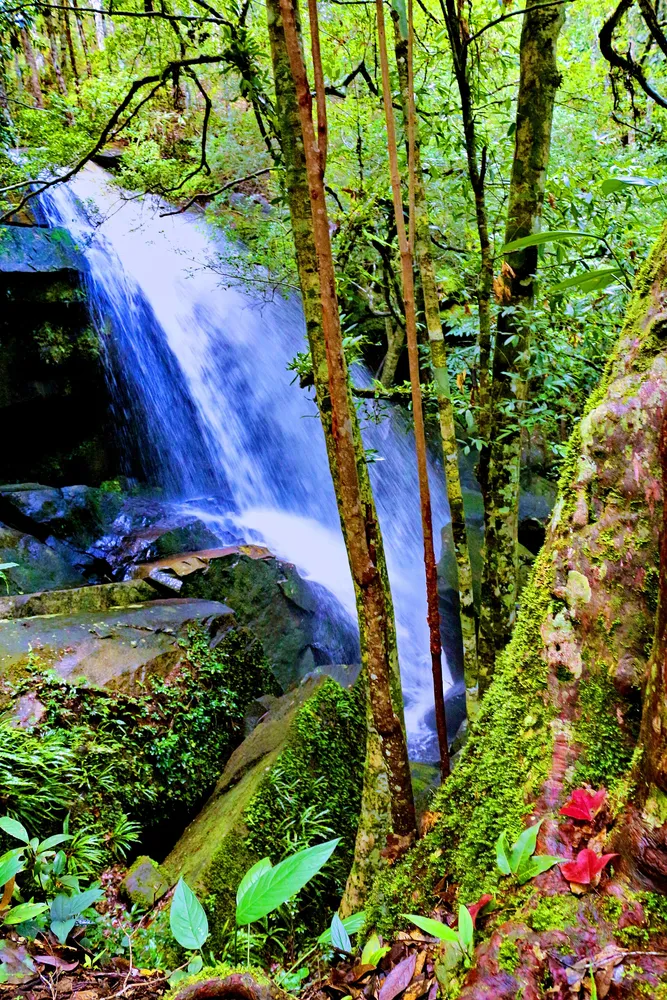 Photo: Mmonthon — CC BY-SA 4.0 (Wikimedia Commons)
5. Phra Phuttha Metta courtyard and the reservoir. Flat, easy walks — good for day two or for kids and older relatives.
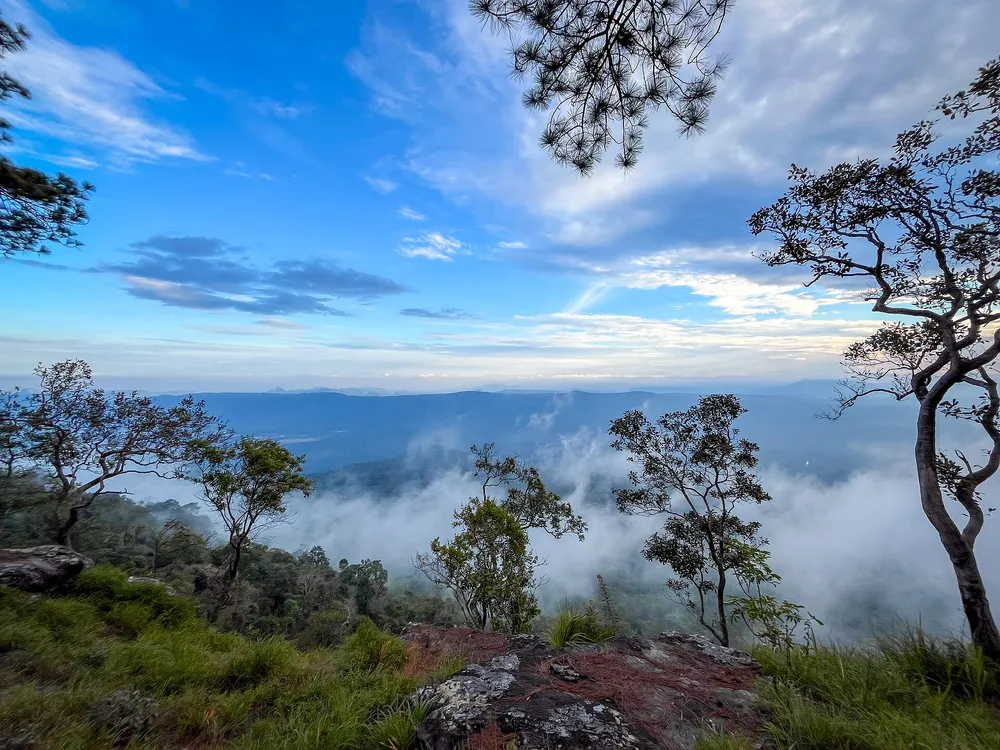 Photo: Nicetory — CC BY-SA 4.0 (Wikimedia Commons)
Getting there
Phu Kradueng is in Phu Kradueng district, Loei. The trail starts at the base visitor centre.
- By car: most flexible; about 8–10 hours from Bangkok depending on route and traffic, with parking at the base. Check the car first with our pre-trip car checklist; EV drivers can plan stops with the EV trip planner.
- By bus: Bangkok–Loei takes roughly 8–10 hours, then a van or songthaew of about 50 minutes to the park, per general traveller reports.
- From the northeast: buses from Khon Kaen or Loei can drop you near the park; check current timetables.
To combine it with other trips see cool-season trips 2026 and Chiang Khan, Loei, in the same province.
Real costs and a per-person budget
⚠️ A note on numbers: the park did not publish all its rates in the opening-season news. The table is older reference pricing (as of October 2026) for budgeting only. Call 042-810-833 / 042-810-834 to confirm before you go.
| Item | Reference price |
|---|---|
| Park entry (Thai) | adult ~40 baht, child ~20 baht |
| Porter | by weight, about 30 baht/kg (older data) |
| Rental tent | about 150–200 baht/night (travel-site figure) |
| Pitching your own tent | about 30 baht/person/night (older data) |
| Accident insurance | about 10 baht/person (older data) |
| Summit bungalows | check the booking system |
Sample 2-day 1-night budget per person (estimate, excluding travel to and from Loei): entry + insurance ~50 baht, tent ~150–200 baht (split between friends), 3–4 summit meals ~300–500 baht, a porter for an 8 kg bag each way ~240 baht — roughly 700–1,000 baht per person. Fuel and tolls from Bangkok are the biggest lump; use today’s fuel prices to estimate it.
Where to sleep: bungalow, rental tent or your own
Up top you can use park bungalows (book through the DNP system), rental tents from the park, or pitch your own in the designated area. What official reports confirm: book at booking.dnp.go.th, call 042-810-834 during office hours (08:00–16:30), and book ahead for long weekends and New Year.
How to choose: big group and no wish to carry gear → bungalow or rental tent plus a porter; budget and love camping → your own tent, but bring a sleeping bag rated for about 5°C or the first night will be miserable.
2-day 1-night itinerary
This plan follows the popular route and this season’s time rules, about 26 km of walking over the trip.
| Time | Day 1 |
|---|---|
| 06:00–07:00 | Register, rent a tent / hire a porter, start climbing |
| 07:00–12:00 | Reach Lang Pae, eat at a rest stop |
| 12:00–14:00 | Walk ~3.5 km on to Wang Kwang, check in |
| 14:00–17:30 | Phra Phuttha Metta, then the cliff walk to Pha Mak Duk for sunset |
| 18:00 | Back at camp (be off the cliff by 18:00). Early night |
| Time | Day 2 |
|---|---|
| 05:00 | Meet at Wang Kwang for the Pha Nok Aen sunrise walk |
| 07:00 | Back for breakfast and packing |
| 08:00–11:00 | Extra waterfall / Pha Lom Sak walk if energy allows, or rest |
| 11:00–13:00 | Start down (must begin by 13:00) |
| 15:00–17:00 | Reach the base and drive home |
With three days, add a day for the waterfall round (08:30–14:00) and an unhurried Pha Lom Sak — you will see far more variety on the plateau.
What to pack — and common mistakes
Pack: hiking shoes or trainers with real grip (smooth soles slip on steep rock), a warm layer and beanie, sleeping bag, headlamp, 1.5–2 litres of water for the climb, a light rain jacket, personal medication, blister plasters and cash — signal and services on top can be patchy.
Common mistakes
- Starting too late. You can only begin until 12:00, and a late start means arriving after dark.
- Carrying too much. Keep the pack to about 6–8 kg or use a porter.
- Under-dressing the first night. It is colder than people expect, especially November–February.
- Not booking lodging early. Long weekends sell out.
- Feeding monkeys or wildlife. Don’t. Wild elephants live in the park, so stay on marked routes and follow ranger advice, especially near waterfalls.
- Leaving litter. Carry out everything you bring.
Verdict: is Phu Kradueng worth it?
Very much, if you can handle a 5.5 km climb and a 4 a.m. alarm for sunrise. It is cheap, the scenery is national-class, and a cool-season summit night is something nowhere else in Thailand offers. If you can’t manage the hike or dislike camping, try a relaxed drive-up alternative in Loei such as Chiang Khan. Rating 4.7/5; the main downsides are crowds on long weekends and the need to book ahead.
Sources
- Thairath — Phu Kradueng opens for the season
- Nation Thailand — Phu Kradueng National Park reopens for 2026-27 hiking season
- Time Out Bangkok — Phu Kradueng reopens on October 1
- Thai PBS — Tourists flood Phu Kradueng, porters short (5 Dec 2021)
- Take Your Backpack — Hike Phu Kradueng Summit Trail
- DNP lodging booking: booking.dnp.go.th · phone 042-810-833 / 042-810-834
Frequently asked questions
- When is Phu Kradueng open in 2026-27?
- The summit and overnight stays are open from 1 October 2026 to 31 May 2027 (eight months). The park closes from June to September for forest recovery and rainy-season safety.
- How long does the climb take?
- About 5.5 km from the bottom to Lang Pae takes roughly 3–5 hours, then about 3.5 km across the plateau to Wang Kwang visitor centre — around 9 km in all. The descent is a little quicker.
- What time can I start hiking?
- Ascents start between 06:00 and 12:00; descents between 07:00 and 13:00 under this season’s notice. Rangers can adjust for weather, so check on the day.
- Do I need to book?
- If you want to sleep on the summit (bungalow or tent area), book through the Department of National Parks system at booking.dnp.go.th well ahead, especially for long weekends and New Year. Phone 042-810-834 (lodging/tents) or 042-810-833 (general).
- Can I go to Pha Nok Aen for sunrise on my own?
- No. This season sunrise at Pha Nok Aen is a ranger-guided outing, meeting at Wang Kwang at 05:00, one round per day. Pha Lom Sak can be visited independently from 08:00.
- Should I hire a porter?
- Not if you travel light. With a tent, sleeping bag and food, a porter makes the climb far easier. Charges are by weight (older data: about 30 baht/kg); confirm current rates at the base.
Related articles
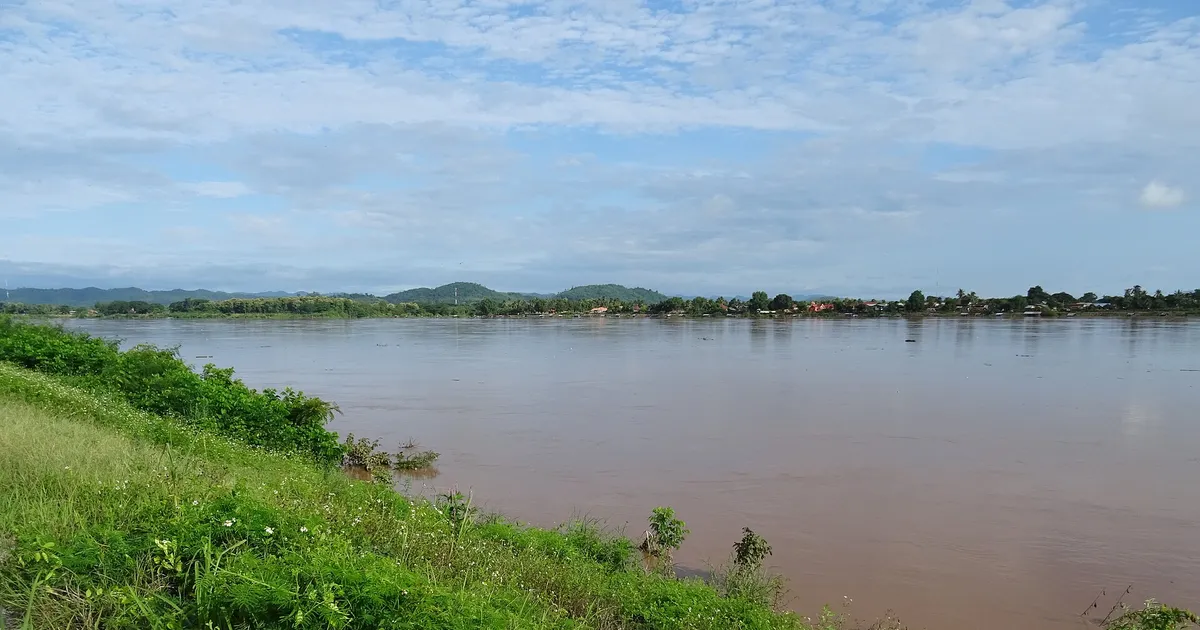
Chiang Khan & Loei Travel Guide 2026: Phu Kradueng, Phu Ruea, Sea of Fog
Complete 2026 guide to Chiang Khan, Loei — Phu Kradueng, Phu Ruea, the walking street, Kaeng Khut Khu, the skywalk, getting there, real costs, and a 3-day itinerary
10 Best Cool-Season Trips in Thailand: Sea of Fog & Flower Fields 2026
10 best cool-season destinations in Thailand for 2026 — sea of fog and flower fields, with real entrance fees, lodging costs, distances, best months, and a pick by budget and style.

Khao Yai National Park 2026: Complete Travel Guide — Fees, Itinerary & Tips
Khao Yai National Park guide 2026 — entrance fees, getting there from Bangkok, Haew Narok waterfall, night safari, hotels, and a 2-day itinerary.