10 Best Rice Cookers 2026: Sharp vs Toshiba vs Zojirushi — Which to Buy?

Rice is central to Thai meals — Thailand ranks among the highest per-capita rice consumers in the world. The rice cooker is therefore one of the few appliances every household runs once or twice a day, every single day. Yet the Thai market spans an enormous range: from ฿350 basic pots at convenience stores to Zojirushi IH cookers approaching ฿18,000.
The question every buyer faces: "Between a Sharp microcomputer, a Toshiba IH, a budget Panasonic, and a premium Zojirushi — what actually makes sense for my household and budget?"
This article answers that directly. Ten models ranked by real value (not commission), covering every budget tier, with a full comparison table, inner pot materials explained, a sizing guide, and the most common buying mistakes spelled out. Read to the end and you should be able to decide without needing another page. (Prices as of June 2026.)
The 4 Types of Rice Cookers: Understand These Before You Buy
Most of the price difference in the market comes down to the heating technology, which directly determines rice quality.
| Type | How It Works | Rice Quality | Price (THB) |
|---|---|---|---|
| Conventional (mechanical) | Single bottom heating element, one-button | Basic — rice gets cooked | ฿350–1,200 |
| Microcomputer / Fuzzy Logic | Sensors + CPU auto-adjust heat and timing | Good — multiple programs, timer | ฿1,200–4,500 |
| IH (Induction Heating) | Electromagnetic field heats the entire pot | Very good — uniform, fluffy grains | ฿3,500–20,000 |
| Pressure IH | IH + high-pressure steam | Best — softest, most consistent | ฿6,000–25,000+ |
Key insight: The price jump from conventional to microcomputer is roughly ฿1,000–2,000 but brings timer scheduling, automatic keep-warm, and multiple cooking programs. That upgrade is almost always worth it for daily use. IH makes sense if you genuinely care about rice texture or want a cooker that lasts 10+ years.
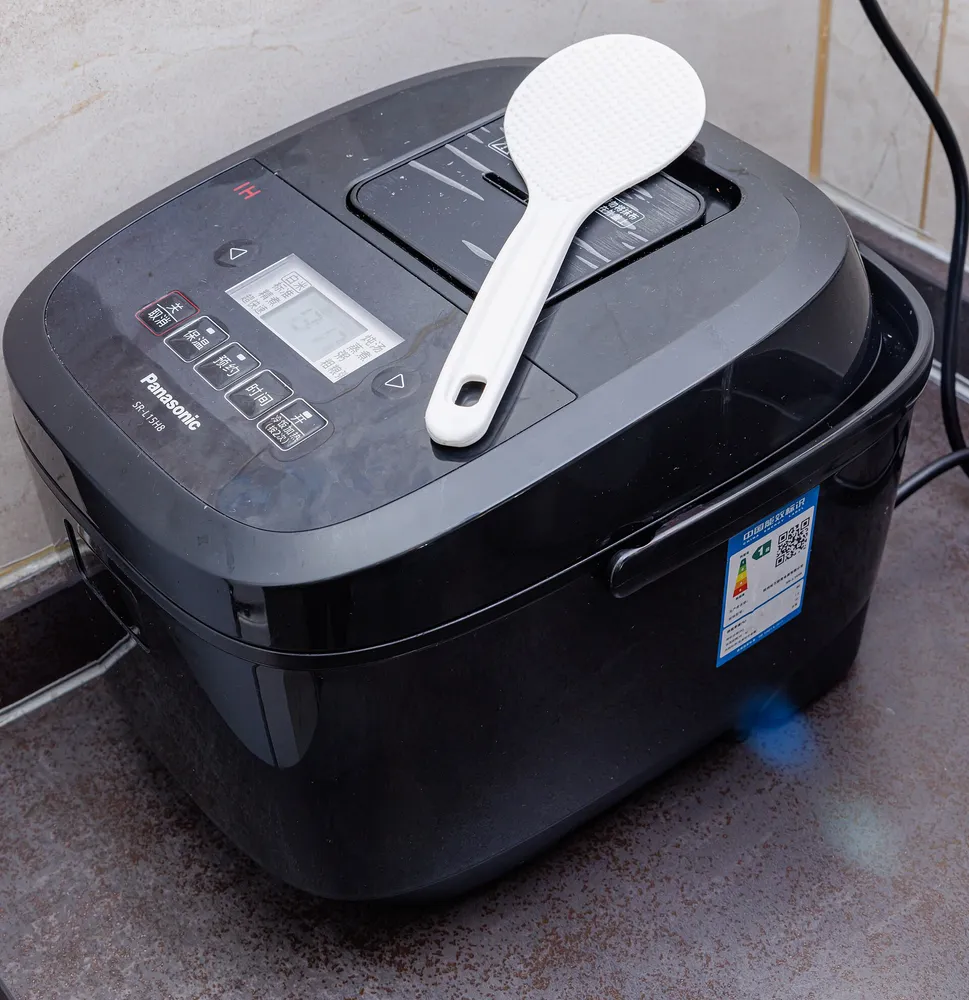
Choosing the Right Size for Your Household
Size determines cooking efficiency just as much as technology does. Too small and you cook two batches; too large and the rice cooks unevenly while wasting electricity.
| Household Size | Recommended Capacity | Example Models |
|---|---|---|
| Single person | 0.3–0.6L | Sharp KSH-Q03 (0.3L, ~฿709) |
| 1–2 people (couple / dorm) | 1.0–1.2L | Hitachi RZ-R10XP (1.0L) |
| 2–4 people (small family) | 1.5–1.8L | Sharp KS-COM18, Toshiba RC-18NMF |
| 4–6 people (medium family) | 2.5–3.0L | Xiaomi Mi 3L, Toshiba RC-T28CE |
| 6+ people / restaurant | 3.0L+ | Commercial rice cookers |
Easy rule: 1L capacity ≈ 5–6 cups of raw rice ≈ feeds about 4–5 people per meal at normal portions. A family of 3–4 is comfortable with a 1.8L pot with rice left over for later.
Important caveat: Never cook less than 20% of the pot's capacity. A 1.8L pot cooking just 1 cup of rice won't measure the water level accurately and may produce unevenly cooked rice.
Inner Pot Materials: What You're Actually Eating From
The inner pot touches your food directly and is the first component to wear out. Material selection matters as much as brand.
Teflon / PTFE (Poly-Flon, Healthy Flon) — The most common coating across all price ranges. Rice doesn't stick, easy to clean. Weakness: scratches if you use metal utensils, typical lifespan 3–5 years. Small Teflon flakes are not acutely toxic, but once you see bare aluminum showing through heavy peeling, replace the inner pot.
Ceramic (Bakuhanseki Stone) — No PFOA/PFAS chemicals, heat-resistant. Safer than Teflon but more expensive and can crack if dropped. Found in certain Philips models.
Binchotan Charcoal Coating — Used in Toshiba IH and some Panasonic models. The charcoal helps rice absorb minerals and produces fluffier, more separated grains.
Kurotsukurikama (Black spherical pot) — Zojirushi's proprietary technology. Extra-thick pot with the best heat distribution and the longest lifespan of any inner pot on the market.
Bottom line: If budget is limited, a thick Teflon pot (4mm or more) outperforms a thin one significantly, without needing ceramic or Binchotan.
#1: Sharp KS-COM18 — Best Overall Mid-Range (~฿3,244–3,550)
Sharp has been the top-selling rice cooker brand in Thailand for decades for good reason: it's manufactured in Thailand, spare parts are widely available, service centers are everywhere, and the quality-to-price ratio is strong. The KS-COM18 is the recommended pick in the microcomputer tier.
Key specs: 1.8L, 830W, Fuzzy Control system, Poly-Flon inner pot, 6 programs (white/brown/porridge/sticky rice/warm/cook), 24-hour advance timer, removable inner lid for cleaning
Price: ~฿3,244–3,550 (Lazada/Shopee/retail)
Warranty: 1 year body + 3 years heating element
Pros:
- Easiest to find spare parts and service in Thailand
- Advance timer is genuinely useful for setting rice before sleep
- Removable inner lid makes cleaning thorough
- Tuned especially well for Thai jasmine rice (khao hom mali)
Cons:
- No IH; heat distribution slightly uneven vs IH models
- Fewer programs than Toshiba at a similar price
Best for: Families of 2–4, anyone wanting a durable, low-maintenance cooker with good local support
#2: Toshiba RC-18NMF(WT)A — Thick Pot, Long Warranty, Under ฿3,000 (~฿2,520–2,690)
Toshiba's standout here is that it costs less than the Sharp above but provides a thicker inner pot (4.4mm) and the longest heating element warranty in this price range. Genuinely the best value pick under ฿3,000.
Key specs: 1.8L, 680W, Digital Microcomputer, Healthy Flon 4.4mm inner pot (thickest in this price tier), 10 programs including Steam, Stew, Quick Cook, advance timer, steam rack included
Price: ~฿2,520–2,690
Warranty: 1 year body + 5 years heating element (longest in class)
Pros:
- 4.4mm inner pot out-lasts thinner competitors
- 10 programs — most feature-rich at this price
- 5-year heating element warranty provides real peace of mind
- Steam rack included, no extra purchase needed
Cons:
- 680W slightly slower to heat than Sharp's 830W
- Auto keep-warm limited to 12 hours
Best for: Anyone prioritizing durability and warranty value under ฿3,000, families of 2–4
#3: Panasonic SR-DF181 — Cheapest Fuzzy Logic (~฿1,390–1,530)
If budget is under ฿1,500 but you still want Fuzzy Logic over a basic one-button cooker, this Panasonic is the answer. It's meaningfully better than same-priced conventional cookers.
Key specs: 1.8L, Fuzzy Logic, 6 programs, Quick Cook (15 minutes), 5-hour auto keep-warm, steam rack included
Price: ~฿1,390–1,530 (retail stores)
Pros:
- Cheapest entry into Fuzzy Logic technology
- 15-minute Quick Cook genuinely useful when in a rush
- Trusted Japanese brand
Cons:
- Keep-warm only lasts 5 hours — shortest in class
- 1.5mm inner pot — thinner than all alternatives above
- No advance timer
Best for: Singles or couples on a tight budget, a second cooker for a larger home, students in dorms who need basic functionality
#4: Toshiba RC-18IH1TTH — Affordable Entry IH (~฿3,990)
Finding IH under ฿4,000 is genuinely rare in the Thai market. This Toshiba is the best "first IH" for people ready to step up from microcomputer without spending Zojirushi prices. The Binchotan Charcoal inner pot coating visibly improves grain separation compared to plain Teflon.
Key specs: 1.8L, 1,300W, IH + Micro-pressure, Binchotan Charcoal inner pot, 8 programs, removable inner lid
Price: ~฿3,990
Pros:
- Most accessible IH price point in the Thai market
- Binchotan coating noticeably improves rice texture and grain separation
- 1,300W heats up quickly
Cons:
- Shorter warranty than microcomputer Sharp/Toshiba siblings
- Fewer features than higher-priced IH models
Best for: First-time IH buyers who want better rice quality without overspending
#5: Tiger JBV-S18 — All-Day Keep-Warm Without Yellowing (~฿4,830)
Tiger (Japan) specializes in one thing nobody else does quite as well: keeping rice warm for a full day without it turning yellow or drying out. The JBV-S18 also includes Tacook, a feature that lets you cook rice and a side dish simultaneously in the same pot.
Key specs: 1.8L, Microcomputer, Spherical non-stick inner pot (curved bottom for even heat), Tacook simultaneous cooking function, 24-hour keep-warm
Price: ~฿4,830 (Lazada/Shopee)
Pros:
- 24-hour keep-warm with no yellowing — best in the microcomputer category
- Tacook saves real time on side dishes
- Spherical pot improves grain evenness vs flat-bottom pots
Cons:
- Premium price vs Sharp/Toshiba for similar base rice quality
- Tacook is only valuable if you actually use it
Best for: Households that cook one big batch of rice in the morning and eat from it throughout the day; large families with multiple mealtimes
#6: Zojirushi NL-GAQ18T — Premium Microcomputer, Made in Japan (~฿7,630–10,900)
Zojirushi has held the #1 rice cooker market position in Japan for over 13 consecutive years. For buyers who want the best microcomputer technology (not IH) and a cooker that will outlast 2–3 conventional models, this is it.
Key specs: 1.8L, only 220W (most energy-efficient on this list), Microcomputer, Kurotsukurikama inner pot (1.7mm, Zojirushi proprietary), GABA Brown rice program, Made in Japan
Price: ~฿7,630–10,900 (Power Buy, Central Online)
Pros:
- Visibly better rice texture and consistency than other microcomputer models
- 220W — uses the least electricity on this list, saves over time
- Kurotsukurikama inner pot lasts 10–15 years with proper care
- True Made in Japan quality, not just branded
Cons:
- 2–3× the price of Sharp/Toshiba for similar category (microcomputer, not IH)
- Still not IH, so there's a ceiling on grain quality
Best for: Quality-focused buyers who want a "buy once, use long" microcomputer without paying full IH prices
#7: Zojirushi NW-QAQ18-BA — Top-Tier IH, Buy Once Use Forever (~฿14,320–17,900)
For buyers who want no compromises, this is the cooker many households buy once and never think about again. At 15–20 years of lifespan, the annual cost works out comparable to replacing a cheaper model every 5–7 years.
Key specs: 1.8L, IH Microcomputer, non-stick IH inner pot, white rice in 3 textures (regular/soft/firm), brown rice, steam function, multiple programs, Made in Japan
Price: ~฿14,320–17,900 (Central Online, with up to 20% discount)
Pros:
- IH delivers the best possible rice texture — every grain even, fluffy, consistently excellent
- Adjustable texture (soft/firm/regular) lets you cook to your preference
- 15–20 year lifespan: annualized cost of ฿700–1,200/year
- Energy-efficient IH technology saves on electricity bills long-term
Cons:
- High upfront cost requires a longer-term mindset
- Heavier and larger footprint than typical cookers
Best for: Families who eat rice daily and want a lifetime appliance; anyone who believes in buying quality once rather than replacing cheaply multiple times
#8: Hitachi RZ-R10XP — 1L Compact with Premium Features (~฿2,500–3,025)
For single people or couples, a 1.8L cooker is over-sized. The Hitachi RZ-R10XP brings premium 1L features — a thick 5-layer 2mm inner pot and up to 14 cooking programs — at a price that makes sense for smaller households.
Key specs: 1.0L, 540–714W, Digital, 5-layer non-stick inner pot (2mm thick), 11–14 programs, large LED touch display
Price: ~฿2,500–3,025
Pros:
- 5-layer 2mm inner pot — best in class for 1L models
- 11–14 programs far exceeds what 1L competitors offer
- Compact form doesn't eat up counter space
- Uses less electricity than 1.8L models for 1–2 servings
Cons:
- Pricier than competing 1L models
- 1L capacity requires cooking twice if guests visit frequently
Best for: Singles, couples without children, dorm users who want proper features in a small package
#9: Xiaomi Mi Rice Cooker 3L — IH for Large Families (~฿3,500–5,000)
Xiaomi brings IH + Micro-pressure to a 3L family-sized capacity at a price significantly below Japanese IH competitors. App control via Mi Home lets you start cooking remotely — something virtually no other cooker at this price can do.
Key specs: 3.0L, 1,200W, IH + Micro-pressure, PFA non-stick inner pot, 6 programs, Mi Home app control, adjustable rice texture
Price: ~฿3,500–5,000 (Shopee/Lazada)
Pros:
- Cheapest IH option for 3L capacity in Thailand
- App control: start cooking from anywhere with your phone
- 3L size handles families of 4–6 comfortably
Cons:
- App dependency — loses convenience if internet drops
- After-sales service and warranty support in Thailand less robust than Japanese brands
- PFA inner pot thinner than Zojirushi's Kurotsukurikama
Best for: Tech-savvy households of 4–6, families wanting IH without Japanese IH prices
#10: Budget Cookers (Smarthome / Kashiwa) — Best for Dorms (~฿350–799)
For extreme budget constraints or temporary use (students, first apartment), Smarthome, Kashiwa, and OTTO deliver basic cooking functionality. Realistic expectations: these work, but the thin inner pot typically lasts 2–3 years before meaningful Teflon wear.
Key specs: 1.8L, 650–900W, conventional one-button, auto keep-warm, thin non-stick coating
Price: ~฿350–799
Pros:
- Lowest possible price point
- Simplest operation — one button, that's it
Cons:
- Thin inner pot, Teflon may peel within 6–12 months
- No timer, no programs, no features
- Keep-warm can over-heat and harden rice quickly
Best for: Students in temporary housing, travelers needing a short-term cooker, extremely tight budgets

Full Comparison Table: All 10 Models at a Glance
| Rank | Model | Price (THB) | Size | System | Inner Pot | Warranty |
|---|---|---|---|---|---|---|
| 1 | Sharp KS-COM18 | 3,244–3,550 | 1.8L | Fuzzy Control | Poly-Flon | 1+3 yr |
| 2 | Toshiba RC-18NMF | 2,520–2,690 | 1.8L | Digital | 4.4mm | 1+5 yr |
| 3 | Panasonic SR-DF181 | 1,390–1,530 | 1.8L | Fuzzy Logic | 1.5mm | 1+4 yr |
| 4 | Toshiba RC-18IH1TTH | 3,990 | 1.8L | IH | Binchotan | — |
| 5 | Tiger JBV-S18 | 4,830 | 1.8L | Microcomputer | Spherical | Thai center |
| 6 | Zojirushi NL-GAQ18T | 7,630–10,900 | 1.8L | Microcomputer | Kurotsukurikama | Thai center |
| 7 | Zojirushi NW-QAQ18-BA | 14,320–17,900 | 1.8L | IH | Non-stick IH | Thai center |
| 8 | Hitachi RZ-R10XP | 2,500–3,025 | 1.0L | Digital | 5-layer 2mm | 1+ yr |
| 9 | Xiaomi Mi 3L | 3,500–5,000 | 3.0L | IH+Pressure | PFA | — |
| 10 | Smarthome/Kashiwa | 350–799 | 1.8L | Conventional | Thin | 1 yr |
Budget-Based Buying Guide
Under ฿1,500 → Panasonic SR-DF181 (~฿1,390–1,530) Best entry into Fuzzy Logic at this price. Clearly outperforms conventional cookers in this range. Best for 1–2 people.
฿1,500–3,000 → Toshiba RC-18NMF(WT)A (~฿2,520–2,690) Thick 4.4mm pot + 5-year heating warranty at this price is unmatched. Best for families of 2–4 prioritizing durability.
฿3,000–4,500 → Sharp KS-COM18 (฿3,244–3,550) or Toshiba IH (฿3,990)
Choose Sharp for Thai brand support and easy parts. Choose Toshiba IH to step into induction heating for the first time.
฿4,500–8,000 → Tiger JBV-S18 (฿4,830) or Zojirushi NL-GAQ18T (฿7,630)
Tiger for all-day keep-warm excellence. Zojirushi for the best microcomputer quality and longest lifespan.
฿8,000+ → Zojirushi NW-QAQ18-BA IH (~฿14,320–17,900) One-time investment. 15–20 year lifespan works out to roughly ฿700–1,200/year — not expensive when viewed long-term.
Large family (5–6 people), budget under ฿5,000 → Xiaomi Mi Rice Cooker 3L (~฿3,500–5,000) Most affordable IH for a 3L household. Best for tech-comfortable families.
Common Buying Mistakes to Avoid
1. Using a metal rice paddle — The single most common cause of premature Teflon peeling. Always use plastic or bamboo.
2. Buying a pot too large — A 2-person household using a 1.8L pot and only cooking 1 cup of rice produces worse results than a properly-sized smaller pot.
3. Not washing the inner pot after every use — Dried rice film reduces heat transfer efficiency and accelerates coating wear.
4. Soaking the IH inner pot — IH inner pots contain embedded induction coils. Never soak them in water; wash and dry immediately.
5. Brand-chasing without evaluating needs — Buying a Zojirushi because someone reviewed it online, when a Toshiba at ฿2,600 would produce perfectly good rice for your household, means paying 4× for features you won't use.
6. Not verifying the Thai 220V plug — Some gray-market Chinese units come with a 2-flat-pin plug without an earth. For water-adjacent appliances in Thailand, always use a 3-pin earthed plug.
7. Comparing only price, ignoring warranty — A ฿2,000 cooker with a 1-year warranty vs a ฿2,700 cooker with a 5-year heating element warranty: the latter is clearly better value over time.
Verdict: Which Should You Buy?
For most Thai households, the ฿2,500–3,500 range delivers the best value. Between Toshiba RC-18NMF and Sharp KS-COM18: choose Toshiba if you prioritize a thick pot and long warranty; choose Sharp if local service and Thai-brand reliability matter more.
Ready to step up to IH without spending big? The Toshiba RC-18IH1TTH at ~฿3,990 is the most accessible IH cooker in Thailand and produces visibly better rice.
For long-term thinkers who care about every bowl of rice, Zojirushi IH is the right answer. The upfront cost is real, but a 15–20 year lifespan and annual cost comparable to cheaper models you'd replace more often makes the math work.
What not to do: buy a basic one-button conventional cooker in the same price range as a microcomputer. At ฿1,200 and above, always choose a model with digital control — the upgrade in daily quality is unmistakable.
Ultimately, the best rice cooker is the one that matches your household size and budget — not the most expensive or the most famous brand. If it reliably cooks hot, fluffy rice every day without drama, that's the right cooker for you.
Looking for other kitchen appliances? Check out our 10 best air fryers in Thailand 2026 or our microwave buying guide 2026.
Sources
- mybest.co.th — Top 10 IH Rice Cookers 2026
- mybest.co.th — Top 10 Digital Rice Cookers 2026
- specbaan.com — Top 10 Rice Cookers by Brand
- Zojirushi Thailand Official
- Tiger Corporation Thailand
- Hitachi Home Appliances Thailand
- Priceza.com — Panasonic SR-DF181 Prices
- Central Online — Zojirushi NW-QAQ18-BA
- Sanook.com — Is Teflon Peeling Dangerous?
Frequently asked questions
- What is the difference between IH and microcomputer rice cookers?
- IH (Induction Heating) uses electromagnetic energy to heat the entire pot uniformly, producing more evenly cooked rice with better texture. Microcomputer/Fuzzy Logic uses sensors to automatically adjust heat from a bottom plate — significantly better than conventional one-button cookers, but not as precise as IH. For budgets under ฿4,000, microcomputer is the sweet spot. If quality matters most and budget allows, IH is worth the premium.
- How many people can a 1.8L rice cooker feed?
- A 1.8L cooker can handle 6–7 cups of raw rice, producing enough cooked rice for 3–4 people per meal comfortably. For 5–6 people or bigger appetites, move up to 2.5–3L. For 1–2 people, a 1.0–1.2L model is more efficient and saves energy.
- Is Teflon peeling in a rice cooker dangerous?
- Small fragments of PTFE (Teflon) are not acutely toxic, but the adhesive layer beneath can pose more risk. If you see bare aluminum showing through significant peeling, replace the inner pot or buy a new cooker. Prevent peeling by always using plastic or wooden paddles, and washing with a soft sponge — never abrasive pads.
- Which brand lasts the longest?
- Zojirushi and Tiger (Japan) are known for 10–15 year lifespans with proper care. Sharp (made in Thailand) and Toshiba typically last 6–10 years. Budget Chinese brands average 3–5 years. Longevity depends heavily on usage: always wash the inner pot after each use, avoid soaking, and use only plastic paddles.
- Can I cook Thai jasmine rice and sticky rice in the same cooker?
- Jasmine rice (khao hom mali) works well in any type of rice cooker, though IH produces the best texture. For sticky rice (khao niao), you need a model with a dedicated sticky rice program (many Sharp and Toshiba models have this) or a steam rack included with the machine. Basic one-button conventional cookers do not cook sticky rice well.
- Is it safe to buy a rice cooker online in Thailand?
- Yes, if you buy from the brand's Official Store on Shopee or Lazada, which guarantees Thai warranty coverage. Avoid suspiciously cheap listings that may be gray-market Chinese imports without Thai service centers. Confirm the unit comes with a 220V Thai plug (3-pin) and adequate cord length.
Related articles
10.10 Shopee Lazada 2026: 10 Categories Worth Buying, and Should You Wait?
When is the 10.10 Shopee-Lazada 2026 sale, which categories discount for real, and should big-ticket items wait for 11.11? 10 best categories plus scams to avoid.
Mid-Autumn Festival 2026: Date, Rituals + 10 Mooncakes Worth Trying
Mid-Autumn Festival 2026 falls on September 25. When and how to make the offering, plus 10 ranked mooncakes from budget to premium gift boxes, with real prices.
10 Best Water Pumps for Flood Season Thailand 2026: What Not to Buy
10 best water pumps for Thailand's 2026 flood season, from ฿600 submersible pumps to ฿9,000+ petrol engines, with a price/power/flow comparison table and buying advice.