A Quiet Milestone: 79% of the World's Adults Now Have a Financial Account

It is the kind of progress that rarely makes headlines, because it happens one phone and one shop counter at a time. But the numbers are striking: 79% of adults around the world now have a financial account — at a bank or with a mobile-money provider — up from just 51% in 2011. That finding comes from the World Bank's Global Findex Database 2025, the most comprehensive survey of how people save, borrow and pay, released in mid-2025 and based on interviews with roughly 145,000 adults across 141 economies.
In a single generation, the share of humanity locked out of the formal financial system has roughly halved. Behind that statistic are hundreds of millions of first-time account holders — market traders, farmers, domestic workers and small-business owners — who can now keep their money somewhere safer than under a mattress.
What the survey found
The Global Findex, published every few years since 2011, is widely treated as the global scorecard for financial inclusion. The 2025 edition tells a story of steady, broad-based gains.
In low- and middle-income economies — where the gap has always been widest — account ownership reached 75%, a roughly 20-percentage-point jump over the past decade. Globally, ownership rose from 74% in 2021 to 79% in 2024.
| Adults with a financial account | Share |
|---|---|
| World, 2011 | 51% |
| World, 2021 | 74% |
| World, 2024 | 79% |
| Low- and middle-income economies, 2024 | 75% |
Data: World Bank Global Findex 2025
Just as important as having an account is using it. The report found that 40% of adults in developing economies saved formally in 2024 — up 16 percentage points since 2021, the fastest rise in more than a decade — and that more than 60% of adults in those economies made or received a digital payment.
Mobile phones did the heavy lifting
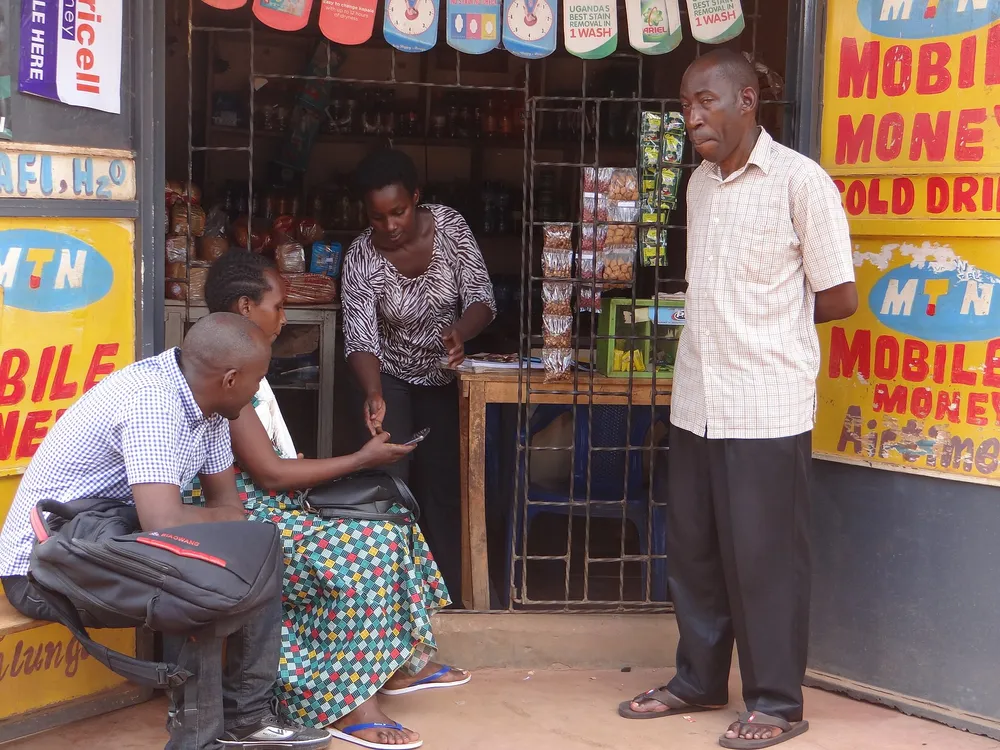 Photo: Ndiwulira — CC BY-SA 4.0 (Wikimedia Commons)
The engine of this change is the mobile phone. Roughly 84% of adults in low- and middle-income economies now own a mobile phone, and that simple device has done what decades of bank-branch expansion could not: reach people in villages and informal settlements far from any branch.
Nowhere is this clearer than in sub-Saharan Africa, the global birthplace of mobile money. There, 40% of adults now have a mobile-money account, up from 27% just three years earlier. The region has the world's largest share of adults who hold only a mobile-money account — no traditional bank needed. Across these economies, mobile money has become a genuine savings tool: about a quarter of all adults in the region now save through their phones, often using a trusted local agent down the road.
The World Bank frames the device itself as the new front door to the economy. As Bill Gates, co-chair of the Gates Foundation — a long-time supporter of the survey — put it, "More people than ever have the financial tools to invest in their futures and build economic resilience, including women and others previously left behind."
The gender gap is narrowing
 Illustrative photo: a vendor's stall displaying a Thai QR-payment code — PattayaPatrol, CC BY-SA 4.0 (Wikimedia Commons)
One of the most encouraging findings concerns women. In low- and middle-income economies, 73% of women now hold a financial account, and the gap between men and women has shrunk to about 5 percentage points — down from 9 points historically. Digital money, the report notes, is doing much of the work of closing that gap, because a phone-based account is easier for a woman to open and control on her own.
The benefits are concrete, not abstract. The World Bank cites evidence that in Kenya, women merchants who gained a basic account invested more in their businesses, while in the Philippines women with a savings account reported greater say over household decisions. An account, in other words, can shift the balance of power inside a home as well as inside an economy.
That matters for resilience too. The survey found that 56% of adults worldwide could now reliably get hold of extra money in an emergency — a buffer that digital savings make far more achievable in a region where one in four adults has faced a natural disaster in the past three years.
Where Asia and Thailand fit in
East Asia and the Pacific is the most financially included developing region in the world, with 83% of adults holding an account and the highest rate of digital-payment use anywhere — around 80% of adults. Within the region the spread is wide, from under 40% in some neighbouring economies to near-universal coverage elsewhere.
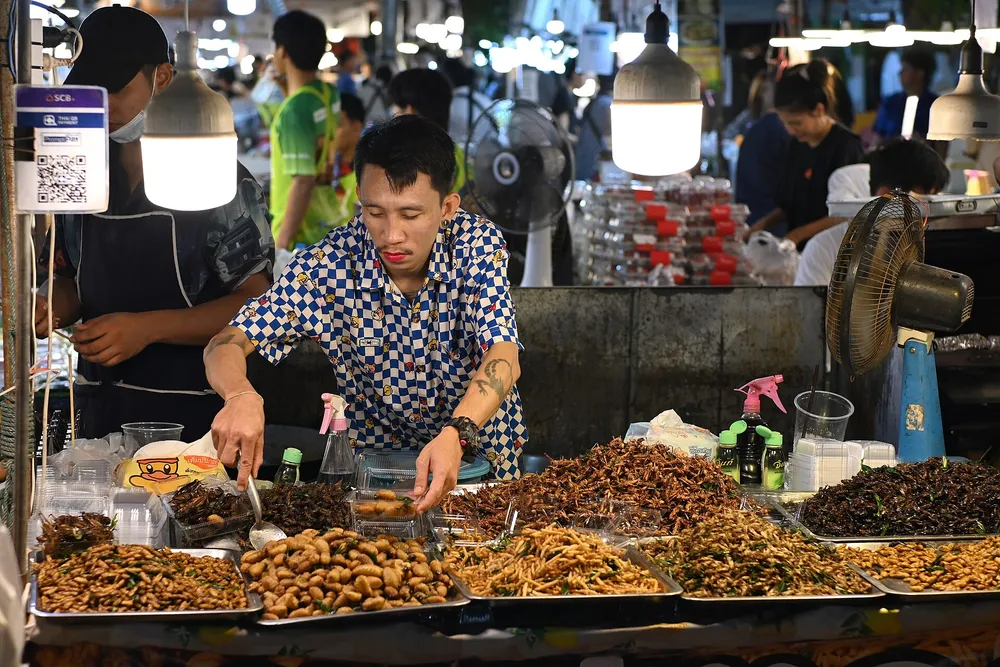
Thailand sits near the top, with roughly 92% of adults holding an account — one of the highest rates in the region and far above the global average. The country's near-ubiquitous Thai QR Payment system, accepted from shopping-mall counters to street-food stalls, has turned everyday cashless payment into second nature for most Thais. Readers can see that same shift in our coverage of Thailand's healthcare and digital-services progress.
What's left to do
 Photo: Shiny Things — CC BY 2.0 (Wikimedia Commons)
The progress is real, but the job is unfinished. About 1.3 billion adults still lack any account, and the World Bank notes that roughly 650 million of them are concentrated in just eight large countries, including India, China, Indonesia, Nigeria and Pakistan. The remaining unbanked are disproportionately women, the poorest households, and people with little formal education — exactly the groups hardest to reach.
There is a hopeful detail even there: a large share of the unbanked already own a mobile phone, which means the tool to connect them already sits in their pocket. The challenge now is trust, identity documents, network coverage and consumer protection rather than technology alone.
"Account ownership has risen, but equal access and use still lag," the World Bank's researchers caution — a reminder that opening an account is only the first step toward genuinely using it.
For Thai readers, the global lesson is familiar from home: when safe, simple digital tools reach everyone, more people can save, plan and weather a shock. If you want to put your own numbers to work, our loan calculator and income-tax calculator can help — and you can follow more good-news developments on our news page.
Sources
Frequently asked questions
- What is a 'financial account'?
- An account at a bank or other regulated institution, or a mobile-money account run through a phone company. Either one lets a person safely store money, get paid, and send or receive payments — instead of relying only on cash.
- What is mobile money?
- A service that turns a basic mobile phone into a wallet. Users deposit or withdraw cash through a local agent and send money by text or app — no bank branch or smartphone required. It is hugely popular across Africa.
- Why does financial inclusion matter?
- Having an account makes it easier to save safely, cope with emergencies, receive wages or government support, and build a credit history. Studies link it to higher savings, more business investment and greater independence, especially for women.
- Where does Thailand stand?
- Thailand is among the most financially included countries in its region, with about 92% of adults holding an account — well above the global average — helped by widespread Thai QR payments and digital banking.
Related news
 World
WorldClean Energy Smashes World Record: Nearly 700 GW of New Capacity Added in 2025
IRENA reports the world added a record 692 GW of new renewable capacity in 2025, the biggest annual jump ever, led by solar — now the cheapest electricity.
 World
WorldTrump Hits Canada with 50% Tariffs — A New Trade-War Escalation Shakes Global Markets
The US imposed 50% tariffs on roughly $20 billion worth of Canadian imports — from wine to cement to furniture — using a Depression-era law. Canada's PM Carney called it a 'direct violation' of USMCA but opened the door to talks.
 World
WorldUS Strikes Iran Again as Three Tankers Attacked in Strait of Hormuz
Three commercial vessels were attacked in the Strait of Hormuz on July 7, 2026 — the US struck Iran and reimposed oil sanctions, lifting Brent crude 5.5%.