Personalized mRNA Cancer Vaccine Sustains 49% Reduction in Melanoma Recurrence After 5 Years

On June 1, 2026, at the American Society of Clinical Oncology (ASCO) Annual Meeting in Chicago, researchers from Moderna and Merck presented data that could reshape cancer treatment for decades: a personalized mRNA vaccine, built specifically around each patient's tumor, reduced the risk of high-risk melanoma returning by 49% — and that figure held firm after five full years of follow-up.
This is not a promising early signal. It is five years of evidence.
A Vaccine Unlike Any Other: Built Just for You
The vaccine, intismeran autogene (also known as mRNA-4157 or V940), is not an off-the-shelf drug. It is manufactured fresh for each individual patient after surgery.
The process starts with the removed tumor. Scientists perform whole-exome and RNA sequencing to map every mutation that exists in the cancer cells but not in the patient's normal tissue. These are called neoantigens — unique molecular fingerprints found only on cancer cells. An AI algorithm selects up to 34 neoantigens most likely to trigger a strong immune response. mRNA strands encoding those 34 targets are then synthesized, packaged in lipid nanoparticles — the same delivery system used in COVID-19 vaccines — and injected every three weeks for nine doses.
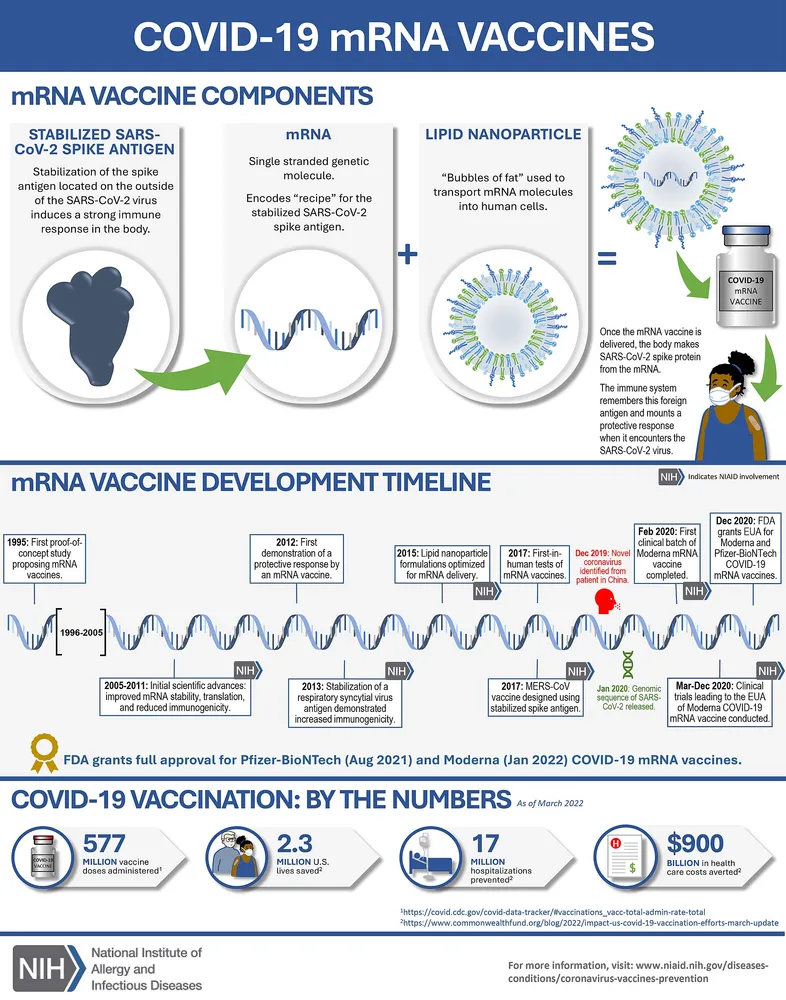
Once the body's cells read the mRNA and display the neoantigen fragments on their surface, the immune system learns to recognize them as threats — and hunts down any cell carrying those markers, including microscopic cancer remnants that surgery may have missed.
Five Years of Numbers That Don't Fade
The KEYNOTE-942 Phase IIb trial enrolled 157 patients with high-risk, surgically resected Stage IIIB–IV cutaneous melanoma. They were split two-to-one: 107 received the personalized vaccine plus Keytruda (pembrolizumab); 50 received Keytruda alone. Results after five years of follow-up:
| Outcome | Vaccine + Keytruda | Keytruda Alone |
|---|---|---|
| Cancer-free at 5 years | 68.8% | 49.1% |
| Overall survival at 5 years | 92.2% | 71.3% |
| Risk of recurrence or death | ↓ 49% | — |
| Risk of distant spread or death | ↓ 59% | — |
The most scientifically significant detail isn't any single number — it's that the 49% reduction matched the 3-year result exactly. In oncology, benefit that holds stable rather than eroding over time suggests the immune system has retained durable memory of the cancer targets. The "training" has stuck.
Why Keytruda? The Brake and the Map
Keytruda (pembrolizumab) is a checkpoint inhibitor — a drug that blocks PD-1, a protein cancer cells exploit to disguise themselves as healthy tissue and evade immune attack. By blocking PD-1, Keytruda releases the immune system's brakes.
Combined with the personalized vaccine, the two work synergistically: the vaccine gives the immune system a precise map of the target; Keytruda opens the gate for a full attack. Neither alone is as effective as both together — which is exactly what the data shows.
What the Scientists Said
Dr. Janice Mehnert, Professor of Medicine at NYU Grossman School of Medicine and the trial's lead presenter at ASCO 2026, said:
"Our study offers strong evidence to melanoma patients that intismeran vaccine therapy, when used in combination with immunotherapy, can demonstrably reduce their risk of having their cancer return and improve clinical outcomes."
"Our findings also serve as encouragement to cancer researchers globally that mRNA vaccines like intismeran could work well in combination with immunotherapy for other cancers."
The full 5-year data were published simultaneously in the Journal of Clinical Oncology, one of oncology's most authoritative peer-reviewed journals.
What Comes Next: Phase 3 and Beyond
The KEYNOTE-942 results have already set a larger trial in motion. INTerpath-001, a Phase 3 randomized study, has enrolled over 1,089 patients with high-risk resected melanoma — roughly seven times the Phase 2 size. The trial is fully enrolled as of 2026, with interim results expected later this year. If Phase 3 mirrors Phase 2, the path to FDA approval could follow around 2027–2028.
Beyond melanoma, the same mRNA platform is being tested in:
- Non-small cell lung cancer (NSCLC) — adjuvant setting
- Renal cell carcinoma (kidney cancer) — Phase 2, fully enrolled
- Bladder cancer — muscle-invasive and non-muscle-invasive
If the approach generalizes across cancer types, the mRNA personalized vaccine platform could become a standard adjuvant option alongside surgery for many solid tumors — a fundamental shift in how cancer recurrence is prevented after the primary treatment.
What This Means for Patients Worldwide
Melanoma accounts for over 330,000 new cases globally each year. The disease is less prevalent in Asia than in Western populations but is rising alongside increasing UV exposure in tropical countries including Thailand. The broader implication extends to all cancer patients: the mRNA technology proven safe at billion-dose scale in COVID-19 vaccines is now being successfully adapted for personalized oncology.
Intismeran autogene remains investigational — not yet approved by the FDA or any other regulator, and not commercially available. But the evidence now spans five years, and the Phase 3 trial is fully enrolled. For patients with high-risk melanoma who face a surgery that removes the visible tumor but leaves behind the risk of recurrence, that timeline matters enormously.
The science has moved from promising to proven at Phase 2. The next step is confirmation at scale — and the world is watching.
Sources
Frequently asked questions
- How is this mRNA cancer vaccine different from COVID-19 vaccines?
- Both use the same mRNA platform with lipid nanoparticle delivery, but COVID-19 vaccines are the same formulation for everyone. The intismeran autogene cancer vaccine is built uniquely for each patient by sequencing their tumor's specific mutations, then targeting up to 34 neoantigens found only on that patient's cancer cells — not a one-size-fits-all drug.
- When will patients be able to access this melanoma vaccine?
- Intismeran autogene is currently investigational and not yet approved by any regulator. The Phase 3 trial (INTerpath-001) is fully enrolled and interim results are expected later in 2026. If those results confirm the Phase 2 findings, FDA approval could follow around 2027–2028 for high-risk resected melanoma.
Related news
 World
WorldRattlesnake Blood Yields Antivenom 10x Stronger Than Current Drugs
Proteins from rattlesnake blood, combined, neutralize venom 10x more potently than current antivenom in lab tests — a study with a Thai scientist on the team.
 World
WorldKākāpō Population Soars Past 300 for First Time in 75 Years
New Zealand's kākāpō, the world's heaviest parrot, reached 325 birds after a record 2026 breeding season added 90 chicks — up from just 51 birds in 1995.
 World
WorldHimalayan Glacier Collapse Floods Nepal-Tibet: A Warning Lesson
A glacier broke away at 5,200m and sent a wall of water into Nepal. Scientists say the technology to warn people already exists — the monitoring does not.