Himalayan Glacier Collapse Floods Nepal-Tibet: A Warning Lesson
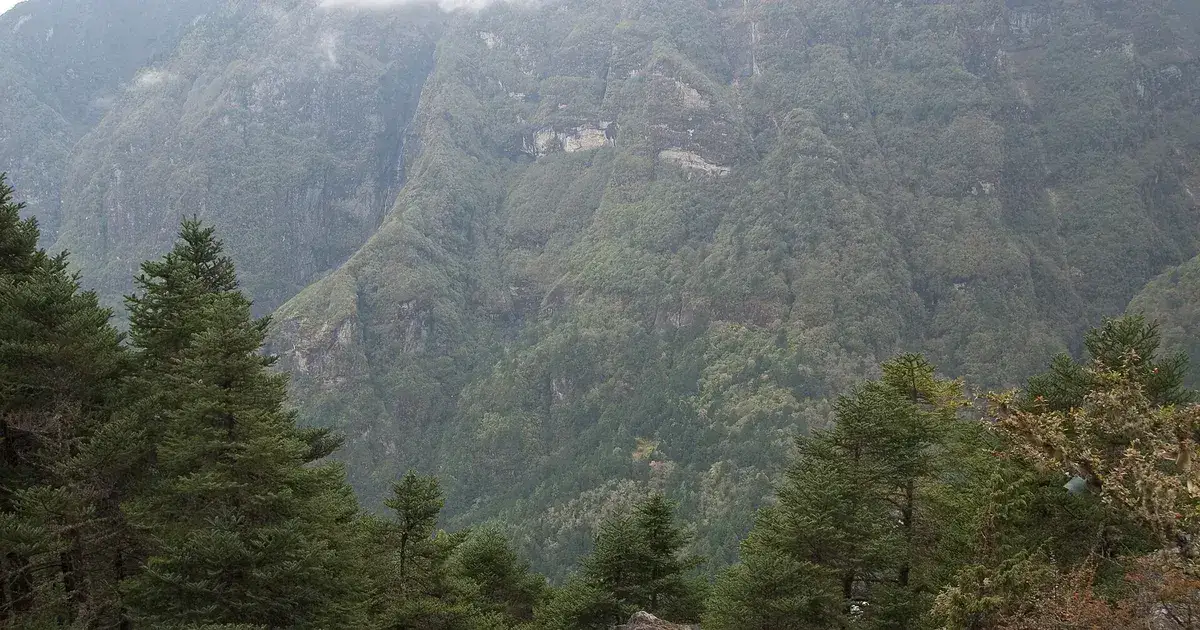
A large section of glacier broke away from a high cliff in Tibet on the morning of Wednesday 26 August 2026, sending water, rock and ice down Himalayan valleys into Nepal's northern Rasuwa district. More than 470 deaths have been confirmed and almost 1,000 people remain missing as of 28 August, according to Nepal's prime minister's office.
This was not a rainfall flood — and that is exactly what made it so dangerous.
What happened, and how fast
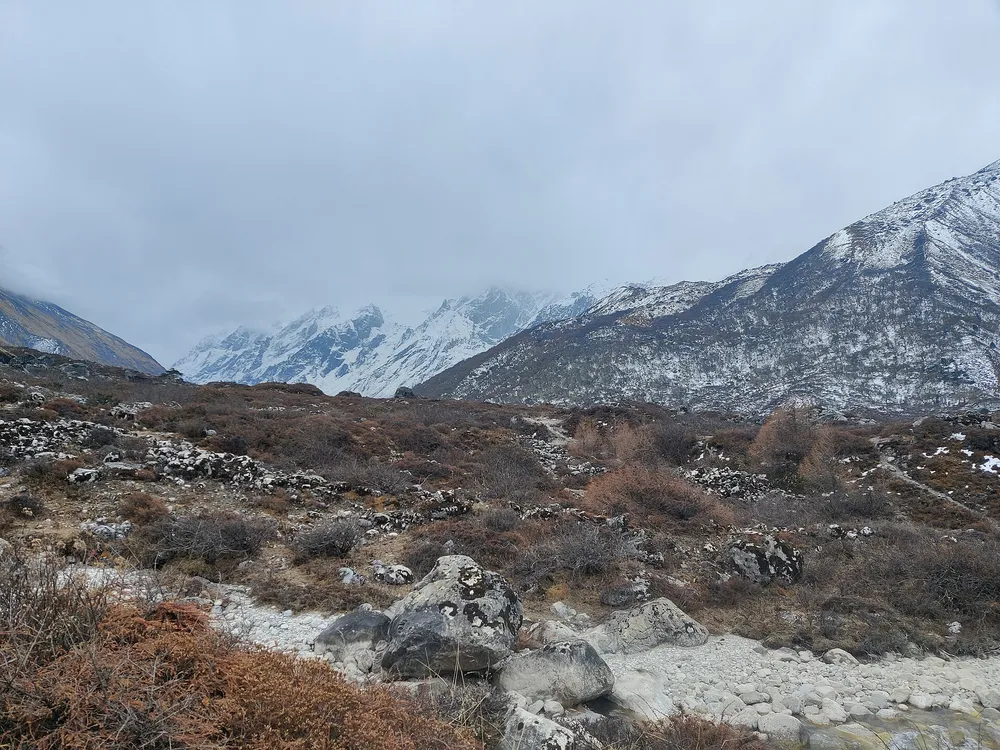 Illustrative: the Langtang Himal valley in Rasuwa — the steep terrain and boulder-strewn riverbed of the kind the flood tore through (photographed before the disaster). Photo: Pustam.EGR — CC BY 4.0 (Wikimedia Commons)
At around 08:40 local time (02:55 GMT) on 26 August, the lower end of a glacier at roughly 5,200 metres elevation broke away and fell some 1,200 metres to the valley floor, striking the Lhende river in Tibet about 20km northeast of the Nepal-China border crossing.
The debris briefly dammed the river, forming a natural barrier that held water behind it. When that barrier failed, the accumulated water, mud and rock came down all at once.
The result was a speed nobody could outrun. The Trishuli river reportedly rose by as much as 9 metres in just 30 minutes. Timure village, the closest Nepali settlement to the border, and the Gyirong Port crossing on the Tibetan side sat directly in its path.
The damage, and the rescue
At least 19 bridges and about 40km of road were washed away, cutting access to the disaster area at the moment it was needed most. The Upper Trishuli-1 hydropower project was damaged, with workers trapped inside its tunnel.
The missing include pilgrims travelling to Mount Kailash in Tibet — a sacred site for Hindus and Buddhists alike — Nepali security personnel stationed at the border, and engineers working on the hydropower project. Nepali authorities say 644 of the missing are foreign nationals. Chinese authorities reported three deaths and 558 missing on the Tibetan side.
Search and rescue mobilised 14,829 security personnel and has reached 3,742 people, of whom 3,253 were airlifted by helicopter to Kathmandu and elsewhere because the roads were gone.
"Our first priority is rescuing the stranded people," said Brigadier General Raja Ram Basnet of the Nepal Army, noting that reaching those trapped in the hydropower tunnel is difficult because mud has covered the entrance.
The United States pledged $500,000 towards the rescue effort, while Nepal's Ministry of Foreign Affairs declined offers from several countries to send search-and-rescue teams.
The second-round threat: a lake that did not exist last week
What keeps this event open is the two lakes that formed after the collapse. One sits high in the mountains near the glacier itself; the other, more dangerous one was created when a massive landslide blocked the valley on the Lhende river system at the Nepal-China border.
China's Ministry of Water Resources estimates that lake holds 1.5 to 2 million cubic metres of water, with a further 3 million cubic metres potentially flowing in over three days — roughly 1,200 Olympic swimming pools.
The danger is a sudden failure, which would generate a fast-moving, debris-laden flood with almost no warning for communities downstream.
"The ice-rock avalanche deposited a huge volume of rock, ice and debris in the river valley, blocking or severely constricting the drainage," explained Pawan Bhattarai, assistant professor in civil engineering at Tribhuvan University, who said the consequences could be reduced through better satellite monitoring and transboundary early-warning systems.
Nitesh Khadka, a glacial flood researcher, warned that a sudden breach would "mobilise the sediments that will hamper search and rescue operation and will also put dangers to those surviving in the hydro tunnels."
Chinese authorities deployed an eight-member engineering team for aerial surveys and 3D modelling of the site. Rescue work paused briefly on Friday when the barrier lake overflowed, then resumed, with officials describing the risk as "manageable".
Why this will happen more often
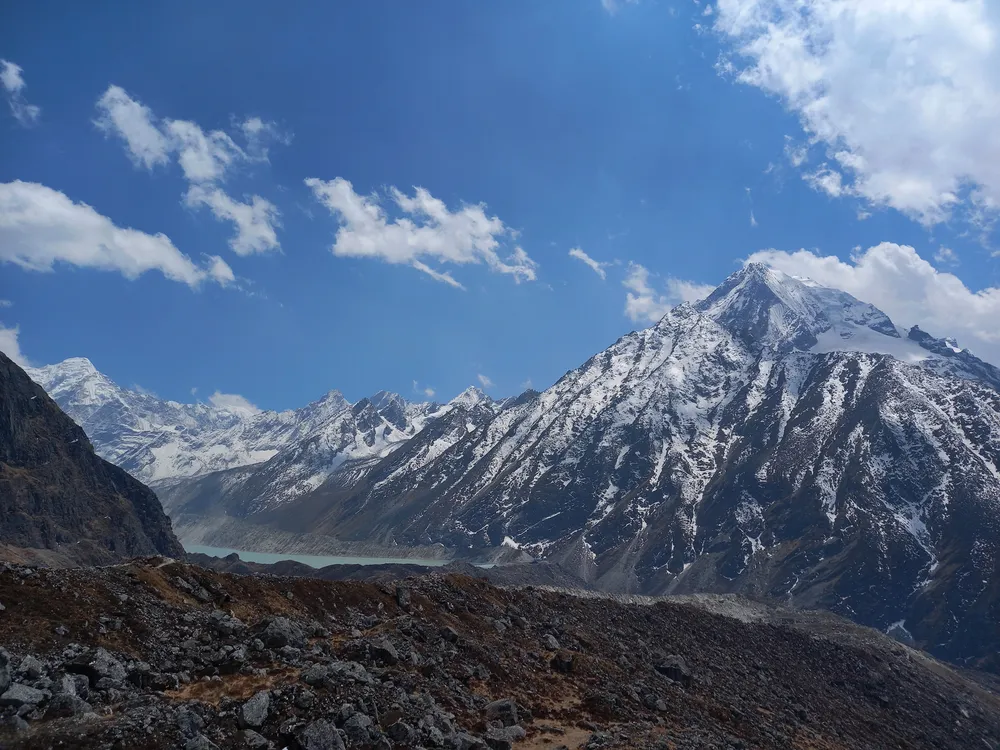 Illustrative: Tsho Rolpa, one of Nepal's most closely monitored glacial lakes, its water held behind a ridge of glacial debris. Photo: Thapaliya19 — CC BY-SA 4.0 (Wikimedia Commons)
The Hindu Kush Himalaya is warming considerably faster than the global average. Research indicates ice-loss rates in the region have doubled since 2000, and roughly 78% of glacier area between about 4,500 and 6,000 metres faces high exposure to warming.
The physical mechanism is straightforward. As temperatures rise, rock faces that were held together by ice lose that support and go through repeated freeze-thaw cycles, while thawing permafrost weakens slope stability.
"What happened yesterday is unfortunately the new normal. It's going to get worse from here onwards," said Jakob Steiner, a geoscientist at the University of Graz.
Scientists remain careful not to attribute any single event directly to global warming, but they agree that as global temperatures rise, the odds of disasters like this one in the Himalaya increase. A 2019 study found around 210 glacial lakes in the region with the potential to threaten downstream settlements.
The practical lesson: warning is a matter of minutes
The point experts converge on is that the necessary technology already exists. What is missing is deployment, and the cross-border plumbing to move data in time.
The shared recommendations are continuous monitoring of glaciers and slopes, satellite tracking of glacial lake formation, and information-sharing between upstream and downstream countries that works in real time — here, that means China and Nepal.
But the timeframe is the brutal part. "We don't have hours... sometimes a few minutes to actually prepare," said disaster-management specialist Saswat Sanyal.
That changes the problem from "forecast days ahead" to "detect the instant it happens and get a signal downstream as fast as possible" — a fundamentally different system from the rainfall-flood warnings most countries are used to.
For readers in Thailand
Thailand's Ministry of Foreign Affairs says that, having checked with the Royal Thai Embassy in Kathmandu, there are no reports of Thai nationals injured or killed. The worst-hit areas lie along the Bhotekoshi river, where most basic infrastructure was damaged. Anyone needing help can reach the embassy on +977-9818749944, 24 hours a day.
For Thai readers generally, the transferable lesson is not about glaciers — Thailand has none — but about the same class of hazard that arrives faster than a multi-day forecast: flash floods and landslides in mountainous areas during the monsoon, where the gap between the first sign and the water arriving can be a matter of tens of minutes, as seen in Thailand's own monsoon warnings in July.
At household level the useful steps are basic but effective: know whether your home sits in a risk area, know the nearest route to higher ground, and keep official alerts switched on. In this class of hazard, the time available to decide is counted in minutes, not hours.
What to watch next
The search continues and the death and missing figures are still moving. Some reports citing Nepali police give a higher death toll than the official figures quoted above (data as of 28 August 2026).
The immediate question is whether the newly formed barrier lake at the border holds or fails — which will determine both the safety of the rescue teams and the fate of those still trapped in the hydropower tunnel.
Sources
Frequently asked questions
- Was this flood caused by heavy rain?
- No. A large section of glacier broke off a high cliff in Tibet, and the rock and ice briefly dammed the river. When that natural dam gave way, all of the water that had built up behind it came down at once — unlike a rainfall flood, which rises gradually and can be forecast.
- What should Thai nationals in Nepal do?
- The Ministry of Foreign Affairs says no Thai nationals have been reported injured or killed. Anyone needing assistance can reach the Royal Thai Embassy in Kathmandu on +977-9818749944, 24 hours a day.
Related news
 World
WorldNew Catalyst Makes Clean Hydrogen at Far Lower Temperatures, Turning Waste Heat Into Fuel
A University of Birmingham team developed a perovskite catalyst that splits water into hydrogen at just 150–500°C, opening the door to cheaper clean fuel.
 World
WorldRattlesnake Blood Yields Antivenom 10x Stronger Than Current Drugs
Proteins from rattlesnake blood, combined, neutralize venom 10x more potently than current antivenom in lab tests — a study with a Thai scientist on the team.
 World
WorldKākāpō Population Soars Past 300 for First Time in 75 Years
New Zealand's kākāpō, the world's heaviest parrot, reached 325 birds after a record 2026 breeding season added 90 chicks — up from just 51 birds in 1995.