Stanford Physicists Capture the First-Ever "Quantum Jump" of Sound in Real Time

Physicists at Stanford University have announced a historic first: observing a "quantum jump" of sound in real time — a phenomenon predicted since the early 20th century but never before captured in a unit of sound. The findings were published in the journal Science on September 17, 2026, and drew wide attention from international science media over the past week.
What a Quantum Jump Is, and Why It Matters
In the quantum world, energy doesn't change continuously the way we're used to in everyday life — it "jumps" instantly from one state to another, with no intermediate values at all. The idea was first proposed in the early 1900s and became one of the pillars of quantum mechanics, but experimental proof had to wait until 1986, when physicists observed quantum jumps in ions trapped in electromagnetic traps, and 2007, when they saw it in photons (particles of light).
What no one had seen before was a quantum jump in a "phonon" — the smallest unit of energy in sound or vibration, arising from the coordinated motion of many atoms in a material, comparable to how a photon is the smallest unit of light. The Stanford team has now closed that final gap.
A Microscopic Quantum Tuning Fork — the Heart of the Experiment
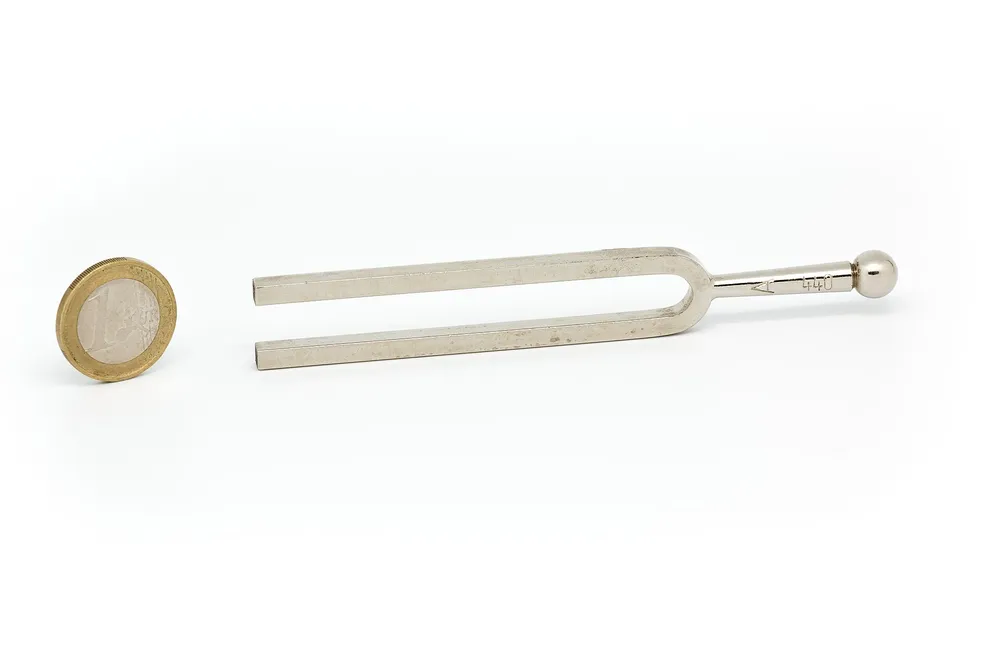 Illustrative: a tuning fork — the same principle behind the microscopic resonator in this experiment — photo by Édouard Hue (User:EdouardHue), CC BY-SA 3.0 (Wikimedia Commons)
The team, led by Amir Safavi-Naeini, associate professor of applied physics at Stanford's School of Humanities and Sciences, together with co-first authors Takuma Makihara (a recent Stanford doctoral graduate) and Erik Szakiel (a current doctoral student), built a chip-fabricated mechanical resonator designed like a "microscopic tuning fork."
What makes the device special is that it vibrates continuously for 2 milliseconds before its energy decays — sounding brief, but scaled up to the size of an everyday tuning fork, that's equivalent to ringing for several hours. That extended ring time is what let the team measure the device's state repeatedly, hundreds of times, before the vibration died out.
Takuma Makihara described the challenge of building the device: "We had to continually develop new processes to make this extremely long-lived, vibrating object and then integrate it with the qubit, which is our little electrical detector — without ruining either subsystem."
How They Caught the Jump: Pairing a Resonator with a Superconducting Qubit
The team coupled the microscopic resonator to a superconducting qubit — an electrical circuit that stores quantum information. The qubit repeatedly measured whether the resonator's vibrational energy sat in a "one-phonon" or "zero-phonon" state throughout the 2-millisecond ringdown. Hundreds of these measurements let the team pinpoint the exact moment the energy jumped from one state to the other — instantaneously, not as a gradual decline.
An experiment at this scale requires temperatures close to absolute zero, to eliminate the thermal noise that would otherwise drown out such a delicate quantum effect. Quantum physics labs worldwide rely on dilution refrigerators that can cool equipment down to just a few millikelvin above absolute zero — colder than deep space.
Why It Matters: From Theory to Quantum Computing
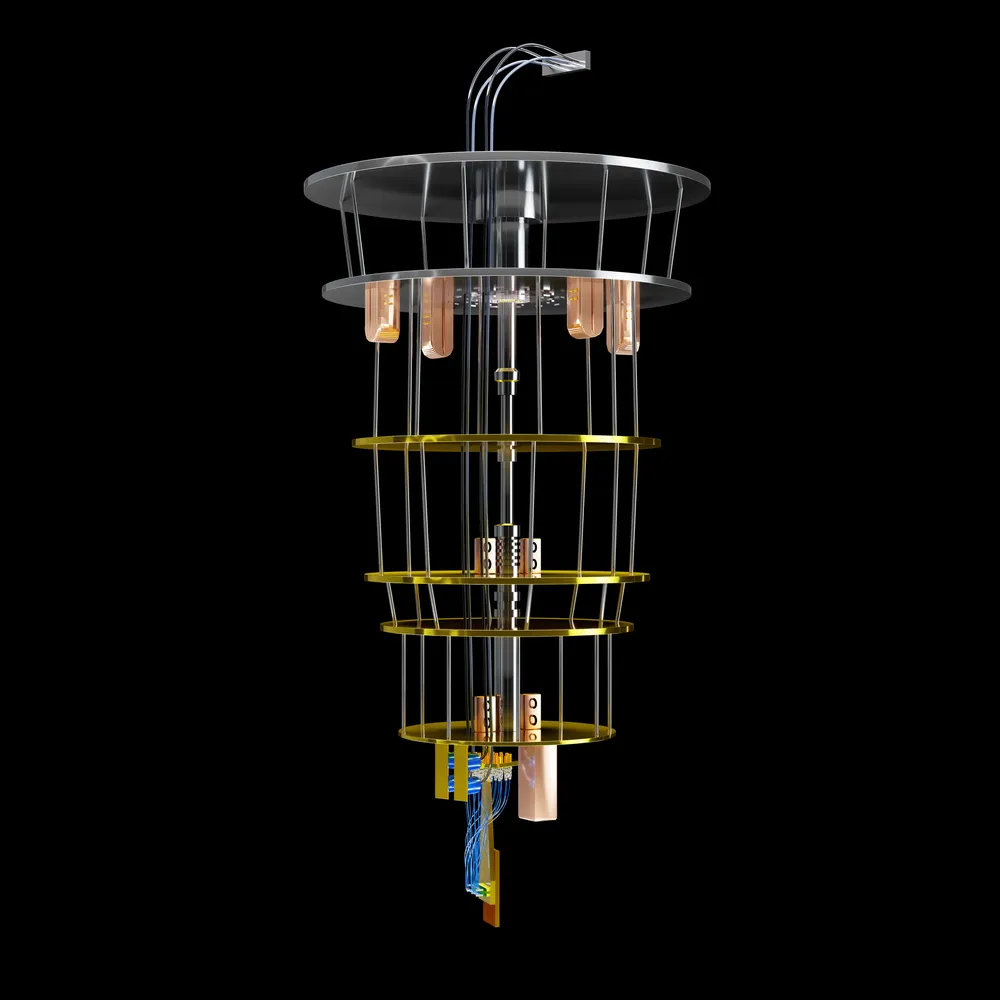 Illustrative: a dilution refrigerator, the type quantum physics labs worldwide use for this kind of experiment — photo by OJB Quantum, CC BY 4.0 (Wikimedia Commons)
Safavi-Naeini summed up the significance: "What this study shows will allow us to move forward with developing new quantum technologies with sound." He added: "We have seen that vibrating objects can exhibit quantum behavior, which is the prerequisite for many operations needed by quantum computing and sensing."
Real-time detection of the exact moment energy jumps has a clear practical meaning: today's quantum computers constantly suffer errors from environmental interference, and knowing precisely when a jump occurs is a key ingredient for quantum error correction — a technique required before quantum computers can be deployed reliably at industrial scale.
Erik Szakiel added: "This shows we can have incredibly fine-tuned control of sound, which might mean that devices that use sound as a fundamental technology can get much better."
What's Next: From Quantum Computers to Detecting Proteins in Cells
The Stanford team plans to extend the work in several directions. The first goal is applying the technique directly to quantum-computing error correction. An equally interesting direction is a collaboration with Michael Roukes, a physicist at Caltech, to develop the platform into an ultra-sensitive sensor for detecting proteins inside cells, using the same principles behind measuring minute forces, mass, and acceleration.
The team also notes that this level of fine-grained control over quantum sound could eventually improve sound-based consumer electronics — such as signal filters in smartphones.
What It Means for Thailand: An Era of Parallel Leaps in Quantum Tech and AI
 Illustrative: a microscopic quantum circuit chip — photo by OJB Quantum, CC BY 4.0 (Wikimedia Commons)
While this research remains at the laboratory stage, it arrives amid a period when multiple frontier technologies are advancing in parallel worldwide. Thailand itself continues to see major investment flow into data centers and artificial intelligence (read more: Thailand's homegrown TSC-1 satellite), industries that ultimately depend on this kind of foundational progress in physics and materials science.
The research also underscores a trend that's been clear throughout 2026: quantum physics is steadily moving from "textbook theory" toward tangible technology, much like the University of Ottawa team's success generating quantum-entangled photon pairs from sunlight just last month (read more: Researchers generate quantum-entangled photons from sunlight) — a sign that the global race to develop quantum technology is intensifying across every corner of physics.
Sources
- Stanford Report — Researchers observe first real-time quantum jump in sound
- ScienceDaily — For the first time, scientists watch sound jump between quantum states
- Phys.org — Real-time quantum jump in sound observed for first time
- The Quantum Insider — Researchers Observe First Real-Time Quantum Jump in Sound
Frequently asked questions
- What is a "quantum jump"?
- It is the phenomenon where a quantum-scale particle switches instantaneously from one energy state to another, with no continuous transition through in-between values — unlike classical physics, where change is gradual. Predicted in the early 20th century, it was first proven experimentally in trapped ions (1986) and photons (2007), before finally being observed in sound in 2026.
- How is a "phonon" different from a "photon"?
- A photon is the smallest unit of energy in light. A phonon is the smallest unit of energy in sound or vibration, arising from the coordinated motion of many atoms in a material. Both are "quanta" of different forms of energy that physicists use to describe the world at its smallest scale.
Related news
 World
WorldScientists Generate Quantum Entanglement From Sunlight
University of Ottawa and Max Planck Institute researchers used sunlight, not a laser, to create entangled photon pairs with 94% fidelity.
 World
WorldNASA Set to Launch Roman Space Telescope to Probe the Universe
NASA is set to launch the $4.3 billion Nancy Grace Roman Space Telescope aboard a Falcon Heavy on Aug 30, 2026, to investigate dark energy and hunt for exoplanets.
 World
WorldUN Opens Historic AI Governance Dialogue: Scientists Warn No Guarantee Advanced AI Will Follow Orders
The UN launched its first Global Dialogue on AI Governance in Geneva on July 6–7, 2026, as a 40-scientist panel warned AI may not follow human instructions.