Scientists Generate Quantum Entanglement From Sunlight

An international research team from the University of Ottawa in Canada and the Max Planck Institute for the Science of Light in Germany has announced a milestone: generating quantum-entangled photon pairs directly from natural sunlight for the first time, instead of relying on lasers as quantum physics research has done for decades. The result was published in the journal Optica on August 6, 2026, and has drawn wide attention from international science media.
What quantum entanglement is, and why it matters
Quantum entanglement is the phenomenon Einstein once called "spooky action at a distance" — when two particles, such as photons (particles of light), become linked in a special way so that measuring one instantly reveals the outcome for the other, regardless of the distance between them. It underlies nearly all modern quantum technology: quantum key distribution for unbreakable-in-principle secure communication, measurements more precise than classical physics allows, and the processing power of quantum computers.
Scientists normally generate entangled photon pairs through a process called spontaneous parametric down-conversion (SPDC) — shining a highly coherent laser beam, ordered in both space and time, through a nonlinear crystal, which splits a single photon into an entangled pair. This method has dominated the field because coherent light was long assumed to be essential for producing entanglement of usable quality.
From scattered sunlight to entangled photon pairs
What overturned that assumption was theoretical work led by Robert Boyd, a physicist and Canada Excellence Research Chair in Quantum Nonlinear Optics at the University of Ottawa, whose team showed that incoherent light — like sunlight — can also produce quantum entanglement, contrary to the field's long-held assumption that it could not.
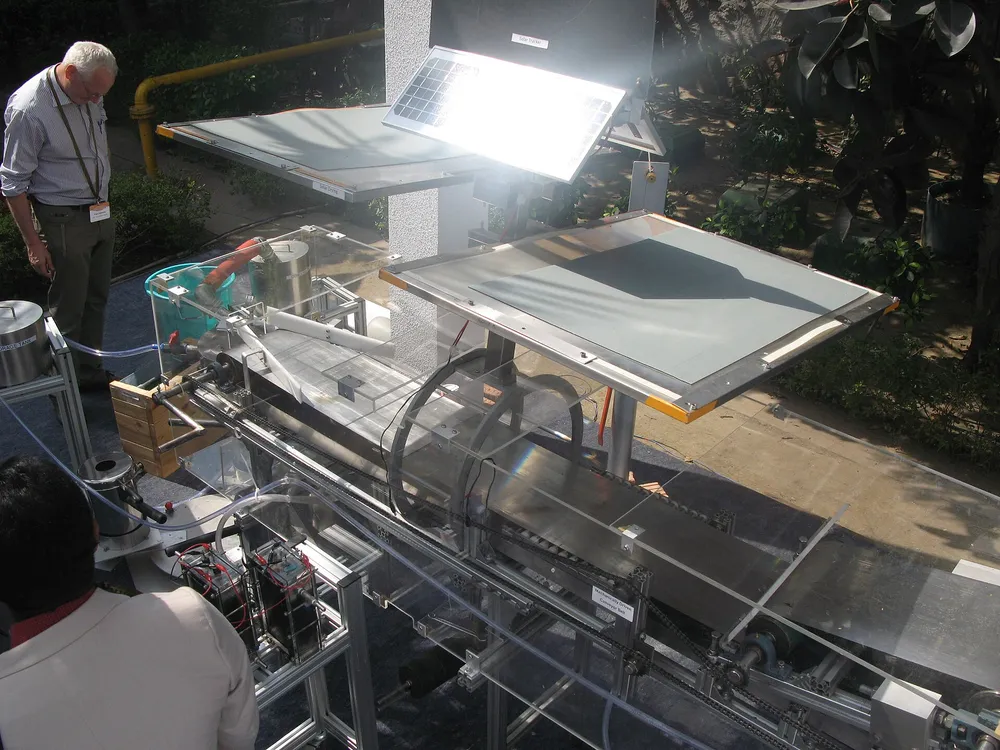 Illustration: an example of a Fresnel-lens solar concentrator — the same underlying principle behind the concentrator the Max Planck team built for this experiment — photo by SuSanA Secretariat, CC BY 2.0 (Wikimedia Commons)
Cheng Li, a University of Ottawa researcher and the paper's first author, described the skepticism the team faced: "Some world-renowned researchers in the field even questioned whether it would be possible to detect any photons — not to mention entangled photons — from sunlight-driven nonlinear optical processes." That reflects just how unlikely the idea seemed before this result.
The breakthrough hinged on a cone-shaped, all-glass solar concentrator developed by Hanieh Fattahi's team at the Max Planck Institute for the Science of Light in Erlangen, Germany. The device uses a household-window-sized Fresnel lens to focus sunlight down into an optical fiber roughly the width of a human hair, before directing that concentrated beam into a millimeter-scale nonlinear crystal. The team ran the experiment outdoors with real sunlight, collecting light over roughly 1.4 square meters to feed the setup.
The result: 94% fidelity, confirmed by Bell's inequality
The outcome surprised much of the field: the sunlight-generated photon pairs reached about 94% fidelity compared with a theoretically perfect entangled state. Just as importantly, the measurements violated Bell's inequality, the standard physics test used to distinguish genuine quantum entanglement from an ordinary classical correlation. That violation is the proof that what the team created was real quantum entanglement, not a statistical coincidence.
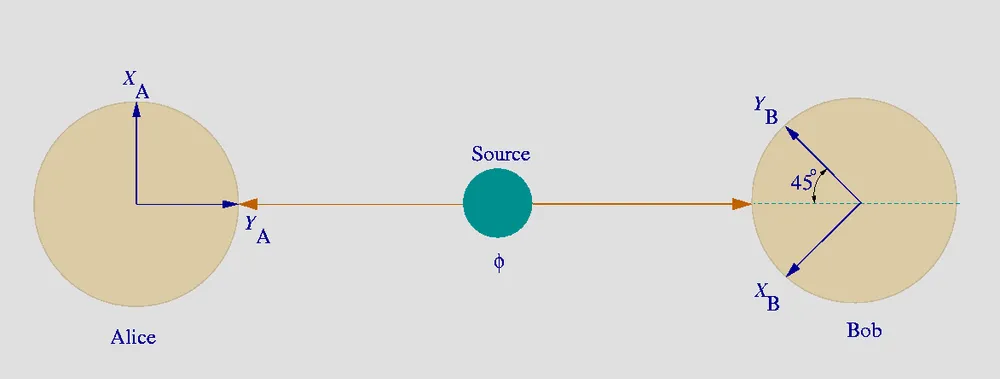 Illustration: a schematic of a Bell test — the standard method physicists use to prove two particles are genuinely quantum-entangled rather than merely classically correlated — via Wikimedia Commons
Compared with conventional laser-based sources, the researchers found the sunlight-derived entanglement quality was comparable once accounting for the different bandwidths involved — since sunlight is naturally broadband and far less ordered than laser light, which underscores how significant the achievement is.
Why this matters for the future of quantum technology
Cheng Li explained the significance: "Quantum entanglement is crucial for applications such as secure communication, ultra-precise sensing and high-performance computation," adding that "our work shows that abundant natural light sources can be used for quantum entanglement, opening the possibility of more energy-efficient and accessible quantum technologies."
The key advantage of this approach is eliminating the electrical-to-laser conversion step entirely — normally an energy-intensive part of the setup that requires complex hardware. Without a laser, devices that produce quantum light sources could become smaller, lighter and cheaper, which suits resource-constrained deployments such as satellites, interplanetary spacecraft, or remote regions like the Arctic.
 Photo: the Max Planck Institute for the Science of Light in Erlangen, Germany, home to the team that built the solar concentrator used in this experiment — via Wikimedia Commons
Li pointed to a concrete future use: "This technology could one day enable satellites to create secure encryption keys using the sunlight already abundant in space, reducing the need for onboard lasers." That means future quantum-communication satellites might not need to carry heavy, power-hungry laser hardware at all — their existing solar panels could double as the source of entangled photon pairs.
What's next
The team says its next goal is improving the brightness and entanglement quality of the setup toward a field-deployable product. There are also plans to extend the concept to other nonlinear optical techniques, such as four-wave mixing, which could open up further new forms of natural quantum light sources.
Why it matters for Thailand
While this research is still lab-stage, the direction toward energy-efficient quantum technology is relevant to Thailand's own ambitions. The country is developing its first largely homegrown research satellite, TSC-1, due to launch in 2027 (read more: Thailand's homegrown TSC-1 satellite), alongside a wave of major data-center and AI investment — both of which depend on reliable cybersecurity and trustworthy data communication as a foundation.
Lower-power, lower-cost quantum encryption technology, if it matures over the coming years, could eventually become more accessible to countries like Thailand that are building out their space and digital-technology sectors — though today it remains early-stage research years away from a deployable product, much like OpenAI's newest AI model, which made its own splash in the science world earlier this month (read more: OpenAI's Astra solves decades-old math problems) — a reminder that 2026 is a year when several frontier technologies are advancing in parallel.
Sources
- Optica — Researchers generate quantum entanglement using sunlight
- University of Ottawa, Faculty of Science — Quantum entanglement generated by sunlight for the first time
- Phys.org — Sunlight-powered setup generates quantum entanglement
- ScienceDaily — Sunlight creates quantum entanglement once thought to require lasers
Frequently asked questions
- What is quantum entanglement?
- It's a phenomenon where two particles, such as a pair of photons, become linked so that measuring one instantly tells you the state of the other, no matter how far apart they are. It underpins quantum encryption, quantum computing and ultra-precise measurement.
- Why does using sunlight instead of a laser matter?
- Sunlight needs no electricity-to-laser conversion, so a device that produces entangled photon pairs can be smaller, use less power, and potentially be deployed in resource-constrained places such as satellites, spacecraft, or remote regions like the Arctic.
Related news
 World
WorldStanford Physicists Capture the First-Ever "Quantum Jump" of Sound in Real Time
Stanford physicists observed a quantum jump of a "phonon" — the smallest unit of sound — in real time for the first time, opening a path to quantum-error correction using sound.
 World
WorldNASA Set to Launch Roman Space Telescope to Probe the Universe
NASA is set to launch the $4.3 billion Nancy Grace Roman Space Telescope aboard a Falcon Heavy on Aug 30, 2026, to investigate dark energy and hunt for exoplanets.
 World
WorldUN Opens Historic AI Governance Dialogue: Scientists Warn No Guarantee Advanced AI Will Follow Orders
The UN launched its first Global Dialogue on AI Governance in Geneva on July 6–7, 2026, as a 40-scientist panel warned AI may not follow human instructions.