Thai-Built TSC-1 Satellite — Over 60% Made in Thailand — Passes Toughest Tests, Aims for 2027 Launch

Thai engineers are closing in on a landmark dream: the TSC-1 research satellite, designed and assembled domestically at over 60%, has now passed testing that simulates the harshest conditions of real space — and the flight version is on track to launch into orbit in 2027. It is a milestone underscoring that Thailand is moving from being a "technology consumer" toward becoming a developer of advanced "Deep Tech" with its own hands.
Over 60% built by Thais — not just assembled from imports
In mid-April 2026, Prof. Dr. Yotsanan Wongsawat, Deputy Prime Minister and Minister of Higher Education, Science, Research and Innovation, visited NARIT's laboratory in Mae Rim district, Chiang Mai province, to review the progress of TSC-1.
The heart of this story is the word "built ourselves." This is not an off-the-shelf satellite purchased from abroad; Thai engineers designed and assembled more than 60% of the key components themselves — the high-resolution imaging camera, the attitude-control software that keeps the satellite oriented, and the ground station used to communicate and receive data — nearly all designed and put together by Thais.
"This is a landmark indicating that Thailand is moving beyond being a technology consumer to becoming a full-fledged Deep Tech developer," said Prof. Dr. Yotsanan, adding that the long-term goal is "building a high-income country by transforming the economic structure through science and innovation."
Passing the toughest tests
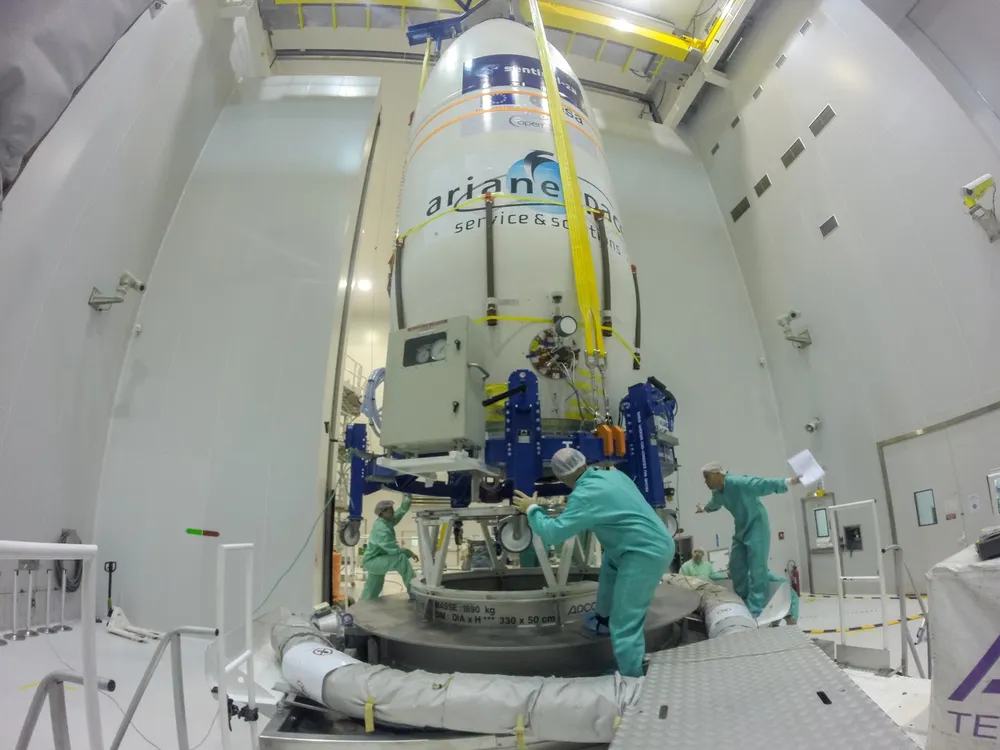 Illustrative: satellite assembly and testing in a cleanroom built to aerospace-industry standards — ESA/CC
Before any satellite earns its trip to space, it must prove it can survive the harshest environment. The team put the Engineering Model of TSC-1 through a battery of tests:
- Thermal vacuum — simulating the extreme cold and heat that alternate in space
- Radiation resistance — because beyond the atmosphere there is no shield from solar and cosmic radiation
- Severe vibration — recreating the violent forces of a rocket launch
The result: the Engineering Model passed every test — one of the hardest stages in satellite development. The next step is building the Flight Model, the real spacecraft that will be launched in 2027, then putting it through systematic testing at the national satellite assembly and testing center together with GISTDA.
Why this satellite matters to Thailand
TSC-1 is a small microsatellite weighing roughly 100–120 kg, flying in a Sun-Synchronous Low Earth Orbit. Its main instrument is a Hyperspectral Imager that captures the Earth's surface across many wavelengths of light, with far more detail than an ordinary camera.
These images are not just pretty — they have real-world uses: assessing forest health, identifying crop and weed species, analyzing the types and yields of farm crops, and detecting water or nutrient deficiencies in fields, covering all regions of Thailand. That data is enormously valuable to farmers, forestry agencies, and natural-resource management.
But the deeper value is knowledge. Every step of designing, testing, and assembling the satellite trains a new generation of Thai space engineers and scientists — the foundation of a future Thai space industry, much as Thailand is investing in other technology infrastructure such as becoming a regional data-center hub.
The power of collaboration — many partners, each a piece
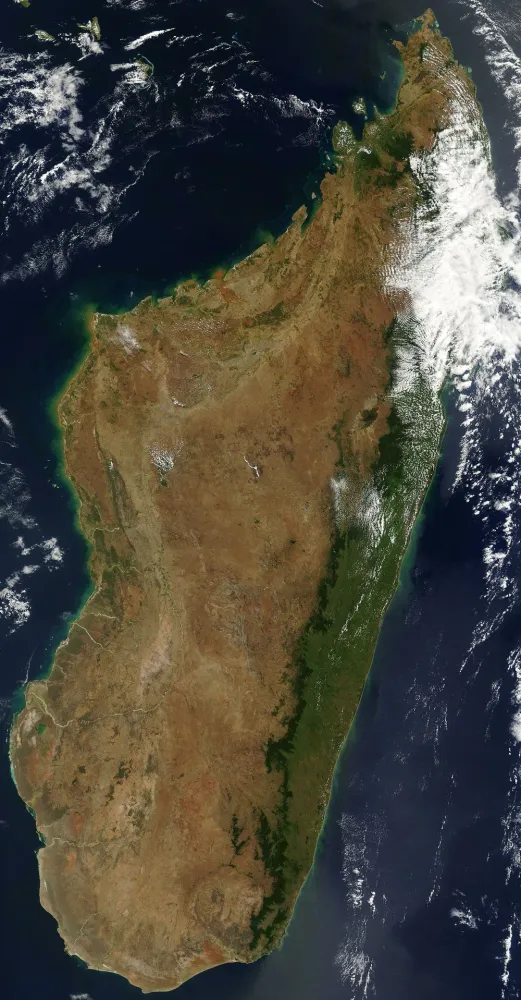 Illustrative: a resource-survey satellite image of the Earth's surface, the kind of data TSC-1 will use — NASA/CC
The Thai Space Consortium (TSC) is not the work of a single agency but a coalition of institutions led by NARIT, together with the Geo-Informatics and Space Technology Development Agency (GISTDA), the Synchrotron Light Research Institute (SLRI), and Mahidol University, which oversees the space-weather instrument. China's CIOMP institute serves as a partner, helping with technology transfer and training the Thai engineering team.
Notably, the National Science and Technology Development Agency (NSTDA) has also joined in developing key components: lithium-ion battery packs with a Battery Management System (BMS) that endure temperature swings from minus 20 to 60°C, and lightweight yet high-strength structural materials for the satellite body — technologies that can spin off into many other earthbound industries.
What's next — and a dream as far as the Moon
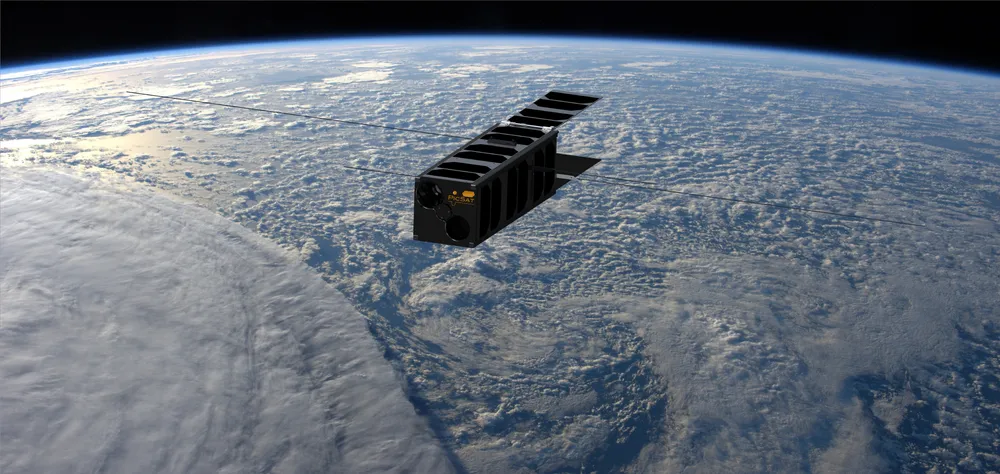 Illustrative: a small satellite orbiting in low Earth orbit, similar in scale to TSC-1 — CC
TSC-1 is only the first step in a long-term plan. The TSC program aims to develop ever more sophisticated satellites and spacecraft, all the way toward the grand ambition of a deep-space and lunar mission (TSC-2), for which the Thai team is developing an ion-propulsion system in parallel.
The road to space is long and challenging, but TSC-1's success in clearing its toughest tests is proof that Thais have the capability to build world-class technology themselves — no different from other inspiring stories such as Thai students who built a malaria-detecting AI and won a global award. Together, they show that Thai science and innovation are steadily moving forward.
TSC-1 satellite at a glance (as of April 2026):
| Detail | Information |
|---|---|
| Name | TSC-1 (Thai Space Consortium Satellite-1) |
| Type | Microsatellite, ~100–120 kg |
| Built domestically | Over 60% |
| Main instruments | Hyperspectral Imager + space-weather detector |
| Orbit | Sun-Synchronous LEO |
| Status | Engineering Model passed extreme-condition tests |
| Target launch | 2027 |
| Lead agencies | NARIT with GISTDA, SLRI, Mahidol, NSTDA |
Sources
- Thairath — 'Yotsanan' highlights TSC-1, Thai-made satellite, a key Deep Tech step (Apr 2026)
- Khaosod — Yotsanan showcases TSC-1 success, set to launch in 2027
- Spaceth.co — An exclusive look at the TSC-1 spacecraft being assembled in Chiang Mai
- Thansettakij — NSTDA joins TSC partners to develop batteries and extreme-condition materials for Thai satellites
- NARIT — TSC-1 (Thai Space Consortium Satellite)
Frequently asked questions
- What is TSC-1, and how is it different from earlier Thai satellites?
- TSC-1 is a small research satellite (a microsatellite) of roughly 100–120 kg, developed under the Thai Space Consortium program. What sets it apart is that Thai engineers designed and assembled over 60% of it themselves — from the imaging camera and attitude-control software to the ground station — unlike most earlier Thai satellites, which were largely bought from or built by foreign contractors.
- When will TSC-1 launch into space?
- According to the latest plan, the Flight Model — the real spacecraft that goes into orbit — is targeted for launch in 2027, after the Engineering Model successfully passed extreme space-condition testing.
- What will TSC-1 image, and how does it benefit Thai people?
- TSC-1 carries a Hyperspectral Imager that captures the Earth's surface across many wavelengths. The data supports assessing forest health, identifying plant and weed species, analyzing crop types and yields, and detecting water or nutrient deficiencies in farmland across Thailand — valuable for agriculture, forestry, and natural-resource management.
- Which organizations are developing TSC-1?
- It is led by the National Astronomical Research Institute of Thailand (NARIT) together with GISTDA, the Synchrotron Light Research Institute (SLRI), Mahidol University, and NSTDA, with China's CIOMP institute as a partner helping with technology transfer.
- What's next for the Thai Space Consortium?
- TSC-1 is the first step in a long-term plan. The roadmap moves toward increasingly complex satellites and spacecraft, with the distant goal of building a deep-space and lunar mission (TSC-2).
Related news
 World
WorldNASA Set to Launch Roman Space Telescope to Probe the Universe
NASA is set to launch the $4.3 billion Nancy Grace Roman Space Telescope aboard a Falcon Heavy on Aug 30, 2026, to investigate dark energy and hunt for exoplanets.
 World
WorldChina's Tianwen-2 Reaches Earth's 'Quasi-Moon' Asteroid — About to Collect Samples from What May Be a Chunk of Our Moon
China's Tianwen-2 entered orbit around asteroid Kamoʻoalewa on June 7, 2026 and will close to 20 km on July 4 — the rock may be a fragment of the Moon.
 World
WorldIndia Edges Closer to Human Spaceflight: ISRO Readies Uncrewed Gaganyaan-1 for Late 2026
India's ISRO targets the second half of 2026 for Gaganyaan-1, its first uncrewed test flight, after 8,000+ ground tests, ahead of a crewed launch in 2027.