Good News from Trang: 72+ Dugongs Return as Seagrass Recovers — No Strandings in 2026

After years in which news about Trang's dugongs was overwhelmingly grim — rotting seagrass beds and dozens of dugongs stranding dead each year — 2026 has delivered the good news many had been hoping for. The latest aerial surveys counted more than 72 dugongs returning to feed around the Koh Libong archipelago in Trang province, including at least two mother-calf pairs. And most importantly of all: not a single dugong has been found stranded all year.
72 dugongs come home
Prajuab Mokrat, director of the Marine and Coastal Resources Management Office Region 7, reported that surveys flown by drone and light aircraft between February and April 2026 counted no fewer than 72 dugongs scattered around the Koh Libong archipelago in Kantang district, Trang — a place known as Thailand's "dugong capital."
What especially encouraged conservationists was the sighting of at least two mother-calf pairs and dugongs gathering in small herds of three to seven animals across a recovering seagrass meadow spanning more than 20,000 rai (about 3,200 hectares). New calves and herds living together signal that the food supply has become abundant enough for the population to resettle.
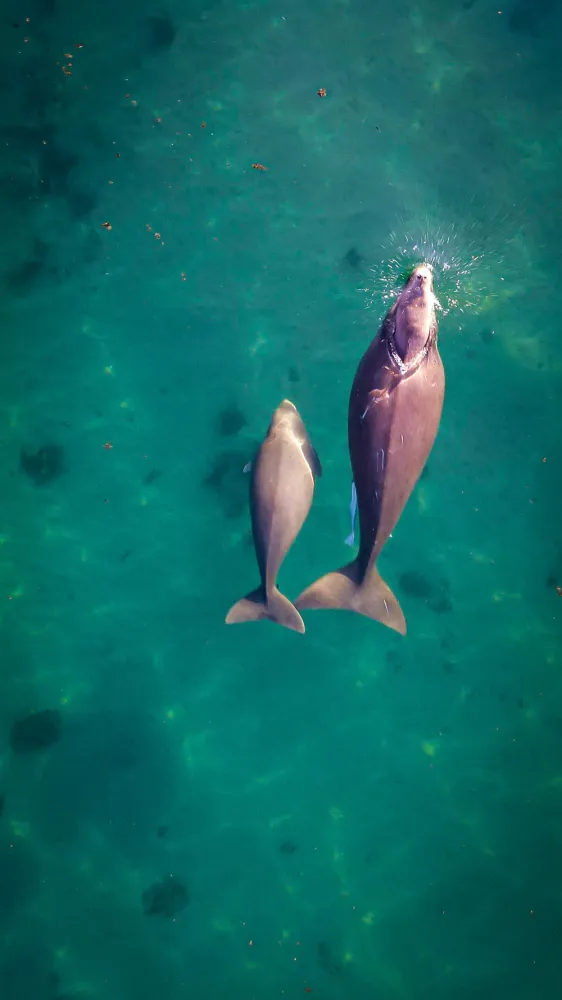 Illustrative: a dugong mother and calf swimming together, seen from above by drone — species image, CC via Wikimedia Commons
Previously more than 100 dugongs had fled the area when the seagrass collapsed, so the herds trickling back marks the first recovery in several years.
From crisis to recovery
Between 2020 and 2024, the seagrass around Koh Libong declined alarmingly. According to Mongabay, roughly half of the seagrass cover was lost to warming, higher sea temperatures and shifting sediment. With their main food gone, many dugongs starved and washed ashore — and in 2023–2024 dugong deaths on the Andaman coast averaged as many as around 40 a year, double the rate of earlier years.
The story that moved the whole country was that of Marium, an orphaned dugong calf found stranded in 2019 who became a national sweetheart before dying of a blood infection linked to swallowing plastic. Marium sparked a wave of awareness about marine waste and pushed communities and agencies to get serious about restoring the ecosystem.
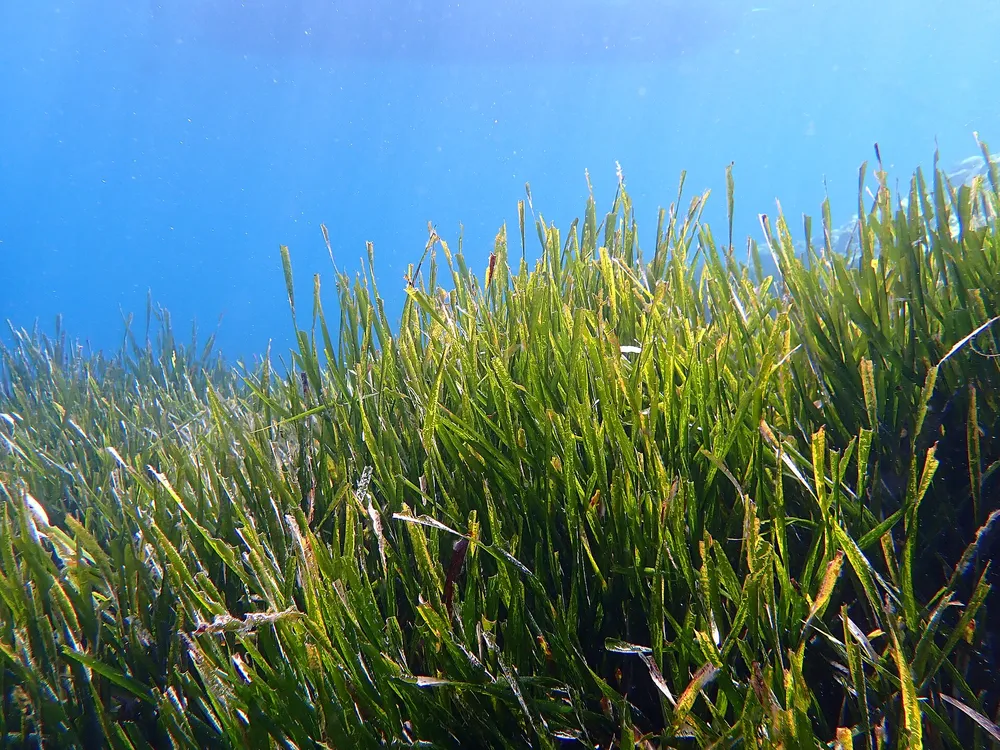 Illustrative: an underwater seagrass meadow, the dugongs' main food source — CC via Wikimedia Commons
When the community took restoration into its own hands
This recovery did not happen on its own. It came from cooperation between government agencies, academics and — crucially — the local community, who refused to simply wait.
One method that worked was a seagrass barrier trial at Ban Laem Sai in Sikao district, Trang, using netting and wood to enclose seagrass beds for about five to six months and keep grazing animals out while the young shoots took hold. The result: seagrass inside the barrier grew more than a metre tall in just five months, while about 2,000 rai of the Ban Laem Sai beds are now under recovery.
At the same time, conservation groups such as the IUCN backed a protective-cage trial at five sites, alongside a three-year seagrass transplantation program with researchers from Prince of Songkla University studying which techniques work best in which locations.
"Seagrass restoration should be scaled up to mirror the success of mangrove reforestation, because it matters both for ecosystem balance and for tackling climate change." — Pontep Wirachwong, lecturer at Rajamangala University of Technology Srivijaya, Trang Campus
Just as impressive is the power of the Dugong Guardians, a network of villagers founded back in 2011 spanning several communities around Koh Libong. They have trained to use drones and GPS to track dugongs, survey the seagrass beds, and run workshops for local schoolchildren and teenagers — turning conservation into something the whole community owns, not just a job for officials.
Why this matters to Thai readers
The dugong is a protected species in Thailand and a symbol of a healthy sea — but the value of this story runs deeper than the animals themselves. The seagrass that has bounced back is a nursery for the fish and young marine life that fishers depend on, a buffer against coastal erosion, and an undersea blue-carbon sink that helps fight global warming.
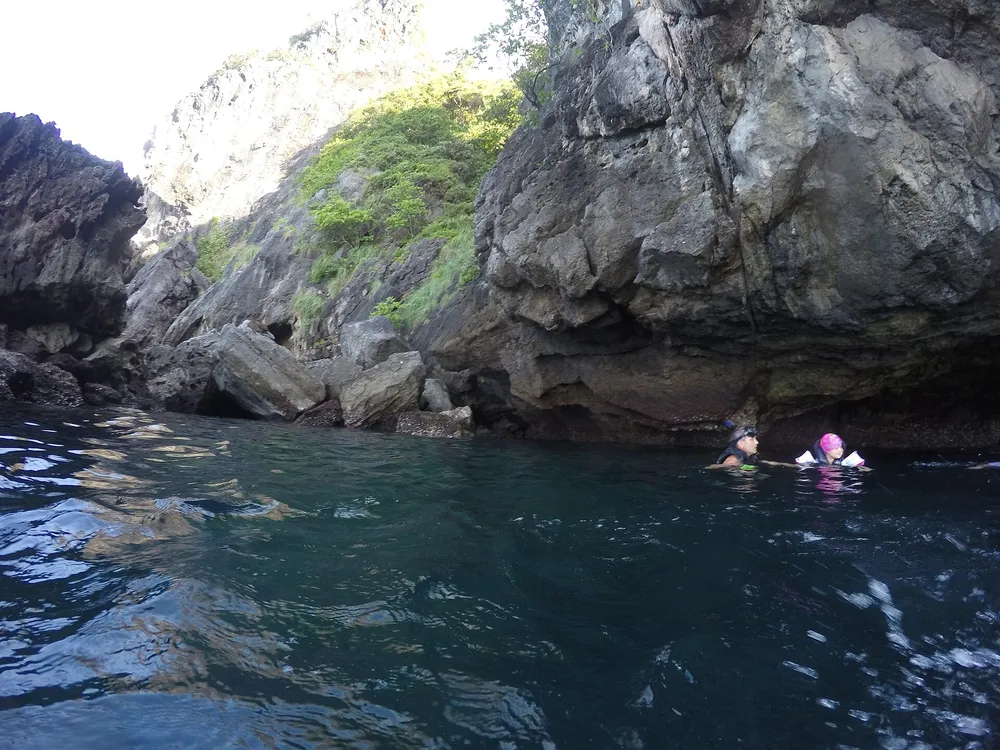 Photo: the coastline of the Koh Libong archipelago, Trang — via Wikimedia Commons (CC)
When the ecosystem heals, small-scale fishers benefit directly, because they no longer have to travel far out to catch fish as they did when the seagrass was degraded. Trang is also a growing eco-tourism destination, and the return of the dugongs draws travellers who want to see genuine nature — fitting with the broader trend of foreign tourists still flocking to Thailand this year.
What to watch next
Although the signs are positive, officials stress that there is no room for complacency, because the seagrass recovery depends on weather and sea temperatures that remain volatile under global warming. A repeat marine heatwave could degrade the beds again.
So the authorities are asking tourism operators, fishers and visitors to help protect the seagrass beds, manage marine waste and slow their boats in dugong feeding zones, to avoid accidents involving the mothers and calves that have only just returned.
Key facts (data as of June 2026):
- Over 72 dugongs counted around Koh Libong in the Feb–Apr 2026 surveys
- At least two mother-calf pairs · small herds of 3–7 animals
- Over 20,000 rai of recovering seagrass meadow
- Zero dugong strandings recorded in 2026 (vs. an average of ~20 deaths per year in 2024–2025)
The story of Trang's dugongs is proof that when communities, academics and the state work together in earnest, even a battered ecosystem can come back to life — and the hope that Marium would be the last dugong to suffer may, little by little, be coming true.
Sources
- Naewna — Dugongs return to Trang: 72 counted after seagrass recovers
- Naewna — Good news for Trang seas: dugong population rises for the first time in years
- Mongabay — Thai island community rallies to protect beloved dugongs, revive declining seagrass
- The Nation — Barrier experiment spurs hope for seagrass recovery in Trang
Frequently asked questions
- How many dugongs were found in Trang's seas in 2026?
- Aerial surveys by drone and light aircraft between February and April 2026 counted at least 72 dugongs around the Koh Libong archipelago in Trang province, including at least two mother-calf pairs, scattered in small herds of three to seven animals.
- Why are Trang's dugongs increasing again?
- The main reason is the recovery of seagrass — the dugongs' food — after a severe die-off between 2020 and 2024 driven by global warming and changing coastal conditions. As food returned, dugongs that had migrated away began coming back to their old feeding grounds.
- Were any dugongs stranded in Trang in 2026?
- Officials say that as of mid-2026 no dugong strandings had been recorded in Trang province, compared with an average of around 20 deaths per year in 2024–2025 due to food shortage — a clear sign of recovery (data as of June 2026).
- Why does seagrass matter to the ecosystem?
- Seagrass feeds dugongs and sea turtles, serves as a nursery for young marine life, stabilises coastal sediment, and is an important 'blue carbon' sink that helps tackle climate change.
- How can ordinary people help protect dugongs?
- Reduce marine litter, especially plastic; slow boats down in dugong feeding zones; avoid disturbing seagrass beds; and support the local dugong-guardian volunteer groups around Trang.
Related news
 World
WorldA Milestone for the Seas: 10% of the World's Ocean Is Now Officially Protected
UNEP-WCMC and IUCN say 10.01% of the global ocean is now protected for the first time, boosted by French Polynesia's new reserve and the High Seas Treaty.
 Thailand
Thailand Wins 3 Silver Medals at Biology Olympiad 2026 in Lithuania
Four Thai students won 3 silver medals and 1 honorable mention at the 2026 International Biology Olympiad in Vilnius, Lithuania.
 Thailand
Thailand Issues 5-Day Flood Warning for 61 Provinces as Monsoon Intensifies
Thailand's meteorological department issued its fourth weather warning on July 25, placing 61 provinces and Bangkok on alert for heavy to very heavy rain from July 26–30, 2026. Flash floods, landslides and rough seas are the main risks.